
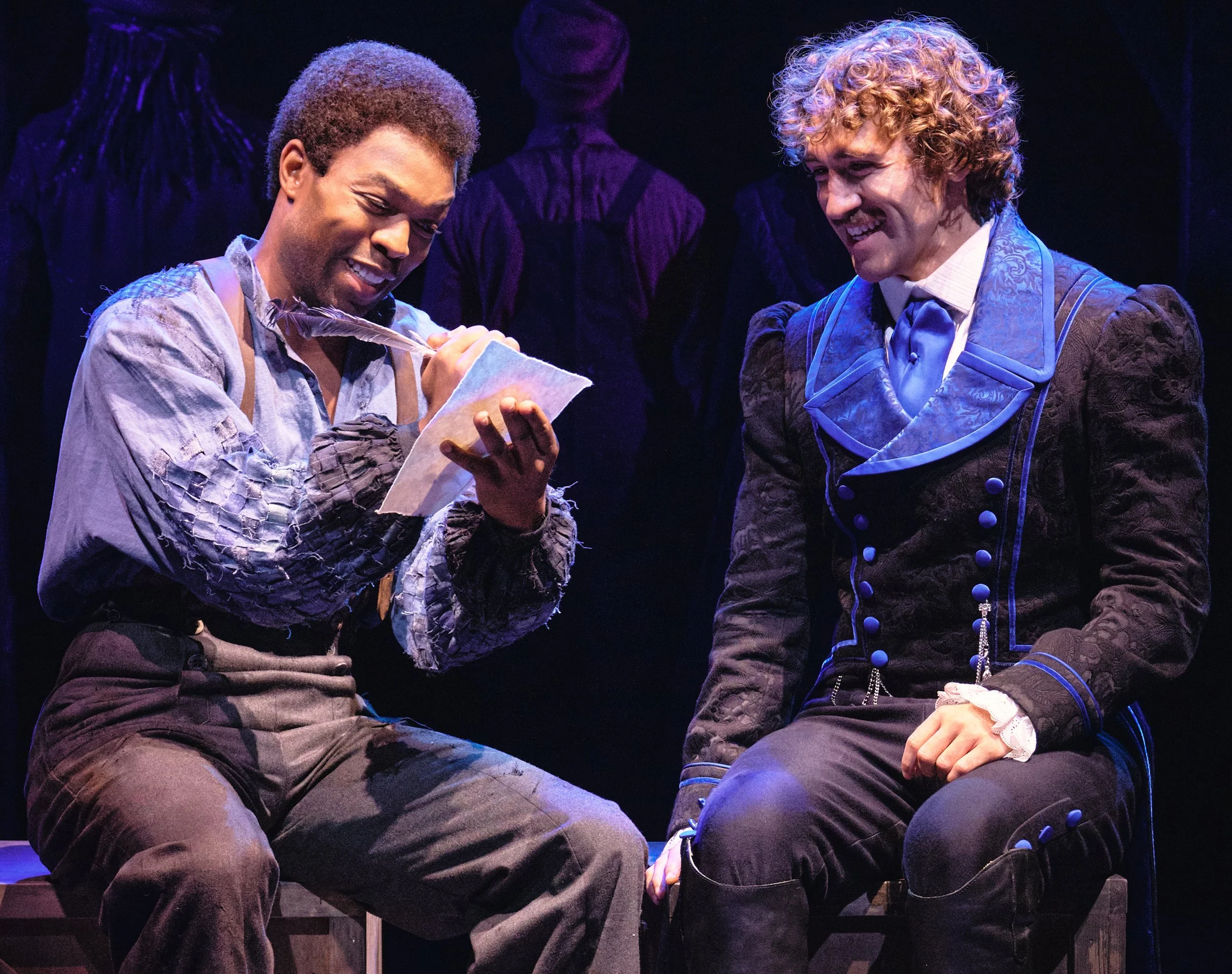
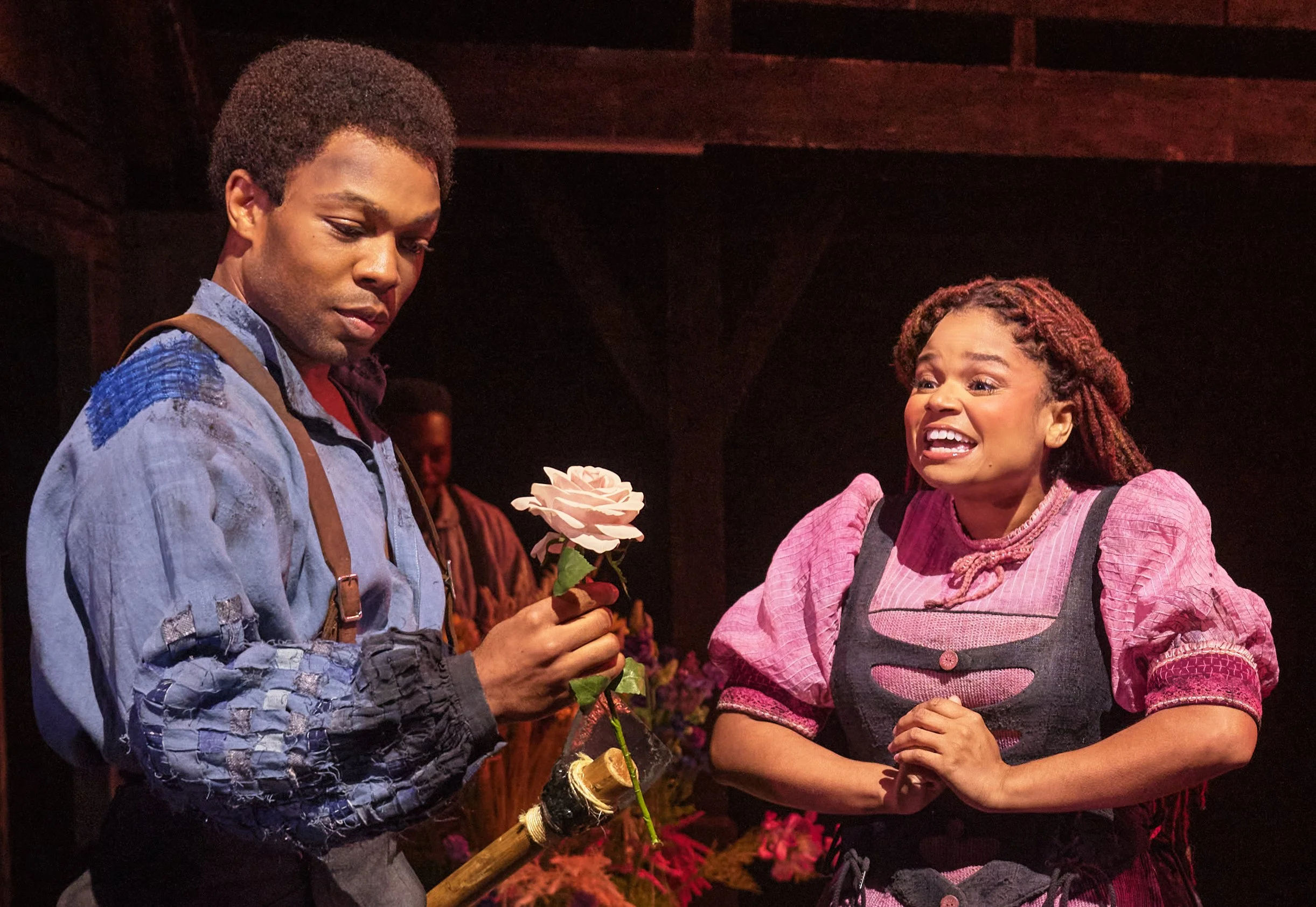
Richard (Jeremy Beloate, right) teaches Rail (Todrick Hall) how to write.
Life for blacks in the antebellum South, during the Civil War, and for generations thereafter consisted of a confluence of injustices at the intersection of class, race, and gender. Todrick Hall's complex new musical Midnight grapples with those injustices by reimagining what it might be like if the oppressors became the oppressed.
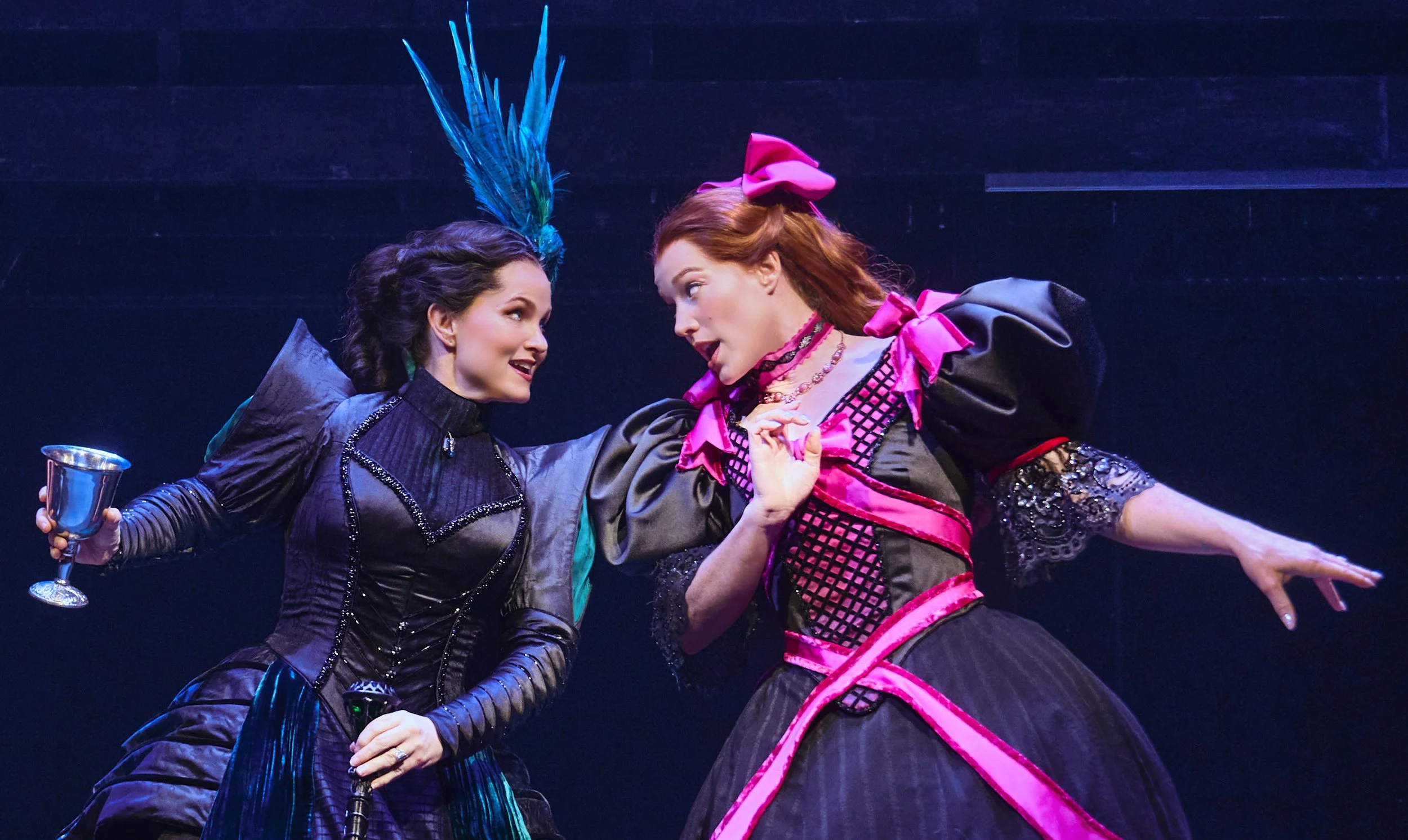
Charlotte (Autumn Hurlbert, left) and her daughter Scarlet (Kennedy Caughall) scheme to find husbands for Scarlet and her sister Violet.
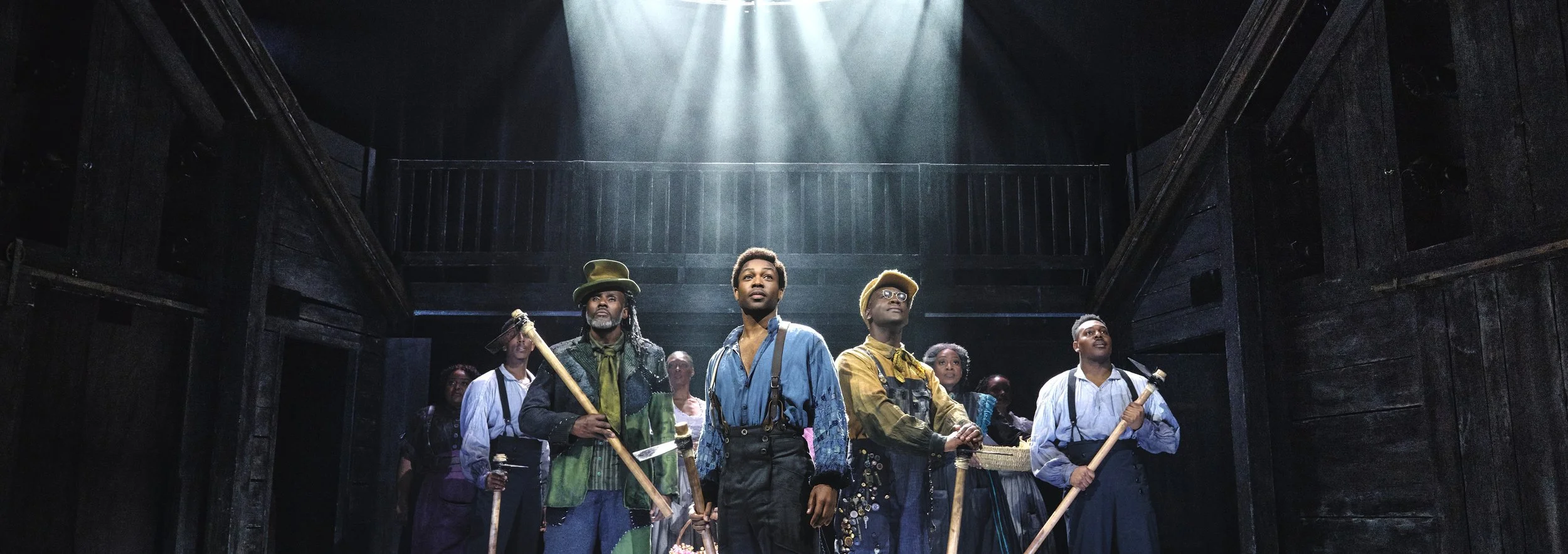
Midnight’s protagonist (Hall himself) gets his name, Rail, after his mother delivers him near some railroad tracks. His rough life as a slave begins in infancy. A sadistic slaveowner, Sylvester (Ciaran McCarthy), breaks up Rail’s family, as was common practice, but Rail’s father resists. Sylvester kills him, and Rail’s mother must relinquish her baby.
The orphaned Rail insists on being called Darail and grows up strong, proud, and ready to resist Sylvester and other ruthless, empowered whites, such as Harry (Jimmy Brewer), the plantation owner’s older son and a lame ex-soldier—abusive, drunk, and ready to attack Rail, who always defends himself, regardless of the consequences.
Hall, also the writer, director, and choreographer, has chosen the number 12 as a recurring theme. Rail is born at midnight, and although its overarching significance is not fully revealed until the end, it recurs throughout the show. This storyline underscores the profound class-and-economics-based gulf among six (well, not quite six) debauched and cruel plantation-owning whites and six desperately poor but proud slaves and their cohesive community.
Charlotte (Autumn Hurlbert), a white society matron, is a vain, social-climbing mother of two marriageable daughters, Scarlet (Kennedy Caughell) and Violet (Bella Coppola). Although Scarlet is more beautiful than Violet, the three women evoke Cinderella’s wicked stepmother and stepsisters.
“Hall’s jaw-dropping talents transcend the term ‘Renaissance man.’ ”
When Scarlet’s maid, Lily Rose (Charlotte Odusanya), sets her eyes on Rail and sings of her love, it becomes the flashpoint for a parallel love between Scarlet and brother Richard (Jeremy Beloate), Harry’s younger, sensitive brother, whose untenable position is his empathy for the slaves. Both couples wed, but the lives of Lily Rose’s and Scarlet’s children will play out under radically different social and economic circumstances, and carry forward the class, race, and economic disparity.
Rail, a grown man, walks barefoot, until he receives shoes the plantation owner’s wife gave to his mother. They, too, carry a fairy-tale quality:
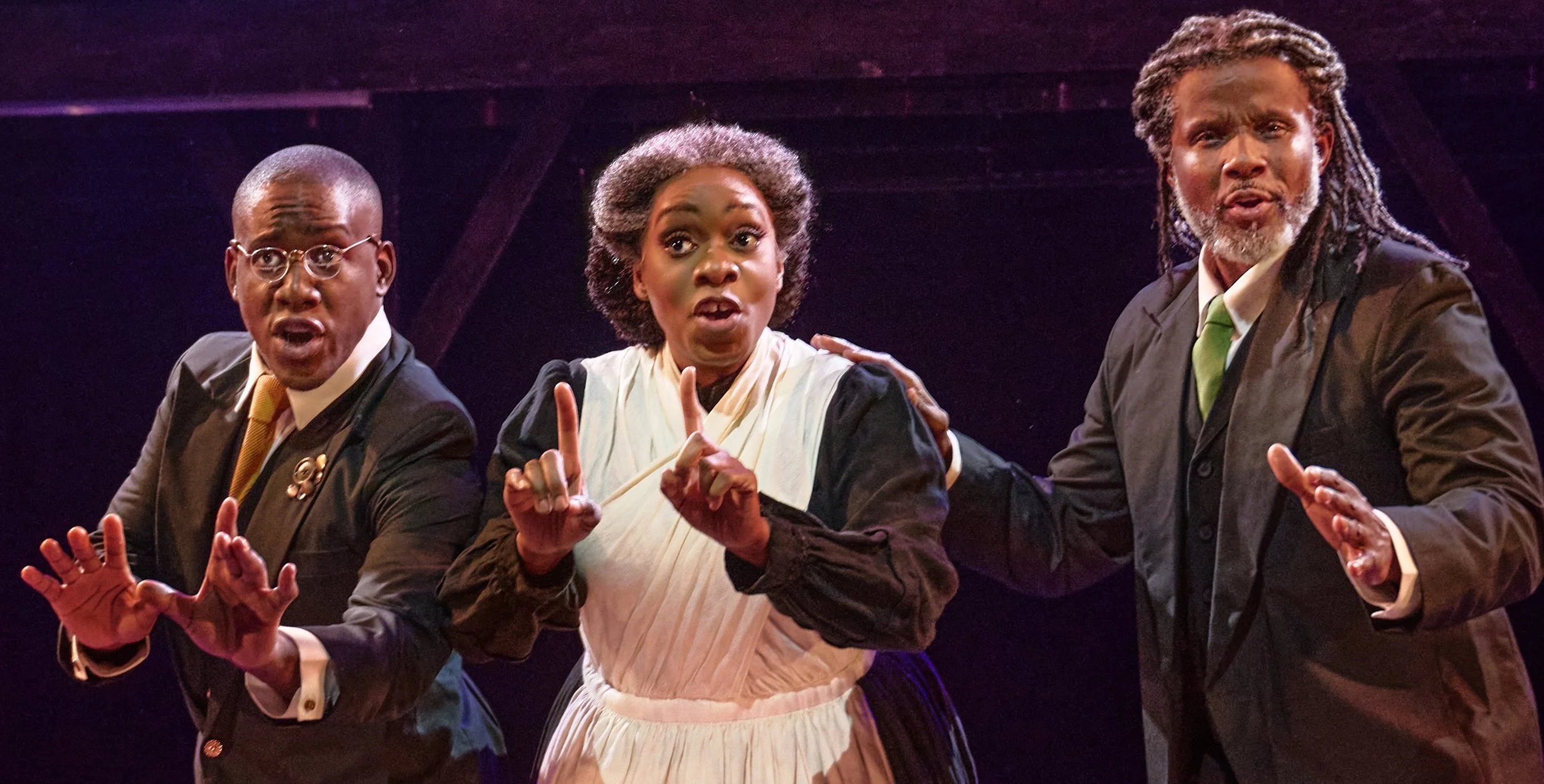
Squeak (Sidney DuPont, left), Ethel (Ayana George), and Horace (Dwayne Clark) caution Rail to “Run Don’t Walk.”
Without my shoes, I just ain’t complete.
I sleep in these shoes, I bathe in these shoes
Cuz once you been shoeless you won’t dare to lose
The only thing I got belong to me
The only thing that give me dignity
Despite lifetimes of hardship that Rail, Lily Rose, and his fellow slaves endure, Rail envies neither his master nor his master’s lifestyle:
Never would I ever want to be like them
Cuz all of them white stars need black skies to be seen….
So, if the stars were grantin’ wishes though
I’d wish for them to be us.
In a role reversal, the slaves are given one privileged night, until midnight (the number 12 again), when, just like Cinderella, they revert to near rags.
Lily Rose (Charlotte Odusanya, right) flirts with Rail. Photographs by Valerie Terranova.
Sylvester: The stroke of midnight unmade and remade us. Whoa,
Twelve souls returned to themselves, Whoa,
changed by one day spent in another’s shoes.
In an unexpected turn of events, Midnight reveals how the twelfth hour affords consolation to Rail and Richard, forbidden lovers who ultimately are just as abruptly forced apart by race, class, and convention.
Hall’s jaw-dropping talents transcend the term “Renaissance man.” His equally talented group of actors and singers bring this drama to life. Charlotte Odusanya, as the flirtatious Lily Rose, provides light relief amid a larger heart-rending tale. In swooning over an indifferent Rail, she excels as both comedienne and displays an extensive vocal range. Similarly, the Kennedy Caughill captures the haughtiness and pretensions of the scheming Scarlet, Lily Rose’s owner and foil.
At times the play is almost pageant-like, given Beck Jones’s stunning period costumes, which contrast with the slaves’ tattered garb and Morgan Large’s bare-bones set for their living quarters. Large’s giant ceiling clock portends the imprint of the twelfth hour on the characters’ dynamic relationships. The fairy-tale elements of the play compound the Cinderella-like alternative reality, where the slaveholders’ payback is indeed fleeting, as is Rail and Richard’s love affair.
Midnight’s sweeping panorama and music (directed by Lawrence Schober) is almost operatic in its depiction of a legacy of injustice that has persisted in much of America. Perhaps its scope could be scaled back a bit: each of its themes deserves full treatment, but in one sitting there is a lot to absorb. Nevertheless, between the moving story and the uplifting music and dancing, it is certainly well worth the time.
Todrick Hall’s Midnight runs at the Daryl Roth Theatre (101 E. 15th St.) through Jan. 3. Performances are at 7:30 p.m. Wednesdays through Mondays; matinees are at 2 p.m. on Wednesday, Oct. 28, Nov. 25, and Dec. 15, 23, and 30, and on Saturdays and Sundays. For more information, or to purchase tickets, call (212) 239-6200 or visit nytf.org.
Playwright, Director, Composer, Librettist, and Choreographer: Todrick Hall
Lighting Design: Jake DeGroot
Scenic Design: Morgan Large
Sound Design: Lawrence Schober
Costume Design: Beck Jones
Musical Direction: Laurence Stannard
Orchestrations: Mark Crossland & Laurence Stannard
If you enjoyed this review, please click on the Like icon below.
