

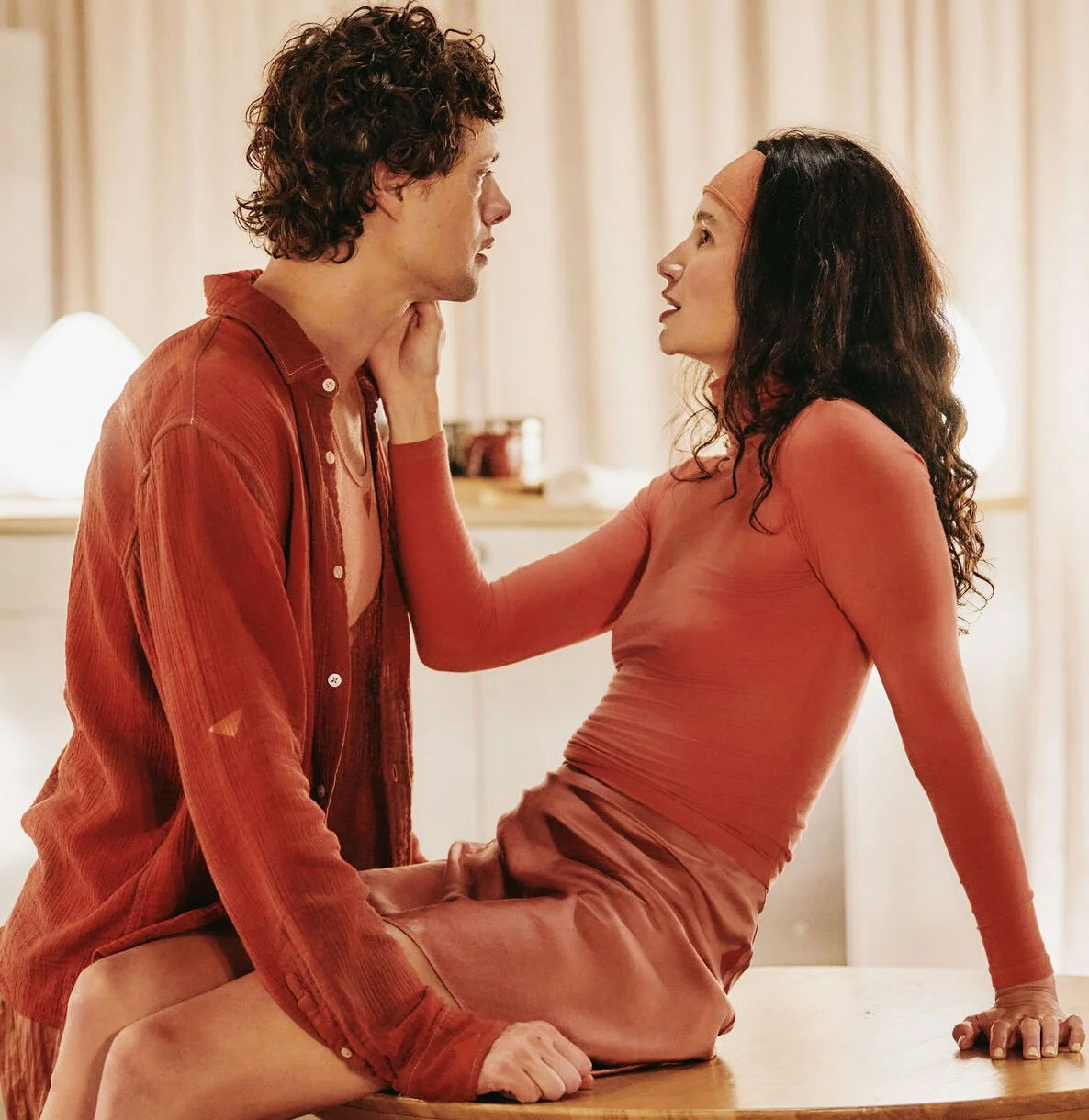
Not at all a model couple: Charlie (Douglas Smith) and Georgia (Delaney Rowe) in Little Engine Theater’s production of Machine Learning.
As a portrait of two relationships imploding when the couples are confined together, Kate Vozella’s Machine Learning provides 90 minutes of fiercely acted, propulsive drama. As a portrait of AI’s expanding influence in our lives, however, it underwhelms.
The play’s title, as well as its marketing, suggests technology is central to the story. “Two couples enter a research program at a remote, sealed facility, believing their interactions will help train humanoid companions in human intimacy,” read the show’s website and other promotional materials—a synopsis that makes Machine Learning sound like a prequel to Marjorie Prime, Jordan Harrison’s 2015 Pulitzer finalist (revived on Broadway last season) in which people are already living with humanoid companions.

Machine Learning’s Willa (Michele Selene Ang, left) and Lucia (Emma Ramos) are trying to overcome a tragedy.
Yet Vozella’s script doesn’t really engage with the robots-in-the-making business. Audience members coming to Machine Learning with no advance knowledge of the plot may not even understand why the characters have relocated. In the first two scenes, when the couples are moving into the facility, the tech project is not discussed, only referenced obliquely as “something groundbreaking.” One character says, “I think they will be studying us, no?”; another also speaks of an unexplained “them.”
Rather than a technology drama, Machine Learning is a relationship drama, and one with a wicked edge. Vozella’s focus is not on the humanoids’ development but on the humans’ behavior—a maelstrom of grief, deception and mind games. Forget about a Marjorie Prime sequel; this is more like a junior version of Who’s Afraid of Virginia Woolf?
“Vozella’s script doesn’t really engage with the robots-in-the-making business.”
The “Martha” in this quartet is Georgia—like Virginia Woolf’s antiheroine, a tart-tongued manipulator who frequently berates her partner. One major difference, though: Georgia is a true psychopath (she uses the word “sociopathy” when semi-admitting it to somebody). “I literally feel nothing about anything you may have done or not done,” Georgia tells one person. “I’ve never loved a single person in my life besides myself,” she says another time. And to her boyfriend, “I could kill you, Charlie. I could actually fucking kill you. I’ve even thought about how I would do it.”
Georgia and Charlie share the facility’s living quarters with Lucia and Willa, married lesbians mourning the loss of their infant daughter and keeping secrets from each other about what they’ve done in the aftermath of the child’s death. All these secrets, along with the mystery of Charlie and Georgia’s attachment—she’s just too awful to him, and he doesn’t seem naive enough to believe she loves him—give Machine Learning the feel of a psychological thriller.
While the play generates the suspense and menace of a thriller, it also proves effective if viewed purely as a domestic tale, as the verbal sparring, kinder interactions and shifting allegiances reveal four compelling characters. Vozella does rely on a few tropes—an author using a loved one’s strife as fodder for a novel, for one thing—but assured performances by the young cast help sell the story.

Georgia (Rowe) calls Charlie “sweetie”—but she doesn’t mean it. Photographs by Valerie Terranova.
Delaney Rowe, a non-Equity actor known for her Instagram performances, plays Georgia with a coldhearted steeliness tempered occasionally by feigned humanity. As the skittish, vulnerable Willa, Michele Selene Ang makes both her heartbreaking experience and her frustrating behavior feel very real. Emma Ramos also hits the right tone as Lucia, a caring and devoted if not completely honest partner to Willa. And while you can’t help but sympathize with Charlie, Douglas Smith’s portrayal shows a man—bullied in childhood by his brothers and now by his girlfriend—too comfortable being a victim and too easily awed by more assertive acquaintances.
For the Machine Learning set, scenic designer Tyler Herald has furnished the apartment in a contemporary if somewhat sterile-looking style, with way more paper-shaded light fixtures than needed and an abundance of plants. It perfectly matches Willa and Lucia’s first impression: “like an Ikea showroom … but just for lamps.” Tasked with dressing the cast in a uniform, costume designer Karen Boyer created various articles of clothing—a miniskirt for Georgia, athleisure for the other women—all in the same dusty orange. Liam Bellman-Sharpe’s sound design centers on a disembodied voice that occasionally responds to what the residents say. “I’m so sorry that these are not to your liking; I can find different varieties for you,” it announces when Charlie dislikes the beer selection in the fridge.
Why that entity intercedes only sporadically, and why the characters behave without regard for the surveillance, represents another sidestepping of technology-related details in Machine Learning. The humanoid project comes to the fore during the final moments of the play, a meta-ish ending unsatisfactory for its ambiguity—were the characters tricked, or the audience?—and abrupt tonal shift. But the drama leading up to it delivers optimum performance.
Machine Learning runs through Nov. 8 at Manhattan Neighborhood Network (509 W. 38th St.). Performances are at 8 p.m. Monday through Saturday. For tickets and more information, visit littleenginetheater.com/machine-learning.
Playwright: Kate Vozella
Director: Colm Summers
Scenic Designer: Tyler Herald
Costume Designer: Karen Boyer
Lighting Designer: Christopher Wong
Sound Designer: Liam Bellman-Sharpe
