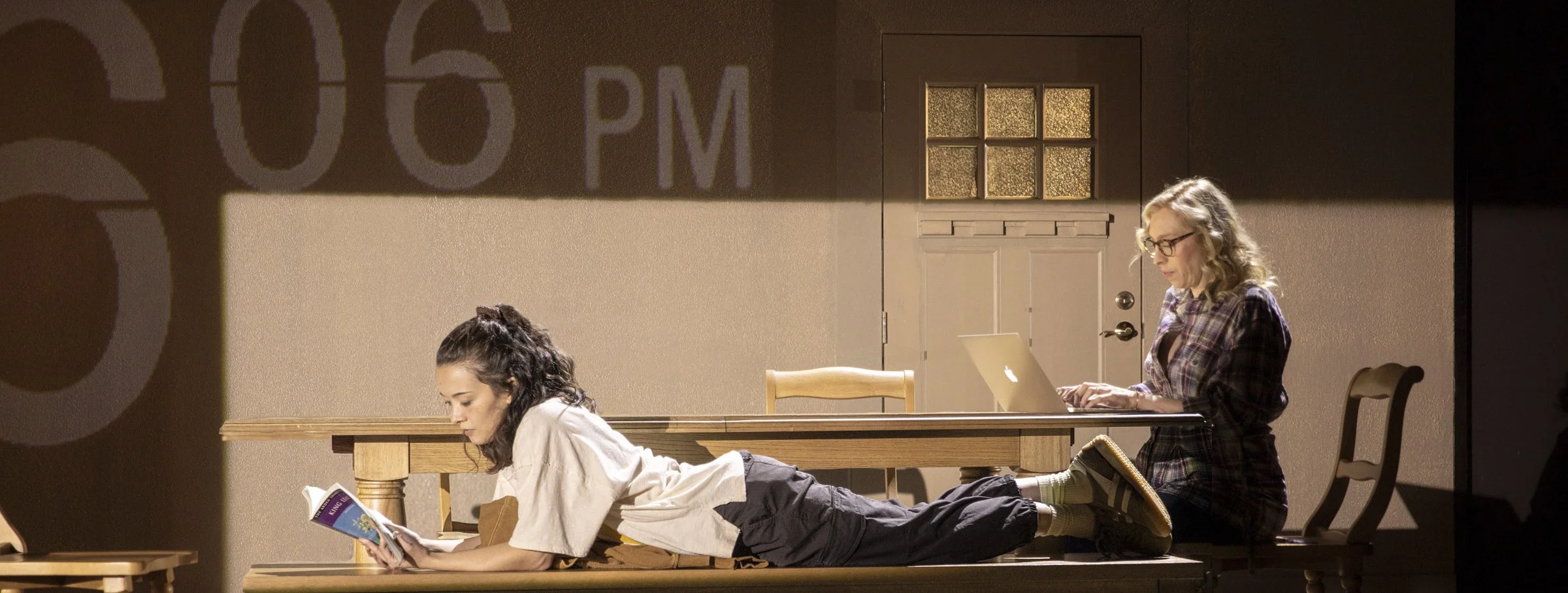

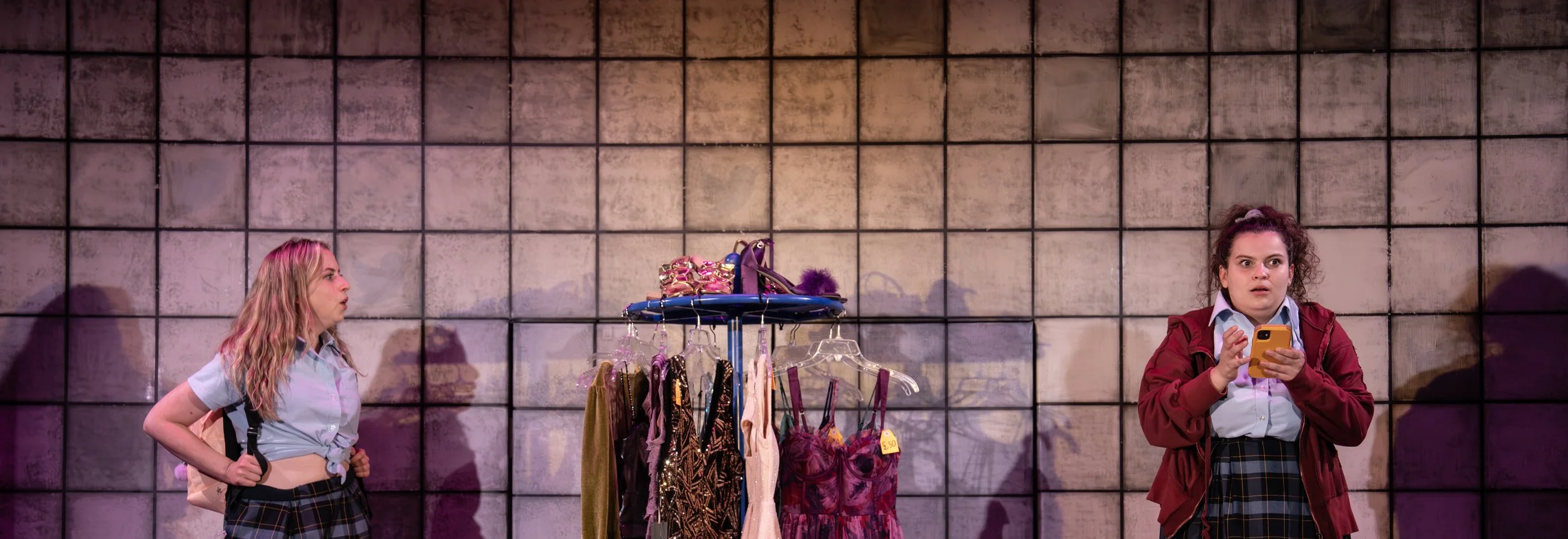



The Disappear feels like an incomplete puzzle: Its pieces don’t fit together. This new play, written and directed by Erica Schmidt, is overloaded with undercooked melodramatics and ideas.

“I thought that was normal MAGA loonie. Is that QAnon?” asks Will (Jeremy Shamos) of his husband, Adam (Jeff Biehl), after they watch a TikTok video by their neighbor Jeanie (Crystal Finn) in the San Antonio suburb they have just moved to. Alas, pretty much everyone is familiar with MAGA looniness these days, but QAnon may be hazier, or merely shorthand for crazy. Anne Washburn tries to illuminate these dark corners of the Internet in Anon. The play is admirably ambitious, overlaying the story of the indoctrinated Jeanie and her family and neighbors with motifs and scenes from Shakespeare’s King Lear, though the results are mixed: ideas and characters feel as though they are still in the process of being worked out.
For the past eight years, Audible, the audiobook behemoth, has joined forces with the Minetta Lane Theatre to produce staged plays that are recorded and eventually made available as streaming audio “originals.” Given that history, their latest collaboration, Jamie Armitage’s A Ghost in Your Ear, is extremely on brand. This 90-minute haunting is set in a sound studio, most of the action involves the recording of an audiobook, and audience members listen to the tale via headphones. If the frights are milder than one might hope, the work surprisingly has something to say about the travails of fatherhood, while unintentionally delivering important lessons on the nature of live performance.
Fish, written by Melis Aker and directed by Tatiana Pandiani, is a darkly comic coming-of-age drama inspired by true events about a teenage girl whose search for her missing brother takes a disturbing turn. Set in London in 2016, the play follows 17-year-old Karya as she tests her Turkish mother’s increasingly plausible theory about her brother’s disappearance by launching an online experiment with her best friend, only to discover that some games carry sinister consequences.
On entering St. Ann’s Warehouse for Daniel Fish’s Kramer/Fauci, the entire expanse of the building is visible. The floor is matte black, and on the far wall a bank of lights beams intensely toward the audience, replicating a high school football stadium in Texas. Although the scenic design is credited to Jim Findlay, Joshua Higgason, and Amy Rubin, and the lighting to Scott Zielinski, the importance is the actors, who re-create a 1993 C-SPAN interview with writer (the novel Faggots; the play The Normal Heart) and ACT UP activist Larry Kramer (Thomas Jay Ryan) and Dr. Anthony Fauci (Will Brill), then known as the premier AIDS researcher in the country.
Anachronisms are a reliable source of fun and surprise in musicals, from the very casting and concept of Hamilton going back to “On any gent who wandered by, she’d pull the Theda Bara eye” (“Cleopatterer,” Leave It to Jane, 1917). But anachronisms have seldom had as strenuous a workout as the one they endure in Slam Frank, the musical at the Orpheum. The work of Joel Sinensky (book) and Andrew Fox (music and lyrics), it aims essentially to resurrect a mid-century classic, burden it with pop culture signposts from a variety of eras, reassess its relevance in these troubled times, and find it wanting. Which it does in an anything-for-a-laugh way, to the point where your sides may be sore from being poked in the ribs so relentlessly.
The Disappear feels like an incomplete puzzle: Its pieces don’t fit together. This new play, written and directed by Erica Schmidt, is overloaded with undercooked melodramatics and ideas.
