


In Erica Schmidt’s The Disappear, Ben (Hamish Linklater) and Mira (Miriam Silverman) have a marriage that’s the epitome of a love-hate relationship.
The Disappear feels like an incomplete puzzle: Its pieces don’t fit together. This new play, written and directed by Erica Schmidt, is overloaded with undercooked melodramatics and ideas.

Raf’s (Kelvin Harrison Jr.) adoration of Mira (Silverman) is unrequited but much appreciated.
If there is a main plotline in The Disappear, it centers on the dissolution of the marriage between best-selling novelist Mira Blair and filmmaker Ben Braxton as they collaborate professionally for the first time. Their 20-year union is already in distress. Ben is pretentious and self-involved and values his work over his family; Mira has had to “handle 100 percent of the child care and the household,” and, she tells him, “sometimes I hate you so much, I want to stab you with a kitchen knife.” Ben claims Mira is “so mean” to him, but he may just be jealous that she makes more money than he does—and is probably more famous, too.
Is Schmidt’s play about bloated Hollywood egos? The sacrifices and compromises of marriage and parenthood? The inevitable professional rivalry that creeps into a personal relationship between creatives? Climate change? Yes to all of them. But she fails to weave them together into a meaningful, cohesive story with salient insights on love, work or “making art while the world is falling apart” (what the “seriocomedy” is about, according to a script note).
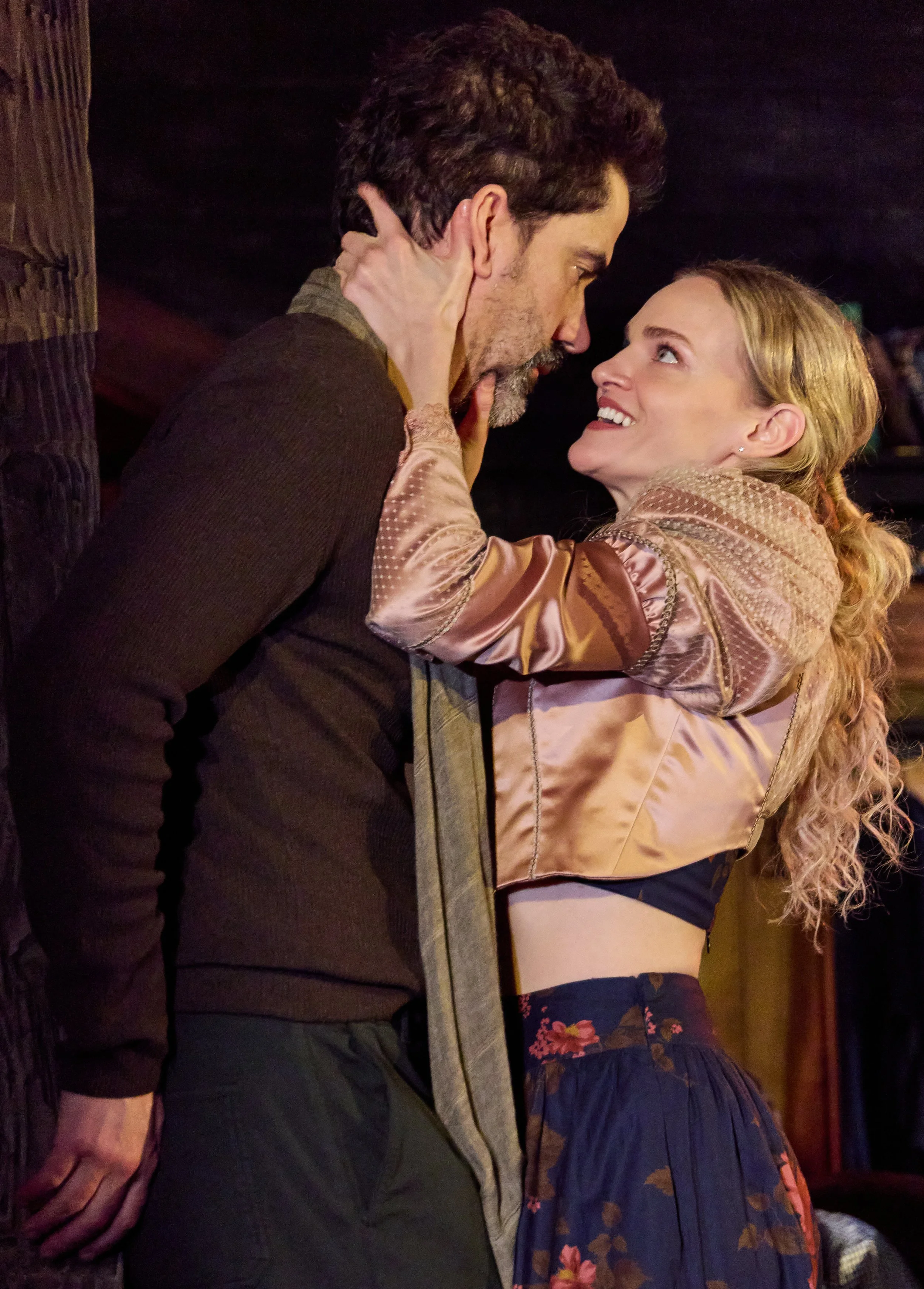
Ben (Linklater) believes actress Julie Wells (Madeline Brewer) is his muse—at least until the film wraps. Photographs by Jeremy Daniel.
Mira and Ben, along with their 16-year-old daughter, Dolly (Anna Mirodin), are living, out of “economic necessity,” in a country home that has been in Ben’s family for generations. (The living room designed by Brett J. Banakis achieves appropriate notes of rustic luxury and well-worn elegance.) The couple’s “shameful retreat” from the city is never fully explained—there’s mention of a lawsuit against Ben for allegedly having stolen someone’s story for one of his movies, and his reputation has also taken a hit due to his philandering with his leading ladies.
Now Ben is smitten with Julie Wells (Madeline Brewer), the wide-eyed blonde—with a wardrobe that looks like it came from Little Bo Peep—who’s costarring with A-lister Raf Night (Kelvin Harrison Jr.) in the film Ben and Mira cowrote.
The play’s focus shifts from Ben and Mira’s relationship to Ben’s prolonged pursuit of Julie to Raf’s infatuation with Mira to Dolly’s occasional enigmatic or angst-ridden appearances. Dolly is on stage for only minutes at a time in Act I—in one scene, espying her father besotted with Julie; in another, screaming hysterically about her dried-out hair; in three of the other four scenes, not at all. Yet the final scene of the play revolves around her. The teenager has no reaction the first few times she encounters hot young movie star Raf in her home, but in a scene set several months later, she’s suddenly flirting with him.
In another example of something mattering for one part of the play that’s mostly insignificant for the rest of it, butterflies figure prominently in the final scene. Julie references them metaphorically and quotes King Lear’s “We’ll laugh at gilded butterflies” line; Dolly receives mesh cages full of caterpillars and chrysalises, which she will use to create a monarch garden. But the only previous butterfly presence in the play consists of a few early lines of dialogue and a momentary, wordless appearance by Dolly holding a butterfly net.
Such disjointedness occurs throughout The Disappear. Every scene seems to be about something else; characters are central to one scene, nonexistent for several others. And every so often, but certainly not often enough for it to be considered a theme, somebody discusses a consequence of global warming.
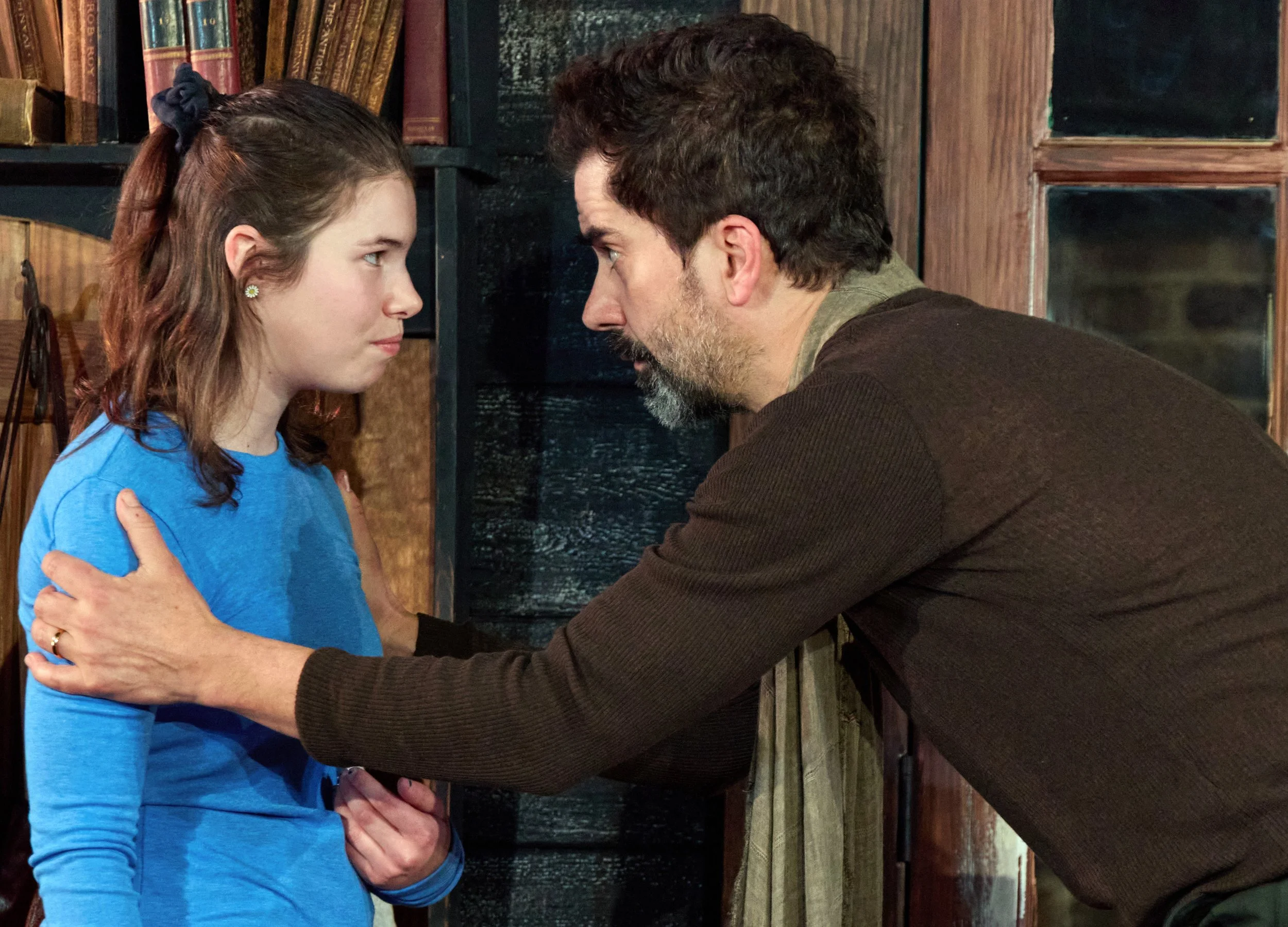
Why wouldn’t Dolly (Anna Mirodin) resent a father (Linklater) who says things like “I love filmmaking more than I love anything in the whole world, including my own child” and “Having children ruined my marriage”?
Portraying the most—or only—relatable character, Silverman walks away with the show. Amid much that feels phony, her performance is grounded in emotional truth. Linklater, more familiar as nicer guys, stretches too hard to play the selfish jerk Ben. Brewer fares well enough as his paramour-turned-foil, but she and the rest of the cast, including the ever-reliable Dylan Baker as Ben’s producer Michael Bloom, are hampered by their confusingly written characters. Michael is British and has a drinking problem—two well-emphasized details that don’t actually make any difference in the story. And with both Raf and Julie, it’s hard to tell if their high-minded ideals and literary knowledge are genuine or they’re just trying to show they’re more than a pretty face.
They and The Disappear’s other adult characters talk a lot about what they think, what they feel, what they aspire to, what they’ve experienced. Audience members may still be left puzzled, however, by what Schmidt means to say.
The Disappear runs through Feb. 22 at the Minetta Lane Theatre in Greenwich Village. Performances are at 7 p.m. Tuesday through Saturday, with matinees at 2 p.m. Saturday and 3 p.m. Sunday. For tickets and more information, visit audiblexminetta.com.
Playwright & Director: Erica Schmidt
Sets: Brett J. Banakis
Costumes: Jennifer Moeller and Miriam Kelleher
Lighting: Cha See
Sound: Palmer Hefferan
