
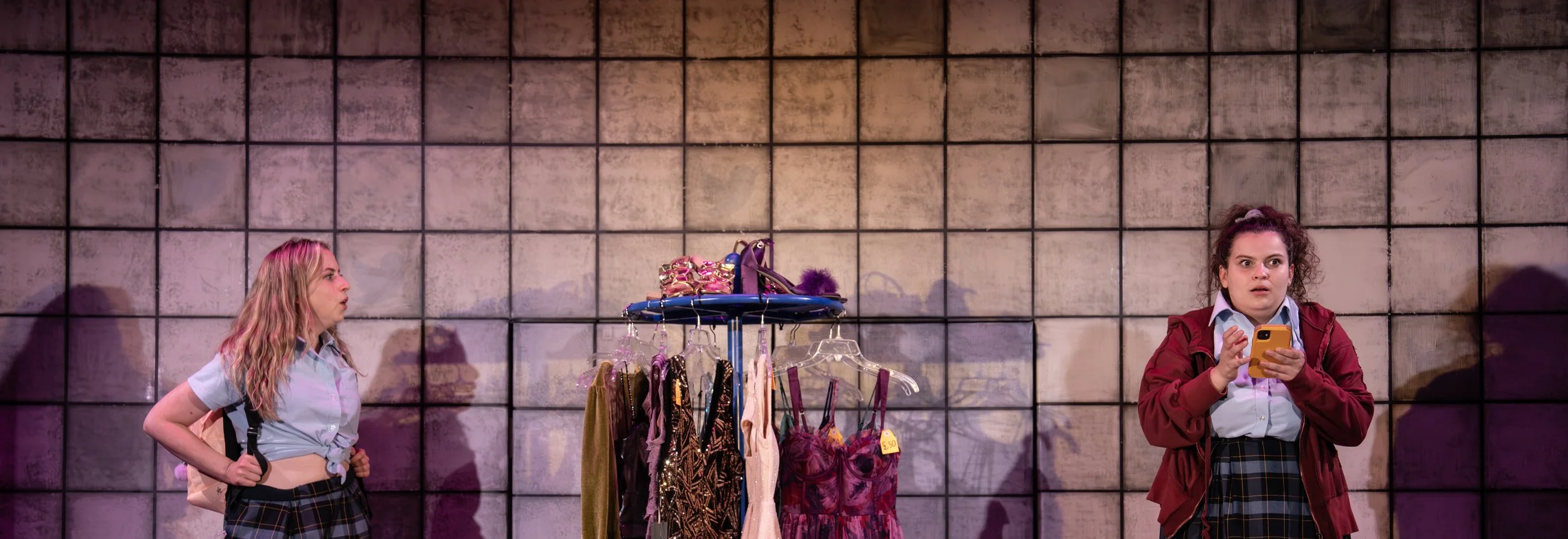

Roxanna Hope Radja (right) plays Ceyda, a Turkish mother in London who is uncertain whether her missing son Emir is alive or dead, while Yasmin Ranz-Lind portrays her daughter Karya, whose struggle to establish her own identity is overshadowed by her brother’s disappearance.
Fish, written by Melis Aker and directed by Tatiana Pandiani, is a darkly comic coming-of-age drama inspired by true events about a teenage girl whose search for her missing brother takes a disturbing turn. Set in London in 2016, the play follows 17-year-old Karya as she tests her Turkish mother’s increasingly plausible theory about her brother’s disappearance by launching an online experiment with her best friend, only to discover that some games carry sinister consequences.
Aker appropriates the journalistic principle “If it bleeds, it leads” for the stage. After a recording of Vivaldi’s Four Seasons wafts through the theater and the lights fade to black, they rise again on wide-eyed Karya in her bedroom with her best friend, Libby, as she examines a massive bloodstain on her underwear. With no physical mirror onstage, the audience becomes the mirror in which Karya inspects her body, an unsettling intimacy reinforced by her slightly elevated position on the multilevel stage. The two give voice to the nightmarish scene in blunt, unvarnished language:
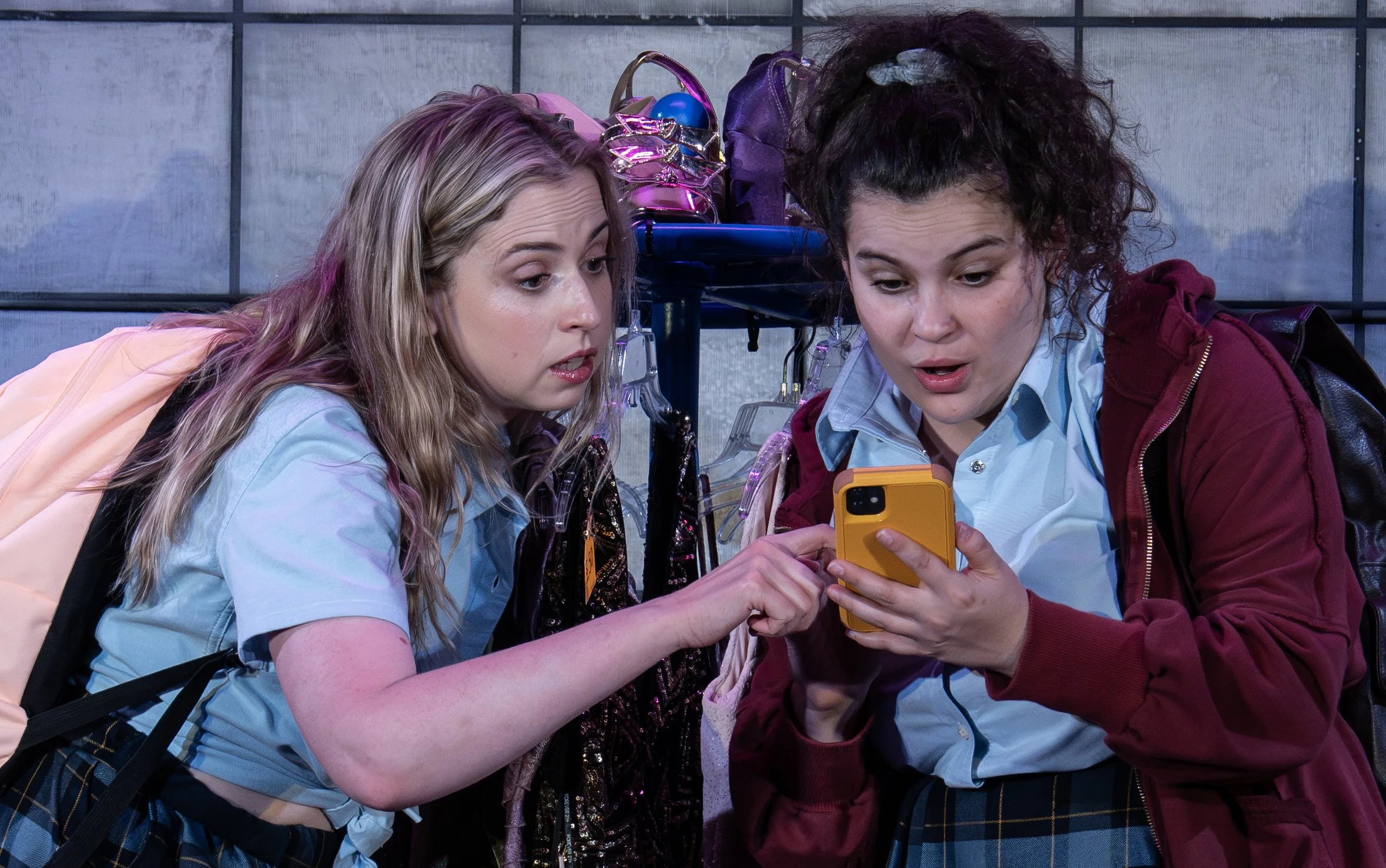
Alyssa May Gold (left) and Ranz-Lind play Libby and Karya, best friends who gradually learn that catfishing on the internet can come back to bite.
Karya: Fffffuuuuuuck—
Libby: Looks like someone shot you in the ass.
Aker’s deliberately shocking image not only establishes the play’s tone and captures the audience’s attention, but the scene collapses the distance between the characters and spectators, exposing something intensely private that ordinarily takes place behind closed doors.
The image also sets off narrative alarm bells: Is this the aftermath of an abortion, a violent assault, or an unusually dramatic onset of menstruation? A moment later, Karya’s urgent request for a sanitary pad begins to resolve the mystery. The exchange veers into comic one-upmanship when Libby offers tampons instead, treating them as a more sophisticated alternative to “nappies.” Karya accepts the package as Libby condescendingly suggests that she watch a tutorial.
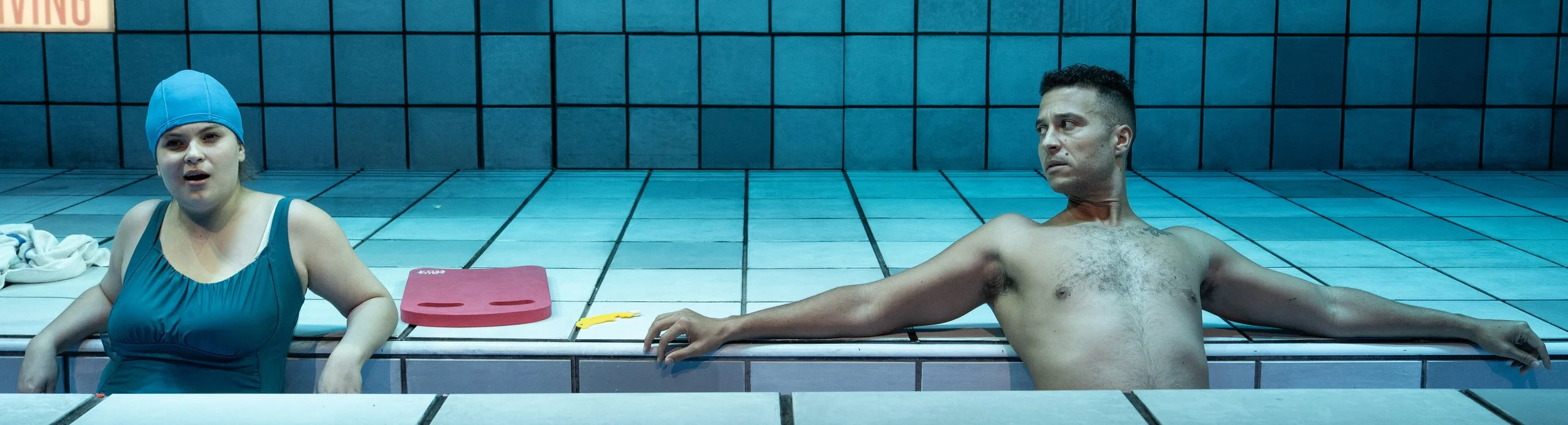
Respecting the wishes of her mother, Ceyda, the aquaphobic Karya reluctantly agrees to take swimming lessons from Jon (Kario Marcel).
Although the raw opening might be dismissed as a mere attention-getter, the menstrual stain becomes a potent symbol of loss, anticipating the deeper emotional wounds in Karya’s life. It marks the messy, involuntary passage out of childhood, when the body asserts itself at the expense of privacy and control.
In the larger context of the play, the stain also suggests a disrupted cycle of biological and generational continuity. Karya is grieving the mysterious disappearance of her brother, Emir, who, whether dead or alive, is no longer part of the family unit. Her fractured relationship with her mother, Ceyda, who is going through menopause, further complicates this picture, underscoring the isolation that shapes Karya’s journey from the opening scene.
At the heart of the play is Karya’s relationship with Ceyda, who is devastated by her son’s disappearance. Karya initially resents Ceyda’s attempt to reopen Emir’s closed police case based on a newly discovered video showing masked terrorists, one of whom Ceyda identifies as her son by his eyes. “I’m his mother, of course, I know his eyes,” she says.
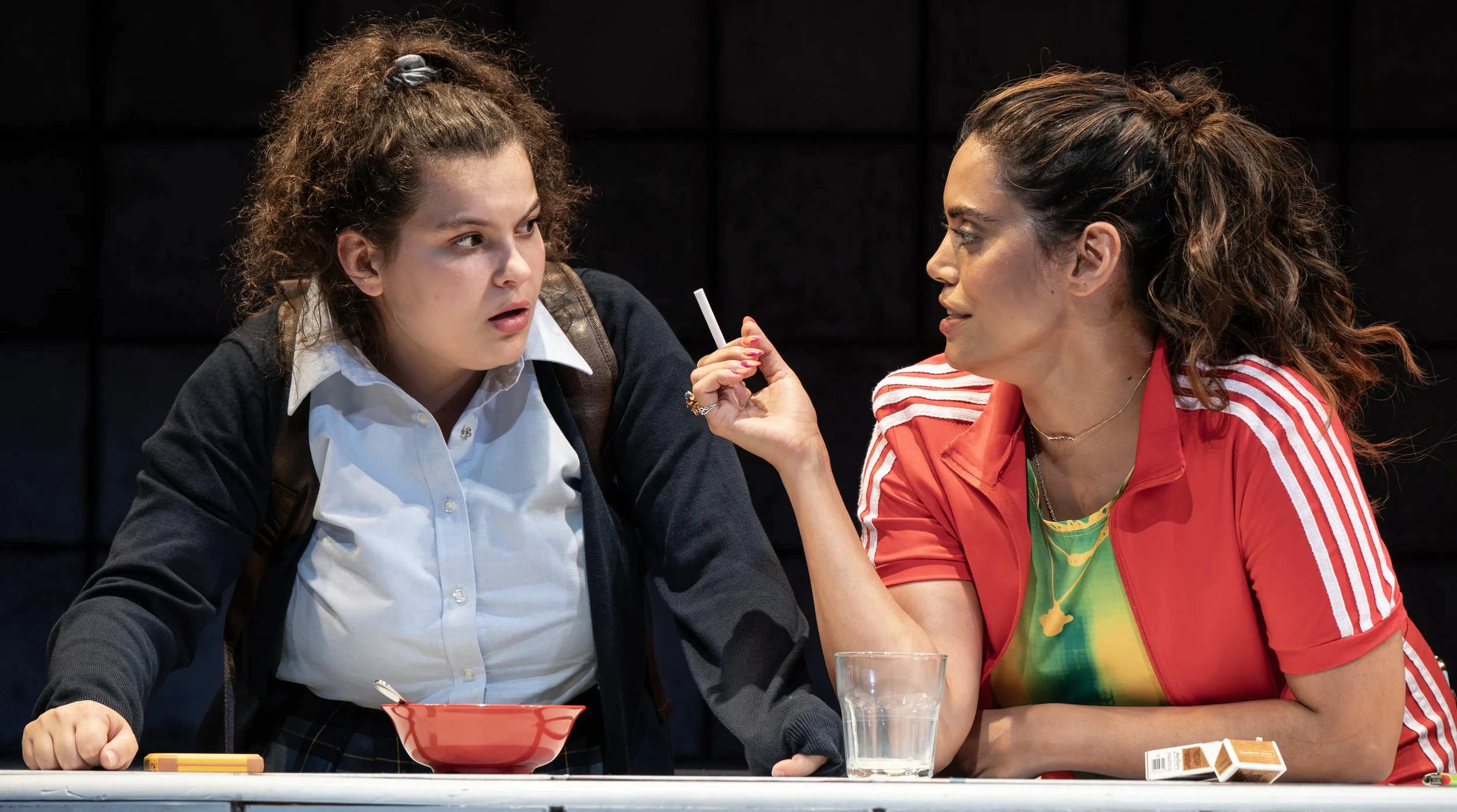
Sara Haider (right) plays Isha, Emir’s Pakistani ex-girlfriend, who pulls no punches when she shares her last memories of Emir with Karya. Photographs by Joan Marcus.
Ironically, Karya soon reopens the family wound herself. What begins as an online search for Emir through direct messages on Twitter, escalates into a dangerous foray into catfishing ISIS Twitter accounts. Although egged on by Libby, Karya realizes she is in over her head and may have broken the law, so she turns to Emir’s ex-girlfriend, Isha, who has drifted back into the family’s orbit, with a chilling question: “How do you disappear on the Internet?”
Aker introduces levity into the dark drama through Ceyda’s insistence that Karya take swimming lessons, hoping her aquaphobic daughter will learn to love the water and accompany her on a summer vacation to Bodrum, Turkey, where they can enjoy the Aegean Sea. The play’s only male character, Jon, Karya’s muscular swim instructor, adds another dimension to this aquatic motif by invoking Thales of Miletus, the ancient Greek philosopher who believed that water was the origin of all things.
The five-member ensemble works in impressive harmony. Yasmin Lara Ranz-Lind captures Karya’s contradictory blend of defiance and naïveté, while Allyssa May Gold brings sassy confidence and youthful innocence to Libby. As Ceyda, Roxanna Hope Radja conveys the resilience of someone who finds hope and humor amid hardship, and Sara Haider brings an unflinching presence to Isha, Emir’s Pakistani ex-girlfriend. Kario Marcel rounds out the ensemble as Jon, the well-built swim instructor given to philosophical pronouncements. Throughout, the actors respond sensitively to one another’s timing and navigate a performance space that shifts fluidly from a teenager’s bedroom to a gym with a swimming pool, a charity clothes shop, cyberspace, and beyond.
Fish is hardly a feel-good play, but it merits attention from theatergoers who look to the stage not merely for entertainment but for a deeper engagement with loss, from the intimate wounds of a fractured family to the global consequences of extremism.
Fish plays at WP Theater (2162 Broadway) through Oct. 25. Evening performances are at 7 p.m. Tuesday through Sunday; matinees are at 2 p.m. Saturday and Sunday. For tickets, visit wptheater.org.
Playwright: Melis Aker
Director: Tatiana Pandiani
Scenic Design: Emmie Finckel
Lighting Design: Reza Behjat
Costume Design: Siena Zoë Allen
Sound Design: G Clausen
If you enjoyed this review, please click on the Like icon below.
