
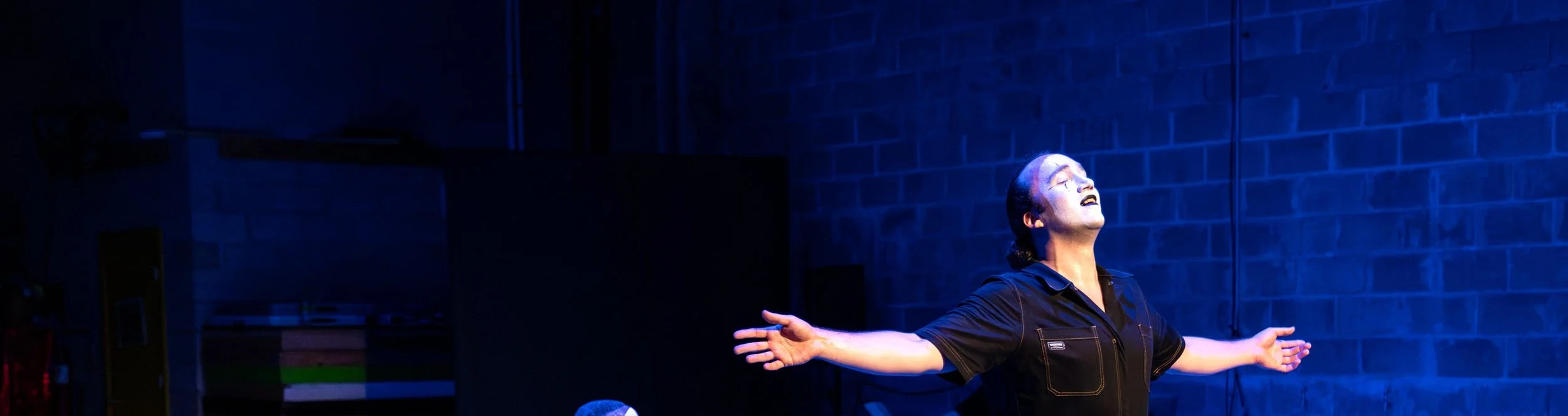
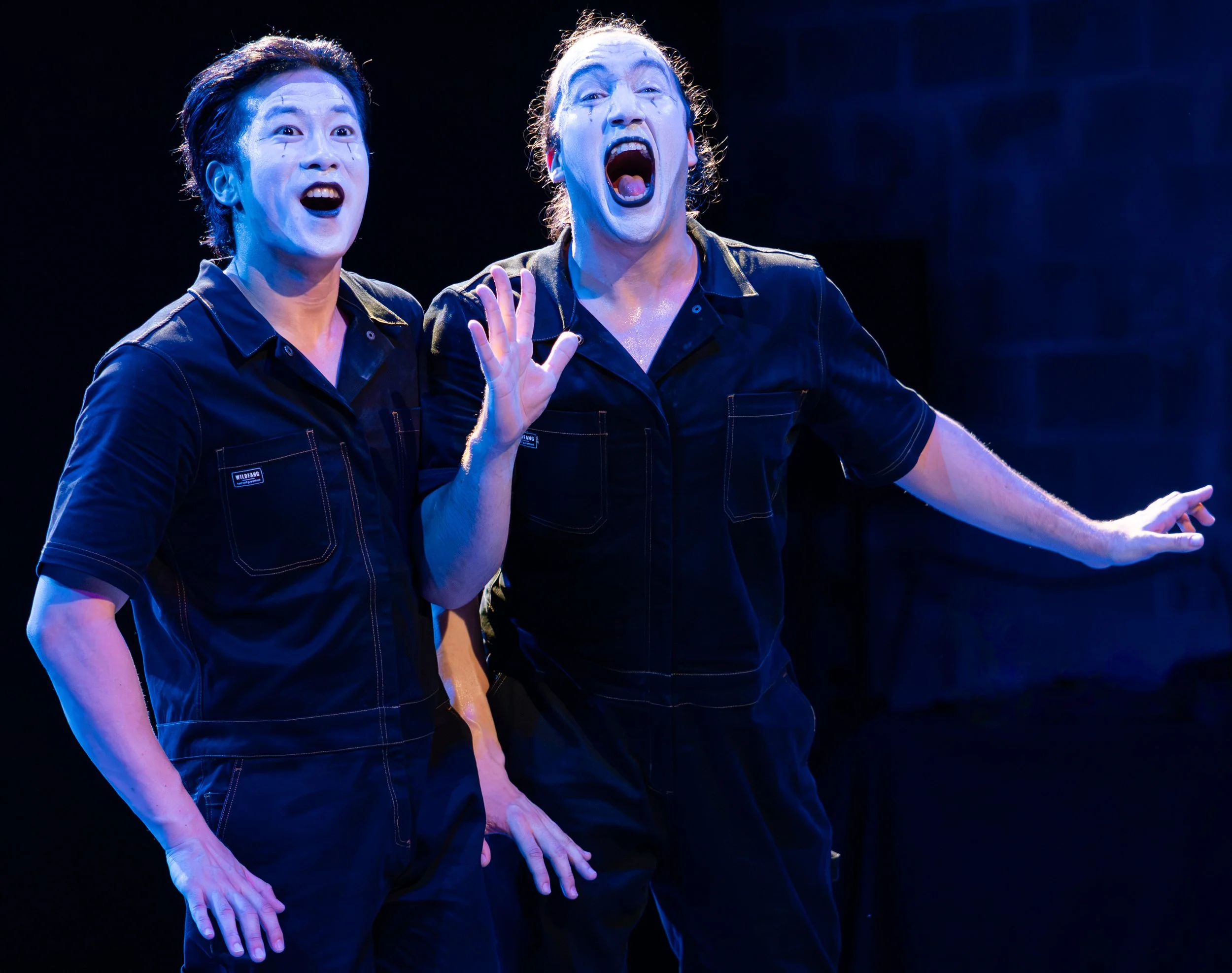
Jae Woo (left) and Deniz Erzaim perform in Myth, Broken Box Mime Theater’s first full-length narrative work that explores how people remember, rewrite, and forget their histories.
In Myth, directed by Becky Baumwoll, Broken Box Mime Theater transports audiences to a distant planet where two moons illuminate an alien world of strange flora, fauna, and unexpected possibilities. Through the expressive power of the body, the adventurous company uses speculative fiction to explore how we remember, revise, and sometimes forget the histories that shape our present.
On a distant planet a young couple has built a life together in a seemingly peaceful village surrounded by an otherworldly landscape. Yet the world is strikingly familiar: its inhabitants move through a largely bare environment, encountering recognizable flora and fauna, until an unexpected discovery disrupts their idyllic existence and opens a window onto the lives of those who came before them.
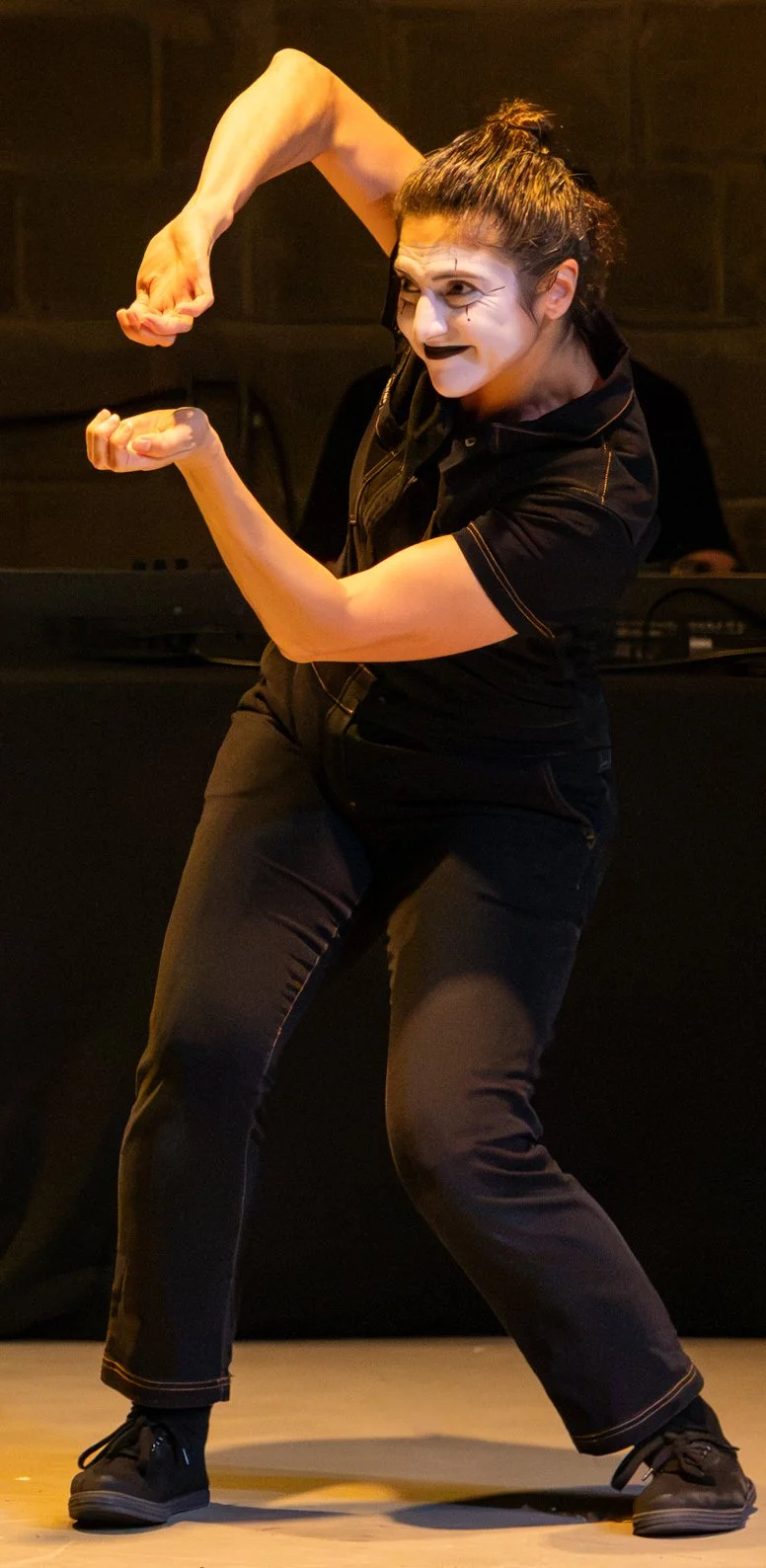
Julia Cavagna uses her miming skills and techniques to reveal the invisible fauna and flora in the alien world of Myth.
The production is organized into a prologue, five chapters, and an epilogue, with each chapter moving the story into a new stage of the fable. The abstract prologue introduces the seven-member troupe and its contemporary spin on the art of mime as the performers circulate through the space, eventually coming to the foreground to give the audience a close look at their signature faces: oval white makeup framed by black brows, blackened lips, and three black lines quartering each eye. Their entirely black clothing creates a striking contrast against the white of their faces.
In Chapter 1, “The Temple,” the moons approach alignment as the villagers gather for a peace ritual practiced by their ancestors. Yet beyond the moons, little distinguishes this world from our own: the villagers inhabit a familiar-looking community, and even the flora and fauna of Chapter 2, “The Forest,” are recognizable through the performers’ playful physical transformations. The narrative shifts when that seemingly benign natural world yields an unexpected discovery. Danger emerges more dramatically in Chapter 3, “The Beast,” as the villagers confront a threatening creature and flee toward boats as the water rises. Chapter 4, “The Truth,” brings a period of psychological and spiritual reckoning when the villagers discover that the history on which they were raised is a lie. The final chapter, “The Cliff,” returns to the story’s beginning and poses the question of what responsibility the living have to those who came before them.
The seven performers—Baumwoll, Ismael Castillo, Julia Cavagna, Tia Cassmira, Duane Cooper, Deniz Erzaim, and Marissa Molnar—display their physical dexterity in these scenes, accompanied by the rhythmic pulse of Jack McGuire’s live keyboard music. Yet the company is less successful telling the story. Although audience members receive a plot summary and a sketched visual outline of the fable before the performance, the action can be difficult to decipher without that advance information. The performers’ physical vocabulary is often vivid, but it does not always communicate the narrative information needed to follow the story.
“Some moments of emotional truth also emerge with remarkable clarity. ”
The production is clearest in its more concrete sequences. The troupe’s tranquil existence in the opening chapter gives way to an abrupt disruption with the appearance of the beast, which the performers create collectively through their supple bodies and expressive faces. Later, after discovering the creature’s danger, they convey their terror by racing toward invisible boats, their hands, arms, and legs propelling their bodies forward in a collective flight for survival; only later do the boats themselves become visible through their miming. These sections demonstrate how powerfully the human body can create an entire world without props.
Some moments of emotional truth also emerge with remarkable clarity. What could be simpler, yet more profound, than the kiss shared by the two male lovers, affirming that their relationship has survived the upheaval of their strange world? It is a moment in which the performers need no elaborate physical vocabulary: a single gesture communicates what the more complicated sections sometimes struggle to convey.
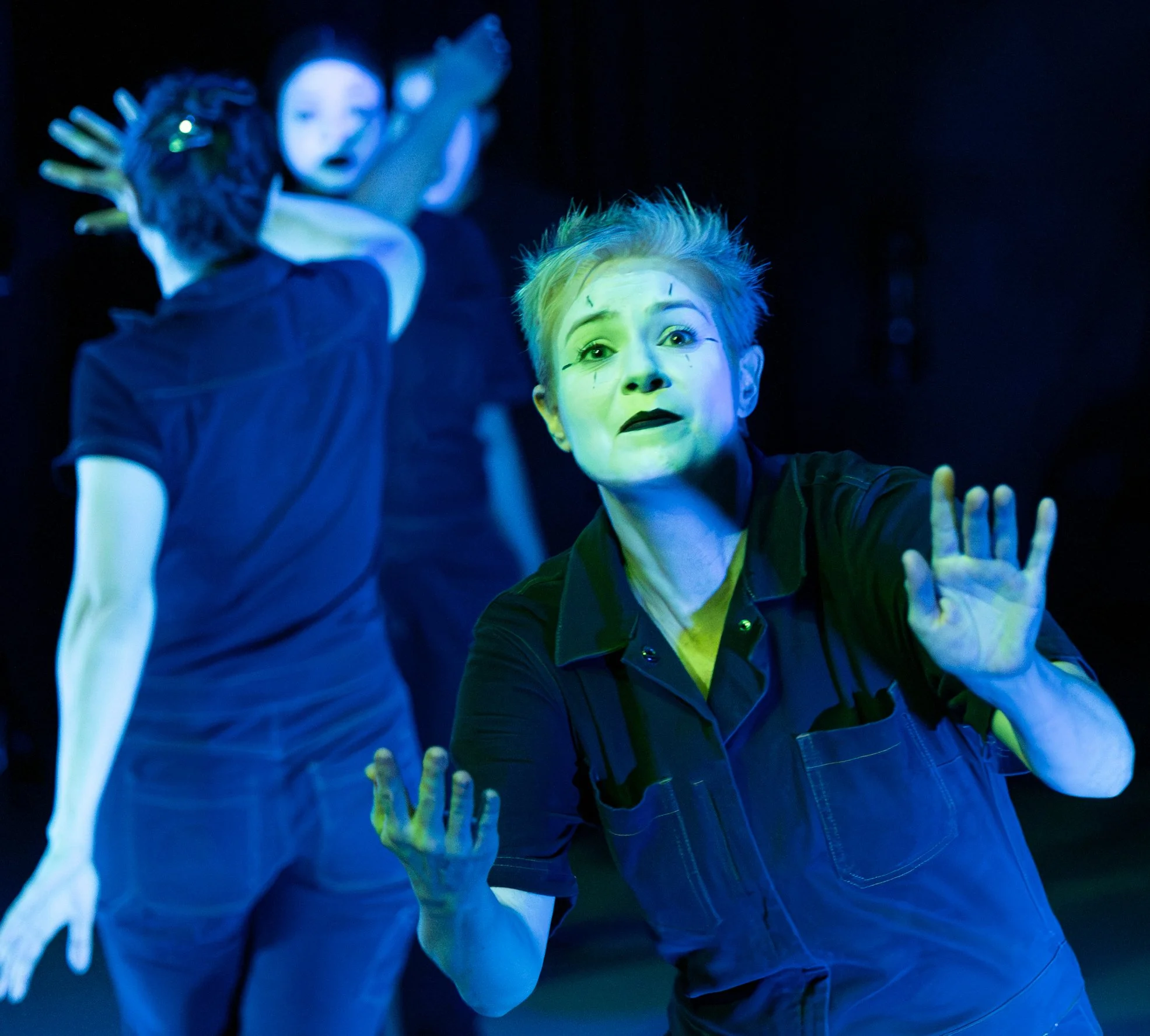
In this scene, Marissa Molnar (foreground) reenacts the peace rituals that her ancestors did before her. Photographs by Bjorn Bolinder.
The difficulty arises when Myth attempts to explore the more nuanced question of how ancestral history shapes the present. Its weightier passages become difficult to follow, and the physical language does not always make the connection between past and present sufficiently clear. Ironically, the production comes most fully alive when the performers are at their most playful—using their hands and bodies to conjure the movements of the extraterrestrial flora and fauna. In those moments, Myth demonstrates the imaginative possibilities of mime: the body itself becomes the scenery, the creatures, and the story.
Staging Myth at JACK is an inspired choice by Baumwoll. This scrappy, grassroots Brooklyn venue gives independent artists the freedom to take creative risks outside the confines of commercial theater.
If Myth does not fully realize its ambitious themes, Baumwoll deserves credit for keeping non-textual theater alive and giving her company the freedom to create original worlds that speak to the present.
Myth plays at JACK (20 Putnam Ave., Brooklyn) through Oct. 18. Evening performances are at 7:30 p.m. Monday, Wednesday, Thursday, Friday, and Saturday; matinees are at 2 p.m. on Sunday. For tickets and information, visit brokenboxmime.com.
Playwrights: The Artists of Broken Box Mime Theater
Director: Becky Baumwoll
If you enjoyed this review, please click on the Like icon below.
