
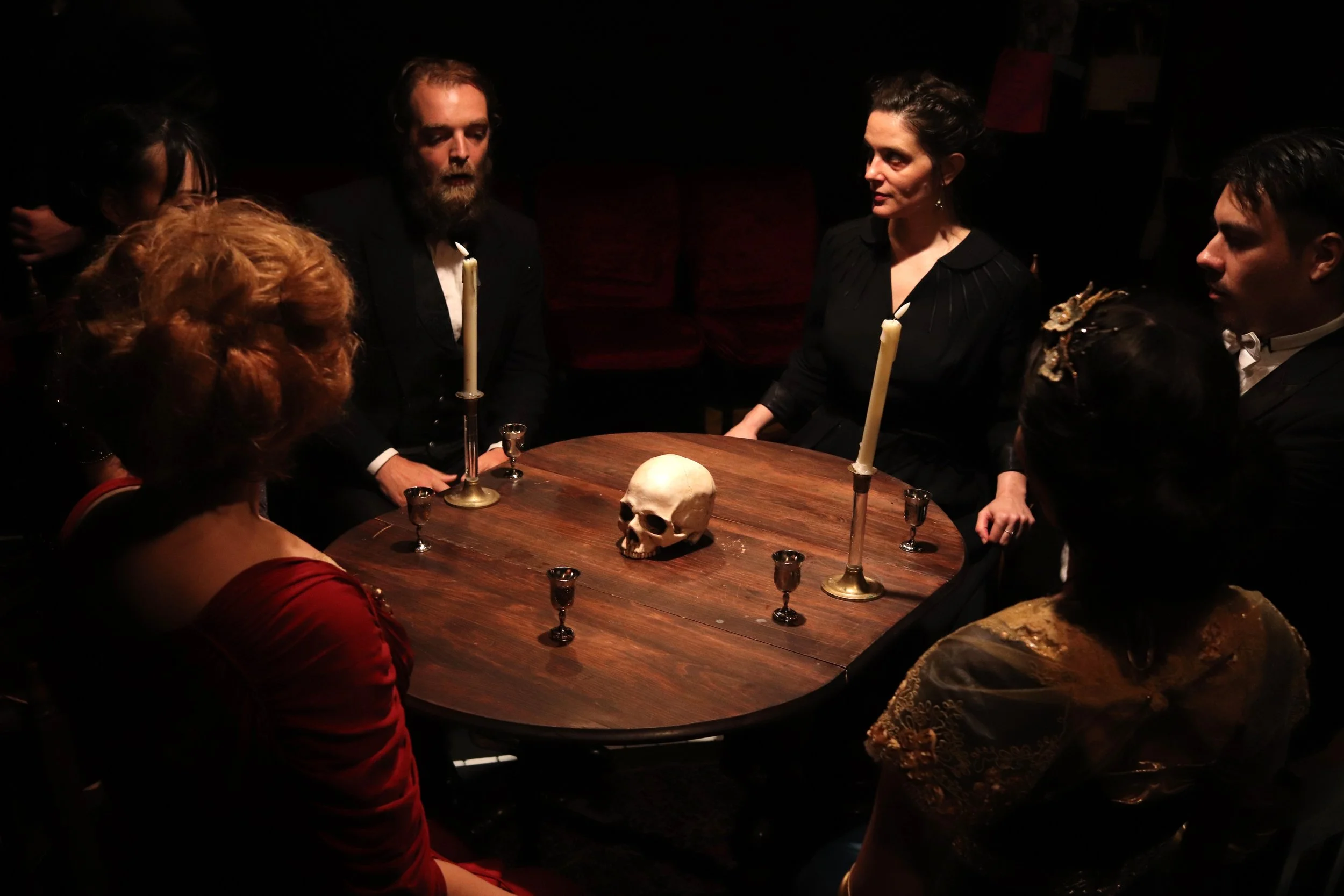
Participants in a séance include, from left: Frances Montfort (Laurel Creighton), George Crookes (Jesse Metz); the medium Sara Conlan (Sara Fellini); magician Ira Orenthall (Federico Mostert); and Mizka Crookes (facing her husband), in Sara Fellini’s Ectoplasm.
Sara Fellini’s Ectoplasm is clearly engineered for a run in October, the month when the supernatural holds sway. Following the success of Paranormal Activity on Broadway, Ectoplasm might be expected to lean into horror and jump scares, but Fellini, who also directed, structures it more like a murder mystery. Though the material is overly familiar, Ectoplasm is buoyed by good acting, interesting details, and a few surprises.
A wealthy patroness, Frances Montfort, has gathered a group of characters at her mansion to contact her late uncle, whose skull she carries around—or is the skull her father’s? In the central character, Sara Conlan, one may detect the trope of the dodgy medium that reaches back as far as Tod Browning’s 1925 silent The Mystic. Sara’s husband and assistant, Kal, wants this to be their last séance—a last-big-score element borrowed from crime films such as Rififi and Thief.
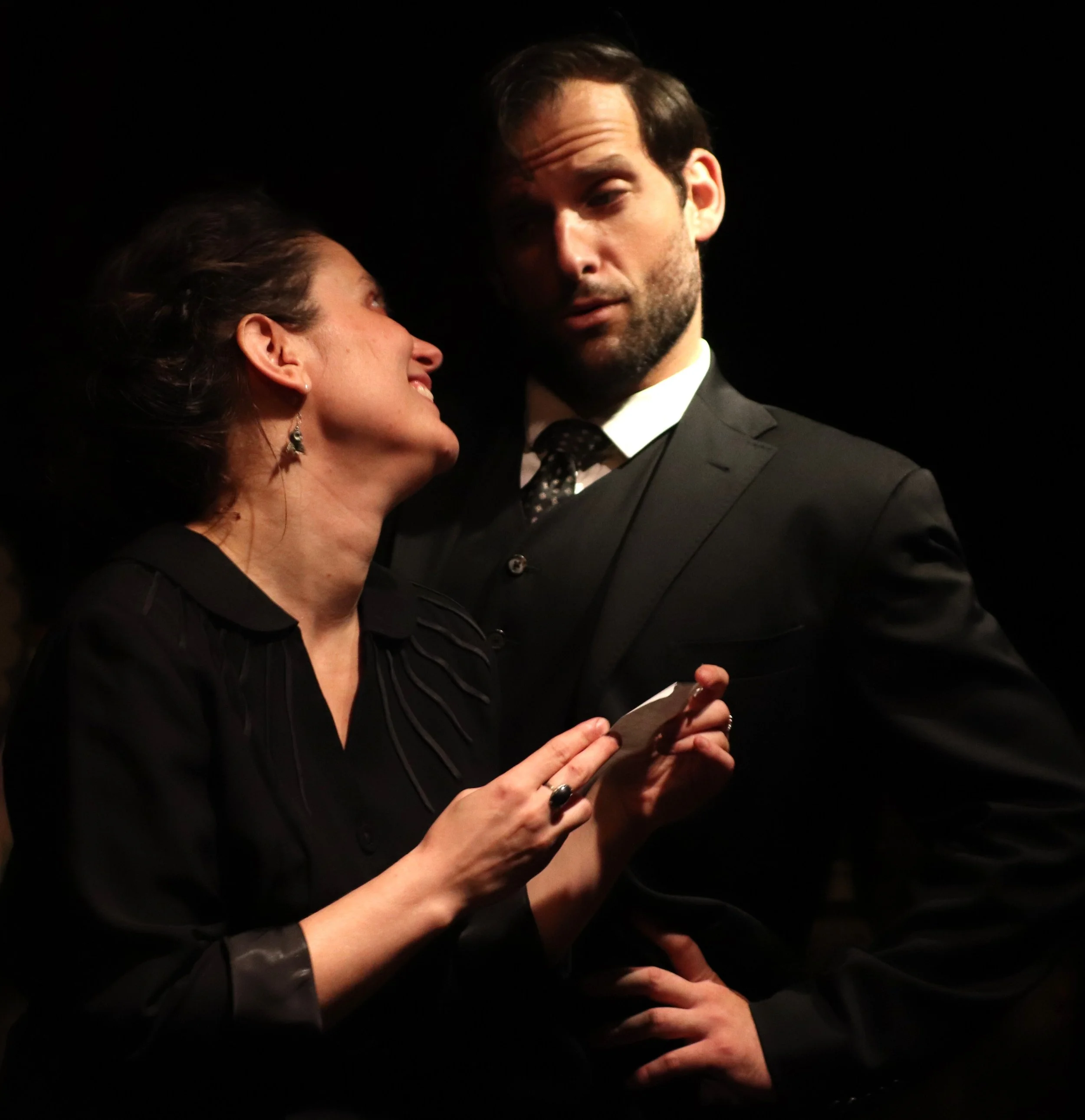
Sara tries to charm her husband, Kal (Steve Gamble), who wants the séance to be their last.
The production takes place in a black box theater, the home of the company spit&vigor, which operates fruitfully on a shoestring. The space evokes an early 20th-century mansion: it’s furnished with carved wooden folding screens, old-fashioned chairs upholstered in red velvet, a large gramophone, a drinks table, and lamps with fringed shades of yellow, pink, and mauve. Though the jumbled décor suggests an attic as much as a receiving room, an atmosphere of wealth and eccentricity comes across.
The play opens a bit bumpily, with a white-jacketed butler named Callum (George Walsh) offering tongue-in-cheek greetings to the audience, seated on the perimeter of the space. The conceit is that attendees are “spirits” who have passed on—yet somehow still support “small-budget theater.” He offers wine to those present. In the current year of 1910, he says, cocktails are a novelty—an abhorrent one. Once the wine has been poured, he exits, the house lights dim, and other lights reveal characters behind two scrims. Behind one is a dying explorer trapped in the arctic; behind the other are two teenage Japanese girls, apparently radio enthusiasts, urging him to hold on.
The play returns to the mansion, where the controlling Sara (Fellini) and the fed-up Kal (Steve Gamble) prepare a few touches for the séance:
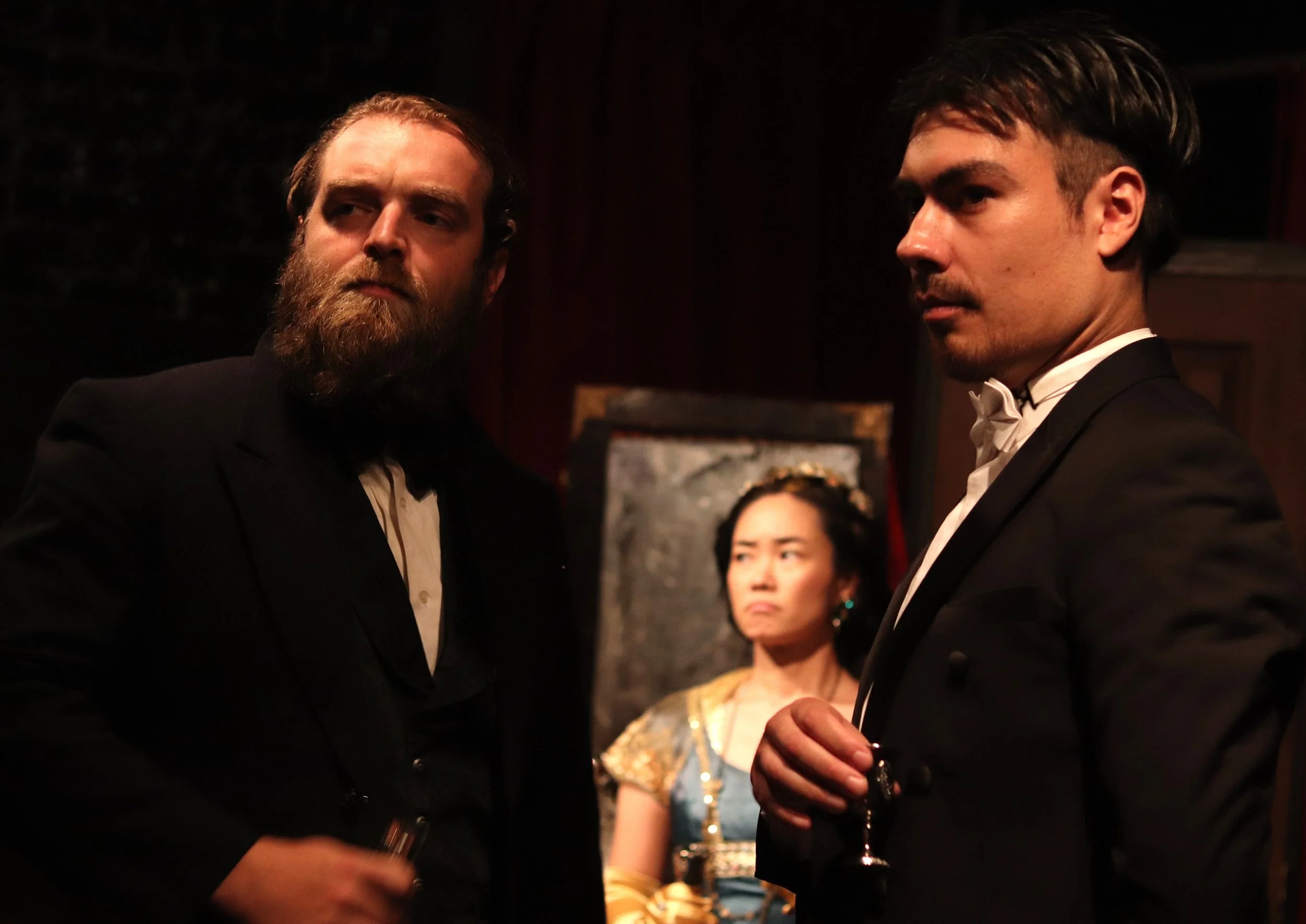
From left, Crookes, his wife, Mizka (Yurika Ohno), and Orenthall observe the Conlans with a jaundiced eye. Photographs by Giancarlo Osaben.
Kal: Just look at yourself, will you? You’re stringing apples together to bump on the floor, to fool grieving people into “hearing” their dead loved ones. That’s not a decent or honest enterprise.
Sara: You know as well as I do that I am augmenting the experience.
Although Sara has real powers, she carries a chip on her shoulder, and Kal is burned out. The risks of exposure are getting to him, and no wonder: obstacles like electric lights that operate on an “all or nothing” basis prevent them from controlling the mood. Then, too, Frances (Laurel Creighton) periodically enters half-dressed (highly unlikely for the time period!—although characters reference Lord Byron to indicate a louche morality). At one point Frances carries a skull, which she claims is her uncle’s. She even invades Kal’s space to touch his face, which infuriates and embarrasses him:
That woman. She thinks she can treat me any way she likes and she’s right. … I am utterly restrained, due to this venture you have us on. … And why do you force me to endure it, hm? It’s unbecoming of a man.
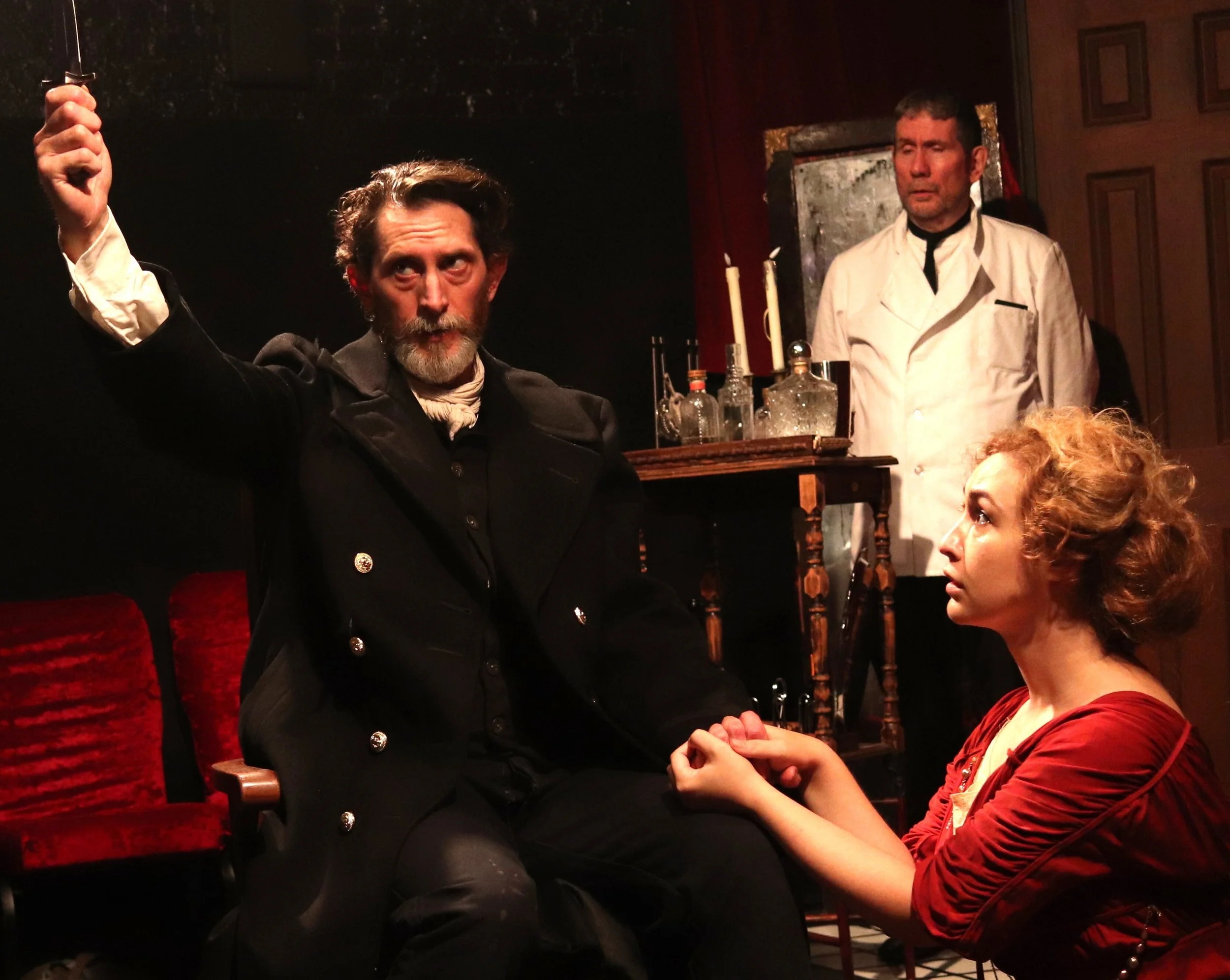
Adam Belvo (left) startles those present at the séance, including the waiter Callum (George Walsh) and the hostess, Frances Montfort.
Before the couple’s bickering becomes too tiresome, the guests arrive, injecting new energy. They include George Crookes (Jesse Metz), a lecherous parapsychologist; his knife-wielding wife, Mizka (Yurika Ohno); her sister Annette (Azumi Tsutsui), a noted suffragist; and Ira Orinthall (Federico Mostert), a magician with a performer’s resonant voice who is, naturally, expected to spot any subterfuge. The boisterous Crookes, played by Metz with a Sydney Greenstreet vibe, is eager to inspect beneath Sara’s clothing to check for tricks, but the canny Mizka, who knows him too well, intervenes. It is soon apparent that she and Annette are the grown-up Japanese girls who contacted the arctic explorer.
Fellini has enriched her play with historical detail. Electric lighting was sporadic in the period of the play; cocktails were not widespread (the first celebrity bartender’s guide, however, dates from 1862); and the custom of men going off to smoke, leaving the women to themselves or cards, was on the way out in the early 1900s. (Kal’s use, however, of the term “fat cats” is a glaring anachronism; it didn’t appear until the 1920s.)
The climax of the play involves the appearance of ectoplasm, rendered by Adam Belvo with jerky movements, wild eyes, and a go-for-broke spirit that manages to avoid laughability. If Ectoplasm may not instill fear or raise goosebumps, it still provides commendable entertainment.
Spit&vigor’s Ectoplasm plays at its “tiny baby blackbox theatre” (115 Macdougal St., 3rd floor) through Oct. 31. Evening performances are at 7:30 p.m. Thursday through Saturday. For tickets and more information, visit spitnvigor.com/ectoplasm.
Playwright & Director: Sara Fellini
If you enjoyed this review, please click on the Like icon below.
