
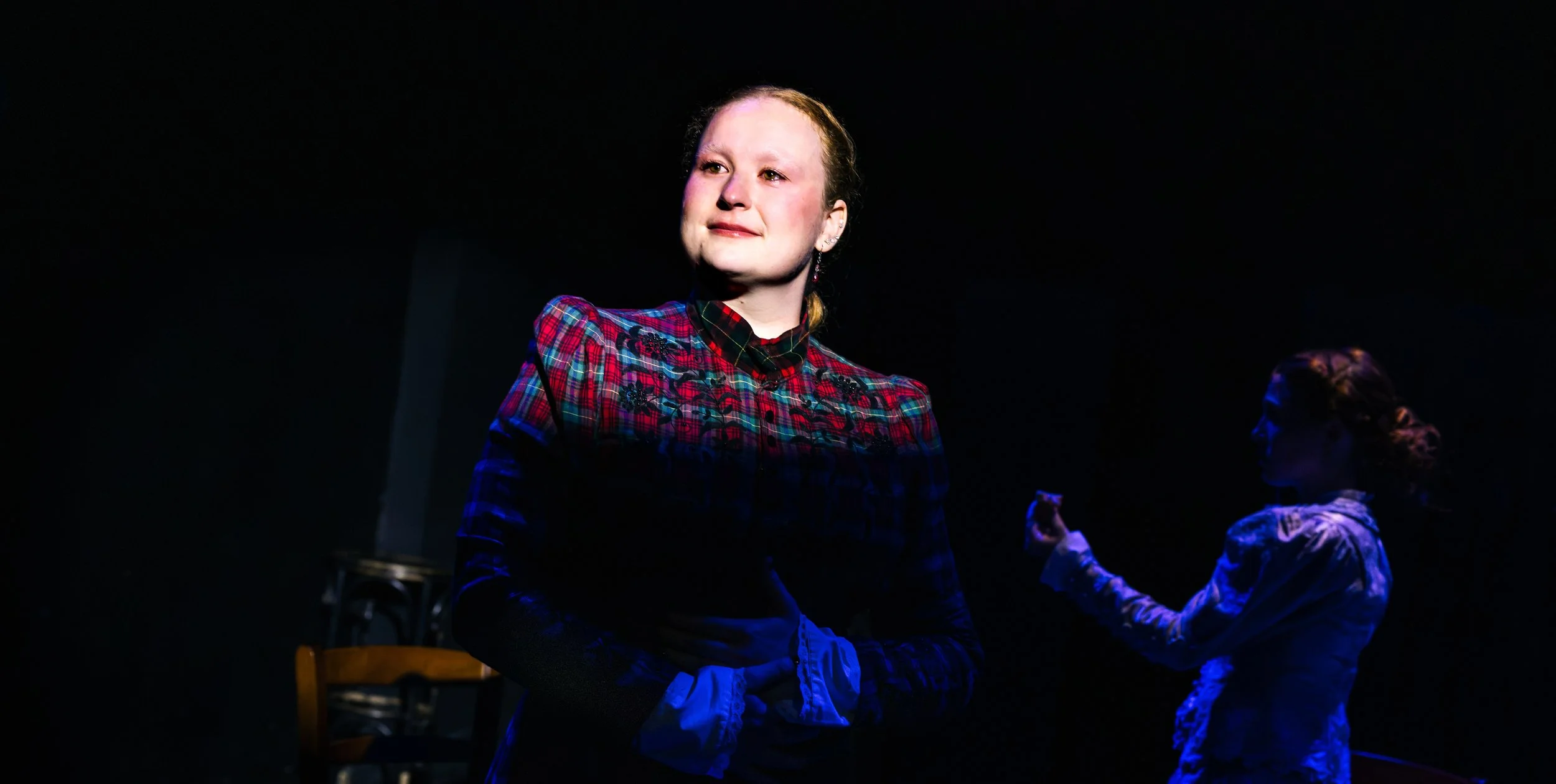
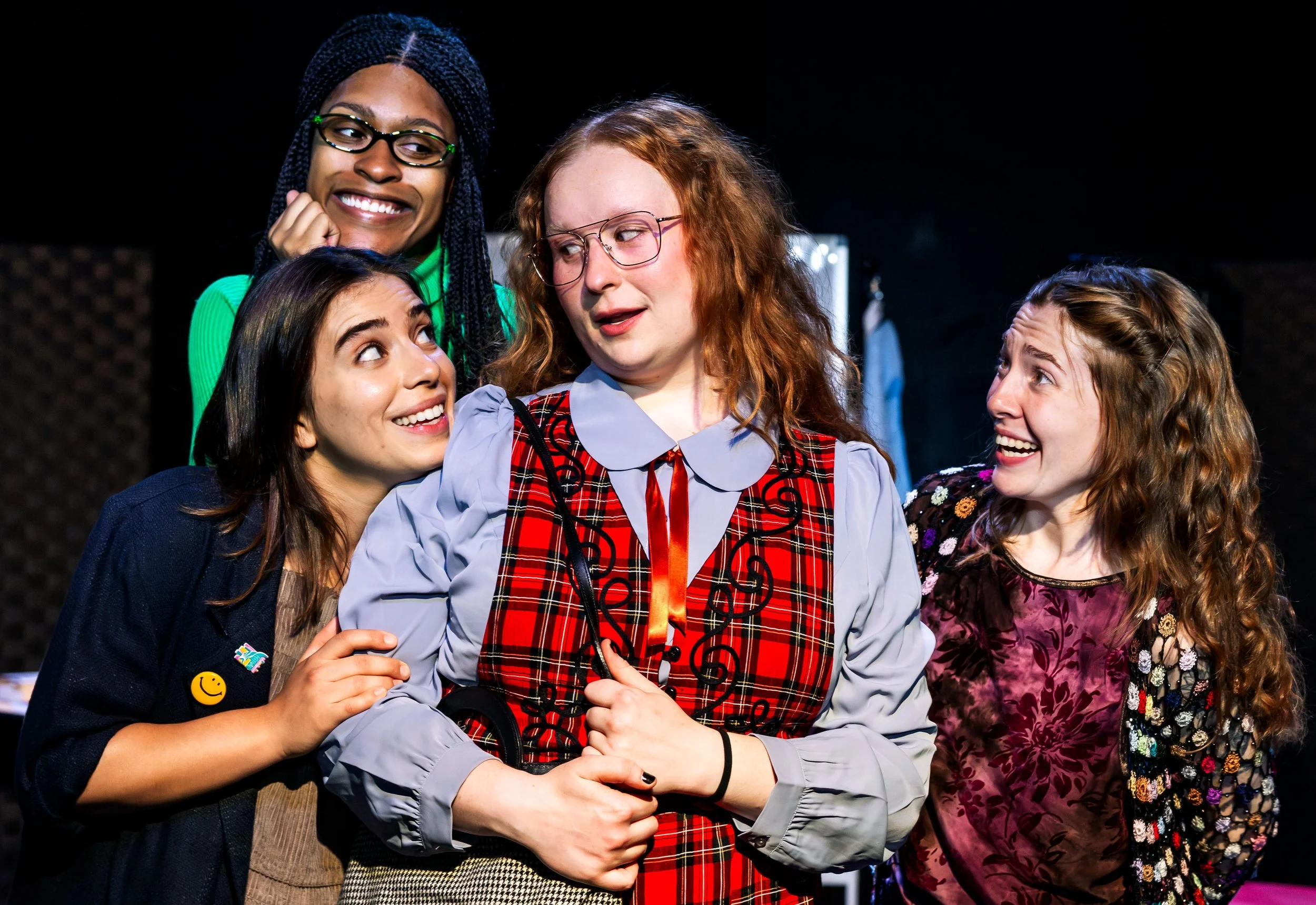
Sophie Zmorrod (left foreground), Julia Lester (center), Zoe Dean (right foreground), and Mariyea (top) play triple roles in Melissa Manley’s dark comedy Hungry Women.
What if men suddenly disappeared from the planet? Melissa Maney’s darkly comic Hungry Women, directed by Daniella Caggiano, imaginatively explores that provocative question across two centuries, using absurdism, macabre humor, and a feminist lens to examine how women might reconstruct society—and what they might ultimately discover they are most hungry for.
Hungry Women is hardly the first play to place women center stage. From Aristophanes’ Assemblywomen and Lysistrata to Bess Wohl’s recent Liberation, which follows a 1970s Ohio consciousness-raising group, playwrights have long imagined women redefining society on their own terms.
Hungry Women, winner of last year’s SoHo Playhouse Lighthouse Series, is a smart, brisk, 90-minute satire that probes survival, identity, sexuality, motherhood, and the reshaping of power in a world without patriarchy. Divided into three interconnected sections—“Hungry Women,” “Curious Women” and “Scared Women”—each introduces a new set of characters while expanding the play’s provocative premise.

Lester plays the uptight Ruth and Dean is the inexperienced Mary in Part 1 of Hungry Women. Photographs by Rebecca J. Michelson.
“Hungry Women” opens the triptych in Concord, Mass., in the 1890s. Here Maney gradually reveals her startling premise: all the men—husbands, cousins, sons, neighbors—have died following an unexplained “incident,” later described as a tragedy or epidemic. Left to rebuild their community, the women must either succumb to despair or assume the responsibilities once reserved for men. Although the four women differ sharply in temperament and ability, each, in varying degrees, rises to the challenge.
The quartet is vividly drawn: Vic is bold and ahead of her time; her sister Eden is well read, composed, and unintentionally funny in her bluntness; Ruth is tough, practical, and shaped by patriarchal expectations; and her younger sister Mary is sheltered, repressed, and quietly curious about the wider world. Three mourn their husbands even as they confront the practical problem of disposing of the bodies before they decay. Vic, however, views the catastrophe as an opportunity for reinvention. She has already solved the problem by carving the corpses into sandwiches and calmly invites the others to share her meal. Horrified at first, the women ultimately recognize that survival outweighs revulsion and take their first bites.
Maney’s dialogue sparkles with wordplay, including an early Freudian slip by Vic as she recounts discovering the bodies scattered across the countryside after walking miles to Lexington in her late husband’s pantaloons:
Vic: “Miles and miles of dead men. Grocers, expired like goods. Farmers, facedown in manure. Railroaders, splayed on the tracks they had laid.”
Ruth, Eden & Mary: “Oh, my.”
Vic: “It was quite a palatable sight.”
Ruth: “Pardon?”
Vic: “It was quite a pitiful sight.”
If Part 1 found women shedding the physical constraints of Victorian corsets, the aptly titled “Curious Women” leaps a century ahead to 1991, where an all-female World Council of differently named women governs society and “Herstory” has replaced history in the classroom. During an AP Herstory review session, substitute teacher Rebecca quizzes three 18-year-old students on the Great Fires of 1891–93. While the young women demonstrate an impressive command of the approved curriculum, they are far more interested in what preceded it—especially the mysterious winter of 1890, when, according to legend, all the men died. Rebecca discourages such questions, insisting there must be good reason for the omissions in the official narrative. Valerie, however, refuses to let the subject rest, challenging both Rebecca’s authority and the World Council’s version of the past. She ultimately crystallizes the play’s larger theme with the pointed observation: “Well, maybe we should question it. Because clearly the men’s story is still woven into ours—even in their absence.”
“Maney’s dark comedy is grounded by a fine ensemble, each actor assuming three roles. ”
Part 3, “Scared Women,” jumps ahead to 2091, introducing Regina, Eleanor, Miranda, and Violet. Here, reproduction in the all-female society is regulated through a state-managed lottery and sustained by reproductive technologies that no longer require men. A major revelation from Violet, however, upends the established social order. Although Maney struggles to bring the triptych to a fully satisfying dramatic resolution, Violet emerges as the play’s likely voice of reason, pointedly observing: “When are you going to realize our problems have nothing to do with the men, and everything to do with us?”
Maney’s dark comedy is grounded by a fine ensemble, each actor assuming three roles. Julia Lester (Little Red in the 2022 revival of Into the Woods) demonstrates dramatic gifts equal to her musical ones, while Zoe Dean, Mariyea, and Sophie Zmorrod are equally assured in their multiple performances.
Though its ambitious triptych doesn’t fully realize the promise of its premise, Hungry Women remains an imaginative, sharply written satire that refuses easy answers. By ultimately turning its feminist thought experiment inward, Maney reminds us that no society can escape its deepest flaws simply by changing who holds power.
Hungry Women plays at SoHo Playhouse (15 Vandam St.) through Aug. 30. Evening performances are at 5 p.m. Sunday and 7 p.m. Thursday, Friday, and Saturday. For tickets and more information, visit sohoplayhouse.com.
Playwright: Melissa Maney
Director: Daniella Caggiano
Scenic Design: Qingan Zhang
Lighting Design: Annie Garrett-Larsen
Costume Design: Olivia Hern
Sound Design: Chris Verde
If you enjoyed this review, please click on the Like icon below.
