
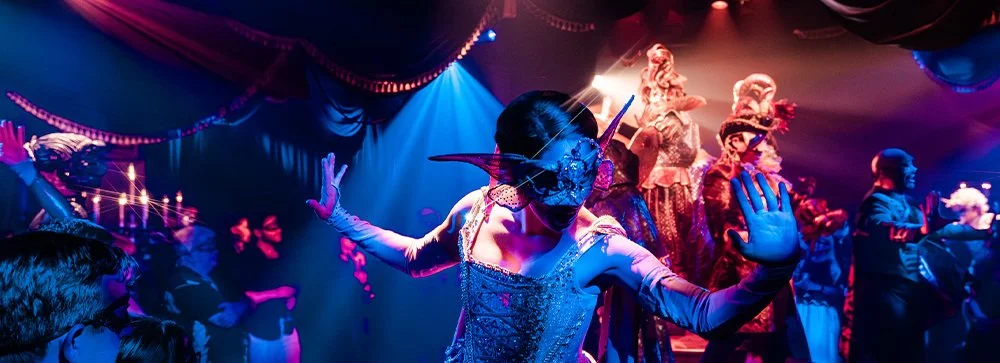
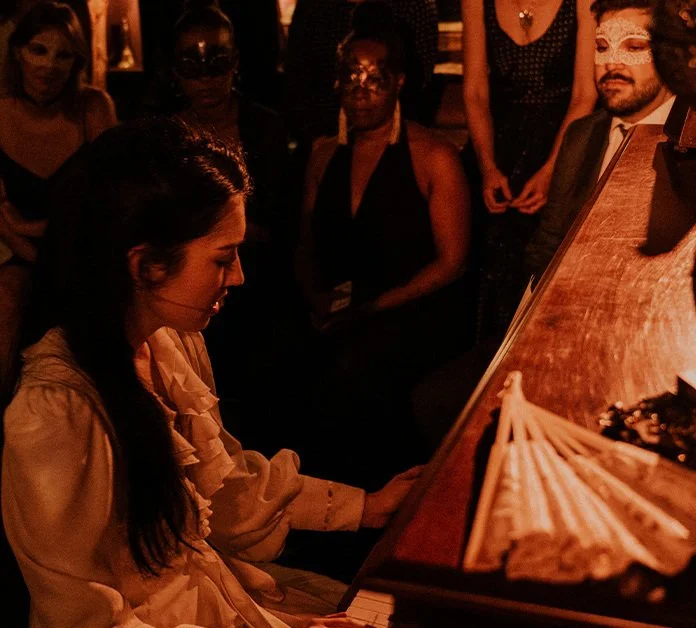
As Christine, Riley Noland is haunted by the Phantom’s “Music of the Night.” Photograph by Andy Henderson. (Banner photograph by Luis Suarez.)
The closing of Bad Cinderella in June 2023 may have ended Andrew Lloyd Webber’s 43-year Broadway streak, but it sparked a radical re-interpretation of his hit shows from the 1980s and ’90s. Last season featured a stripped-down, video-heavy revival of Sunset Boulevard, while a ballroom-inspired Cats: The Jellicle Ball is currently running. Next season, Jamie Lloyd’s pulsing, monochromatic revival of Evita, having triumphed in London, arrives in New York. However, the most transformative reimagining has arrived with Masquerade, an immersive and interactive Off-Broadway production that deconstructs and reconfigures The Phantom of the Opera.
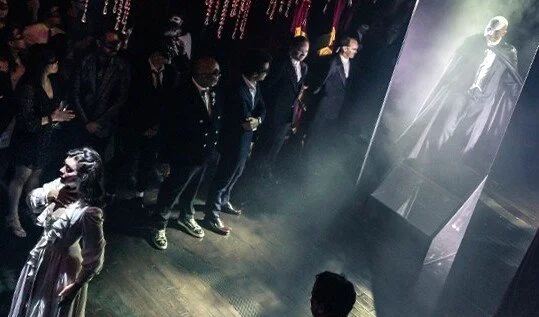
Masquerade offers audiences an intimate view of “the strange affair of the Phantom of the Opera.” Photograph by Matthew Murphy and Evan Zimmerman.
The new Phantom has taken up residence in the old Lee’s Art Shop, a multilevel complex on 57th Street in Manhattan. Groups of 60 audience members enter at six consecutive, 15-minute intervals and are escorted through a veritable funhouse that includes excursions through the anterooms, stage, dressing rooms, and flies of the Paris Opera House, with detours to a carnival sideshow, a mausoleum, and, of course, the Phantom’s subterranean lair.
The mastermind behind Masquerade is Diane Paulus, and seemingly no expense has been spared in capturing the minute details of the 19th-century milieu. (Thankfully, the 20th-century escalators have been retained.) Production and scenic designers James Fluhr and Scott Pask, along with a host of fine-arts collaborators, such as Marina Abramović, Bob Dylan, and Phoenix Ancient Art, have reconstituted the space into a vibrant art installation. Ben Stanton’s lighting, Emilio Sosa’s costumes, and Brett Jarvis’s sound design contribute to the breathtaking spectacle.
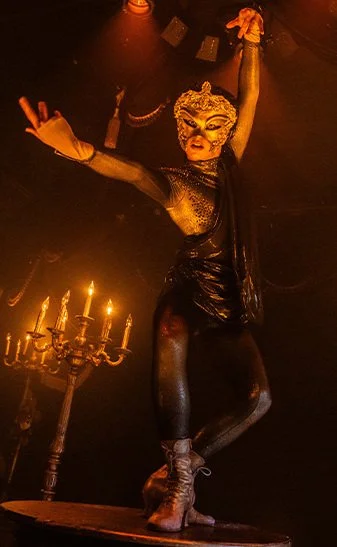
The immersive musical boasts a host of notable production designers, including Nicola Formichetti, who is the Director of Masks. Photograph by Matthew Murphy and Evan Zimmerman.
Spectators familiar with the musical that played on Broadway for 35 years will also find their share of surprises. Most of Lloyd Webber’s songs with lyrics by Charles Hart and Richard Stilgoe are featured—although often in truncated form and with recorded music—but the show’s book (by Lloyd Webber and Stilgoe) has been significantly modified. The basic premise is the same, but the scene order has shifted, and there is an added backstory that is only alluded to in the original.
The specific cast depends on the audience member’s ticketed time, but once inside, the experience begins with an overture performed by a violinist (Nikita Yermak). Next, visitors are welcomed by an official guide, Madame Giry (Georgia Mendes), who leads them through the story of the famed Opera Ghost. After being instructed in a few dance moves, viewers are thrust into the “Masquerade” sequence that formerly opened the second act.
The scene takes place on the stage of the Opera House, where the rehearsals for Hannibal are under way. Within minutes, Christine Daaé (Riley Noland) has replaced the temperamental diva Carlotta (Tia Karaplis) at the ghostly behest of the Phantom (Clay Singer). Christine’s childhood friend Raoul (Francisco Javier González) is in the audience, and their youthful romance rekindles.
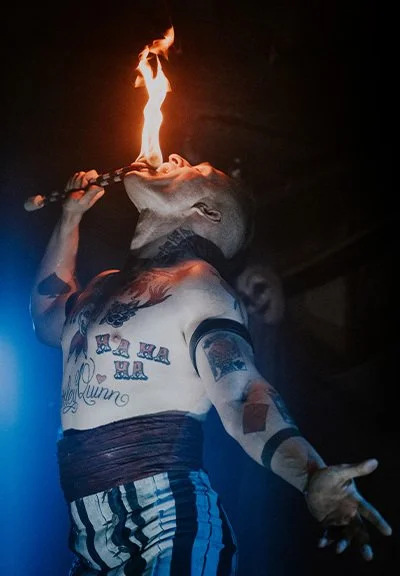
A carnival scene that reveals the Phantom’s backstory features several trick performers, such as Joe Kerr, a fire-eater and pyromancer. Photograph by Luis Suarez.
While the central plot focusing on the Phantom’s catastrophic obsession remains, the musical incorporates flashbacks that depict him as a sideshow freak, an experience that engendered his murderous nature. Lloyd Webber wrote a new song, “Come and Marvel at the Freak,” for this production, and in a tender moment, Giry sings “Learn to Be Lonely,” the Oscar-nominated song from the 2004 film version, to the disfigured boy (Lee H. Alexander). The lyric hints at the life of solitude the Phantom will lead:
Child of the wilderness
Born into emptiness
Learn to be lonely
Learn to find your way in darkness
The revised book and the performances sometimes lean into the 19th-century melodrama conceit nearly to the point of being mawkish, but it doesn’t really matter. The presentation is utterly beguiling, and the expert choreography of both the actors and audiences (with the assistance from a legion of seen and unseen handlers) through the building boggles the mind.
All the actors do fine work, and they interact effectively with the audience. As Christine, Nolan has a crystalline soprano voice and beautifully conveys the young woman’s suppressed sensuousness. Singer’s Phantom is compelling and sexy, and vocally, he is thrilling.
Like Sleep No More, the promenade-theater hit that ran for almost 14 years downtown at the McKittrick Hotel, Masquerade is likely to become a New York staple. The show will attract repeat viewers for sure, but it’s a special thrill to see the clockwork timing, intricate machinations, and the sheer audacity of the execution.
The recipient of a special Drama Desk award, Masquerade (playing at 218 West 57th St.) is currently booking through Sept. 27, 2026. The production features six staggered “pulses,” or entry times, with multiple casts, every 15 minutes beginning at 7 p.m., Tuesday through Sunday; matinee cycles begin at 1 p.m. on Saturdays and Sundays. For tickets and more information, visit masqueradenyc.com/.
Original Book: Richard Stilgoe & Andrew Lloyd Webber
Music: Andrew Lloyd Webber
Lyrics: Charles Hart & Richard Stilgoe
Creator & Director: Diane Paulus
Choreography: Sidi Larbi Cherkaoui
Production & Scenic Design: James Fluhr & Scott Pask
Costume Design: Emilio Sosa
Lighting Design: Ben Stanton
Sound Design: Brett Jarvis
