
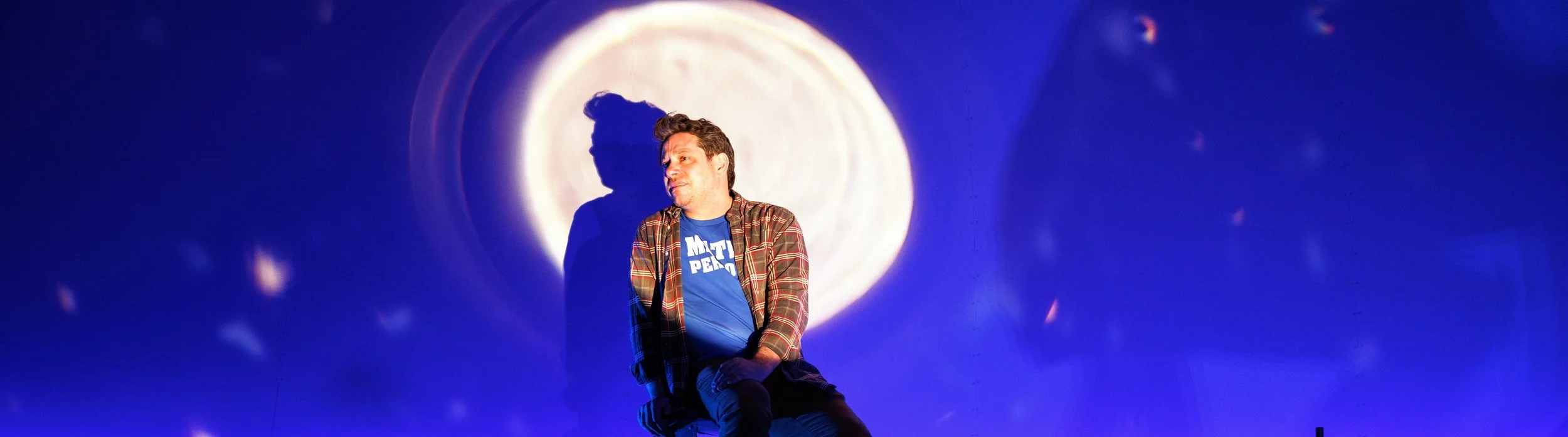

Writer and performer Jared Mezzocchi traces his mother’s hidden connections to NASA in his solo work 73 Seconds.
Some plays tell stories; 73 Seconds excavates silences. In this haunting and ambitious solo work, writer and performer Jared Mezzocchi traces his mother Rosemary’s hidden connection to NASA to explore the fragile constellations of family memory, loss, and unrealized possibility. Sensitively staged by director Aya Ogawa inside the 64-seat planetarium at the Lower Eastside Girls Club, Mezzocchi’s autobiographical narrative is structured in three movements.
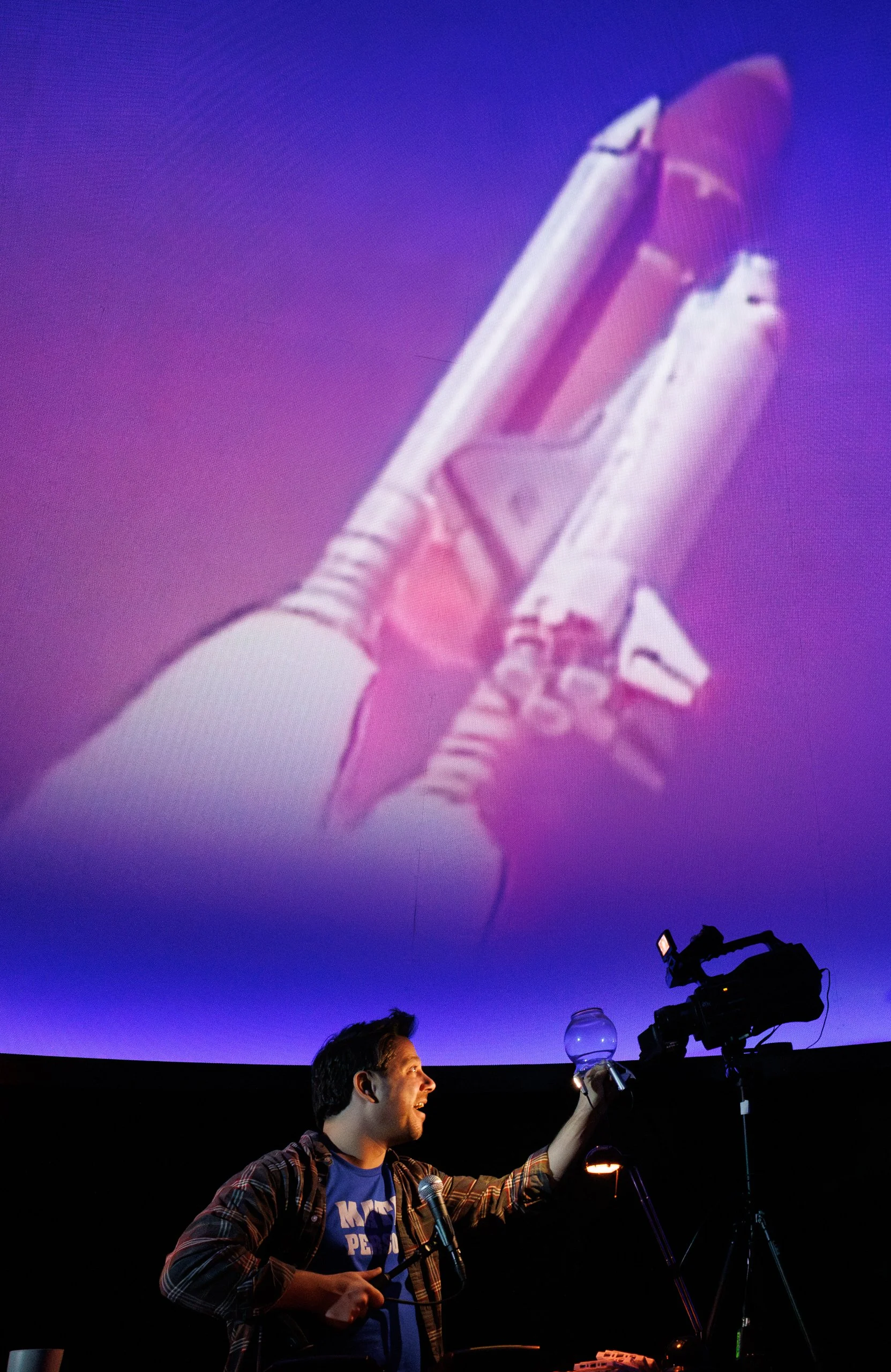
At the outset of his autobiographical play, Mezzocchi talks about growing up in New Hampshire and loving outer space and star-gazing from the family’s flat-roofed barn.
The first begins during a celebration of his high school graduation at a rustic steakhouse where, beneath the restaurant’s lone photograph of astronauts, he learns a startling family secret: his mother, Rosemary, an accomplished junior high school algebra teacher, once worked for NASA and had been vetted for its Teacher in Space program. She ultimately withdrew from consideration after becoming pregnant with him, while teacher Christa McAuliffe went on to join the crew of the ill-fated space shuttle Challenger. The revelation reframes Mezzocchi’s understanding of his mother, transforming her from an ordinary parent into someone whose life once brushed against history. (“But as I sit and eat steak, I’m looking at my mom as if she’s morphing into this real-life superhero.”)
The work then pivots from cosmic possibility to intimate loss. While attending college in Connecticut, Mezzocchi learns that his father has suffered a fatal brain aneurysm, though his mother initially conceals the severity of the situation by repeatedly assuring him that his father is “in the same condition.” Sensing something is terribly wrong, he rushes to the hospital in New Hampshire, only to discover the truth upon arrival. The production’s final movement is perhaps its most devastating: Mezzocchi’s mother, now remarried, is suffering from Alzheimer’s disease. During a visit with his girlfriend, he witnesses his mother spiral into a meltdown over a card game while her second husband struggles to manage the situation and she herself remains in denial about her condition.
These three autobiographical episodes form the emotional trajectory of the play while also revealing a painful pattern: Rosemary repeatedly withholds crucial information about herself and important family matters, rendering her strangely unknowable to her only son. The final section, centered on her Alzheimer’s diagnosis, proves the most emotionally wrenching, as Mezzocchi finds himself mourning a mother who is still physically present but gradually slipping away psychologically. The anguish of that liminal state is distilled in one of the production’s most affecting lines: “What am I doing, memorializing someone who’s still alive?”
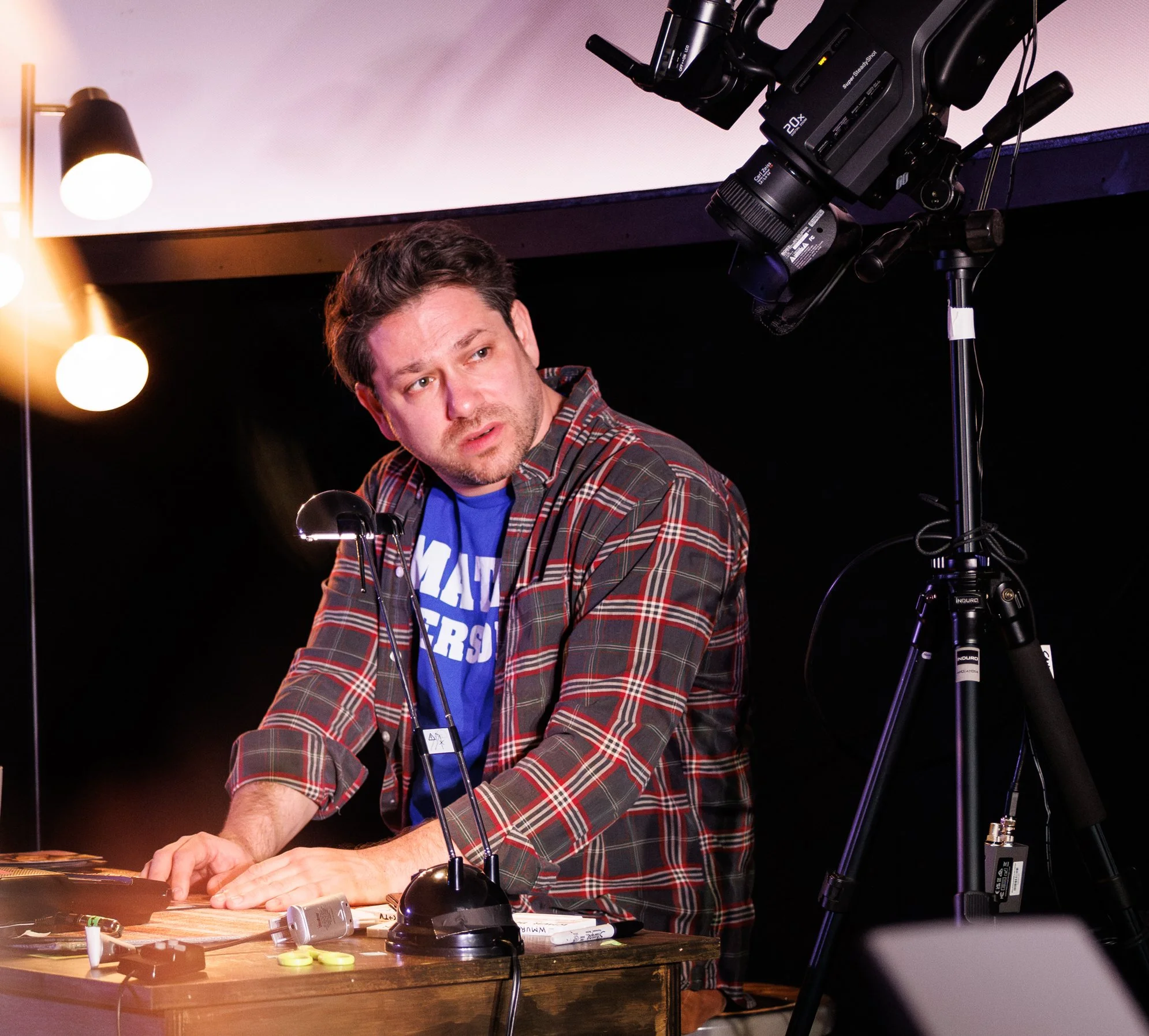
A multimedia theatermaker, Mezzocchi tells his autobiographical stories in 73 Seconds by blending theater and recorded film, live-mixing feeds, and 1980s technology. Photographs by Maria Baranova.
What works especially well in 73 Seconds is the way dramatic tension steadily builds as Mezzocchi unfolds his story. He comes to see himself, paradoxically, as both the antagonist—having derailed his mother’s space-bound ambitions by virtue of his birth—and the inadvertent protagonist, since that same circumstance may have ultimately saved her life from the fate that befell the Challenger crew. The play’s title is a direct nod to the shuttle’s catastrophic explosion just 73 seconds after liftoff, a tragedy that claimed all seven astronauts and transforms Mezzocchi’s own existence into a source of both guilt and fragile gratitude.
In a program note, Mezzocchi describes 73 Seconds as the latest installment in a trilogy of autobiographical works: The One Stoplight in Hollis, created after his father’s death; On the Beauty of Loss, developed during the pandemic following the loss of his grandfather; and now 73 Seconds, shaped by his mother’s aging and his own growing awareness of mortality. Best known for his career as a multimedia artist and director in notable Off-Broadway productions such as Vietgone and Russian Troll Farm, Mezzocchi brings considerable technical sophistication to his work. There is little question that his multimedia artistry remains a major asset here.
Mezzochi inventively uses high- and low-tech media—overhead projectors, family photographs on plastic slides, archival footage, and live-mixed camera feeds—to give the production both intimacy and visual texture. Yet one may still question whether Mezzocchi made the right choice in performing the piece himself. While he is an engaging storyteller, he appears less assured as an actor, particularly in moments that require him to shift rapidly between his own perspective and his mother’s. At times, greater emotional restraint might have better served the material, allowing the audience more space to absorb its emotional weight without being overly guided toward it.
Still, 73 Seconds remains worth seeing for its immersive experience alone. Staged inside the planetarium at the Lower Eastside Girls Club, the production places audiences beneath a shimmering replica of the Milky Way, creating an evocative setting for Mezzocchi’s memoir-play about memory, loss, and the emotional distances within families.
73 Seconds plays through May 18 at the Lower Eastside Girls Club (402 East 8th St.). Evening performances are at 7:30 p.m. Monday, Thursday, Friday, Saturday, and Sunday; matinees are at 3 p.m. Saturday and Sunday. For tickets and more information, visit engardearts.org.
Playwright: Jared Mezzocchi
Director: Aya Ogawa
Sound Design: Ryan Gamblin
