
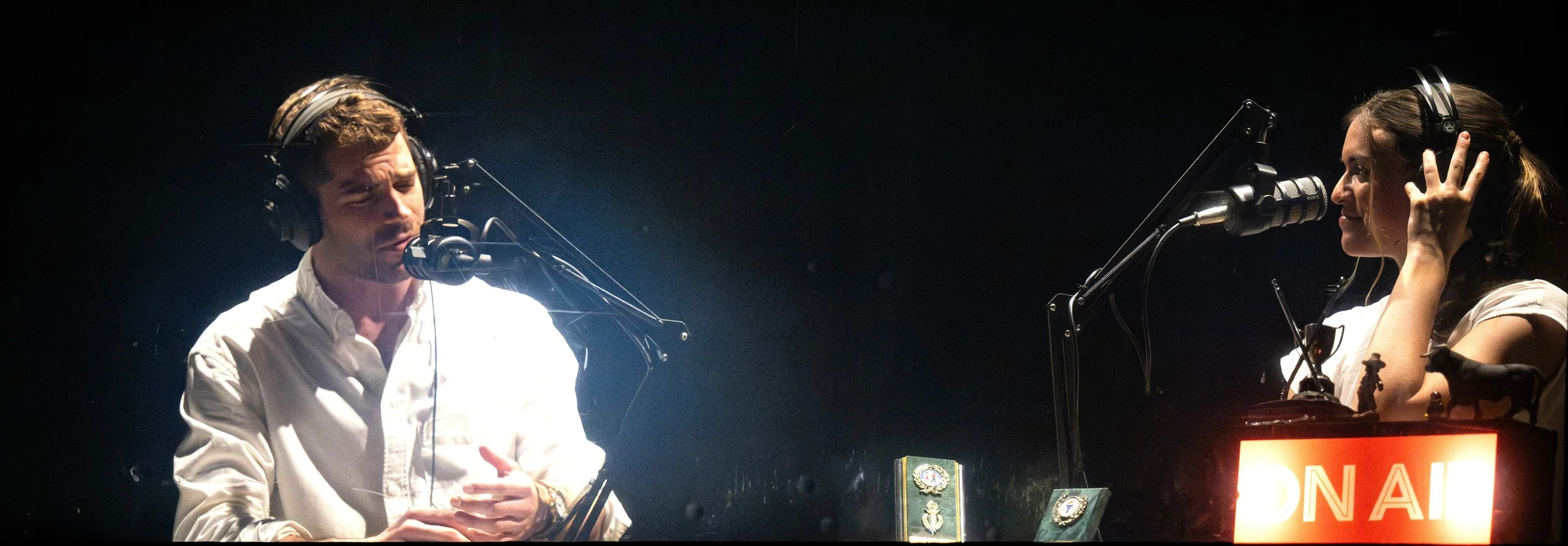
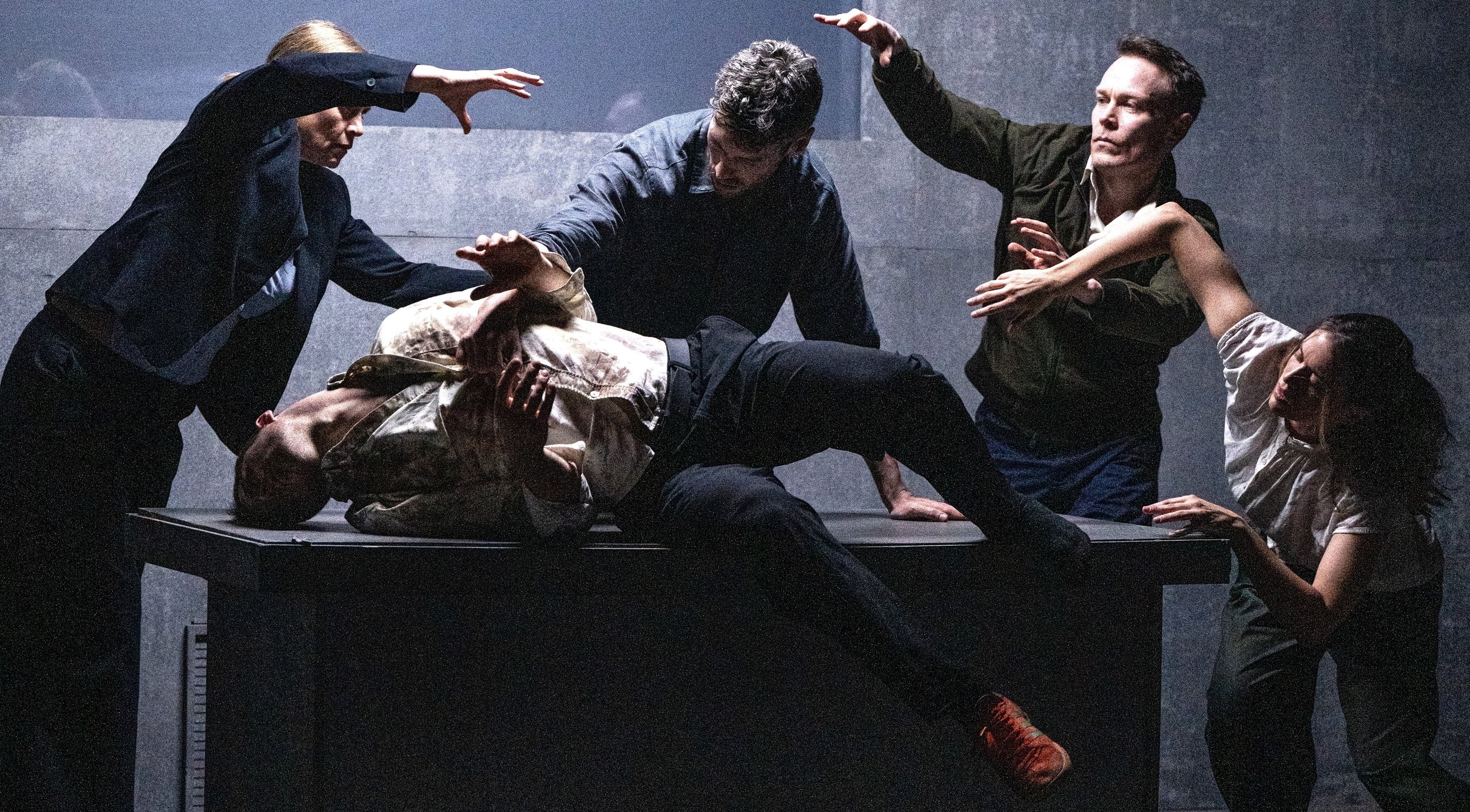
William Dean (Will Thompson, lying on table) appears throughout the play as both living and dead, while the cast of Scorched Earth (from left: Sarah Dowling, Luke Murphy, Ryan O’Neil and Tyler Carney-Faleatua) reveals the circumstances of his death through dance and narration.
Scorched Earth, a dance theater piece created, directed and choreographed by Luke Murphy, asks, “What does it take to be of a place?” At the center of the play is the tension between William Dean (Will Thompson), a confident new arrival in a rural Irish community, and John McKay (Luke Murphy), a local tenant who lives on land that is up for auction. The work digs into territorialism and the violence that can occur over land disputes.
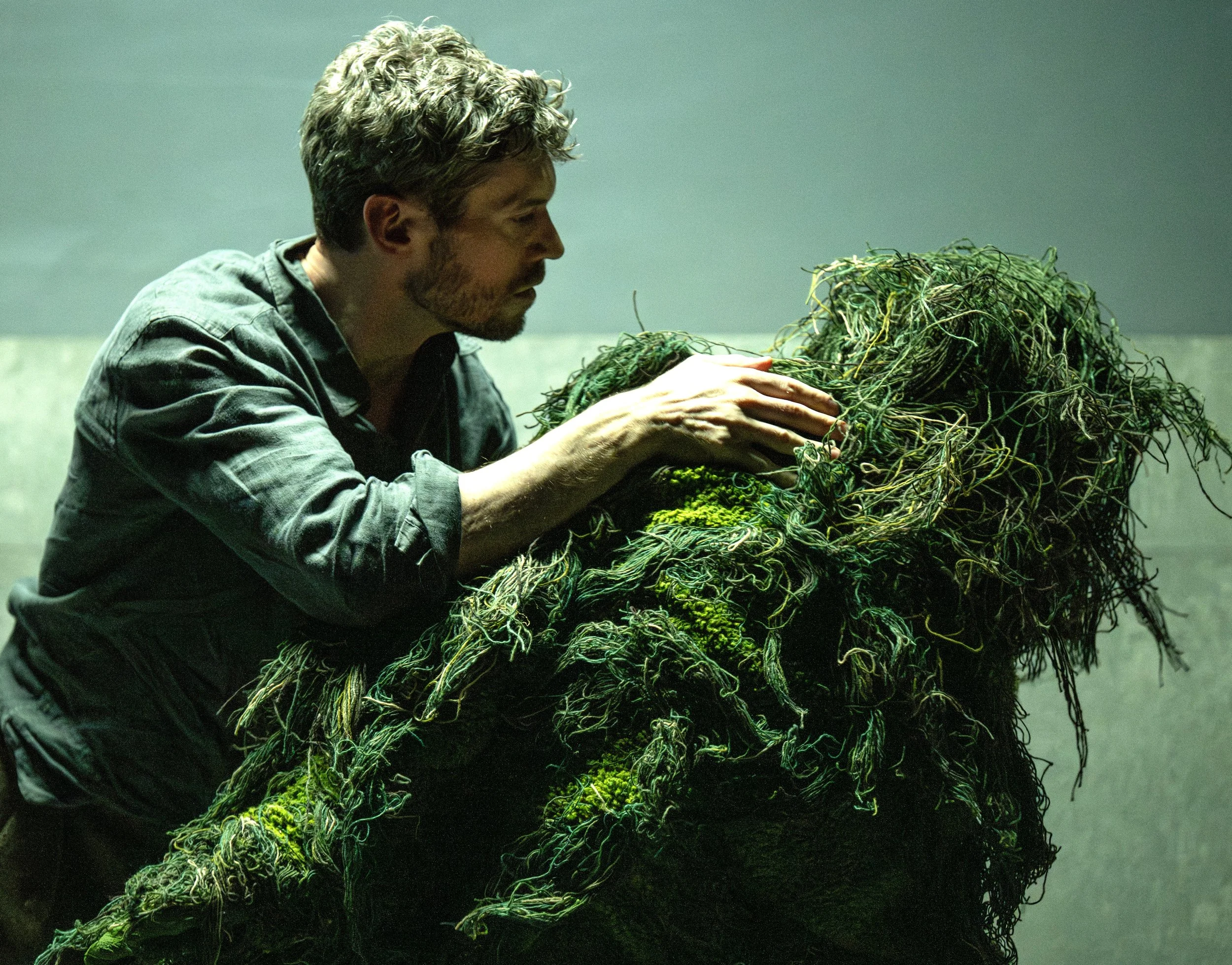
McKay, who is intimately tied to the land he has cultivated as a tenant, dances with a grassy figure (Carney-Faleatua). Photographs by Teddy Wolff.
Told like a true-crime story, Scorched Earth unfolds through narrative, projected images from a slide carousel, and dance. Time moves between past and present. The piece opens with an abstract dance that fades into a pub scene, capturing a little glimmer of life in a small Irish town, where people meet to drink, line-dance, and share local events and news. One of the announcements is that John O’Donnell’s donkey is missing.
The presence of newcomer Dean is first met with excitement. In an interview with talk-show host Leanne Meany (Tyler Carney-Faleatua), she introduces him as “landlord, entrepreneur, budding mogul—am I leaving anything out?”
Dean: I like to think of this as coming home, so maybe prodigal son?
Presenter: Well, we’re thrilled to have you in William. I know everyone’s just waiting to hear your story.
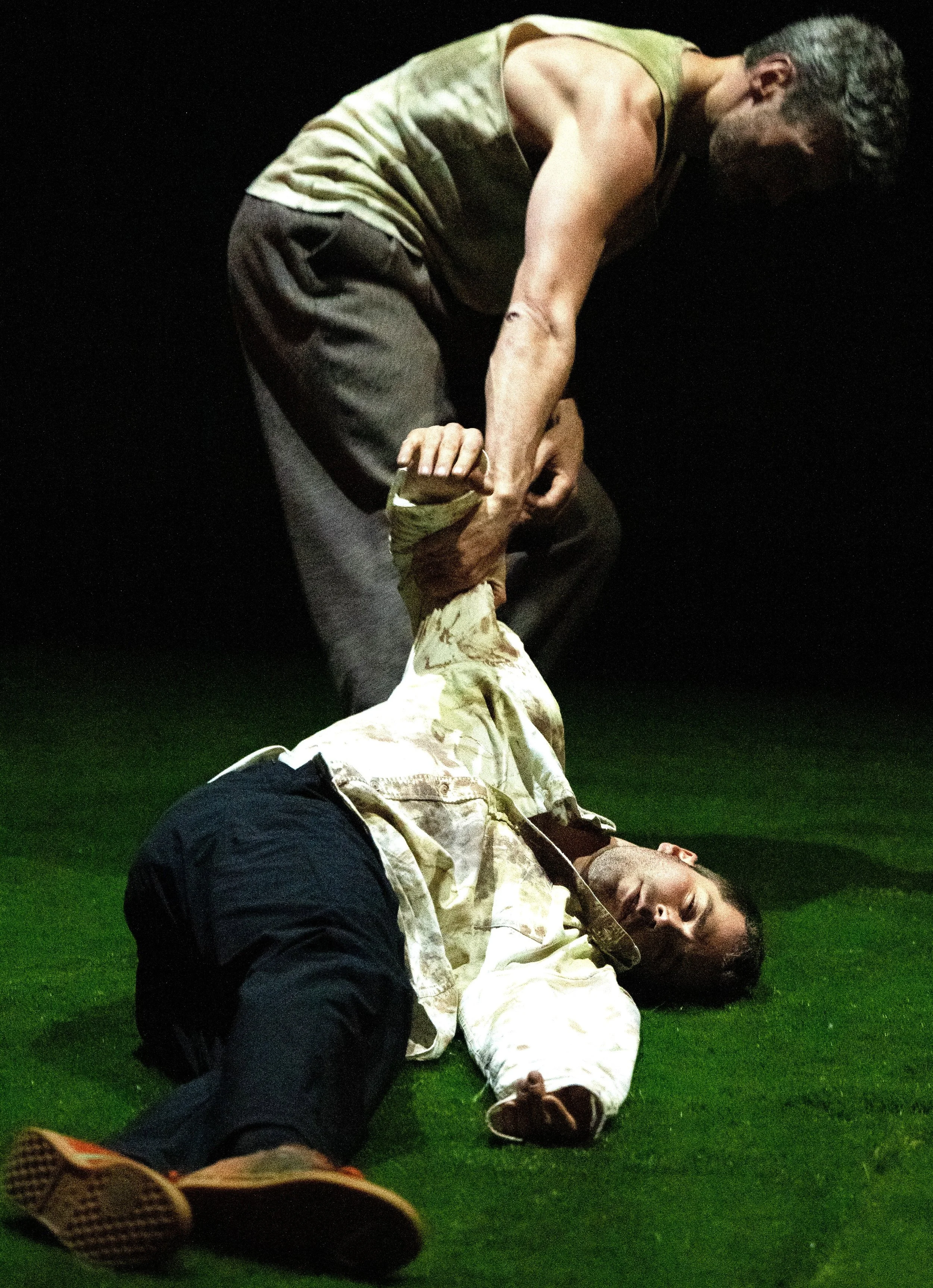
McKay drags Dean through the grass after Dean is found slain.
When Dean outbids McKay for the land, the loss is a big blow, and McKay drowns his sorrows at the pub. That evening, Dean is found dead on the auctioned property. Physically, the tall and angular Murphy towers over the compact Thompson, further emphasizing the tension between the characters, especially in a duet with Dean as a dead man. The dance does not confirm that McKay is culpable, but it hints at foul play.
Murphy’s choreography has a slippery quality that makes the movement appear improvisational in its absence of codified dance movement. However, the dance sections are clearly tightly choreographed for the five cast members (all trained dancers), who are phenomenal movers, to be able to work the continual and rigorous push-pull and shifting weight changes so gracefully.
Ten years after Dean’s death, Detective Alison Kerr (Sarah Dowling, who plays the part with a prim tenacity) wants to solve the cold case, and McKay becomes the prime suspect.
The play is punctuated by several interviews between Kerr and McKay. In one, McKay explains: “It was a waste when I found it. ... But I could see what it could be. Full of gorse and half stone … The incline was too steep, the growth too far gone. But I could see it, what it could be.”
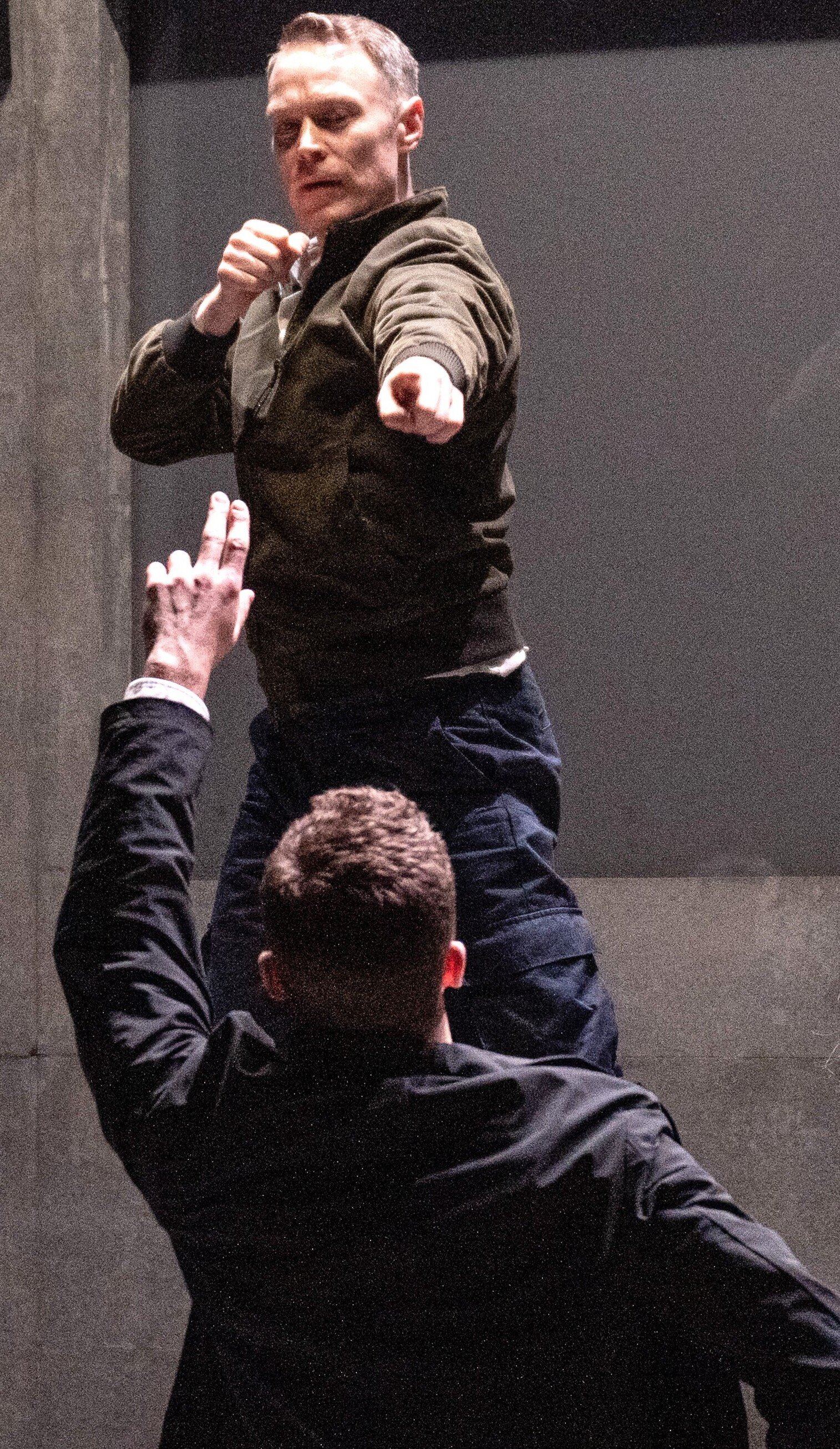
Sgt. Leahy (O’Neil) towers over Dean as he tries to illustrate a point.
Kerr: Did you love it?
McKay: Something like that.
Kerr: Or just desire it?
McKay: Is there a difference?
Kerr: One’s about giving, the others about taking.
McKay: Well then, love it is.
To convey the intimacy McKay has with the land, the interrogation morphs into a duet with a grassy, Sasquatch-type creature (Carney-Faleatua). As McKay explains how he refurbished the soil by cutting away at it and scorching it so it could be revived, he dances with the creature who twirls him and swallows him up in its grassy arms, only for him to emerge and lie on top of it.
Kerr reaches out to Sgt. Leahy (Ryan O’Neil) to find out more details. In a recorded conversation that is acted out onstage, Kerr asks Leahy why he didn’t continue the investigation:
Leahy: I didn’t know him. He wasn’t from here.
Kerr: He would have argued differently.
Leahy: He might have said he was, but he wasn’t, not really.
Kerr: What does it take to be from somewhere?
The rural Irish landscape laid out is brooding and dark. Throughout, a dancer in a donkey mask appears on the periphery, like a creature conjured by a shaman. Moody lighting (Stephen Dodd) and a stage painted in shades of gray emphasize a sense of desolation. Alyson Cummins’s simple set has many surprises: performers turn a door into a telephone booth, a bar into an interrogation room and, at one point, the set is dismantled by the dancers to reveal an emerald-green hill peppered with rocks which dancers climb up on and roll down. A soundtrack (Rob Moloney) filtering songs such as The Chain by Fleetwood Mac and Wayfaring Stranger, a traditional American folk song, through an ethereal lens extends the ominous feeling.
In the end, there is a small blip of humor when O’Donnell’s donkey is finally found. It seems all will be right, now that the donkey has returned to its rightful place.
Scorched Earth plays through April 19 at St. Ann’s Warehouse (45 Water St., Brooklyn). Evening performances are at 7:30 p.m. Tuesday through Saturday and at 5 p.m. Sunday; matinees are at 2 p.m. Saturdays. For tickets and more information, visit stannswarehouse.org.
Playwright, Director, & Choreographer: Luke Murphy
Set & Costume Design: Alyson Cummins
Lighting Design: Stephen Dodd
Composition & Sound Design: Rob Moloney
