
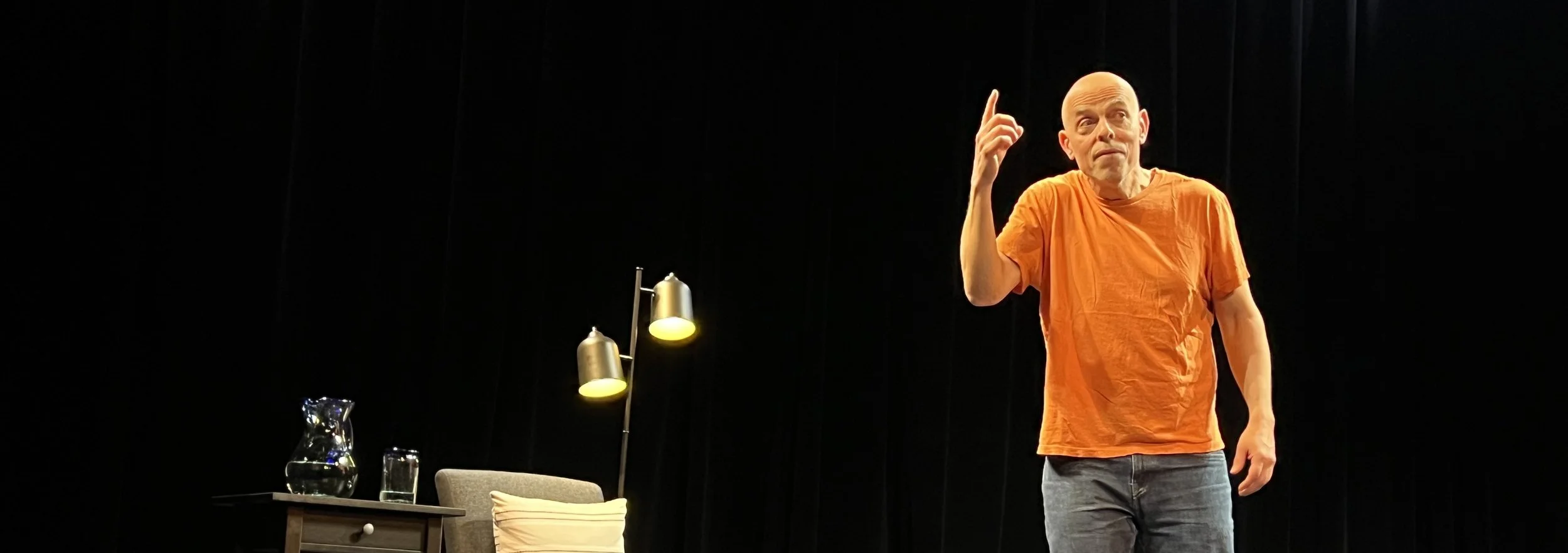
Performer-playwright Alex Koltchak grapples with the question of why his oldest child, Parker, died by suicide in his solo play, Bent Through Glass.
Bent Through Glass, written and performed by Alex Koltchak, transforms unimaginable loss into a work of emotional clarity, as a grieving father traces the aftershocks of his daughter’s suicide with unflinching honesty. Under the sensitive direction of Michael Sladek, this deeply personal solo piece becomes not only a testament to anguish, but a quietly radiant affirmation of love’s endurance, shaped by Koltchak’s willingness to bare his soul.
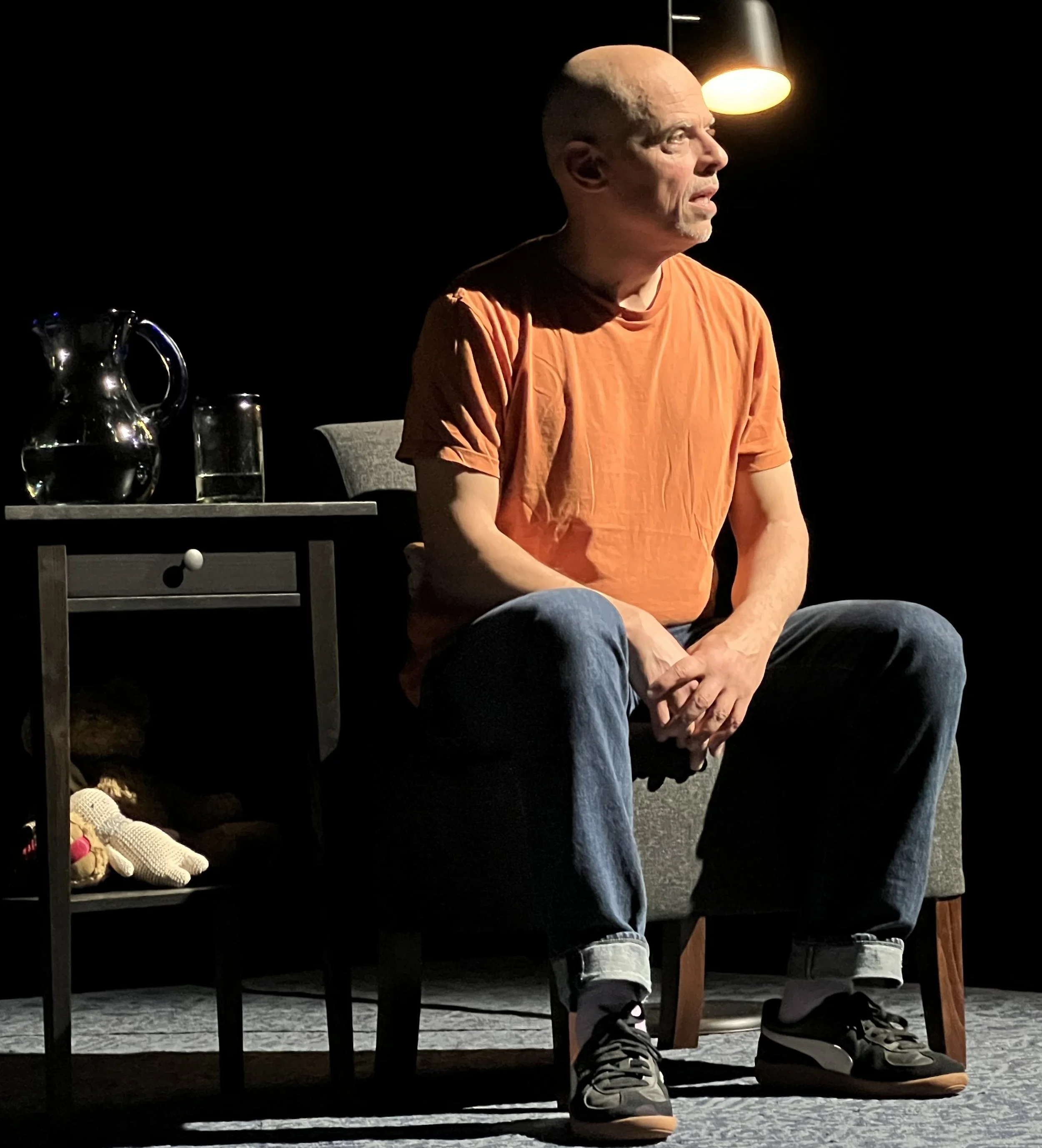
The playing space greets the audience in near-bare stillness: at center stage, an armless chair with a white cushion sits beside a floor lamp and a double-shelved table, its top lined with glass bottles and its lower tier dotted with stuffed animals. Resting on a rectangular Persian rug, these objects suggest the outline of domestic warmth while withholding any real sense of comfort—a visual echo of absence.

Drawing on his background as an actor and comedian, Koltchak finds ingenious ways to render his daughter present through memory, animating her not as an absence but as a vivid force within the performance.
Koltchak enters in a T-shirt, jeans, and sneakers and faces the audience with a steadiness that belies the weight of what follows. He opens with candor—a warning that “it’s about to get sad” while assuring listeners that he and his family are coping—before delivering the devastating fact of his daughter’s death by suicide on Nov. 10, 2017, a moment that lands with unadorned force.
Although nine years have passed, it is clear that Koltchak is still grappling with the question of why his oldest daughter, Parker, died by suicide. Over the next 75 minutes, he emerges not as a man in search of neat answers, but as a restless wanderer moving through memory’s dim corridors—part investigator, part captive—circling the domestic penumbra his loss has cast.
Koltchak is hardly the first playwright to grapple with suicide, nor is Bent Through Glass the only work on New York stages to confront its aftermath. On Broadway Every Brilliant Thing, by Duncan Macmillan and Jonny Donahoe, traces a son’s attempt to make sense of his mother’s self-inflicted death, while Arthur Miller’s Death of a Salesman lingers over Willy Loman’s end, and, although the 2024 Broadway revival of Marsha Norman’s 1983 Pulitzer Prize–winning ’night, Mother has closed, it offers perhaps the theater’s starkest portrait of self-annihilation. What distinguishes Koltchak’s work is not simply its subject, but its authorship: this is not a story he interprets, but one he has lived, and his performance carries the weight of that experience.
Koltchak finds ingenious ways to render his daughter present through memory, animating her not as an absence but as a vivid force within the performance. He recalls the overwhelming love at her birth and the delight of watching her take those first unsteady steps—“arms up like a little orangutan,” he notes, with disarming tenderness.

In Bent Through Glass, Koltchak demonstrates his stubborn will to keep showing up for the living while honoring the dead. Photographs by Paul Siebold.
Most movingly, he enshrines her artistry in the production: the program cover features her sketch of a radiant young woman in quiet meditation, an image holding both serenity and ache. Parker, he tells us, was a gifted visual artist who had just stepped onto the stage in a high school production of Almost Maine at Oldfields Academy in Maryland a week before her death. And though he acknowledges the paternal impulse to boast, Koltchak’s pride lands with conviction as he reflects that he knows “natural talent when I see it,” and that she was transcendent.
In the wake of these recollections, Koltchak does not shield himself—or the audience—from the aftermath of Parker’s death. He describes himself as “a divorced father of three who’s lost a daughter to suicide,” a man who felt like a failed husband and parent, “totally exposed and free falling.” Deb, his ex-wife, comes into sharper focus when, 10 months later, their younger daughter Rory overdoses on her mother’s Wellbutrin, a crisis that leads to the emergency room and Bellevue. When Koltchak asks what drove Rory to such a brink, Deb’s response lands with devastating clarity: all she wanted was to be with her sister.
Chastened by experience, Koltchak helps Rory reclaim agency by placing her in a mental-health facility in Newport, R.I., Deb found a specialized school and treatment center in Utah for at-risk kids. Meanwhile, their son Hudson—reduced to one-word replies—begins to reconnect, as father and son discover a shared solace in trips to Yankee Stadium.
In Bent Through Glass, Koltchak shapes private grief into an act of communal witness, refusing easy catharsis in favor of hard-earned honesty. What lingers is not only the magnitude of loss, but the fragile, persistent gestures of care that follow it—the stubborn will to keep showing up for the living while honoring the dead. It is, ultimately, a work of quiet courage, one that asks its audience not simply to observe, but to reckon and to remember.
Bent Through Glass plays through April 25 at 30th Street Theater (259 W. 30th St.). Evening performances are at 7 p.m. Monday through Saturday. For tickets and more information, visit bentthroughglass.com.
Playwright: Alex Koltchak
Director: Michael Sladek
Lighting Design: Paul Jonathan Davis
