
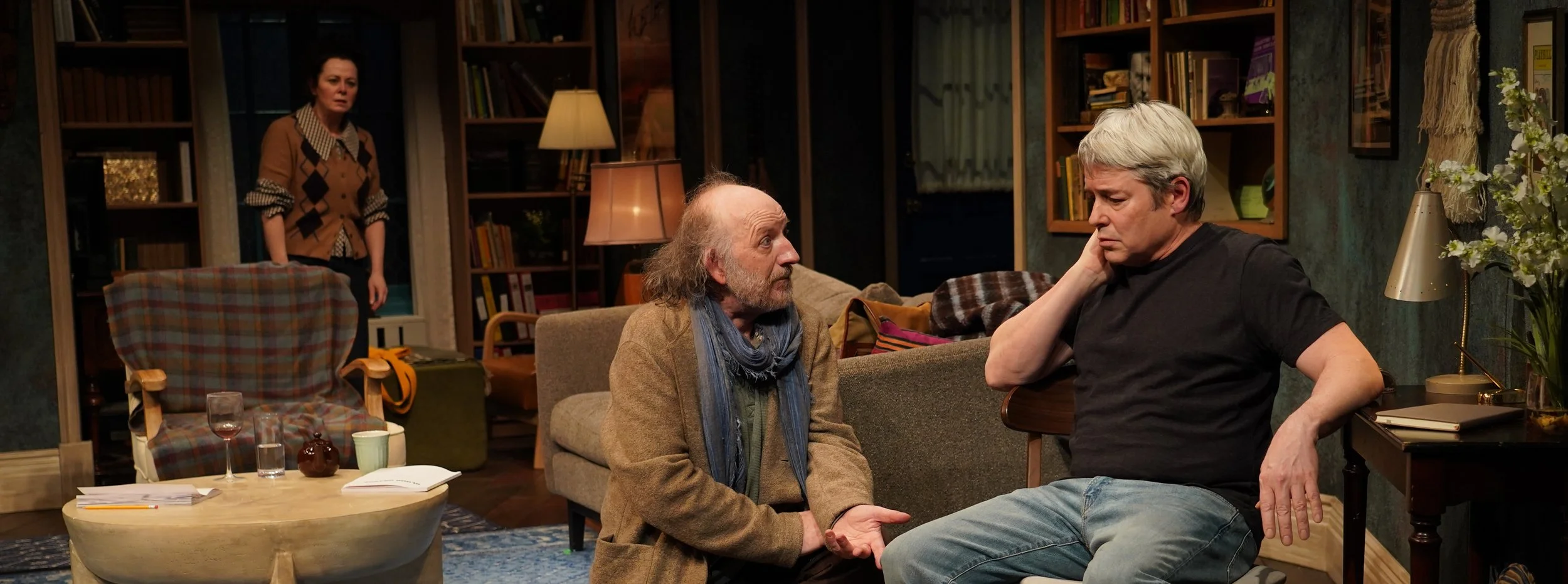
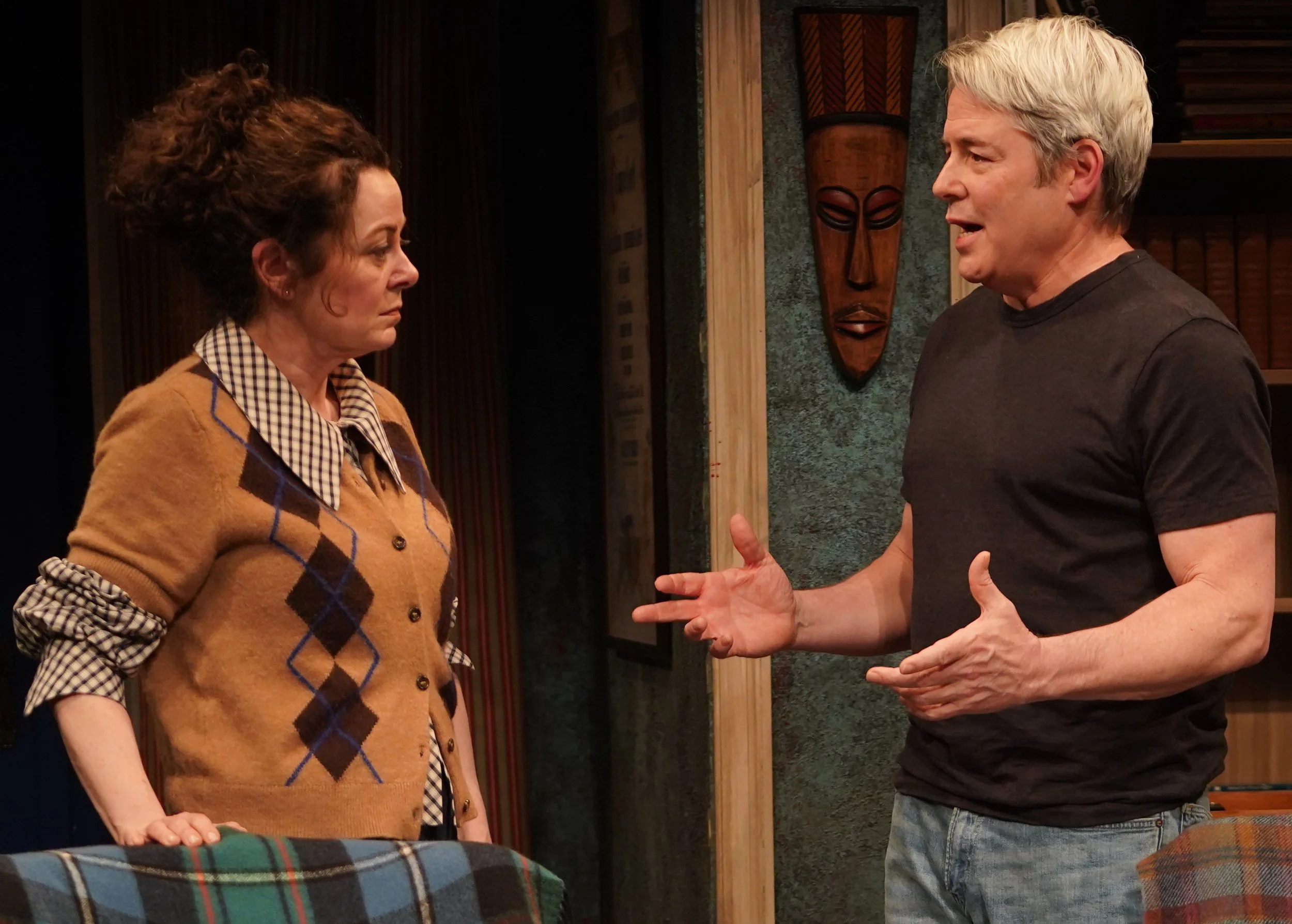
Ruth Davenport (Geraldine Hughes, left) is a British-identifying playwright from Belfast who is having trouble explaining her play about the Troubles to American Hollywood star Jay Conway (Matthew Broderick) in David Ireland’s Ulster American.
Ulster American, David Ireland’s reworking of his 2016 play, wants to shock from the moment it begins, with two ostensibly progressive white men discussing whether it’s acceptable for white people to reclaim the N-word as their own. The play seems to position itself as a no-holds-barred satire, steeped in the cynicism of David Mamet and Martin McDonagh. But what exactly is being satirized and to what end? A rare miss for the Irish Rep and for the great Ciarán O’Reilly, who directs, Ulster American never moves past the surface of its faux-bad-boy persona; it’s a satire too lazy to be satirical and with humor too juvenile to actually offend.
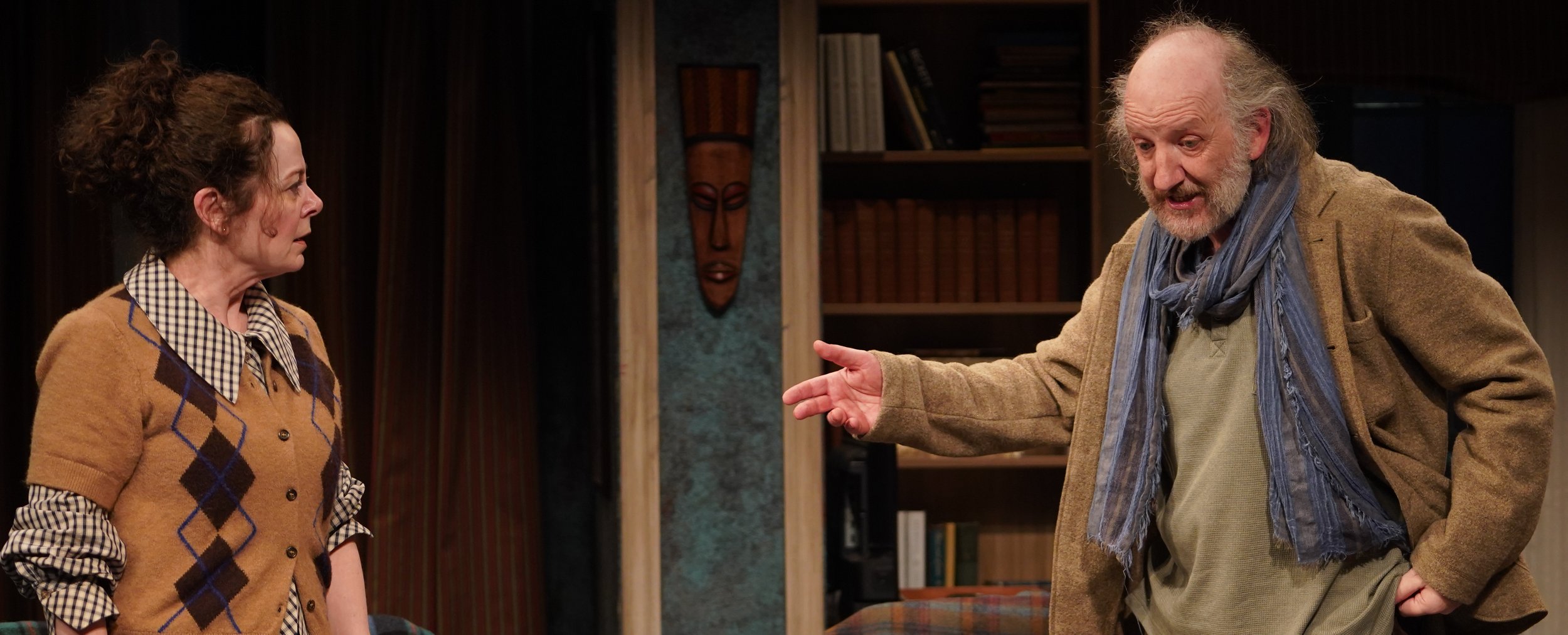
Among other things, Davenport and the play’s English director, Leigh Carver (Max Baker), disagree on what it means to be Irish.
The play opens with English theater director Leigh Carver (Max Baker) and American Hollywood star Jay Conway (Matthew Broderick) meeting in Carver’s London apartment the night before they begin rehearsals for a new play by Belfast-based playwright Ruth Davenport (Geraldine Hughes), who is running late for the meeting. Rather than discussing Davenport’s play, which both men compliment in vague terms, Conway seems intent, despite his self-avowed respect for women and Carver’s own status as a self-declared feminist, on discussing rape.
Drawing from an improbable scenario from one of his films, he becomes insistent on the question of whom the men would rape if they “had to” rape someone. For Conway, the answer is Princess Diana: “If you raped Diana, it would have given her a deeper sympathy with the victims of sexual assault.” Carver initially resists answering, condemning the question, but eventually concedes he would rape Margaret Thatcher because she was so destructive to British society.
“Tension escalates into fights over the play, identity, and politics.”
This is one of several outrageous conversations the men have while waiting for Ruth, but it becomes central to the play’s denouement. Conway is also quite fond of discussing his genitals, and never misses an opportunity to invoke transgender people: “Am I trans? Well, I love my dick, so no.”
The play threatens to become interesting when Davenport finally arrives, late because of an accident on the way to the airport. It turns out that, despite what the condescending Carver says, Davenport does not consider herself Irish, but rather British; that Carver keeps insisting otherwise shows his own covert imperialism. All of this is very confusing to Conway, who assumed he was doing not only an Irish play but one aligned with his own Irish Catholicism. The questions and complexities of cultural identity are rich but ultimately squandered.
Davenport’s description of her own identity echoes the author’s in a program note, where Ireland describes himself as having grown up in Belfast as a Protestant and “unflinchingly loyal to the British crown,” and still identifying as British. Davenport speaks casually of murdering Irish Catholic civilians, and it turns out her play is, essentially, Unionist propaganda. That the historically ignorant Conway, who doesn’t know what Ulster is and thinks Fenians (Irish Catholic nationalists) are Protestant (there is a helpful glossary to ensure that audience members don’t make the same mistakes), would so radically misinterpret Davenport’s play makes sense, but it stretches belief that Carver, who hopes to become the director of the National Theatre, would as well.
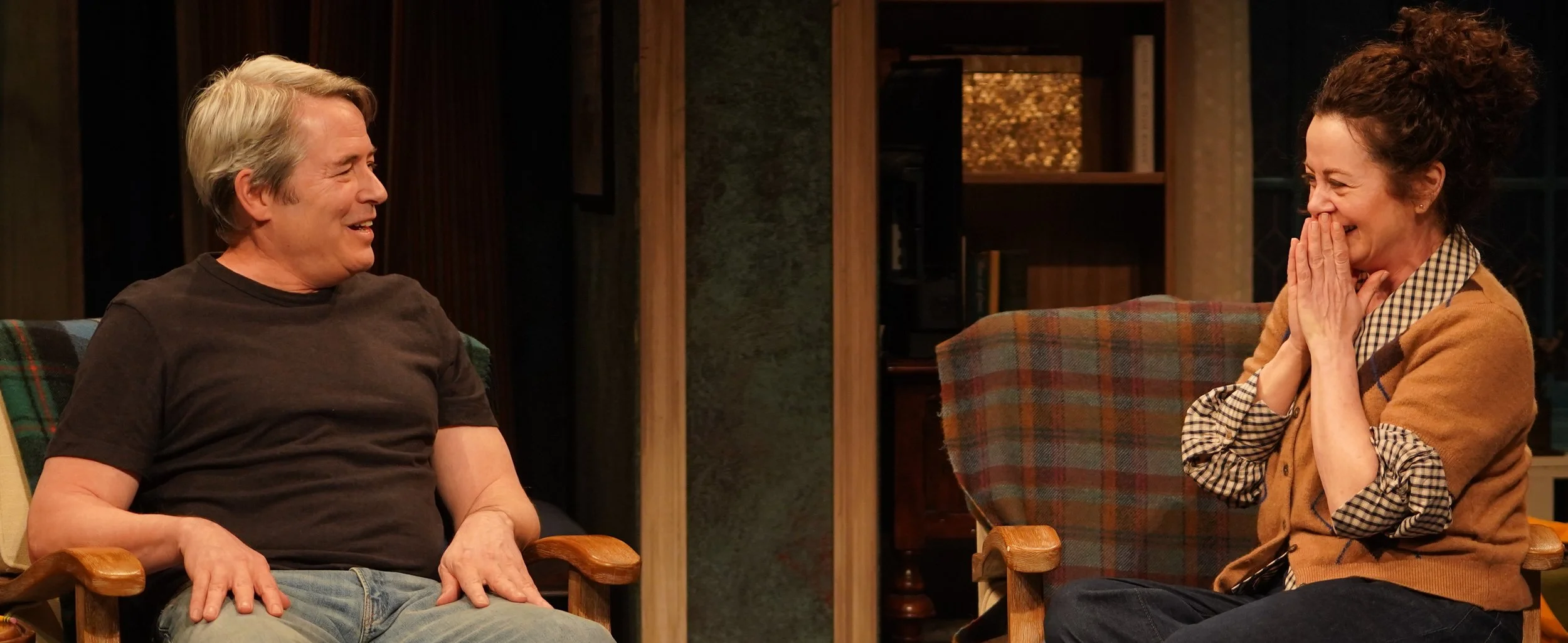
At first Davenport is starstruck by the Oscar-winning Conway. Photographs by Carol Rosegg.
Tension escalates into fights over the play, identity, and politics—Davenport turns out to be a pro-Thatcher, pro-Brexit conservative who seems to be there to enact revenge on the poseur liberals. (The focus on the Brexit referendum as though it has just happened betrays the play’s 2016 roots.) Every twist and turn can be seen coming from a mile away, including the one toward gory violence, which arrives without dramatic effect.
None of these shortcomings belong to the actors, who all heighten the humor with their skill and timing and have fun with some of the genuinely funny moments, including Conway’s insistence that his character should wear an eyepatch. Charlie Corcoran designs one of his customarily detailed and on-point sets, and Orla Long’s costumes, including a slightly too weird jacket and hat for the Hollywood darling Conway, are also precisely calibrated.
Ireland notes that after his play Cyprus Avenue he was celebrated as an enfant terrible. Indeed, Ulster American feels like a writer straining to live up to that label. No doubt any criticism will be dismissed as simply showing that people are in thrall to political correctness. What offends about the play, though, is the lack of wit or depth and the easy nihilism.
One amusing sequence in the play divulges the characters’ attitudes toward theater critics. This escalates from disregard to outright hostility: “Only thing I ever want to read from a theater critic is a suicide note,” Conway says. Now that’s a funny line.
David Ireland’s Ulster American runs through May 10 at the Irish Repertory Theatre (132 W. 22nd St.). Evening performances are 7 p.m. Tuesday through Saturday; matinees are 2 p.m. Wednesday and Saturday and 3 p.m. Sunday. For tickets, visit irishrep.org.
Playwright: David Ireland
Director: Ciarán O’Reilly
Scenic Design: Charlie Corcoran
Costume Design: Orla Long
Lighting Design: Michael Gottlieb
Sound Design: Florian Staab
Sound Design & Original Music: Ryan Rumery
