

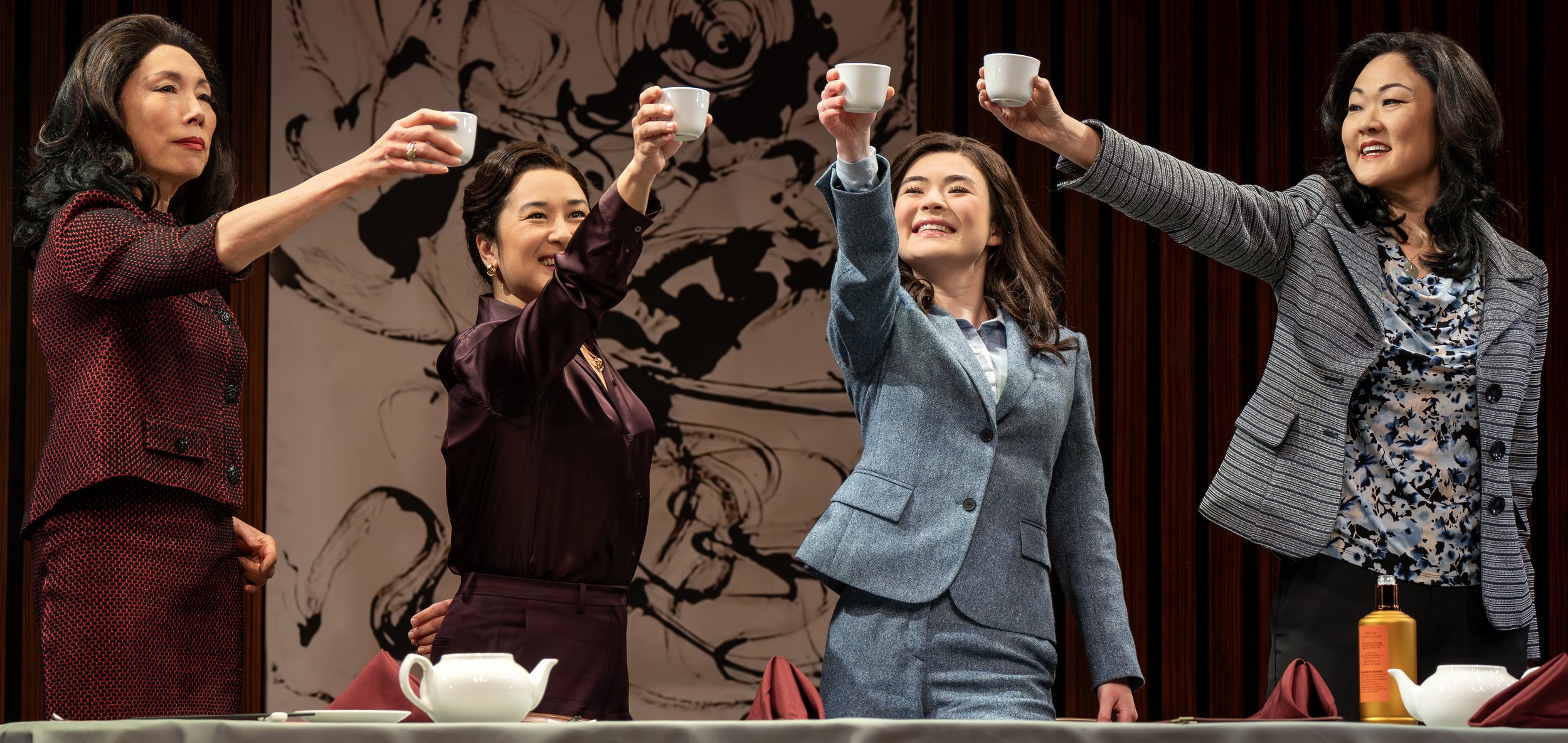
Phyllis (Jodi Long), Ellen (Jennifer Ikeda), Katie (Anna Zavelson) and Iris (Jully Lee) toast a promotion in Alex Lin’s Chinese Republicans.
Four employees of investment bank Friedman Wallace gather for an “affinity group” meeting. Their affinity? They are women of Chinese descent. Yet Alex Lin chose to name her new play Chinese Republicans. Consider it the first sign of dissonance in Lin’s ineffectual script.
The group members are Ellen Chung (Jennifer Ikeda), middle-aged managing director for South American trading; Phyllis Ong (Jodi Long), who previously held that job—she was the first Asian woman ever named managing director at a New York investment bank—and now, in her 60s, is a consultant with the firm; Katie Liu (Anna Zavelson), the 24-year-old intern turned research associate Ellen is mentoring, who’s half Chinese and can pass for white; and computer scientist Iris (Jully Lee), a Chinese national in the U.S. on a work visa.

Ellen (Ikeda, left) thinks of Katie (Zavelson) as a surrogate daughter. Bad idea.
All four women—including, ostensibly, noncitizen Iris—are Republicans, although that’s immaterial to the plot. Obama and De Blasio are dissed, Giuliani is praised (as mayor), but no one ever mentions the Republican who was president in 2019, when the play is set. There is something very disingenuous to a story about Republicans—first- and second-generation immigrants, no less—who have nothing to say about Trump.
Outside of a clumsy late-in-show conversation about abortion, no political issues are even discussed. Lin’s characters are recognizable as Republicans only if one assumes everybody who works in finance is Republican, or defines Republican as somebody who says things like “Depression isn’t real,” “When is this kid going to get it together and go die in Afghanistan like a real man?” and (after being shown the correct way to reboot) “First I can’t hit my kids, then I can’t hit my dog, now I can’t hit my own damn computer?”

In the play’s only fantasy sequence, Lee and Zavelson appear on a game show. Photographs by Joan Marcus.
These, of course, are hackneyed generalizations of how Republicans think, and they reflect personalities rather than politics. They also don’t fit with the personalities onstage: Ellen, who grew up poor with parents who couldn’t read English, who’s always deferential to Phyllis and supportive of Katie, rants derisively about the homeless and “participation trophies”; Phyllis curses incessantly and insults Ellen and Katie in exceptionally cruel terms, yet she objects to the interjection “Jesus Christ!”
Lin’s script is riddled with other illogical or contradictory character motivations and actions. Both Ellen and Katie enter their career saying they want to help people—so they go into investment banking? Some of the women’s interactions feel redundant or too adversarial or as spurious as the “Republican” opinions. Their loyalties whipsaw during a big fight late in the play. Personal details, like Katie’s relationship with her mother, are underdeveloped. A fantasy sequence featuring a game show called Say It in Mandarin is out of place—the play’s only surreal episode, it oscillates confusingly between Mandarin lessons and Ellen’s backstory. The fifth character, a waiter (Ben Langhorst), also seems unnecessary.
Another problem is that Phyllis, having spent four decades propping up the industry’s white male power structure, is bitter as hell—she doesn’t say a single nice word to or about anybody in the entire play. Long, a lauded veteran of stage and screen, gets the requisite mileage out of her quips, but Phyllis’s nastiness is hard to stomach. And Ellen, trained by Phyllis to subordinate any concerns she may have as a woman and Asian (and ethical) in pursuit of professional success, just seems delusional. She’s sacrificed her personal life for work, only to see men repeatedly take credit and get promoted for her accomplishments, yet three decades on, she still anticipates making partner, even when Phyllis flat-out tells her it will never happen.
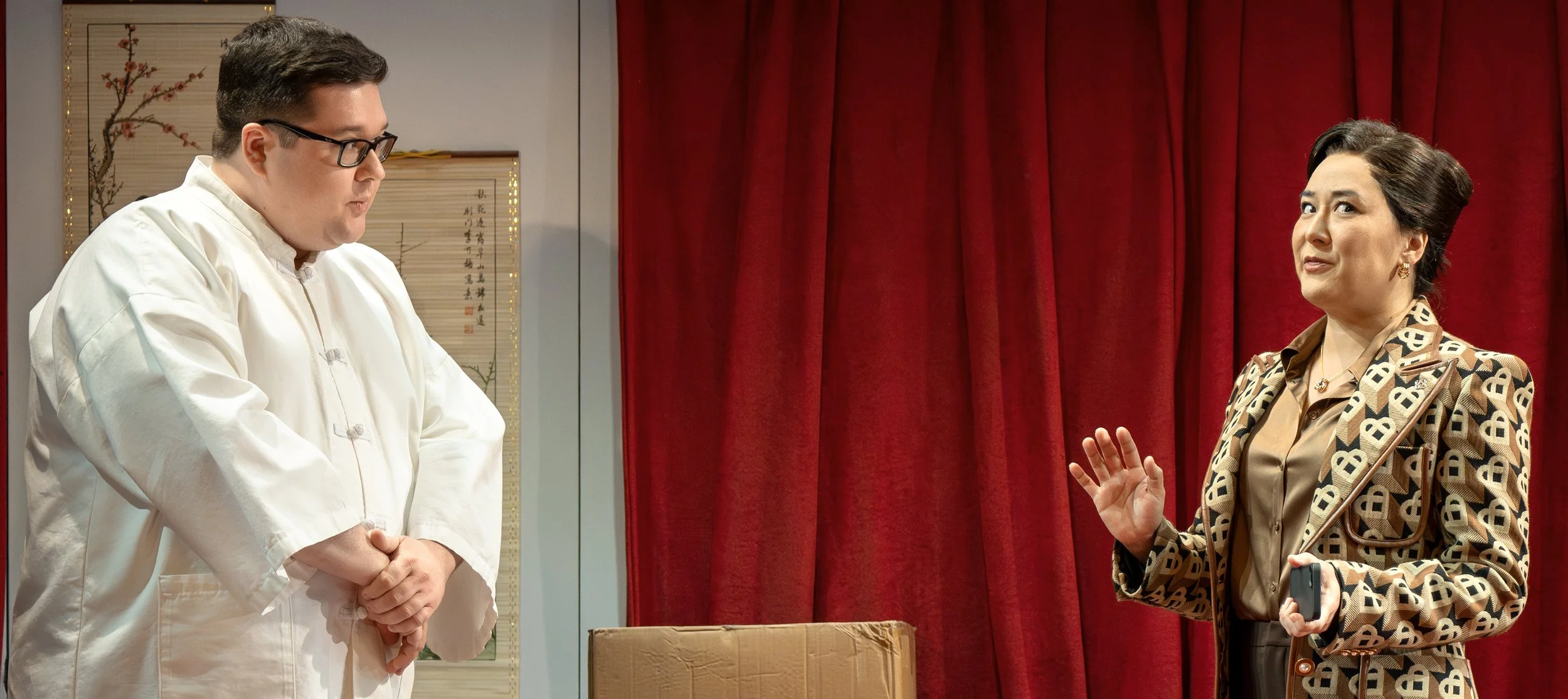
The Caucasian waiter (Ben Langhorst, with Ikeda) at the restaurant where the affinity group members meet speaks Chinese better than most of them do.
With Phyllis and Ellen so entrenched, this leaves Katie to emerge as the heroine who finally challenges their sexist, racist, mercenary workplace. But her socialist awakening is painted in all kinds of ridiculous strokes, starting with her wandering into a bookstore and discovering “A People’s History of the United States, and Marx and Engels, and de Beauvoir and Foucault and Said and Garvey,” then lugging all those books around—just like any Gen-Zer would do when the material is accessible online.
Under Chay Yew’s direction, Chinese Republicans gets a polished production, complete with a revolving set (designed by Wilson Chin) and a slew of Chinese-themed props, from a jade bracelet to Lunar New Year gift bags to a bottle of baijiu. The play has the feel of one of those four-female-friends sitcoms—and on that account, it’s watchable. But the audience may not be sure who they’re supposed to sympathize or agree with and what they’re supposed to take away from the show.
Chinese Republicans runs through April 5 at the Roundabout’s Harold and Miriam Steinberg Center for Theatre (111 W. 46th St.). Performances are at 7 p.m. Tuesday through Friday and 7:30 Saturday, with matinees at 2 p.m. Wednesday and Saturday and 3 p.m. Sunday. For tickets and more information, visit roundabouttheatre.org.
Playwright: Alex Lin
Director: Chay Yew
Sets: Wilson Chin
Costumes: Anita Yavich
Lighting: Jeanette Oi-Suk Yew
Sound: Fabian Obispo
