
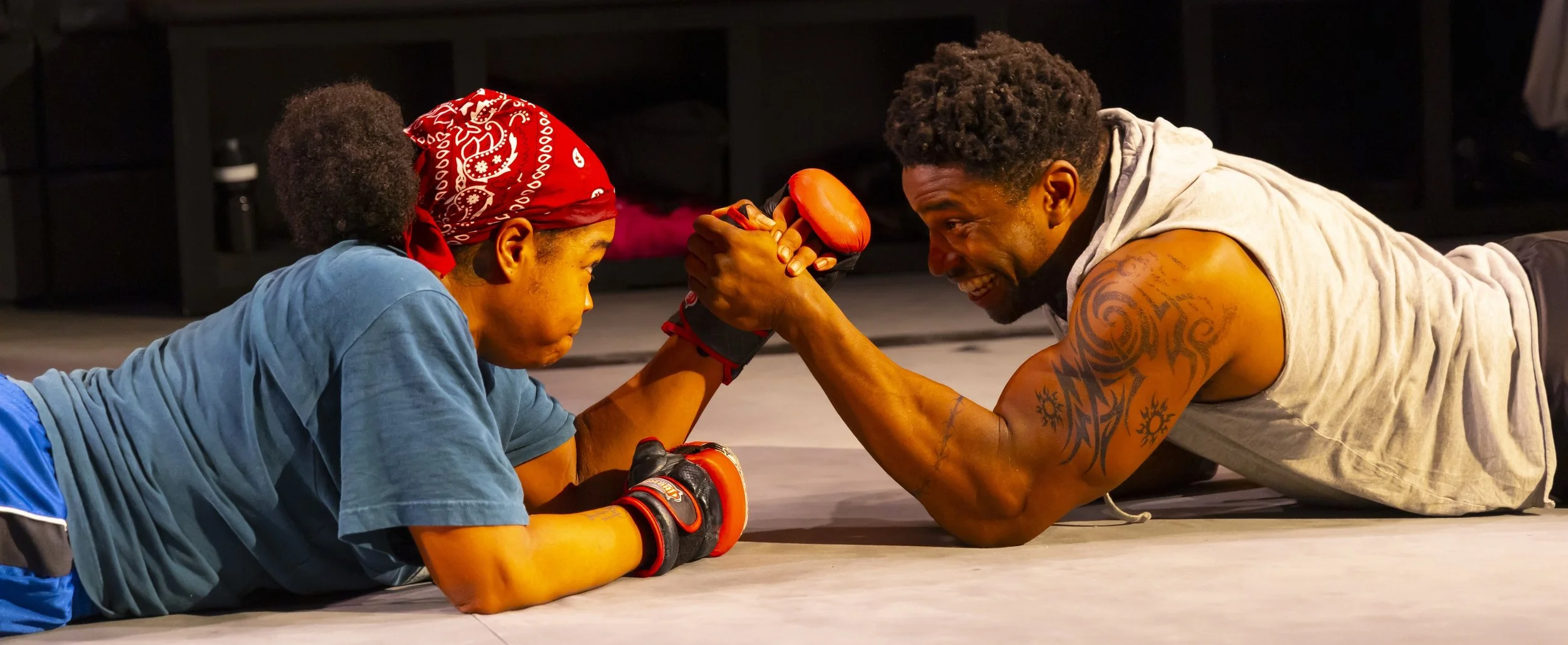
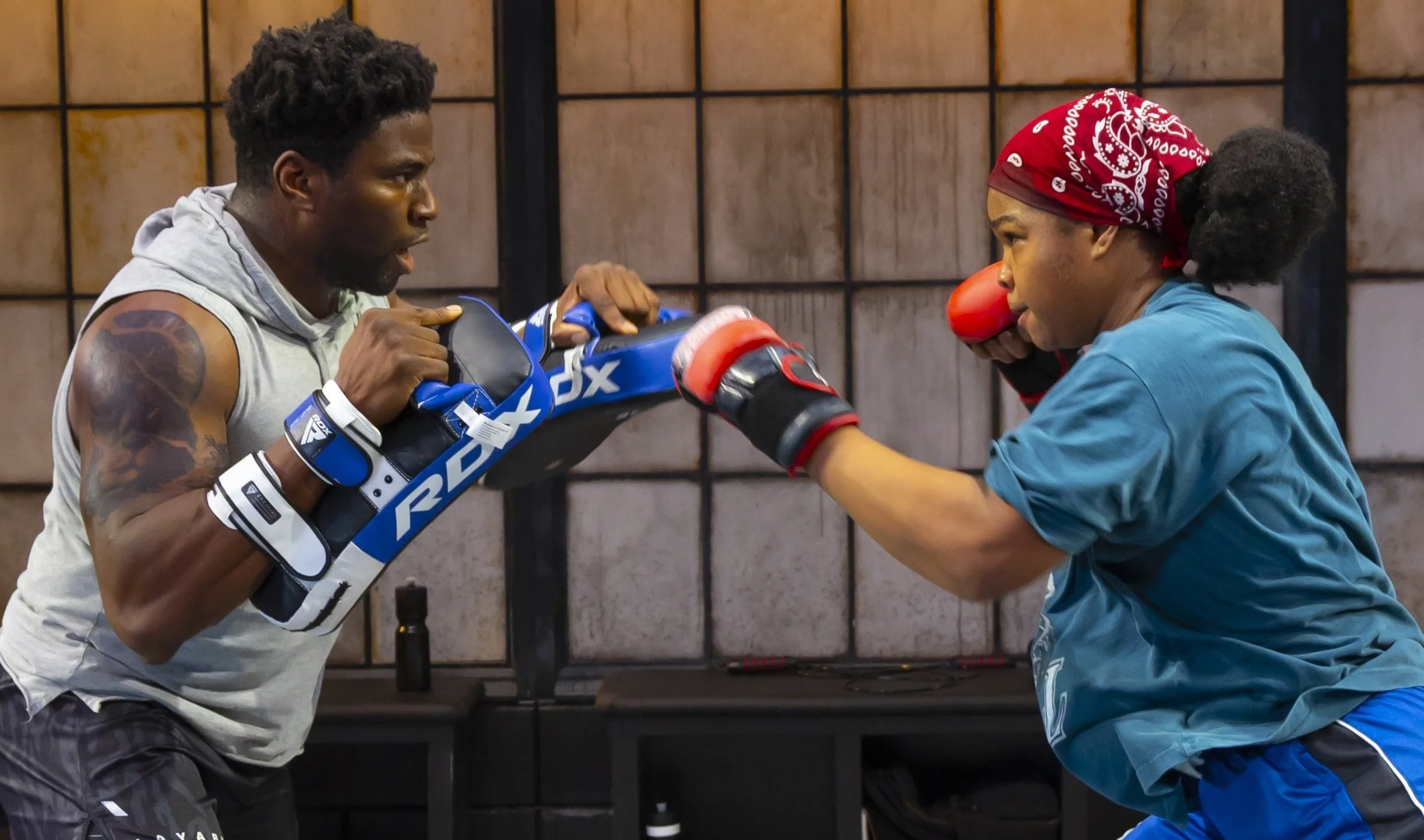
Okieriete Onaodowan (left) as Big, trains his little sister, Lil (Aigner Mizzelle), in Mixed Martial Arts fighting, in Ngozi Anyanwu’s The Monsters.
Mixed Martial Arts (MMA) is the ostensible subject of Ngozi Anyanwu’s taut two-hander The Monsters, now running Off-Broadway at Manhattan Theater Club after a fall stint at Two River Theater in New Jersey—but the play’s true combat is emotional. Beyond the excellent choreography and fight direction (by Rickey Tripp and Gerry Rodriguez, respectively), the deeper exhilaration stems from seeing two actors, Aigner Mizzelle as Lil and Okieriete Onaodowan as her big brother Big, deliver beautifully realized performances.
Anyanwu (who also directs) gives them depth and complexity to work with, and, as in all good sports stories, the world of the sport becomes secondary—in this case, to the evolving relationship between the siblings.
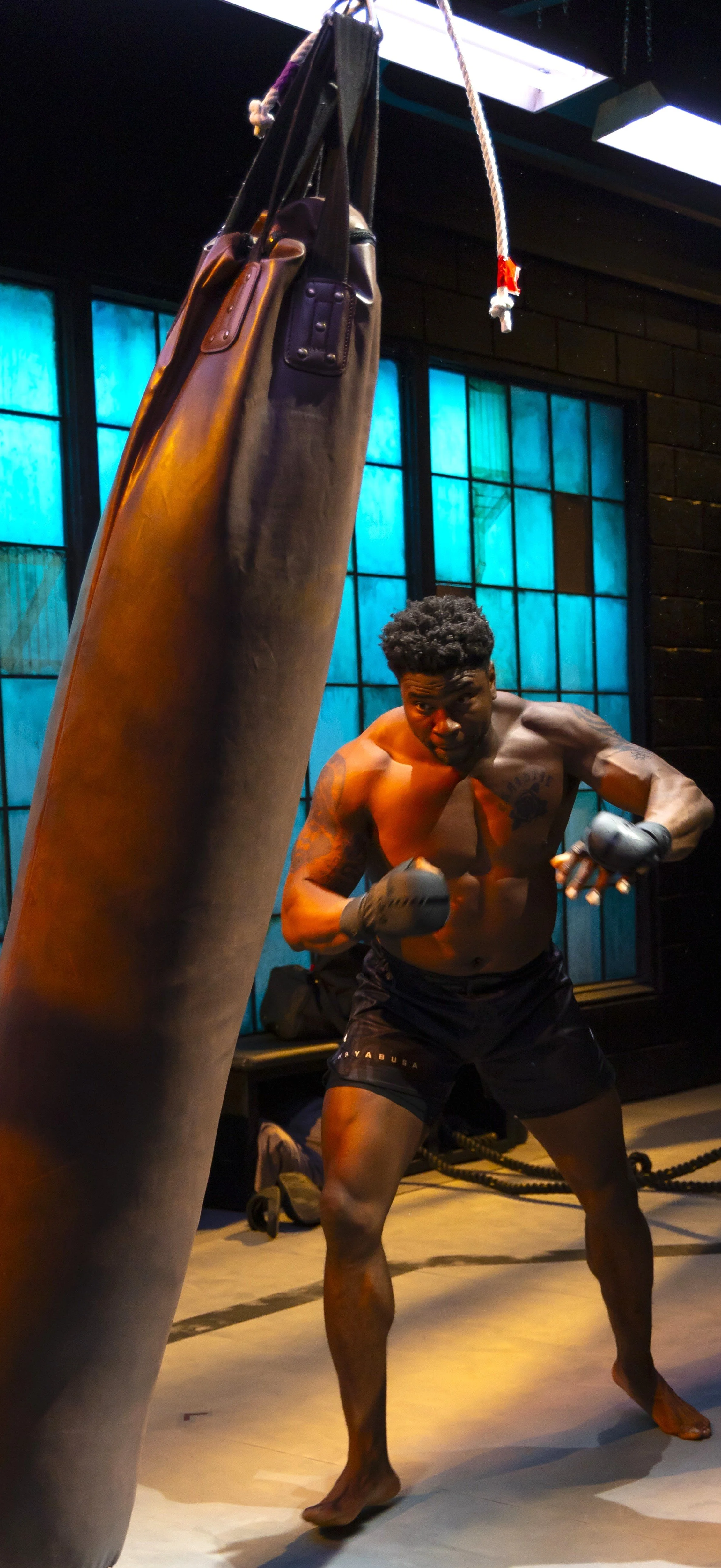
Big is an accomplished and fearsome fighter, but he has aged out of national contention.
When Lil re-encounters Big on the streets of Philadelphia after one of his regional MMA fights, he doesn’t recognize her. It has, it turns out, been sixteen years since they’ve seen each other. (Lest their names seem overly allegorical, the characters do have given names but almost always call each other by the childhood monikers.) He’s quiet, matter-of-fact, even hostile at first, while she’s a boisterous talker with a quick wit:
Big: So what. You like stalking me or something?
Lil: Huh? you can’t stalk your brother.
Big: Just because got the same dad, don’t make us brother and sister.
Lil: That’s actually exactly what makes us brother and sister.
Mizelle has a gift for landing big laughs without overselling lines or flattening them into sitcom zingers. This initial conversation avoids clumsy exposition but does give the audience some background: Lil works as a waitress at Applebee’s, and her living situation is not great; Big is leading a solitary existence, entirely focused on his fighting, and even though he’s good, he’s aged out of serious national competition.
As Lil and Big attempt, slowly, to reforge what was once a fierce attachment, the play offers brief glimpses into the past, guided by Cha See’s intelligent lighting plot and the seamless transformation by Mizzelle and Onaodowan into their childhood selves. The specter haunting both past and present is alcohol and addiction. Their idyllic childhood games and their deep, protective bond are interrupted by the terrifying sounds of a faceless, angry father arriving home (sound design is by Mikaal Sulaiman).
Big tries to be a protector in these situations, setting up Lil with her headphones at full volume and positioning himself between her and their father. Wrenched back to the present, it is revealed that Lil’s mother’s death was alcohol-related, and that Big’s own absence involved alcoholism and recovery. This is why he disapproves when he notices that Lil gets through her shifts at Applebee’s with the aid of rum in a soda cup.
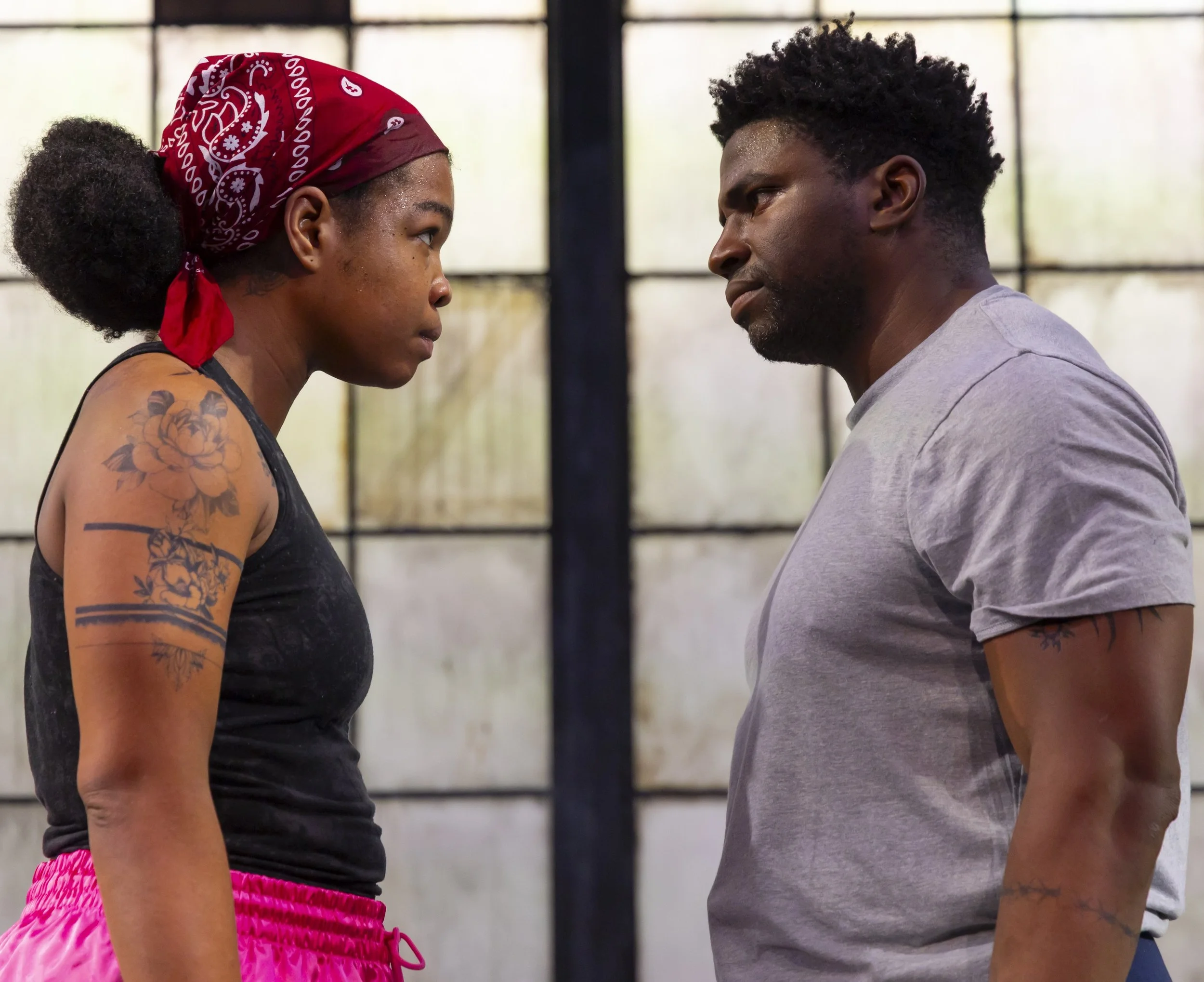
Lil proves up to the task of being an MMA fighter, but her success, and other issues from their past, threaten to drive a wedge between the siblings. Photographs by T. Charles Erickson.
The play then moves through several time leaps, and eventually Big decides that Lil’s time to start training as a fighter has arrived. No sports story is complete without a training montage, which the production accomplishes with the aid of Sulaiman’s original music, Andrew Boyce’s scenic design of gliding, hanging punching bags, and Mika Eubanks’s ingenious costume design, in which each new stage of Lil’s progress is marked by her shedding layers into different iterations of fighting gear. And then there is Mizzelle’s own physical prowess with the moves; both she and Onaodowan stage their respective fights in powerful solo renditions that juxtapose the violence of the sport with a kind of beauty.
Even as some of the inevitable tropes of the sports story emerge—Lil falls in with trainers who promise her faster success but may not have her well-being at heart, and she rises to heights that Big never reached—Anyanwu’s writing never loses sight of the central relationship, the way past wounds gnaw at the siblings, and how the fighting offers liberation even as the punishment they endure feels like expiation.
The final scene, which comes after another painfully long separation, offers tentative hope of genuine reconciliation and self-acceptance. Though during the play there is talk of leagues and championship bouts and training regimens, there is no distracting attempt at deep immersion in the culture of MMA. This is Lil and Big’s story—a story of trying to overcome a past that also had Edenic elements that can never be fully regained—brought to poignant life in two superb performances.
The Manhattan Theatre Club and Two River Theater production of The Monsters runs through March 22 at New York City Center Stage II. Evening performances are 7:30 p.m. Tuesday through Saturday; matinees are at 2:30 p.m. Wednesday, Saturday, and Sunday. For tickets and more information, visit manhattantheatreclub.com.
Playwright & Director: Ngoi Anyanwu
Choreographer: Rickey Tripp
Scenic Design: Andrew Boyce
Lighting Design: Cha See
Costume Design: Mike Eubanks
Original Music & Sound Design: Mikaal Sulaiman
Fight Direction: Gerry Rodriguez
