


From left: Taylor Iman Jones plays aspiring actress Josephine, who tells the troupe—Gilbert L. Bailey II as Carl, Justin Sudderth as Neil, Sky Lakota-Lynch as Sebastian, and Timothy Matthew Flores as Tim (kneeling)—that she plans to defy the king’s prohibition against women acting on stage in The King’s Critique.
With its royally ridiculous premise of a monarch’s prohibition against women performing onstage, The King’s Critique, a new musical by Nat Zegree (music and lyrics) and Eric Holmes (book and lyrics), sets the stage for a raucous comedy about one woman’s scheme to challenge the king’s decree. But despite some infectious musical moments, director Catie Davis’s production becomes bogged down by an overly convoluted plot and excessive length, stretching to a wearisome two hours and 30 minutes.

The banished Sebastian and Josephine listen to the witchy royal advisor Cora (Donna Lynne Champlin) who devises a scheme to return them to court disguised as a pair of gay brothers.
A period-inspired parody set in a mythical kingdom reminiscent of Renaissance times, when women were banned from the stage, The King’s Critique is peppered with contemporary jokes and metatheatrical commentary aimed at today’s theater world. Beneath its silly exterior, this unlikely blend initially entertains with a Monty Python–esque absurdity, but its novelty eventually wears thin. The show also bears a resemblance to Something Rotten, but lacks that musical’s devilishly clever wit.
The story: The aspiring actress Josephine enlists Sebastian, an ambitious, womanizing tenor, to circumvent the ban of King Benjamin. Their scheme spirals into complications involving backstage machinations and romantic entanglements within the troupe.
The musical opens in darkness. A narrator introduces the breed of men who populate the kingdom:
In a time not so long ago, the human species evolved a subspecies. Across plagues, wars, and tyrannies, this distinct type of man endured. They reaffirmed a shared humanity, regardless of the brutality of the ruler or the darkness of the age. Once a year these men gathered, part ritual, part reckoning, to exchange ideas, renew their alliances and, in increments too small to measure, alter the course of the world. These men were actors.
As the lights go up, the men strike heroic poses amid theatrical effects. But this heroic world has a catch, as the narrator makes clear in a male-centric pronouncement underscoring the kingdom’s gender restrictions: “Men. Not women. That would be ridiculous.”
“Eric Holmes’s book falters with its proliferation of twists.”
The conceit grows increasingly preposterous with the owner of the theater festival, Virgil, who is introduced as his house burns. Worse, the actors have apparently set the home ablaze before, prompting Virgil to exclaim, “What did I say about burning my house down again this year? I said specifically, ‘No.’” He bears the brunt of the actors’ anger and insecurities, reflected in the anthem “Raise Your Voice”: “If the King doesn’t like your play, you’re murdered.” Virgil is not conspiring with the monarch; he is trying to keep his festival running and his head attached. A realist amid the actors’ grandstanding, he warns Josephine against defying the ban, knowing it will end badly.
Eric Holmes’s book falters with its proliferation of twists, which obscures the central narrative. After Josephine defies the king’s prohibition, she is banished with Sebastian and the rest of the troupe. Matters grow more complicated with Cora, a cunning witch and rival claimant to the throne, who devises a scheme to return Josephine and Sebastian to court disguised as gay brothers. She wants them to infiltrate the court and win the king’s favor long enough to bring about his downfall.
Although Cora’s machinations initially succeed, her increasingly elaborate scheme begins to unravel, taking the musical down narrative detours. The result is a loss of focus: rather than remaining invested in Josephine’s aspirations to become an actress, the audience is drawn into Cora’s political maneuvering.
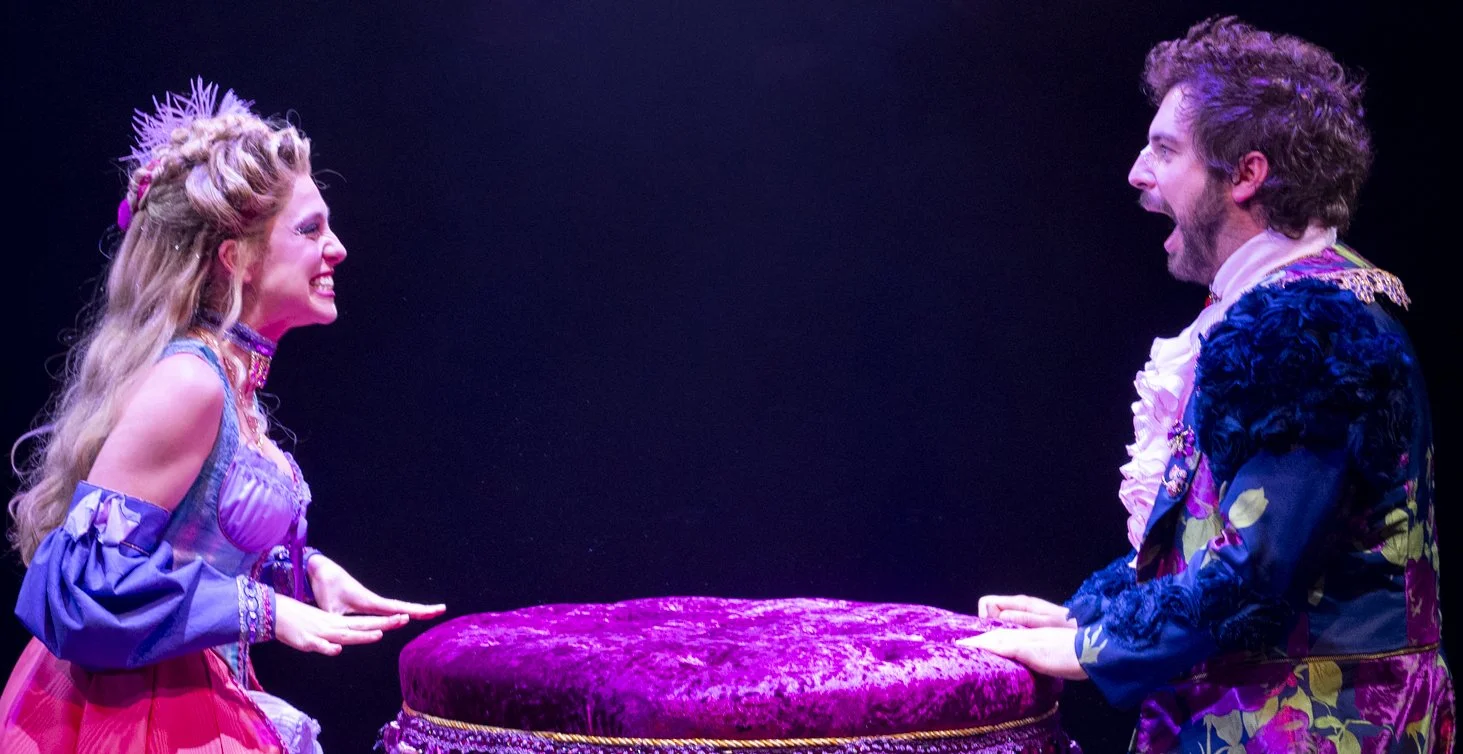
Justin Collette (right) portrays the dim-witted King Benjamin and Gabi Carrubba plays Isabella, his lover and socialite mistress. Photographs by Russ Rowland.
Nat Zegree’s score and the lyrics by Zegree and Holmes are largely serviceable, with 20 songs, but three numbers stand out for the vocal strengths of their performers. In Act I, Justin Collette as the dim-witted but likable King Benjamin brings heartfelt sincerity to the title song (“Theater. Now where to start? / There’s nothing else that truly grasps onto my heart”). Sky Lakota-Lynch gives “I Am” a memorable charge, turning Sebastian’s bruised male ego after his dismissal from the troupe for womanizing into a comic display of vocal one-upmanship with Josephine. Though the song is not especially memorable melodically, Lakota-Lynch makes it work, particularly in the defiant refrain: “They throw me away like they don’t give a damn, / But I won’t go away, that’s not who I am.”
In Act II, Taylor Iman Jones brings even greater vocal firepower to “The Gem of Arcanum Vitae,” about Josephine’s father. Her delivery sends the number soaring, as she recalls how he “would look in her eyes / and tell her the tales of the gem of Arcanum Vitae.” The ensemble energetically delivers the remaining numbers, but none is likely to leave audiences humming.
Clearly, Zegree and Holmes have their hearts in the right place with this valentine to the theater. But in The King’s Critique, they seem to have forgotten a fundamental theatrical lesson: less is more.
The King’s Critique plays through Dec. 20 at the Pershing Square Signature Center (480 42nd St.). Performance dates and times are somewhat irregular and may be viewed, along with other information, at kingscritiquemusical.com.
Book: Eric Holmes
Lyrics: Nat Zegree & Eric Holmes
Music: Nat Zegree
Direction: Catie Davis
Scenic Design: Paul Tate Depoo III
Costume Design: Emily Rebholz
Lighting Design: Cory Pattak
Sound Design: Jessica Paz
If you enjoyed this review, please click on the Like icon below.
