
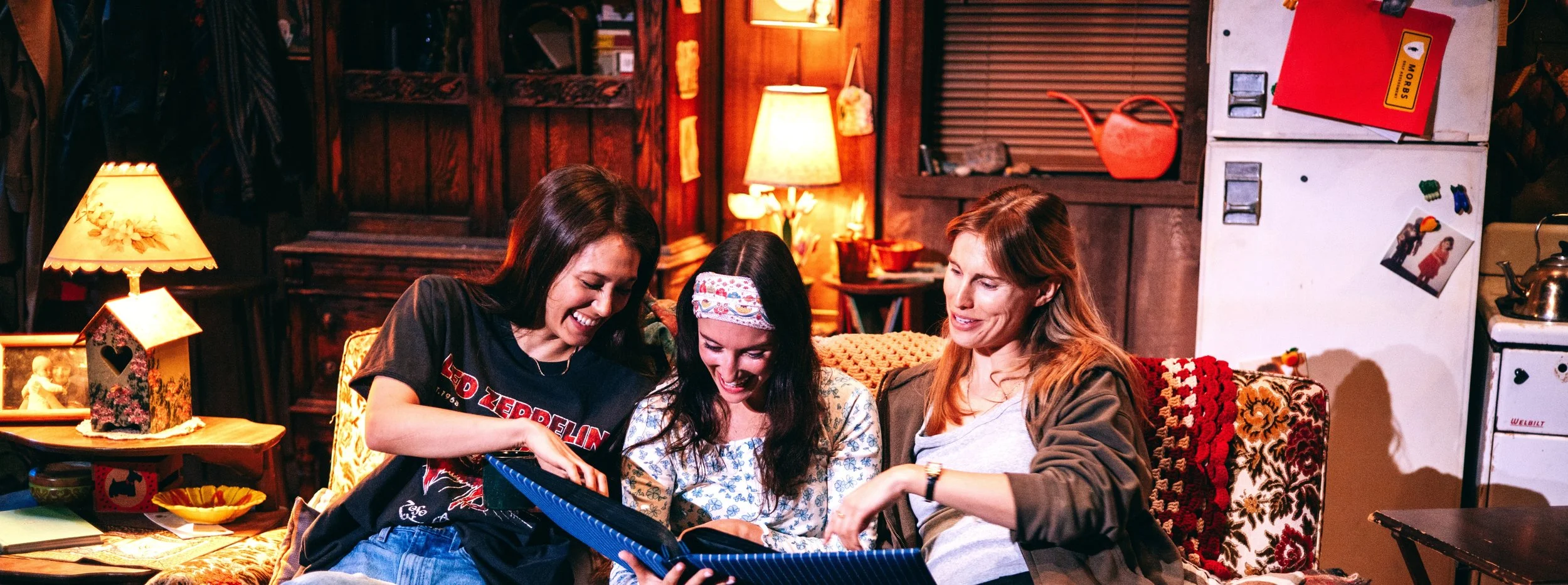
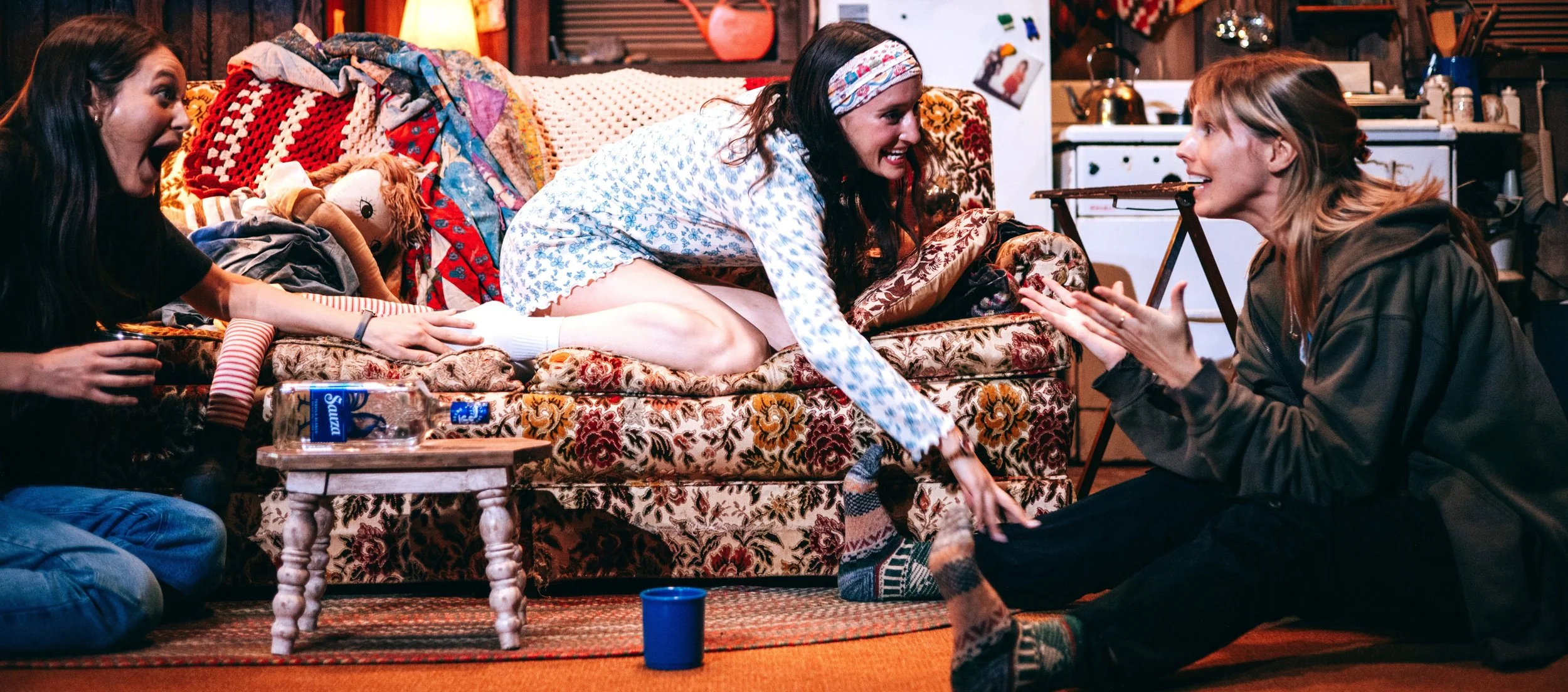
Tatum (Emma Kikue, left), Trish (Rachel Ravel, center), and Wendy (Alexandra Templer) have fun despite an outbreak of the Morbs, in the Egg & Spoon production of The Morbs.
Jen Diamond has invented a deadly contagious disease, named her play after it, and set the drama during an outbreak. What is truly infectious in The Morbs, though, are its other storyline—about three former sorority sisters reuniting after several years—and the trio of dynamic performances that bring it to life.
Tatum, Wendy, and Trish, once college besties, now in their late 20s, have fled their sorority homecoming together (in Tatum’s car) after the event was evacuated because somebody a couple of states away came down with the Morbs. They stop for the night at Tatum’s childhood home, a cottage in the woods, and then have to extend their stay due to heavy snowfall.
Count this setup among The Morbs’ trappings of a horror movie. In the play’s eerie opening moments, a mysterious figure sits still, back to the audience, in the darkened cabin as lights flash on and off and sounds are heard from outside—wind, water, the roar of a jet plane’s engine. It’s Tatum’s aunt Harriet sitting there, and she certainly seems haunted when she starts moving and speaking.
“To our sudden vacation … to my two best friends in the whole world,” Tatum toasts during her all-nighter with Wendy and Trish.
Scenic designers Christopher and Justin Swader, along with prop supervisor Natasha Dell, contribute to the ambience, with their rustic cabin interior cluttered with knickknacks, throw pillows, framed family photos, sewing projects, and more. Nobody’s resided in the house for years, but it looks very lived-in.
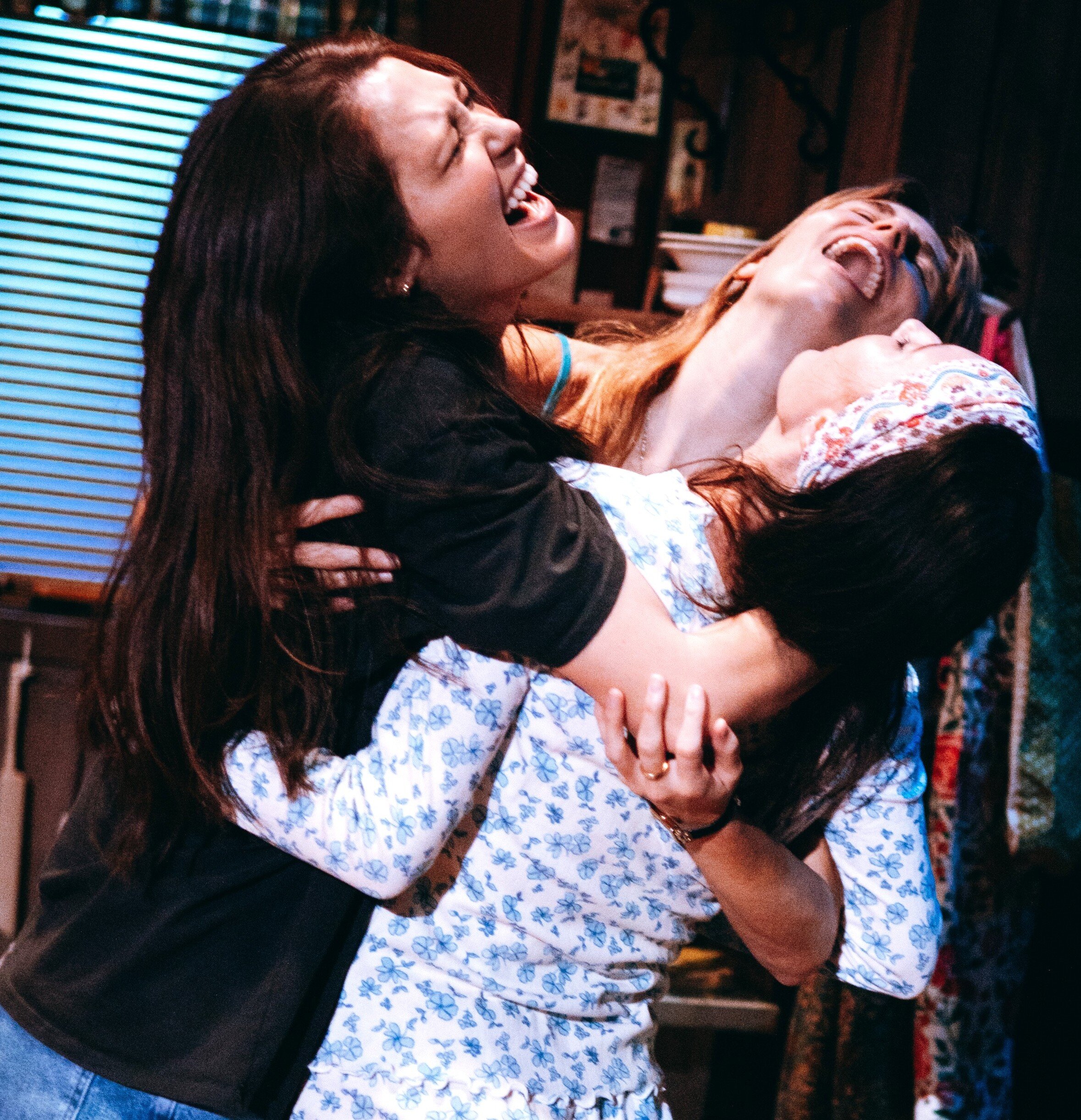
Director Lily Kanter Riopelle and her lighting and sound designers, Paige Seber and Brandon Bulls, respectively, have done a great job fostering the creepy vibes. Seber’s exemplary work is also showcased in the play’s standout sequence, an increasingly fast series of cuts depicting the women’s tequila-fueled night of reminiscing, confiding, and reconnecting. Blackout, lights up, and they’re looking through photo albums; blackout, lights up, and Trish is describing her childbirth; blackout, lights up, and they’re playing a freeze game; blackout, lights up, and Wendy is peeing in a pot on a dare; blackout, lights up, and they’re performing the Theta cheer; blackout, lights up, and Tatum brings out her vape. The women just keep going—a different activity, a different position each time the lights come on—through about a dozen of these super-short scenes, until they’re dancing around to the Cranberries’ “Dreams” before finally passing out.
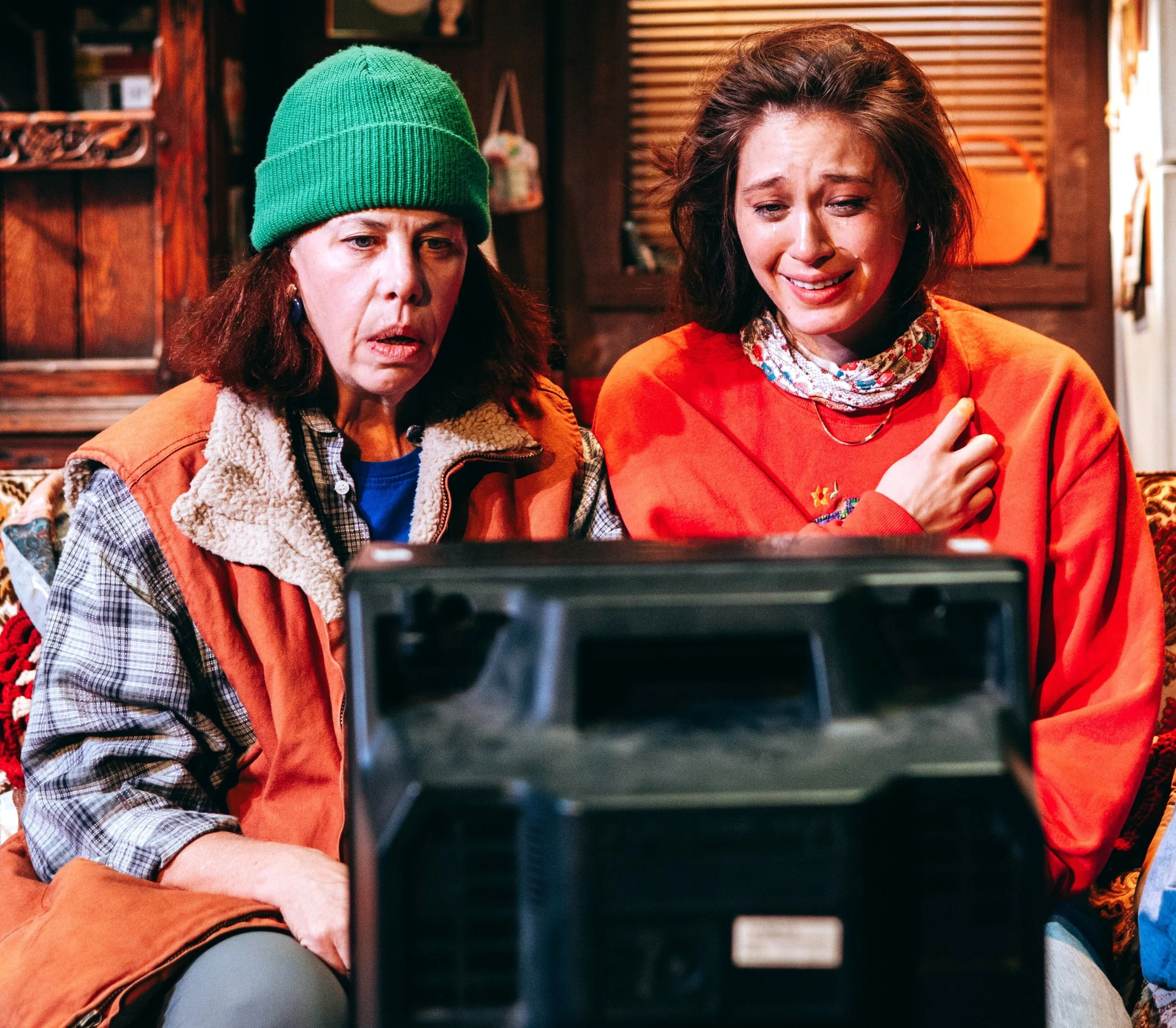
Harriet (Jennifer Regan, left) shows Tatum (Kikue) an old home video.
It’s an enthralling cascade of moments that takes sharp direction, perfect timing, and terrific cast chemistry to pull off. Actors Rachel Ravel, Emma Kikue, and Alexandra Templer not only mesh well but also create distinctive individual characterizations. Ravel’s Trish, a mother and corporate executive, still sounds and behaves like a perky, frivolous sorority girl, though that persona belies a complexity only revealed, in a startling transformation, late in the play. Kikue is appropriately blasé as the spoiled Tatum but clearly carries wounds from her underprivileged childhood as well as the questionable source of her father’s fortune. Wendy, played by Templer, is slower to join in the fun—losing her mother to the Morbs has left her hypervigilant about the health risk and resentful that Tatum didn’t come to Wendy’s aid—but she can’t resist the pull of nostalgia (and, perhaps, her romantic feelings for Tatum).
The fourth member of the Morbs cast, Jennifer Regan, portrays Harriet, who was made “hollow” by the Morbs. Hollow survivors “lose facts of their life. They drop these details out of the window of their soul one by one … [and] begin acting strangely, emptied out, a shell.” In her excellent performance, Regan speaks in a monotone and often seems estranged from her feelings even as she holds on to glimmers of memories and affection.
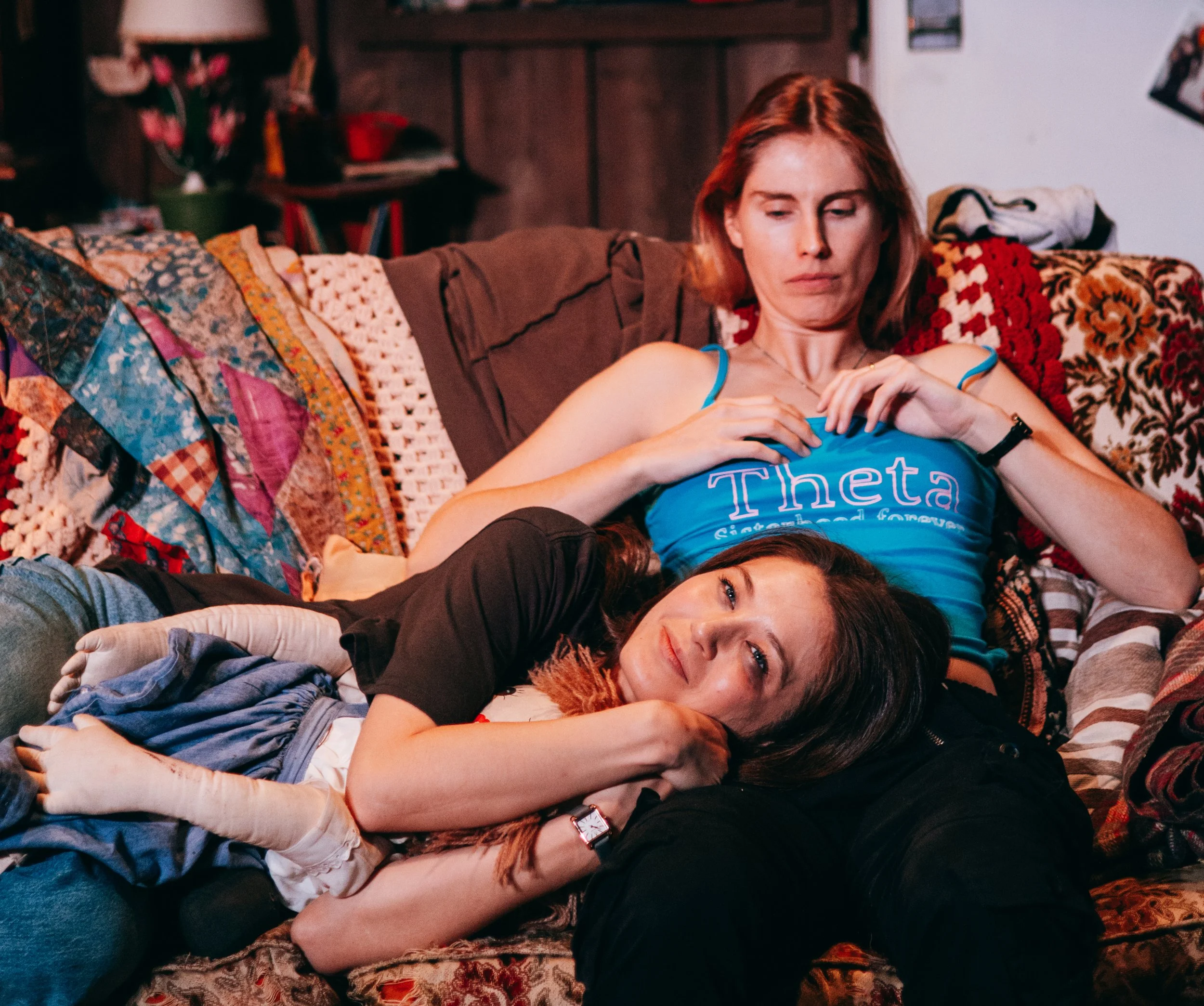
Tatum (Kikue, bottom) is trying to repair her friendship with Wendy (Templer). Photographs by Geve Penn.
Besides “hollow,” Morbs-related vocabulary and practices include the “commitments” and “checks” used to screen for the disease; its “lethal” iteration (Harriet’s lethal husband “set the bed on fire with me still sleeping in it”; in a case at a monastery, the patient “smashed in another monk’s skull with a statue of Saint Jude”); and an agency called the MHC—founded by Tatum’s dad—which works to contain outbreaks but also hires firing squads to eliminate the lethally infected.
Despite all the details Diamond concocted, the Morbs seems like a framing device rather than an integral part of the plot. The narrative heart of the play lies with the women and their relationship, then and now. The public health dystopia—like The Morbs’ spooky elements—is more atmospheric than essential to the story.
But the playwright is keen on the theme of personal change, and the Morbs serves as a metaphor there: This illness changes people, just like five years out of college does. The vibrant performances as Trish, Wendy, and Tatum convey both the personalities the friends knew in college and the women they have become.
The Morbs runs through Nov. 21 at A.R.T./New York Theatres (502 W. 53rd St.). Performances are at 7:30 p.m. Monday through Saturday, and at 2 p.m. Saturday. For tickets, visit eggandspoontheatre.org/the-morbs.
Playwright: Jen Diamond
Director: Lily Kanter Riopelle
Scenic Designers: Christopher Swader & Justin Swader
Costume Designer: Avery Reed
Lighting Designer: Paige Seber
Sound Designer: Brandon Bulls
Movement Director: Willow Funkhouser
If you enjoyed this review, please click on the Like icon below.
