
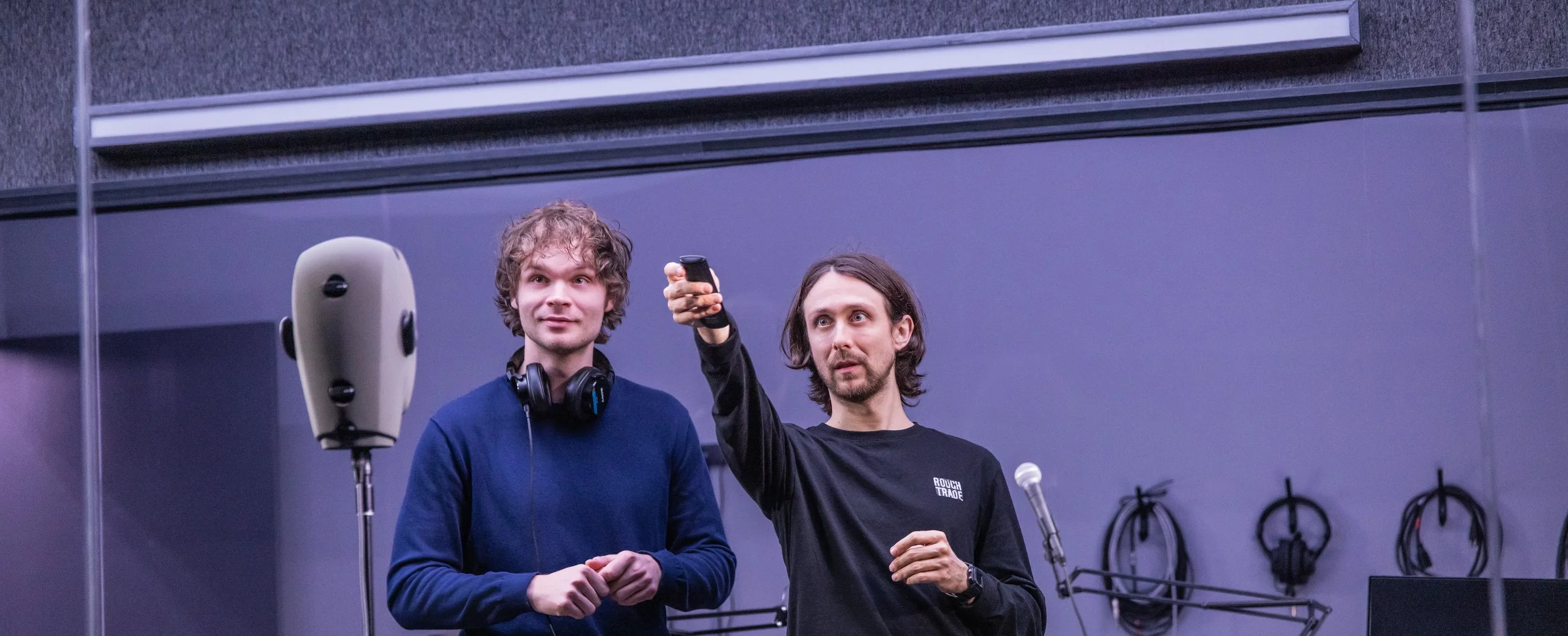
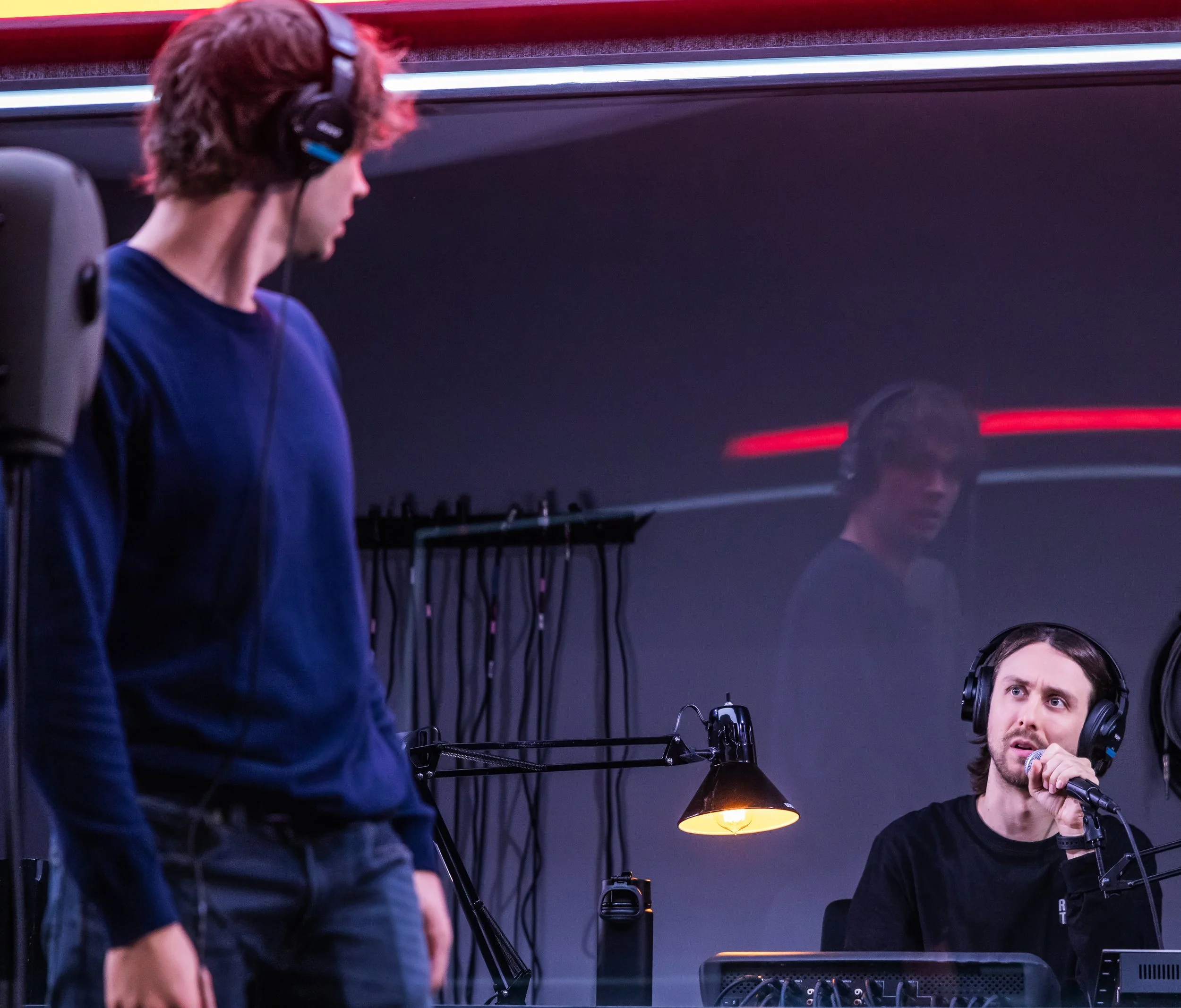
For the past eight years, Audible, the audiobook behemoth, has joined forces with the Minetta Lane Theatre to produce staged plays that are recorded and eventually made available as streaming audio “originals.” Given that history, their latest collaboration, Jamie Armitage’s A Ghost in Your Ear, is extremely on brand. This 90-minute haunting is set in a sound studio, most of the action involves the recording of an audiobook, and audience members listen to the tale via headphones. If the frights are milder than one might hope, the work surprisingly has something to say about the travails of fatherhood, while unintentionally delivering important lessons on the nature of live performance.
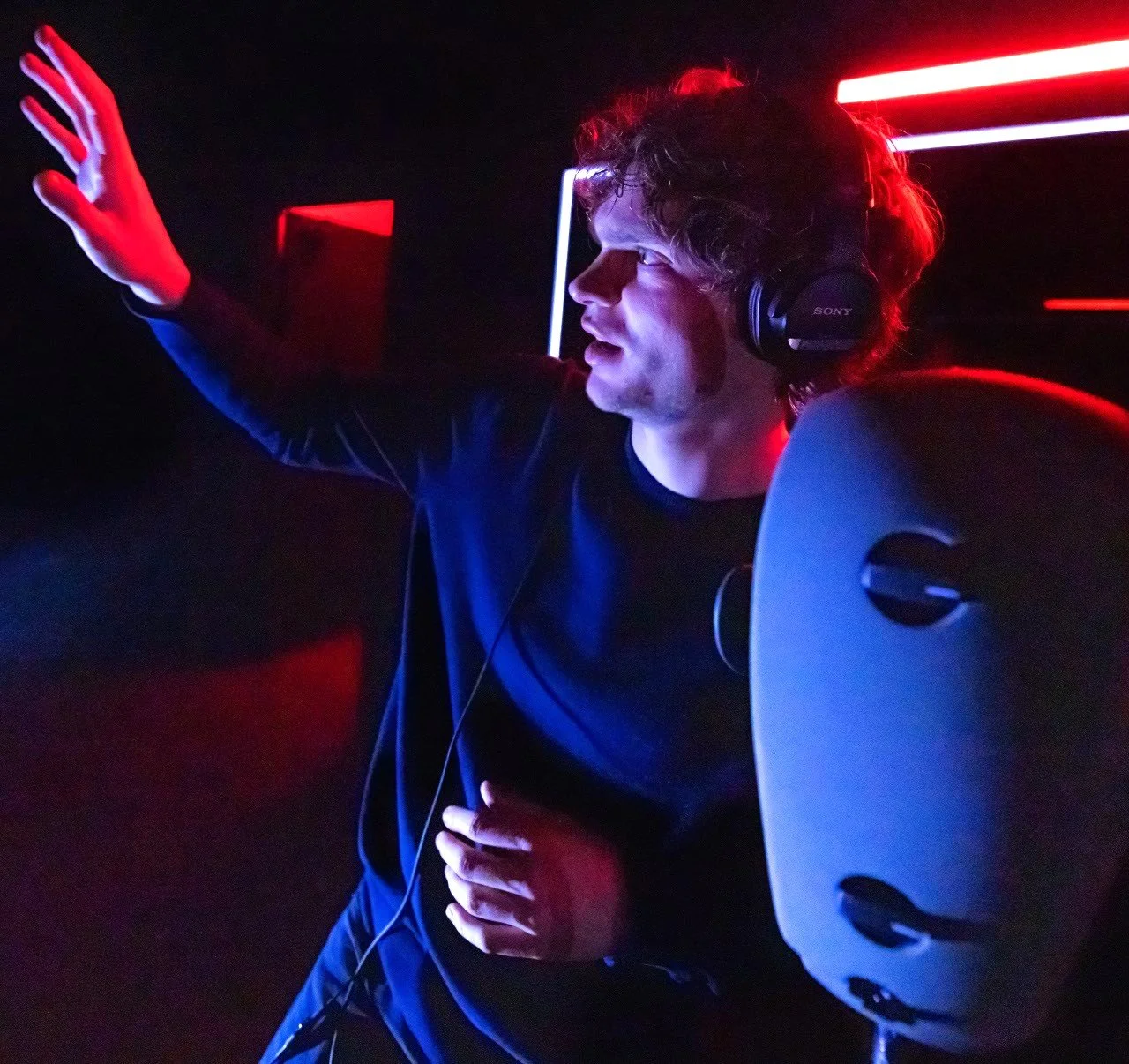
The cast includes two humans and two others who are less so. Sid (Owen Campbell) is a secretive sound engineer with a baby on the way and an evil agenda on his mind. Lucas (Lucas Iverson) is a naive and soon-to-be-cursed actor hired by Sid to record a spooky story for an anonymous client. As Lucas recites and recites some more, the titular ghost occasionally pops out from the darkness to try and shut him up, offering the audience a chance to be startled.
The fourth character, Lucas’s recording partner, is a piece of foam sculpted in the shape of a human head and attached to a stand. It has no working mouth, but its ears are binaural microphones. When Lucas speaks into its left ear, audience members hear the words through the left ears of their headphones, fulfilling the title’s promise while providing stereo effects mostly for the sake of it.
The sound team of Ben and Max Ringham are the duo behind the design. With numerous impressive credits on Broadway and in the UK, their most similar previous work was the stunning 2021 sound installation, Blindness. Staged in often total darkness with no actors physically present, audience members listened through headphones to a narrated tale of a mass blindness epidemic. Arriving Off-Broadway (at the Daryl Roth Theater) just as COVID restrictions were lifting, the production’s isolating effects transformed into indelible fears and a terrifying production.
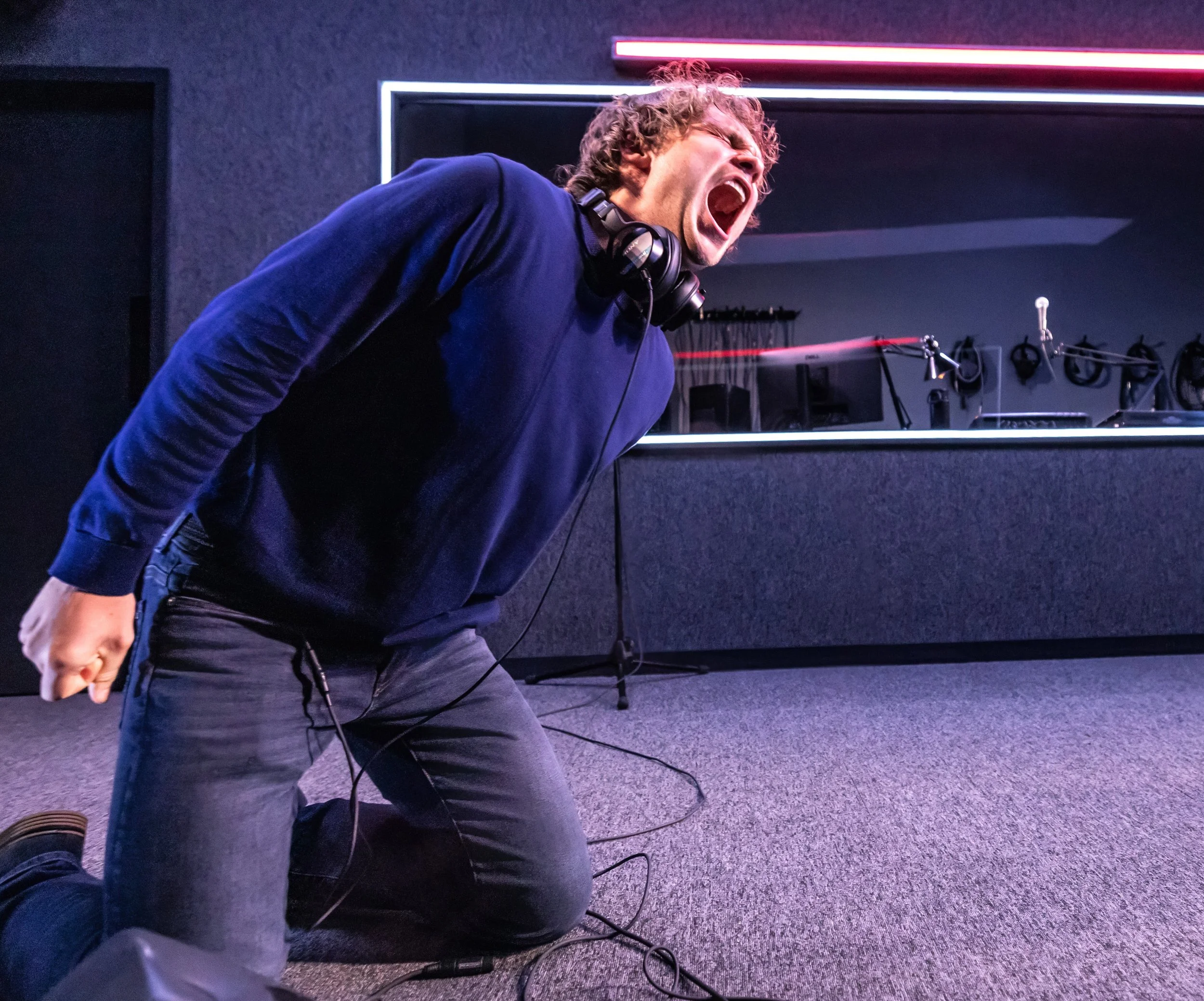
But isolation, when the stage lights are on with actors beneath them, is a joy killer, and the headphones in this production are all too quarantining for no good reason. As any horror movie attendee knows, a good scream is more pleasurable as a shared experience; catharsis is more cathartic en masse. Broadway’s Paranormal Activity is a hit because what is more satisfying than screaming together in the dark, fully hearing the reactions of booth friends and strangers?
Armitage, directing his own work, faces other factors that remove the audience from the immediacy of the piece. The scenic design, by Anisha Fields, puts the glass wall of the recording studio in front of the action, leaving the actors to be watched as if through a window. Sid spends much of the time upstage in the engineer’s booth behind yet another window, as distant as the British town where the play is set.
The primary plot is not the uneasy relationship between Sid and Lucas, but rather the story that Lucas reads aloud. A gothic tale of paternal evil that smacks of Edgar Allan Poe, it comes with the requisite haunted house full of broken mirrors, swinging doors, and unreliable lighting. A typical passage reads:
I pulled back the fabric to let in the last of the daylight… It was only then I clocked that huge lengths of cloth had been thrown over every mirror too. Perhaps my father’s vanity couldn’t bear the look of his ageing face — a wrinkled reminder of all the pain he’d caused in the world.
The further Lucas goes into the story, the more present it becomes on stage as objects in the studio crash about and lights flicker (indeed, the show’s visual effects are as important as the sonic ones). But rarely does it become fully compelling. Plot devices are another part of the problem. When Sid explains to Lucas that the room he is in locks from the outside, it is not only the theater season’s most obvious bit of foreshadowing, it also strains credulity. Similarly, Lucas leaving his phone outside the studio, rather than just turning it off, is overly convenient, as is his ability to so smoothly perform a story that he is reading through for the first time. More successful is the play’s final twist, which, without giving too much away, leaves the audience at the end of their rope.
A Ghost in Your Ear plays through Nov. 22 at Audible’s Minetta Lane Theatre (18 Minetta Lane). Evening performances are at 7 p.m. Tuesday through Friday, and 5 and 9 p.m. Saturday; matinees are at 3 p.m. Sunday. For tickets and information, visit audiblexminetta.com.
Playwright & Direction: Jamie Armitage
Sets & Costumes: Anisha Fields
Lighting: Ben Jacobs
Sound: Ben & Max Ringham
If you enjoyed this review, please click on the Like icon below.
