
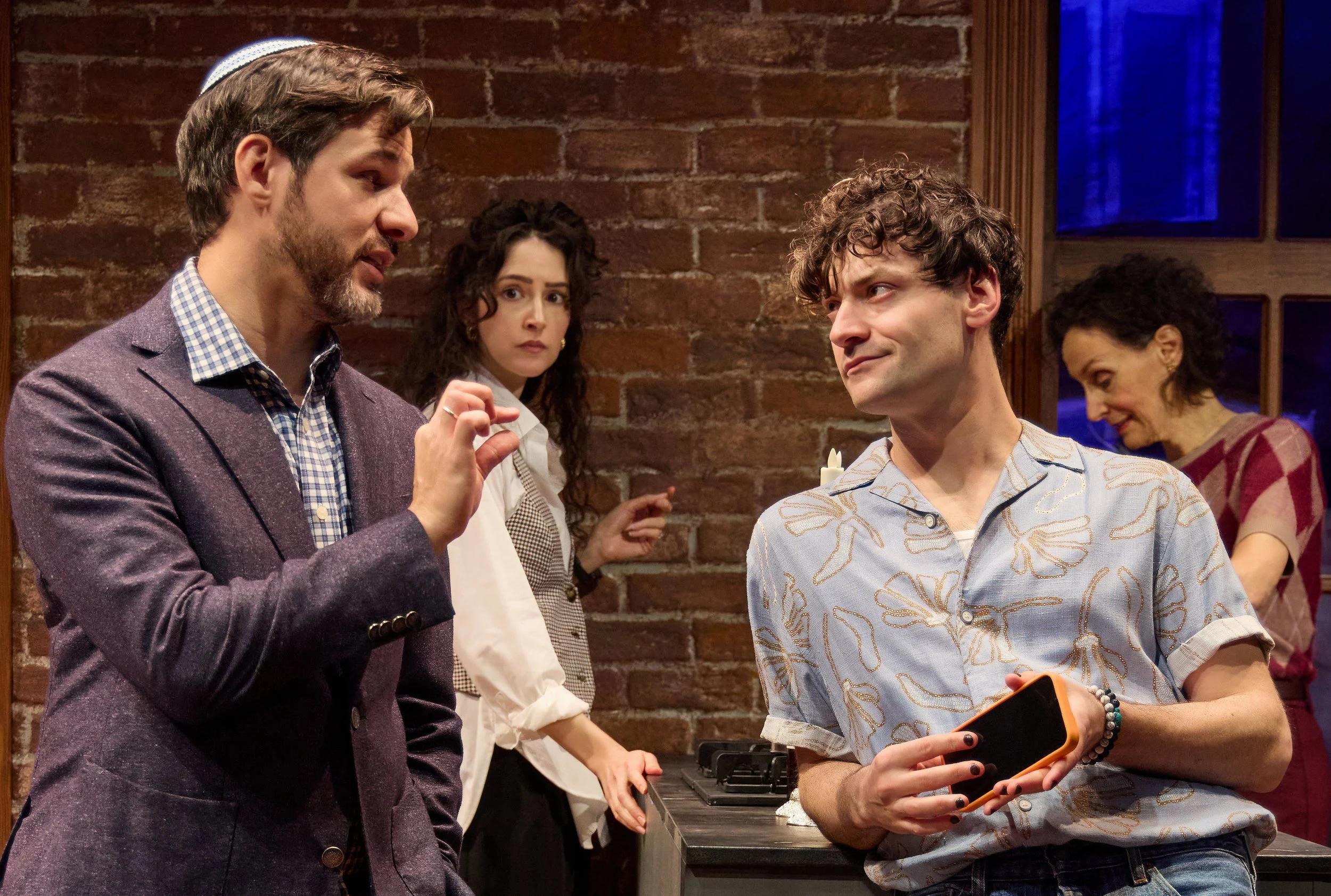
Yitzhak Stein (Etai Benson, left) explains his love of Judaism to his brother Joseph (Harrison Bryan), while their sister Rachel (Lauriel Friedman) looks on, concerned, and their mother Dina (Barbara Walsh, back right) attends to the cooking, in Debbie Goodstein’s The Blue Violinist Over West End Avenue.
Welcome to a 21st-century American Jewish home, where whatever comes along is embraced with love—with some exceptions. Debbie Goodstein’s The Blue Violinist Over West End Avenue introduces a prototypically eclectic family, who bear little resemblance to the Jews of their great-grandparents’ era.
When Stein family matriarch Dina (Barbara Walsh) enters her Upper West Side home, she tells the audience about the late flower delivery and wonders whether the food for Shabbat (the Sabbath) will be finished before sunset. Similarly, patriarch Abe Stein (Adam Heller) enters and addresses the audience as if they were old friends.
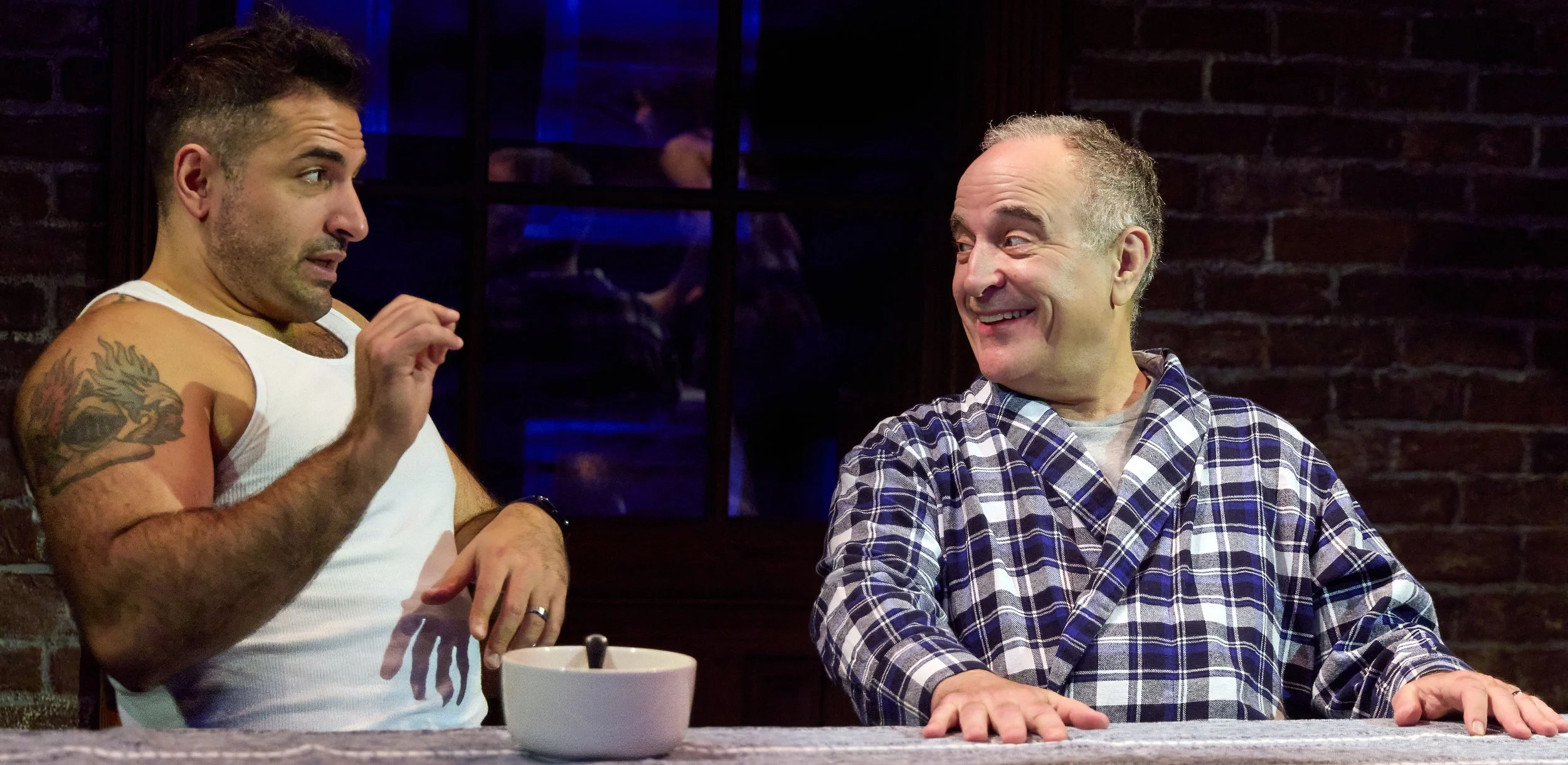
Vinny (Mike Labbadia, left), Abe’s (Adan Heller) son-in-law, shares his newfound command of Yiddish expressions.
The Steins’ children and their significant others arrive for Shabbat. Son Yitzhak (Etai Benson) is visiting from Israel, where his family now resides. He sports a yarmulke and tzitzit (ritual fringes) and is the go-to person for performing rituals or giving sermons. Rachel (Lauriel Friedman), the only daughter, married Vinny (Mike Labbadia), an Italian cop who learns Yiddish. Joseph (Harrison Bryan) will soon marry Sami (Yair Ben-Dor), of Moroccan Jewish heritage. Only Harvard student Jake (Rory Kulz), the youngest, is missing from the Shabbat table.
Dina and Abe accept their daughter’s intermarriage and their gay son’s fiancé. They also respect Yitzhak’s Orthodox lifestyle and Israeli war routine of dashing with kids to the nearest shelter. The family tapestry is unusual, but so is the fact that this drama has many funny moments, such as Vinny’s attempts to be cool while he botches Yiddish pronunciation, and Joseph and Sami’s repartee about Sami’s Moroccan identity.
Although Joseph and Sami’s forthcoming wedding raises the Steins’ spirits, divisive challenges cloud this near-perfect family tableau—predictably so. Middle East geopolitical issues soon emerge as a flashpoint for conflict.
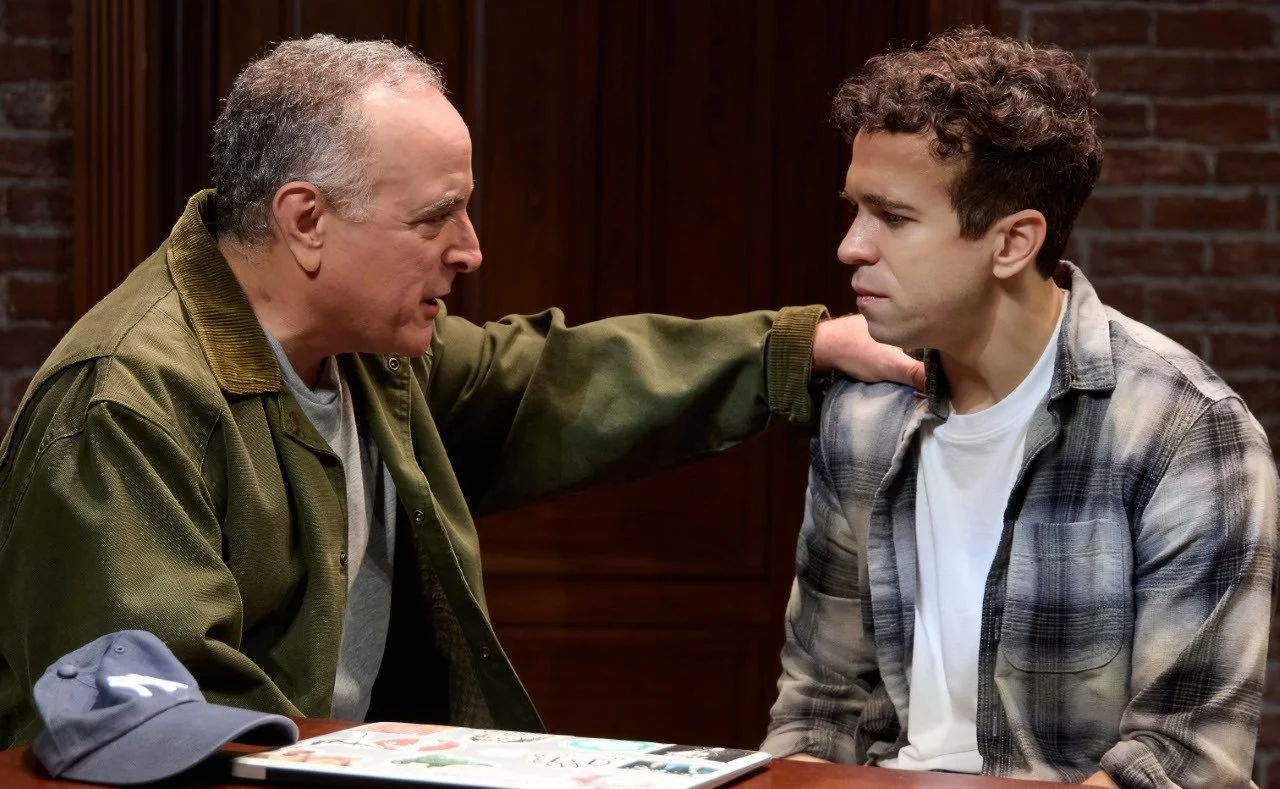
Abe expresses both his love for his son Jake (Rory Kulz) and his dismay at Jake’s views about Israel. Photographs by Jeremy Daniel.
When Jake finally arrives home with his girlfriend Jenna (Ali Axelrad), Dina embraces her, but Abe regards her suspiciously: “I’m just wondering why he didn’t mention her before. A boy doesn’t keep a girl from his parents without a good reason.”
Vinny also is skeptical. When Rachel asks his opinion of Jenna, his cop instincts kick in:
Vinny. Call it a hunch—I don’t know. I feel like she may be hiding something.
Rachel. And what? That’s supposed to be probable cause now?
Vinny. First of all, I don’t trust people who don’t eat meat. They look at your burger like they’re going to its funeral.
Rachel. It’s a burger, Vinny. You’re insane.
Vinny. Maybe, but my gut has a pretty good track record.
Joking aside, it’s Vinny who discovers Jenna’s keffiyeh, which he steals but eventually returns. Jenna’s pro-Palestinian advocacy and Jake’s acquiescence are triggers for Abe, Yitzhak, and especially Rachel. They all face off against Jenna over the situation in Gaza after October 7 and Israel’s right to exist, even though, Yitzhak aside, they are cultural rather than religious Jews. Abe orders Jenna and Jake to leave, which they do. Jonathan Silverstein’s direction and Lauren Helpern’s multipurpose scenic design, which transforms from a dining room to bedrooms, provide a perfect storm—not in a teacup, but still tight enough to be uncomfortable.
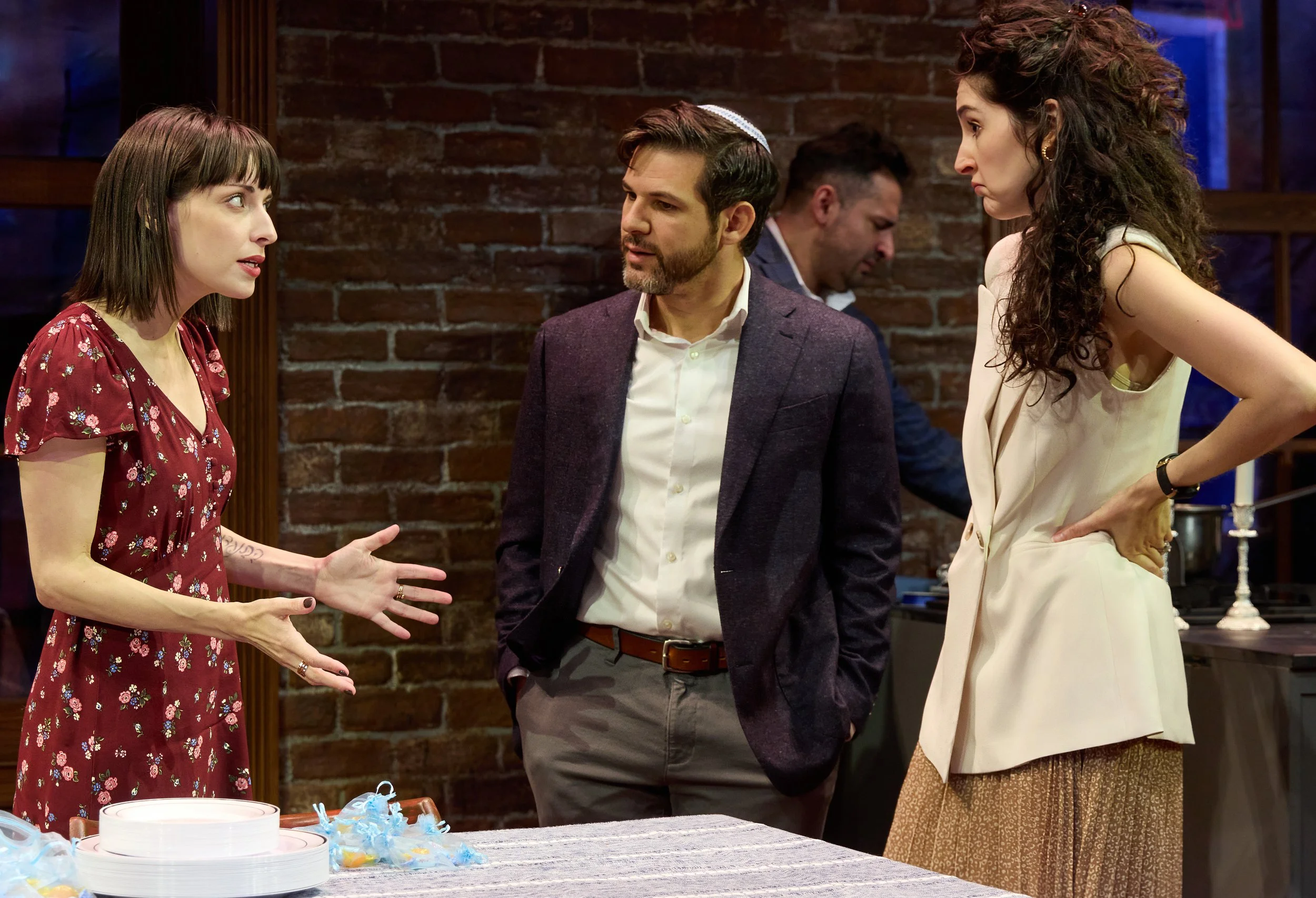
Jenna (Ali Axelrad, left) tries to persuade Yitzhak and Rachel that her anger at Israel is justified.
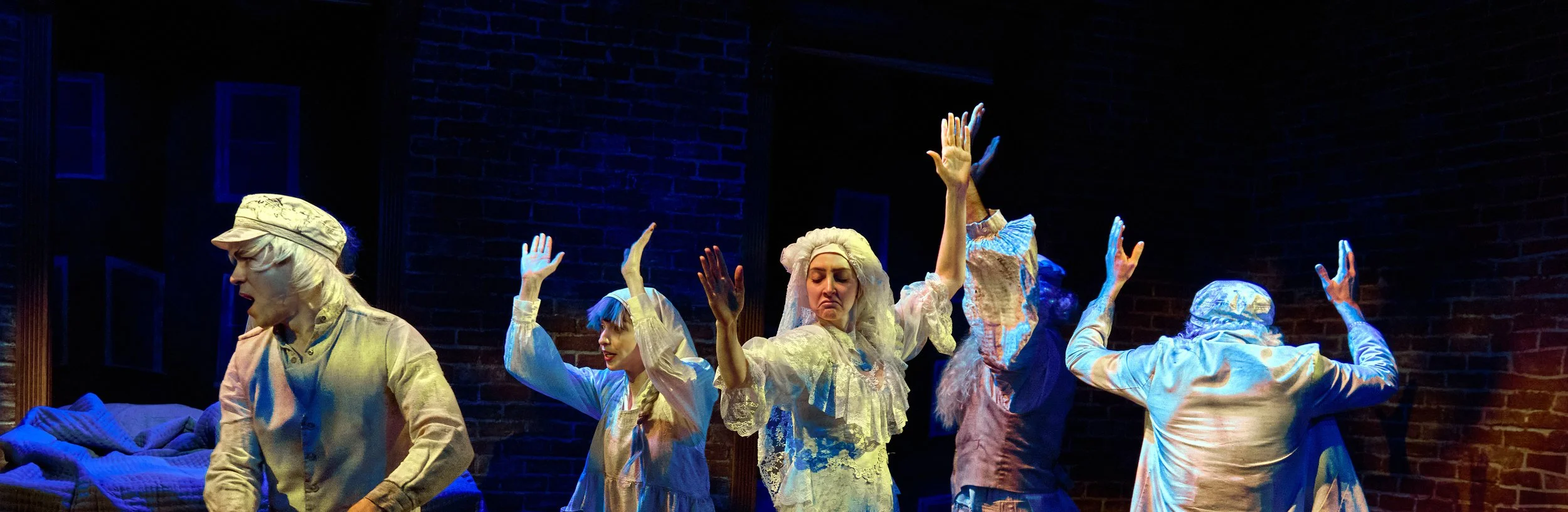
Abe’s behavior toward Jake pivots after Dina awakens from a dream and they are surrounded by dancing and cavorting ancestral ghosts from both sides of their family. The cast doubles as the ancestors, made disturbingly spooky by Jennifer Paar’s shroud-like costumes and David Lander’s surreal lighting.
Abe’s patrilineal milkman-grandfather figure berates him for driving Jake from his life. The parallels between this scene and the one with Tevye and Golde in Fiddler on the Roof are unmistakable, especially since Abe has proudly stated earlier that his grandfather’s village was also that of Sholem Aleichem, who created Tevye the milkman.
Who, then, is The Blue Violinist on the Steins’ wall? And why is he meaningful to the family? Chagall’s painting is mentioned early on but acquires context only later. Jake leaves home without his ancestral violin, which survived the family’s near destruction in Europe, and Abe brings it to him. The instrument echoes Chagall’s otherworldly violinist, whose feet never touch the ground and whose melody transcends the chaos on earth below. In returning it, Abe reconciles with Jake and lovingly entrusts him with the continuity across generations that music brings.
The Blue Violinist Over West End Avenue runs at Theatre Row (410 W. 42nd St.) through Dec. 5. Evening performances are at 7 p.m. Tuesdays through Sundays; matinees are at 2 p.m. on Saturdays and Sundays; there are special Wednesday matinees on Nov. 25 and Dec. 2. For more information or to purchase tickets, call 212-714-2442 ext. 45 or visit blueviolinistplay.com.
Playwright: Debbie Goodstein
Director: Jonathan Silverstein
Lighting Design: David Lander
Scenic Design: Lauren Helpern
Sound Design & Original Music: Daniel Baker
Costume Design: Jennifer Paar
Choreography: Sarah Parker
If you enjoyed this review, please click on the Like icon below.
