
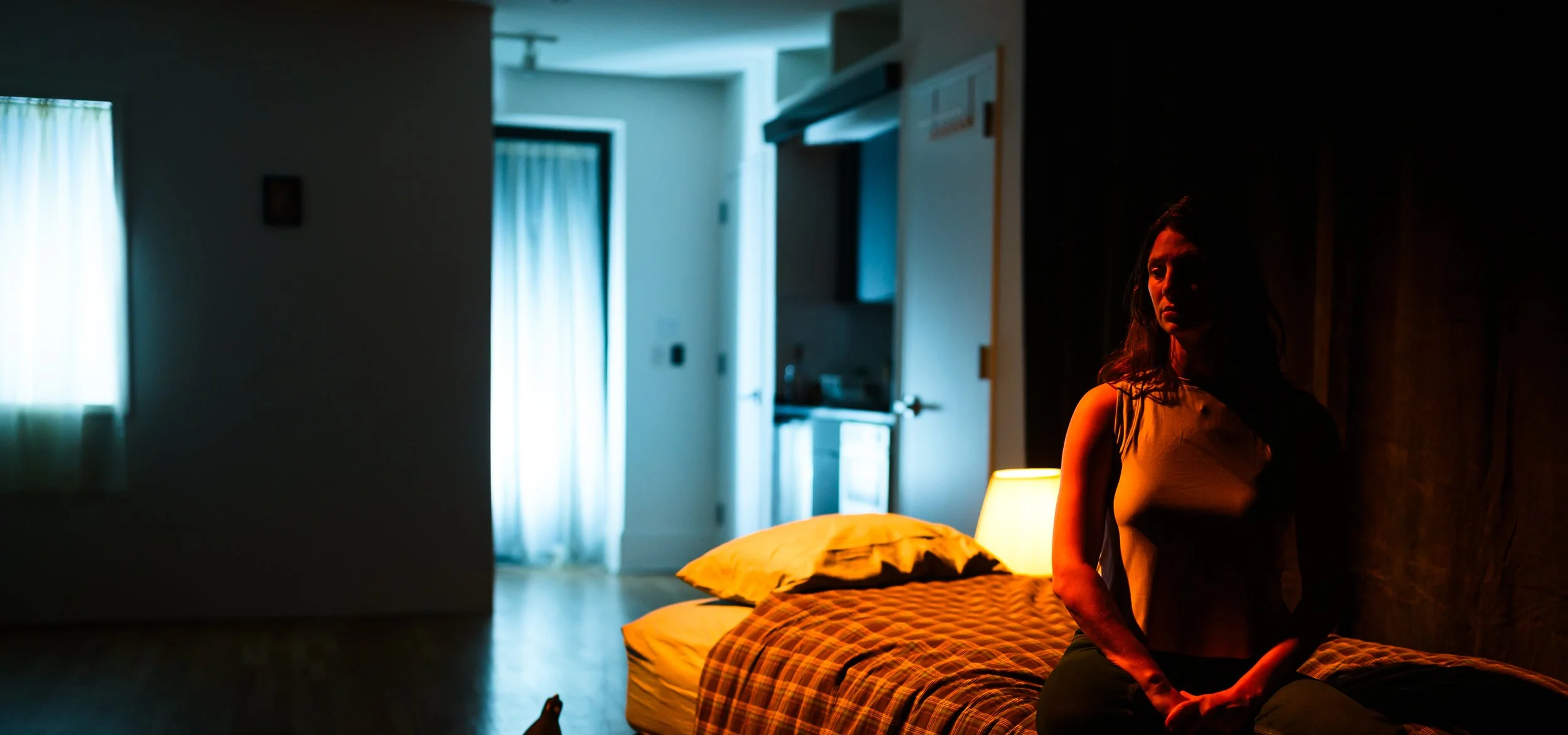
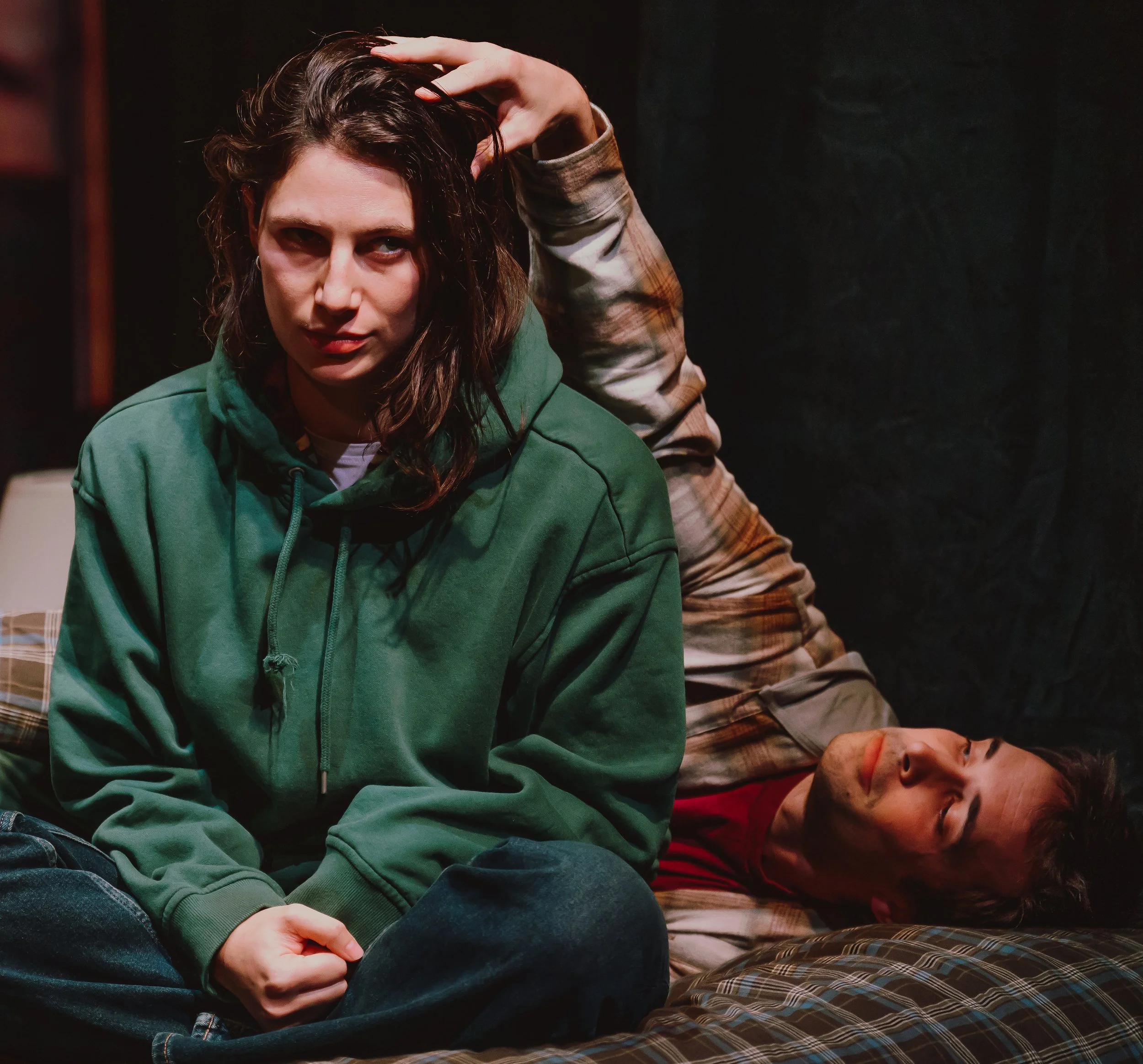
Owen (Jake Horowitz) performs a what he calls a “brain-sucker” on his sister, Charly (Mia Wurgaft), when she visits him at his college.
In Dan Giles’s play The Charioteer, two siblings attempt to forge a relationship despite their reluctance to share their true feelings, wanting to connect but unsure of themselves. High school senior Charly (Mia Wurgaft) visits her brother Owen (Jake Horowitz) at college and has her first drink—and her first experience of getting blackout drunk. Owen, who went away to college a few years earlier, has essentially abandoned his family. Owen takes Charly along to an anarchist house party, where he essentially abandons her in favor of spending the night trying to reconcile with his ex-girlfriend Ellen.
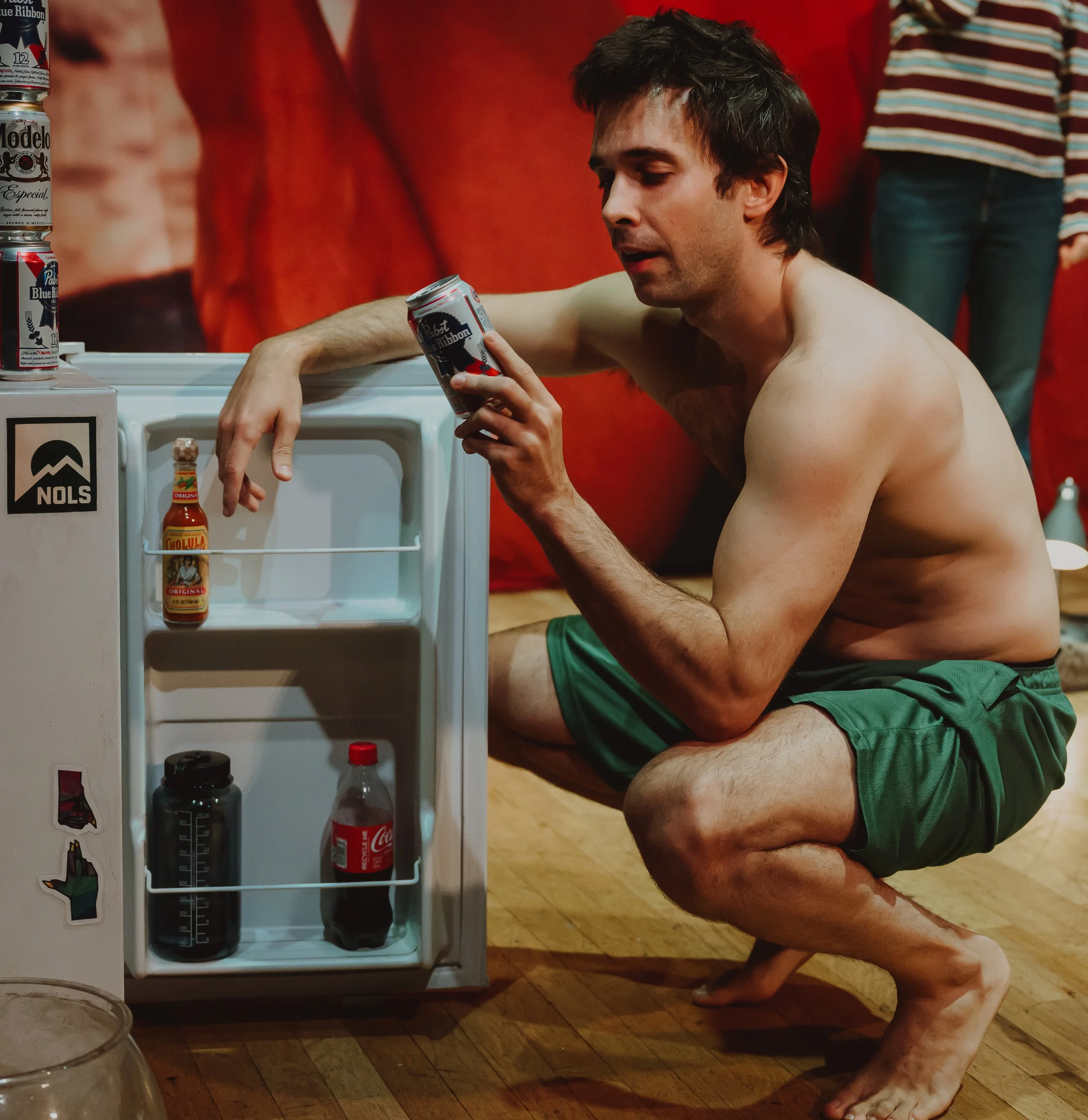
Owen retrieves a brew for his visiting sister. Photographs by Austin Ruffer.
Charly wakes up the next morning unable to remember what happened the night before. Owen is initially concerned but quickly shrugs off the incident. He boldly informs Charly that he is joining a campus group favoring divestment that intends to change society radically. He rails against society's decline and the effects of climate change facing the next generation, committing himself to bringing down the industrial complex: “We can’t plan for their future,” he says. “We have to plan for the future that’s actually gonna happen.”
Then 10 years pass. Charly is now a lawyer who defends men accused of abusing women. Owen arrives to see her while on his way to Maine. The years have not been kind to him. He has left the radical group and split with Ellen but still wants to see his sister before moving on. He has gone from an engaged activist to a wounded, defeated shell of his former self.
Horowitz slows his speech, and his movements become hesitant—a striking reversal from the confident young man who pumped iron between shots of vodka the last time Charly saw him. Literally, he limps away from the good fight. Charly offers to help:
I’ve worked with a lot of men who realized they needed help.
Men who’ve done things they feel a lot of guilt and shame about.
Domestic violence, battery, sexual assault—it doesn’t scare me.
Owen asks for money, but Charly is unwilling to provide it. Instead, she insists: “You just have to want to change.” He is unwilling to do so, and he leaves his sister again. Left with the emotional baggage of her family, Charly, who has invited her mother to live with her, laments:
And if you say no, will I be free?
And if you say yes, will I be ready?
The siblings' lives echo the parable of a charioteer from the Bhagavad Gita. They are trapped in the dysfunction of their upbringing. Owen paraphrases the parable of the charioteer as a reflection of his own reality:
And he has to fight a battle against his own family …
There’s nothing that could justify killing my own family.
Then the charioteer reveals that he’s actually the god Krishna in disguise.
And Krishna shows the prince that he and his enemies are part of a greater design.
Like the destinies of everyone in the universe, all woven together.
For Owen, the idea of the charioteer offers a way to navigate his inner conflicts and life choices. Charly finds herself caught between an emotionally abusive father and a victimized mother who refuses help. Their mother constantly texts Charly; the incoming messages sounding like gunfire. Coincidentally, during a fight with Ellen, Owen's phone also pings sharply, like Morse code.
“Under Matt Dickson’s direction, the actors demonstrate impressive skill.”
Their parents’ marriage is over, yet it continues on because one "can't kill something that is already dead." Nothing changes, and the children repeat the same patterns in their own lives.
Under Matt Dickson’s direction, the actors demonstrate impressive skill, shifting between confidence, confusion, and vulnerability, with an undercurrent of constant pain throughout the 75-minute production. The play portrays damaged people valiantly trying to heal themselves as best they can.
The script balances bursts of dialogue and stretches of halting conversation, and Wurgaft is very good at it, creating tension and holding the audience's attention. However, the revelations rarely materialize, leaving more questions than answers. For instance, was Charly abused while blacked out at the house party? Was Owen violent with Ellen? How abusive was their father toward their mother?
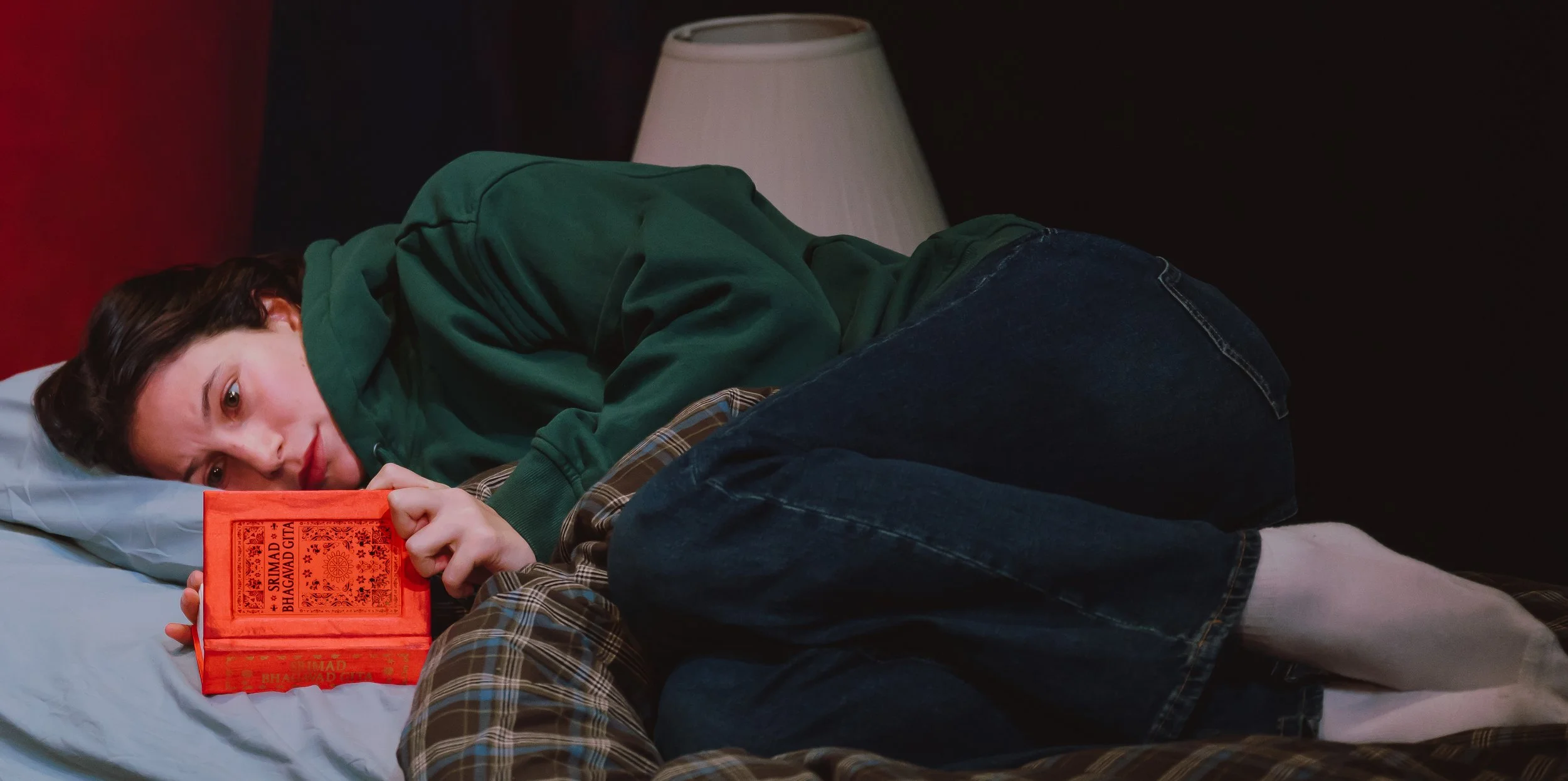
While visiting Owen, Charly scans his copy of the Bhagavad Gita.
The play ends as it began, with a desire for connection that remains unfulfilled: “Everything that’s ever lived will always live, and everything that dies is already dead.”
Throughout the play, the siblings want to talk but rarely reveal themselves. Thanks to the talented cast, the characters’ frustration does not become the audience’s frustration. Instead, they present an engrossing portrait of siblings struggling to connect despite their inability to do so. They simply never learned how to love while growing up. Bad habits die hard.
The Charioteer runs through Nov. 22 at the cell (338 W. 23rd St.). Evening performances are at 7:30 p.m. Wednesday through Sunday. For tickets and more information, visit thecelltheatre.org.
Playwright: Dan Giles
Director: Matt Dickson
Scenic Design: Cat Raynor
Costume Design: Azalea Fairley
Lighting Design: Yiyuan Li
Sound Design: Carsen Joenk
