
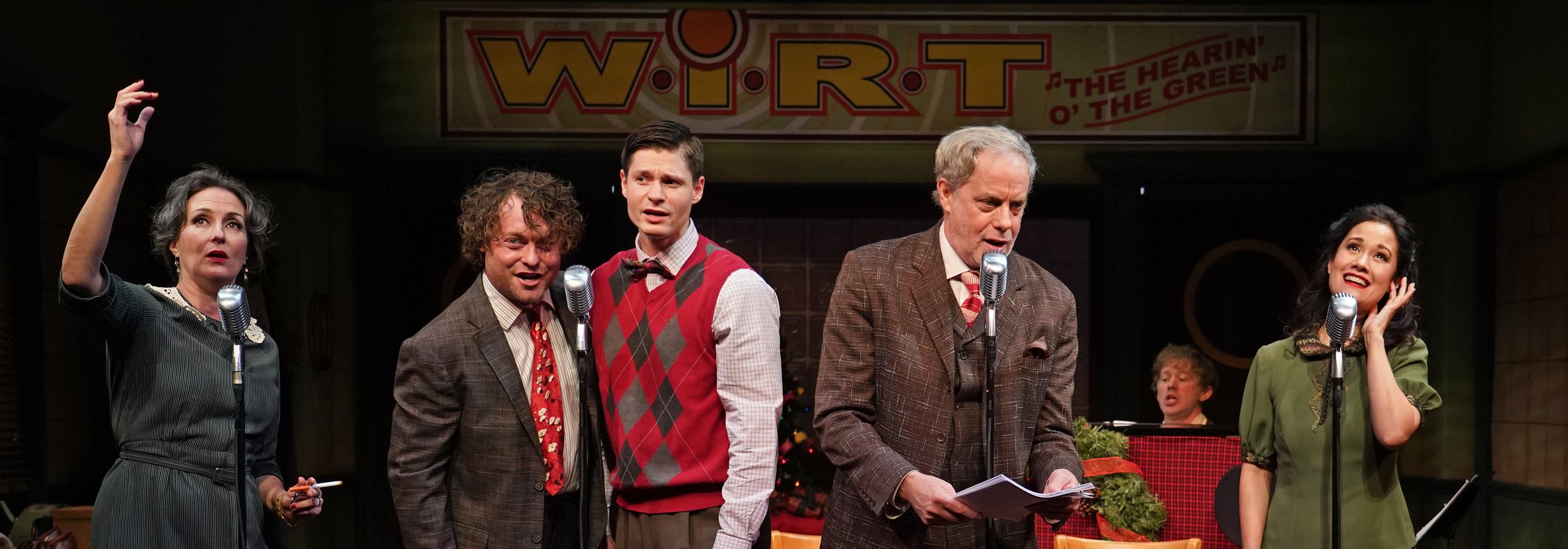
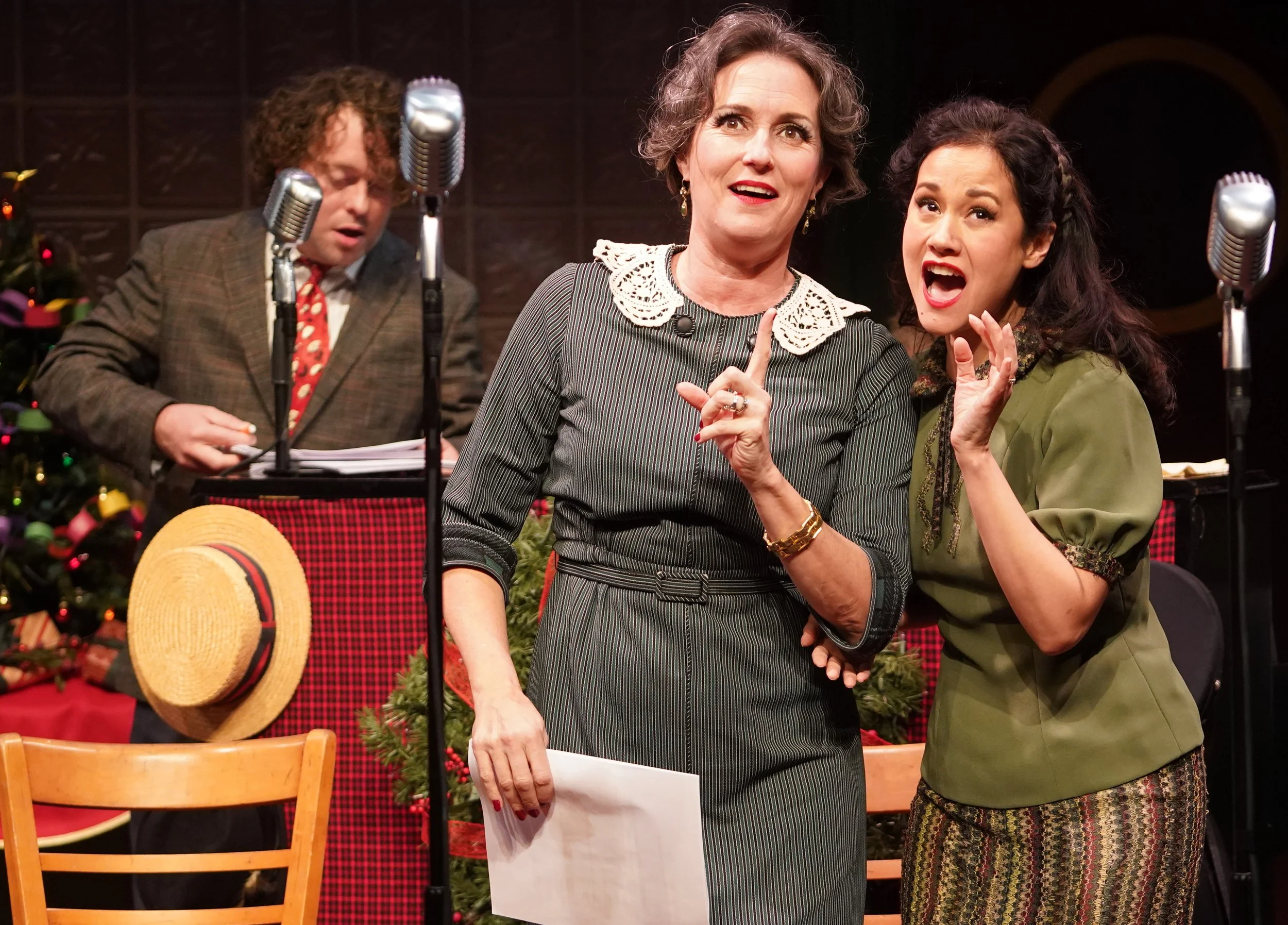
Leenya Rideout (center) and Ali Ewoldt (right), as radio show performers, sing a commercial-break jingle while ensemble member Ashley Robinson prepares for a scene in It’s a Wonderful Life! A Live Radio Play.
When Frank Capra’s It’s a Wonderful Life premiered a few days before Christmas in 1946, New York Times reviewer Bosley Crowther was not exactly filled with glad tidings. “The weakness of this picture,” he bah-humbugged, “is the sentimentality of it—its illusory concept of life.” He observed that the small-town denizens represented in the film, “all resemble theatrical attitudes rather than average realities.” In a return engagement of Irish Repertory Theatre’s It’s a Wonderful Life! A Live Radio Play, Anthony E. Palermo’s adaptation of the film’s screenplay unapologetically leans into the sentimentality and accentuates the theatrical attitudes to deliver a sparkling and joyful Yuletide delight.
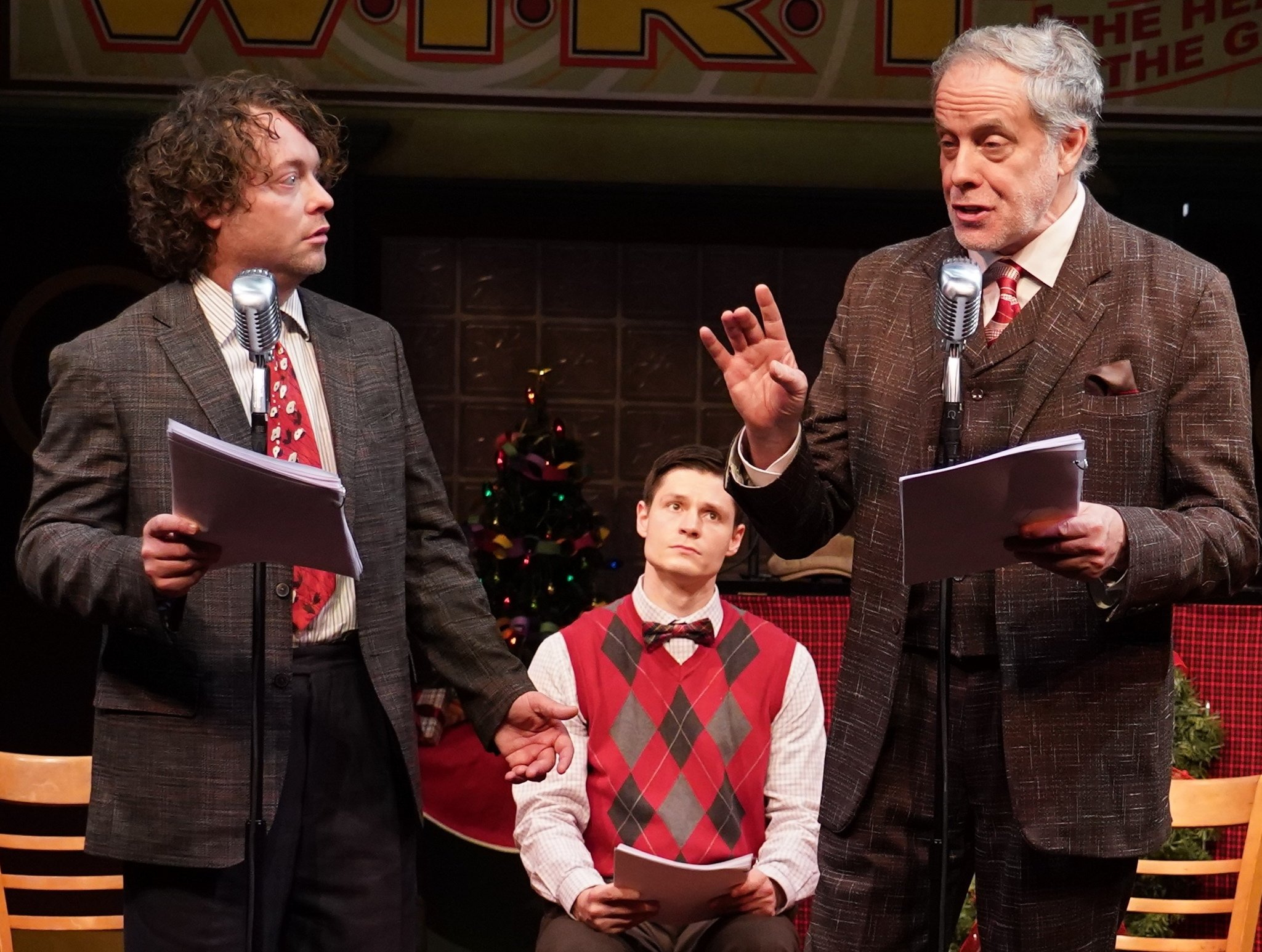
Robinson (left) plays Clarence, an angel second class, while Rufus Collins (right) the Angel Superintendent. Reed Lancaster (center), who reads the part of George Bailey, looks on.
Set on Christmas Eve in 1946, the play takes place in the WIRT (referencing the theater’s initials) radio studio. (James Morgan’s set, Michael Gottlieb’s lighting, and David Toser’s costumes perfectly capture the milieu.) The show’s pianist and musical director, David Hancock Turner, enters first and warms up with a few seasonal tunes. The studio actors gradually file in and, with scripts in hand, take their places for the evening’s show. Announcer Freddie Filmore (Rufus Collins) instructs the theatregoers (doubling as the live studio audience) on responding appropriately with guidance from the applause sign hanging above the stage.
It’s a Wonderful Life lends itself beautifully to the radio-show treatment. The plot is structured around narration by the Superintendent of Angels (Collins), who details the key events in the life of George Bailey (Reed Lancaster) to Clarence (Ashley Robinson), an angel eager to earn his wings. The story unfolds in a series of dramatic flashbacks leading up to George’s intention to commit suicide. There is a succession of snapshots of life in Bedford Falls, N.Y., starting with George’s boyhood. In the earliest episodes, he saves his brother Harry (Robinson) from drowning and later averts catastrophe when a grief-stricken pharmacist mistakenly fills a prescription with poison.
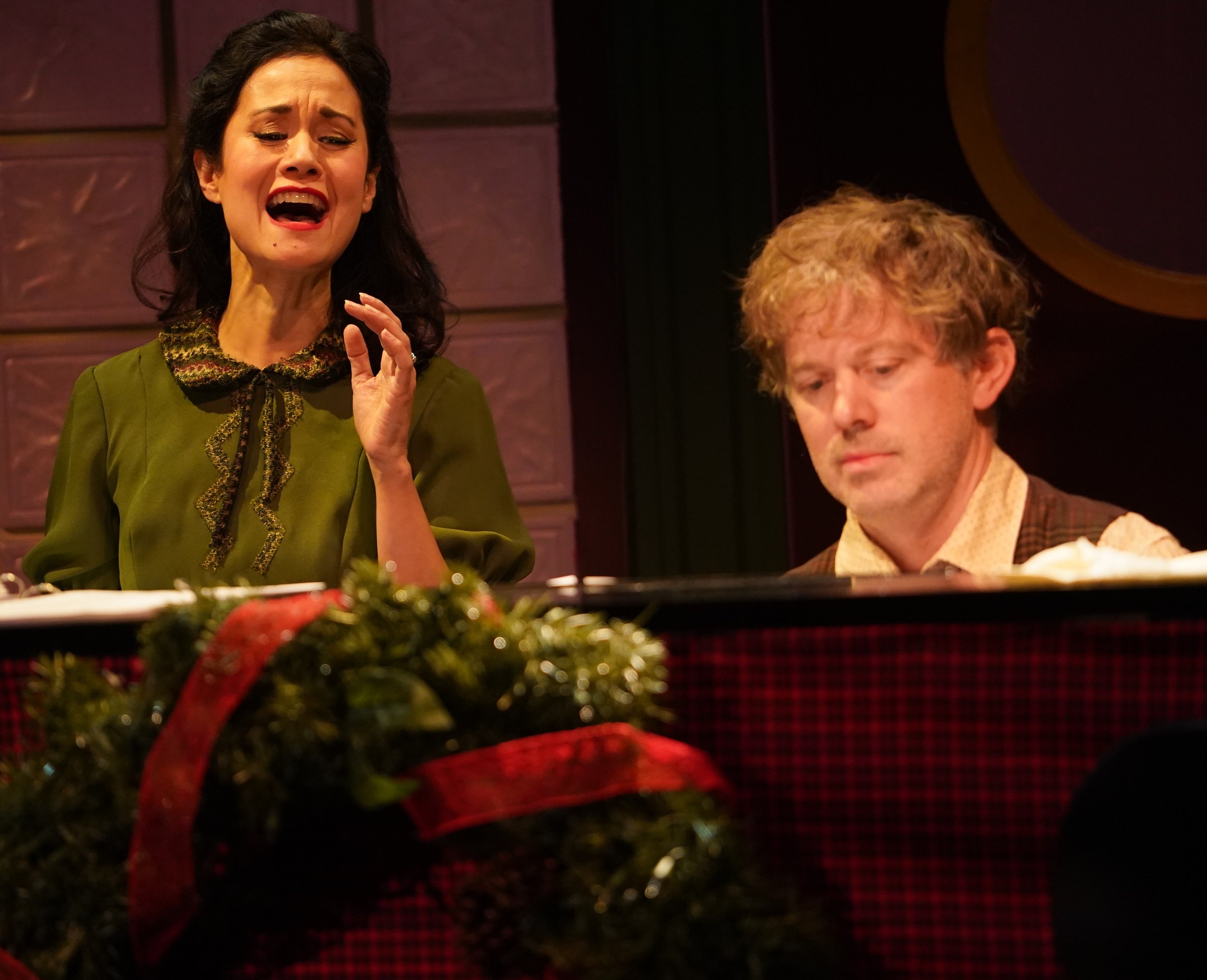
Ewoldt and music director David Hancock Turner perform holiday standards. Photographs by Carol Rosegg.
Still, George has big dreams, declaring, “I’m leaving this crummy little town. I want to see the world! Italy! Greece! The Parthenon! And that’s just this summer!” But it’s not to be. He is tied to Bedford Falls, trapped by the constraints of running his deceased father’s building and loan business. He marries Mary Hatch (Ali Ewoldt), raises four children, and throughout his adult life, George is the primary buffer between the town’s residents and the villainous Mr. Potter (Collins).
Under Charlotte Moore’s affectionate direction, the production is imbued with multiple levels of nostalgia, like a set of nesting gift boxes. Theatergoers familiar with the film (and who isn’t familiar with the film?) will listen to the staged reading and bring to it their own indelible visuals, including an ebullient Jimmy Stewart running through the streets of Bedford Falls with a new lease on life.
The radio drama conceit is a throwback to simpler, less technologically advanced times. Cleverly, the actors serve as Foley artists, providing the sound effects of footsteps, creaking doors, and breaking glass, to list just a few. Furthermore, Florian Staab’s sound design mimics the sonorous vocal soundscape of a 1940s radio broadcast.
There are also several commercial breaks that cheekily reflect a more innocent era. For instance, one of the advertisements extols the smoking pleasures of Lucky Strike cigarettes, which “twenty thousand doctors recommend!” Accordingly, the ensemble (featuring Leenya Rideout) cheerfully sings a parody of “Zip-a-Dee-Doo-Dah,” (with updated lyrics by Moore): “Zip-a-dee-doo-dah, zip-a-dee-ay / Light up a Lucky, have a wonderful day.”
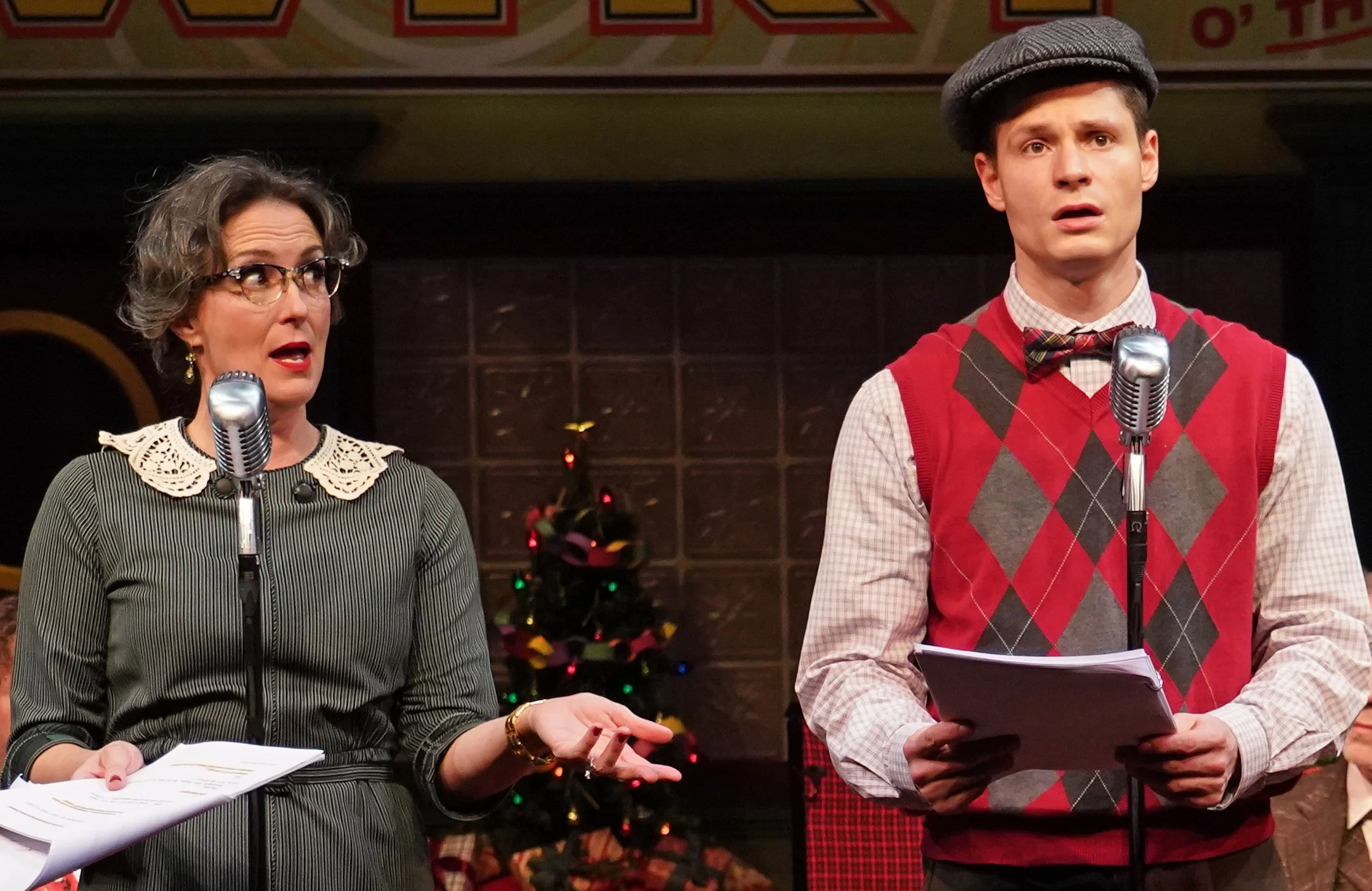
George contemplates a life in Bedford Falls as his mother (Rideout) appeals to his familial loyalty.
Finally, the program interpolates several wistful standards of the pre–World War II period, such as “Look for the Silver Lining,” “We’ll Meet Again,” and “Keep the Home Fires Burning,” that supplied emotional comfort and demonstrated the country’s resilience during difficult times.
The cast is outstanding, and they effortlessly transition between their numerous roles and assignments. With eyes closed, the company sounds like a cast of dozens, but there are just five. In the central part of George, Lancaster elicits Jimmy Stewart’s characteristic stammer and folksy cadence while avoiding mere impersonation or pale imitation. He effectively balances the character’s moodiness and simmering frustrations with his innate optimism and everyman quality.
At just over an hour, the show offers a fully satisfying theater experience. Indeed, it is quite gratifying to step back into a mythic postwar America, even if it is an “illusory concept of life.” This visit to WIRT studios is worth the trip, but be sure to bring plenty of hankies.
It’s a Wonderful Life! A Live Radio Play runs through Dec. 31 at the Irish Repertory Theatre (132 W. 22nd St.). Evening performances are at 7 p.m. Tuesdays through Saturdays; matinees are at 2 p.m. on Wednesdays and Saturdays, and at 3 p.m. on Sundays. For more information and the schedule of performances during the week of Christmas, visit irishrep.org.
Playwright: Anthony E. Palermo
Director: Charlotte Moore
Set: James Morgan
Lighting: Michael Gottlieb
Costumes: David Toser
Sound: Florian Staab
