


Musical

‘9-to-5 Clerical Poets’

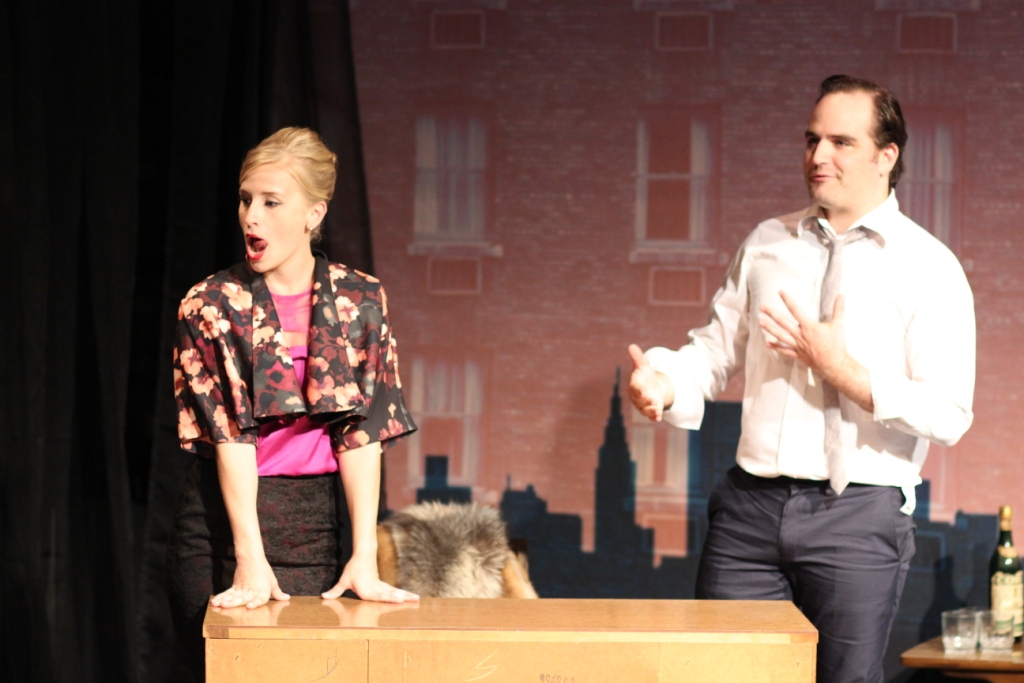
Someone To Belong To, a self-proclaimed, “sweet little love story,” starts out with lyrics that are sure to cause any New Yorker sitting in the audience to nod their head in agreement. “A typical day in New York is no cause for popping a champagne cork,” sings the ensemble. Based on the book by Lori Steele and Christine DeNoon, this new musical with music and lyrics by David DeNoon, has its celebratory moments.

Set in 1963, Someone To Belong To revolves around two love stories involving four main characters. Davis (played by Chris Ware), a writer who feels he’s wasting his potential working in an advertising agency, falls for his often-frazzled but endearing secretary, Annie (played by Samantha Eggers). Unfortunately, Annie becomes engaged to cheesemaker Ted, played to comedic perfection by Jonathan Desley. Two other copywriters at the advertising agency, the strong and determined Lois (Katherine Henly) and the ladies’ man Joe (Justin Colombo) are in an open relationship. This works for the two non-committal flirts until Joe realizes he may have fallen in love. The core cast is solid but the real standout is the hilarious secretary Miss Sasslebaum, played by Carla Nager.

When Christine DeNoon’s father, David DeNoon, passed away, she had no idea that he had penned over 100 songs. Upon finding them in 2012, seven years after his death, she decided that they deserved to be heard and gathered a team to shape 11 of his songs into a musical. The show’s memorable anthem, “The Great American Would-Be Novelist,” essentially tells the story of DeNoon’s real life. A talented songwriter, DeNoon, like the character Davis, felt trapped working as a copy editor at an advertising agency. 

Many of DeNoon’s songs contain clever, catchy lyrics such as “Here’s To Manhattan,” “Some Get The Bumpy” and “Don’t Bad-Mouth New Jersey” while others leave something to be desired. Christine DeNoon, who has experience in improv, certainly injects some laugh-out-loud lines to the script, though sometimes the jokes are somewhat cheesy (literally “You don’t like cheddar? But cheddar makes everything better! Hot damn I’m on a roll!”).

For a small New York International Fringe Festival production, the lighting, choreography and costumes are all commendable. Director Leslie Collins does a great job with the show, which while predictable, leaves audiences smiling as the curtain closes. 

But as you understand the love-lives of Davis, Annie, Joe and Lois, you can’t help but feel that the better story already took place, when Christine DeNoon discovered her father’s binder of songs and decided to bring them to life.

Click for print friendly PDF version of this blog post

Mommas on the Prowl

It seems hard to believe that Cougar the Musical is celebrating a year’s run Off-Broadway at St. Luke’s Theatre. The show brings to mind those mismatched couples one sees periodically who provoke the thought: “What’s she doing with him?” (Or vice versa.) In this case, the unprepossessing half is the show itself, a smartly crafted, moderately pleasant musical comedy about three women who seek sexual liberation in middle age.

The women — Clarity, Mary-Marie and Lily — are played by actresses who have been with the show from early days (respectively, Brenda Braxton, Babs Winn and Mary Mossberg); they are joined by a newcomer, Andrew Brewer, who plays a variety of young studs (and one female). Collectively, they are the element that makes one’s head turn — superb talent making a good deal of hot air seem like it's propelling a shiny zeppelin.

Written primarily by Donna Moore, with additional music by Mark Barkan, John Baxindine, Arnie Gross, Meryl Leppard and Seth Lefferts in a variety of combinations, Cougar has the requisite “he done me wrong” song, as Lily, having filed divorce papers, finds herself in the dating pool again and attending Over 40 and Fabulous meetings. Mary-Marie is the wealthy proprietress of a bar for older women, a “den of antiquity”; although she is persistently wooed by the unseen Frank, she resists dating a man her own age (54) and is determined to find a young stud for sex. The third heroine, Clarity, is a self-possessed career woman who has raised her child and denied herself any physical relationship, apart from one with a personal mechanical device, which she sings about in the evening’s most cringe-inducing song, “Julio.” But Braxton radiates so much class that she makes it palatable — barely.

The women all connect in a manicurist’s office, and the song they sing there, “Shiny and New,” is one of the highlights of the show. In fact, the female power anthems — “I’m My Own Queen,” “My Terms,” “Love Is Ageless” and “Say Yes” (whose sentiment uncomfortably echoes that of “Yes” from John Kander and Fred Ebb’s 70, Girls, 70, and is used in the same preachy, affirmative way) — are less interesting than the ones that have to do with character.

One of the best of them is “Let’s Talk About Me,” a Cole Porter-ish list song that name-checks Alvin Ailey, Eva Gabor, Stephen Hawking and Manolo Blahnick, among others, in its clever lyrics. It’s sung by Lily and Buck, a would-be actor who’s working as the bartender at Mary-Marie’s watering hole, and Brewer and Mossberg lend a delicate touch to the romantic banter so that you’d almost think they were the leads in a Porter show.

The songs, however, are hung on a book that often settles for sitcom humor. When Lily meets Mary-Marie and tells the story of how she was shoehorned into the role of mother and housekeeper, she says, “I was doing time.” “Prison?” asks Mary-Marie. “Marriage,” says Lily.

To be fair, a large portion of the audience was having a great time, applauding at the message songs and even lending an occasional shout-out. It’s a truism that the right casting is the most important element of any project, and director/choreographer Lynne Taylor-Corbett certainly deserves credit for her finds. Winn, with a resemblance to Betty White, summons memories of Sue Ann Nivens, the middle-aged man-trap that White embodied on The Mary Tyler Moore Show. Winn is an adroit physical comedian and, like the others, possesses a strong singing voice. As Clarity, Braxton is a crisp, composed presence and the real belter; although the lady is well into middle age, her looks scream, “Thirty-five, max!”

Mossberg’s Lily is a likable linchpin, yet the actress can’t really put over Lily’s life-changing decision about Buck. The notion that an older man and a much younger woman might be emotionally and intellectually soul mates was the core of Woody Allen’s Manhattan back in 1979. That resolution was a daring choice of hope and affirmation, in spite of uncertainty. In 2013, the authors of Cougar advocate a woman’s right to pair with a younger partner, then undercut their message with a plot twist that feels bourgeois, defeatist and unsatisfying, no matter how they spin it.

Brewer, with less than a fortnight under his belt, has seamlessly integrated his characters with the others, and his roles give him ample opportunity to display a wide-ranging talent. His Buck is low-key and genial, while his Latin lover is a bit more high-strung and polished. He delivers hard-boiled noir dialogue adeptly (in a scene that seems out of place), and he sings and dances with panache. He has the looks of a leading man — specifically, Ryan Reynolds, with whom he also shares splendid comic chops. Like the women, he deserves a bigger show for his talents. But for now, they are burnishing Cougar the Musical, and that’s reason enough to check them out.

Click for print friendly PDF version of this blog post

Revels in a Grey Area

The satirical musical Cuff Me: The Fifty Shades of Grey Unauthorized Musical Parody has popped up almost as quickly as a topical bit on Saturday Night Live, and it’s best, perhaps, to think of it as a goofy SNL sketch that lasts 90 minutes. Fifty Shades of Grey, is, of course, the 2012 erotic trilogy by E.L. James about the initiation of its heroine, Anastasia, into submissive sex with the rich, handsome Christian Grey. By many accounts—including those of the narrators of Cuff Me—James’s self-published works feature turgid writing, light-years from the explorations of sex written by D.H. Lawrence or Henry Miller. But then who would come to Lady Chatterley’s Lover: The Unauthorized Musical Parody? Probably not the middle-aged to elderly women who lined up after the show to have their programs signed by the charming cast of four.

Any parody promises silliness, and Sonya Carter’s production delivers. Carter keeps the action moving at the speed of farce, which is a good thing, because the plot neither requires nor deserves a lot of thought. The show is at its strongest musically; the writers Bradford McMurran, Jeremiah Albers, and Sean Michael Devereux have fitted their lyrics to well-known pop hits, from Madonna’s Like a Virgin to Frank Loesser’s Baby, It’s Cold Outside to La Vida Loca. (On occasion, however, the lyrics are hard to follow, partly because of the swiftness and partly because of the sound design.) The choreography, which is uncredited, suggests that the energetic cast all have advanced degrees in writhing. They also wiggle, jump up and down, swivel their hips, and occasionally twist nipples. The abundance of pelvic thrusts, flicked tongues, and hands smoothing torsos may grow overly familiar as the show progresses, but then sex is the only topic at hand. 

The action is framed by two women in bright track suits who meet in a nail salon. One (Tina Jensen) is unfamiliar with the story; the other (Alex Gonzalez in drag) undertakes to explain it. And as she does, the story of Anastasia and Christian unfolds.

As Anastasia, aka Ana, the lovely Laurie Elizabeth Gardner has lungs of iron that can belt out a number. In addition to her looks and voice, Gardner has the twin gifts of great comic timing and being a dexterous physical comedienne. She seems to have modeled Ana on Goldie Hawn, right down to Hawn's giggle from Laugh-In. Whether or not that’s true, her interpretation of a dumb bunny is spirited fun. A sample exchange:

“I’m having a problem with my phone,” Ana tells her best friend Kate. “Spotty reception?” Kate asks. Ana: “No—I’ve never been good at math.”

Matthew Brian Bagley as Christian plays with a drier humor. His aloof hero is less frenetic, often a straight man to Gardner’s idiocy, and there’s a running joke that he’s not gay. When Ana pointedly asks him if he is, he says, “What I do in the confines of my bedroom with other guys is none of your business. And it doesn’t make me gay.” Still, there are several indicators, among them a super sight gag from set designer Josh Iacovelli as Christian sits at a café table. (Costumer Riona Faith O’Malley matches him with a sartorial gag of her own.)

The two supporting players—the chameleonic Rodriguez and the plus-size Tina Jensen, undertake a variety of characters with elan. Rodriguez is particularly good as a Zumba instructor and a lawyer named Willy Blowman, and if you can spot the double entendre, be assured there are many more on the same level. The latter, in addition to the nail salon client, plays Ana’s inner goddess, and her best friend, Kate, and has a singing voice as powerful as Gardner's.

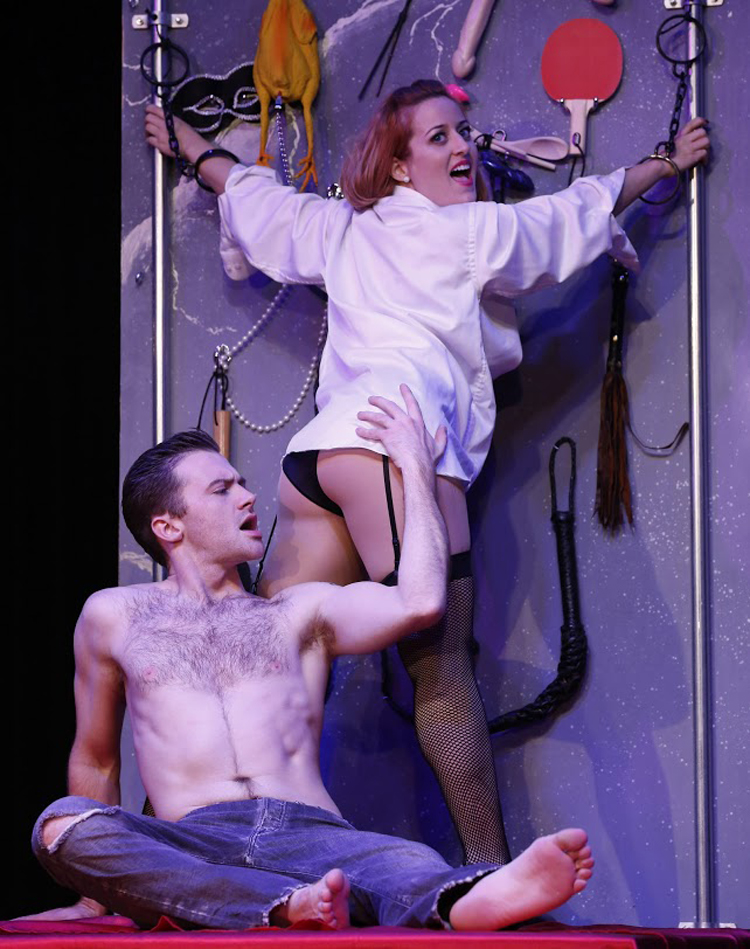
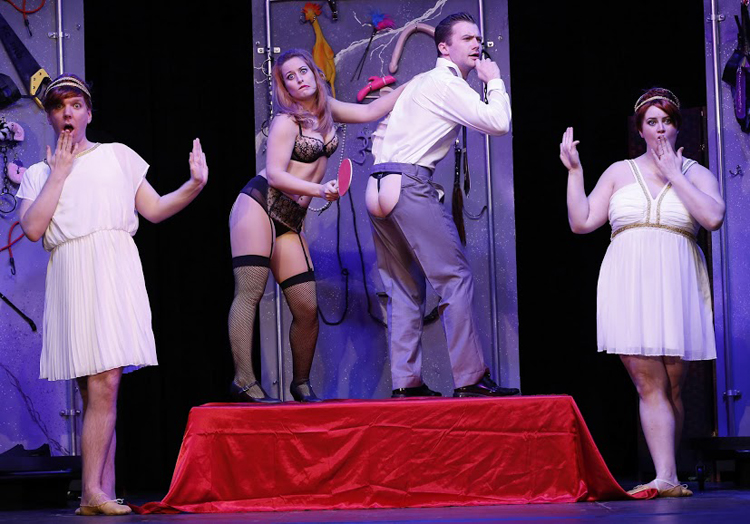
Under Carter’s direction, the predominant tone is hysteria. The story hurtles forward, and the jokes seem to be thrown out to see what will stick, as if her template were the wall of the sex shop on stage that displays a wild variety of fetish paraphernalia. Nothing is taken too seriously, not even the show itself, as characters periodically break the fourth wall: When Blowman misunderstands an order from Christian, he is told, “Not you. You have a quick change.”

For a show extolling sex, there’s very little, in fact. Gardner gets down to black undergear and garters, and Bagley does a strip to briefs and plays a late scene bare-chested, but Fifty Shades is about fantasy, anticipation, and expectation. That said, some of the elements, particularly a contract that Christian wants Ana to sign to be his submissive, sit uneasily with musical comedy. An audience used to, say, Guys and Dolls, will find language and descriptions of kinky behavior far beyond mainstream limits of bawdiness, let alone good taste.

Still, it’s not likely Fifty Shades will be more than a musical of its moment, and already a fleeting one at that. But it provides an impressive calling card for four talented performers, and some lowbrow fun with a frisson of transgressive pleasure.

Click for print friendly PDF version of this blog post

Little Girl, Big Show

Laura Ingalls Wilder’s long life on the frontier certainly provided her with plenty of storytelling fodder – enough, at least for eleven novels and ten television seasons. And yet somehow, when many of the early highlights are compressed into one piece, as they are in Little House on the Prairie – The Musical,” currently playing at the Paper Mill Playhouse, the work feels oddly lacking. It is likely that the creative team of this family-friendly musical relies too heavily on fans of the long-running television incarnation, which starred Michael Landon as Pa Ingalls and then-child star Melissa Gilbert as protagonist Laura, to be the chief audience. Well, Gilbert may be all grown up, but she’s still attached to the Prairie. Now, she plays Ma Ingalls, a much slighter role, but one that nonetheless is designed to draw in nostalgists.

I say this because the show does very little to stand on its own. Despite a long out-of-town tryout process – Prairie has already played the Guthrie Theater in Minneapolis and has replaced much of its original book and score – the show still plays as though it is in draft form. Rachel Sheinkin replaced Pulitzer Prize-winning playwright Beth Henley, the original scribe who first helped shape the musical, and perhaps some of her narrative grace notes went with her. (Donna di Novelli provides the lyrics.) The current result plays mostly as a checklist of boldface events from the early novels.

I say “current” because I firmly believe that Prairie still has plenty of room to grow. It certainly isn’t lacking in talent, particularly in the form of Kara Lindsay in the leading role of Laura, a precocious young tomboy. Over the course of the show, Laura learns to mind her parents and schoolteachers, support her family when older sister Mary loses her sight, make amends with nemesis Nellie Oleson, feels the joy of breaking through to schoolhouse pupils, and even finds a love of her own (there’s little mystery as to who the lucky guy might be when the talented Kevin Massey first appears as Almanzo Wilder.) Lindsay, who is also a terrific singer, ably plays beneath her real age, and gradually bridges Laura’s maturation in ways the episodic script doesn’t provide for her.

But what the show cannot do is delve into the culture of the lifestyle it sets out to portray. Director Francesa Zambello erred in similar fashion with her last show, the musical adaptation of The Little Mermaid. Both shows impress as spectacles, but offer less beneath the surface. The technical elements are there, but they lack inspiration. Similarly, Michele Lynch choreographs several professional ensemble numbers, but they feel rote and do little to enhance the story.

As a result, one never feels the hardship of prairie life, even as a raging fire destroys the Ingalls’ wheat prospects, nor does the viewer get the chance to fully grasp the details of the Homestead Act that grants the Wilders and the other settlers their right to sojourn to the unsettled Dakota territory in the first place. Instead, the audience is stuck watching them from afar, as events befall the Wilders in too fast and frequent a manner. The view gets a little better in Prairie’s slightly protracted second act, when Laura comes into her own as both teacher and woman; one hopes that this storytelling sensibility will work its way into more of the show as it continues its run.

Nonetheless, Alessa Neeck and Carly Rose Sonenclar hold their own with the material as Laura’s sisters, and Loprest acquits herself well as the mischievous Nellie. Steve Blanchard is a solid Pa Ingalls. In fact, the weakest link in this musical chain is actually Gilbert herself. The actress handles her dialogue with the ease of a pro, and proves she can dance with the best of them during the show’s curtain call, but her talk-singing though the show’s eleventh-hour number, “Wild Child,” leaves a bit to be desired.

Still, there is nothing in Prairie that cannot be improved with some effort. The Ingalls’ journey is one worth taking, and hopefully, one that will continue to improve in time.

Click for print friendly PDF version of this blog post

Cruel to Be Kind

In plays such as Fat Pig and Reasons to be Pretty and similarly dyspeptic films like In the Company of Men, playwright Neil LaBute has spared no mercy in displaying just how cruel man can be, invading the dark corners of the mind people keep hidden from strangers and shining a bright light upon them. bash, one of LaBute’s earlier works of note (it debuted Off-Broadway a decade ago featuring a searing cast that included Ron Eldard and Calista Flockhart), is perhaps one of his most searing. Director Robert Knopf certainly holds nothing back in Chris Chaberski's and Eastcheap Rep’s current production, running at Tom Noonan’s Paradise Factory.

The show is essentially a triptych of three extended monologues. Though the order has changed in various productions, the first of the three scenes I saw was “Medea Redux.” It features a lone woman, matter-of-factly addressing the audience about a sexual relationship she had with her teacher when she was thirteen years old. The unnamed woman ultimately becomes pregnant from this relationship, but keeps the child and defends this teacher, even though the two eventually become estranged.

Chelsea Lagos plays the woman in a performance that’s part endurance test and part act of deception: her character tells us a lot, and does so in very carefully measured amounts, but what is most important is what she doesn’t tell us. LaBute’s most important character attributes lie in what remains unsaid. It isn’t that his narrators in bash are unreliable, but that what we see is not totally what we get. The playwright wants us to dig in between the lines and come up with our own conclusions, forcing us to turn a mirror on our own dark impulses.

Take, for example, the next monologue, “Iphigenia in Orem,” starring Luke Rosen as Young Man. Rosen, in a wonderfully polished performance, recounts to an unseen party (and really to us) how a practical joke between himself and a work colleague escalated severely. As with Lagos’ Young Woman, circumstances eventually escalate to the point where the Young Man makes a shocking decision. This is shocking not just because of the weight of the decision, but also jarring because his assured delivery doesn’t fit that weight appropriately.

More than most of LaBute’s plays, including his later Wrecks, bash reflects the playwright’s dexterous ear for language and imagery. He knows how to make these long scenes more palatable for his less auditory audience members. Throughout the play, he subverts the major events of each monologue. His characters gloss over heavy subjects effortlessly – sometimes Lagos and Rosen display sweetness or fondness when describing difficult certain choices they have made – and speak in a lilting, lyrical way.

Knopf also demonstrates real style for each monologue. Each scene feels perfectly paced, and make the seemingly impossible possible: he finds a way into each character that not only hooks us in, but makes us care regardless of the information we get from them. We feel the pain, shame, foolishness and regret that these characters have experienced at some point in the stories they share.

And it really does feel like sharing. Throughout the performance, we feel as though we are right there witnessing the acts discussed in the play, rather than simply hearing accounts of past incidents. Nowhere is this more paramount than the second act monologue, “A Gaggle of Saints,” in which Lagos and Rosen play Sue and John, a New England couple who recount a disturbing trip to New York in ways that contradict each other while filling in missing blanks.

Lagos and Rosen are perfectly cast in each of their two roles. They both feel completely honest and lend an enormous amount of credibility to their respective pieces of the show. Additionally, Jessica Fialko’s design deserves mention, particularly the lighting, which becomes a character of its own during the performance.

Perhaps the most alarming about bash may be the same thing that makes it the most successful. Knopf’s production shows that, while cruelty can take many different forms and occur in a variety of different situations, it is something that lives in all of us.

Click for print friendly PDF version of this blog post

Nightmare Scenarios

Two men in grim, adjacent cells talk to each other through prison walls. They have been incarcerated for years and are repeatedly tortured for information—or rather, initially for information, but now pointlessly, as a distraction to their tormentors. The men in this Kafkaesque nightmare are named Valdez and Wallace. Wallace calls Valdez “Mr. Valdez,” but Valdez is more casual and uses “Wallace.” To pass the time, they speculate on what they don’t know—The Unseen of the title. Dramatist Craig Wright’s Kafkaesque situation invites some comparison with Samuel Beckett’s Waiting for Godot, whose characters also wait in uncertainty and near despair for some resolution to their fate. The Unseen is bleak but not depressing, and it feels especially timely and universal in Lisa Denman's taut, riveting production. The men might be in Abu Ghraib, or Guantánamo, or any number of hellholes around the world. Their names, too, suggest a breadth of places the action might be occurring. "Valdez" calls to mind a banana republic; "Wallace" might be American or British, of which neither nationality has escaped accusations of torture in the struggles with Iraq and the IRA, respectively; and their guard, Smeija, has a distinctly Slavic name that summons up the brutality in the Balkans in the 1990s.

To pass the time, Wallace and Valdez exchange words in shorthand about their torture: “Trips to the sink, making knots … twice, the whole drooling gang…” Wright leaves it to the listener to surmise the specifics of the horrors they endure. The men play an old game that starts “I went to the ocean and took…,” and they list various objects whose names must be in alphabetical order. They speculate on whether the prison layout is irregular or not. “We don’t know the structures or rules,” says a worried Valdez. “We don’t know the grand design.” (His point is skillfully demonstrated by Sarah Brown in her asymmetrical set.)

Wallace moves objects on the floor of his cell—saucers and a piece of chalk and other objects—in a pattern that only he understands. Suddenly he announces that they must escape that day, that all the signs point to its being their only chance. But a visit from the hulking, black-masked thug Smeija, nicknamed “Smash,” reveals that Wallace’s sanity hangs on a thin thread.

Smash is not only a guard but one of their torturers, and Wright indulges in pitch-black humor as Smash (played with frustration and intensity by Thomas Ward) complains that he’s been too nice to them and is being punished with double duty on his birthday. Wallace tries to butter him up—“We’re here for you”—but it doesn’t work. “All you people think about are yourselves,” fumes their anguished inquisitor. “No one with a heart is safe around you people.”

Steven Pounders as Wallace captures his character's suspicion and confidence, with a streak of arrogance; he’s not sure that Valdez isn’t a spy. Valdez (Stan Denman) has opposite qualities: he is more upbeat and hopeful, certain that someone is in the adjoining cell and aching to make contact. He’s open enough to admit that his captors don’t trust him because they think he lies—even though his admission jeopardizes Wallace’s trust in him.

As time passes, Valdez exhibits his own delusions with a theory of a vast array of tunnels under the earth with the entry points in graveyards that is just as chilling as the moment that Wallace accidentally learns that his hope of escape is built on an illusion.

Both actors, superb in their roles, seem to have done their own makeup just as superbly. They look like victims of brutal beatings, with scars, welts and bruises disfiguring their bodies; costumer Carl Booker’s torn and shredding clothing matches their skill.

Although the physical action is limited, Wright’s dialogue takes up the slack with unexpected lyricism, from the story of a button that Valdez’s mother has taught him, to Smash’s gruesome descriptions of what he has done to a prisoner. And his ending suggests, hopefully, that somehow humanity can never be extinguished, that an unseen spark survives even in the most inhumane circumstances. The play may be short, but it packs a wallop.

Click for print friendly PDF version of this blog post

The Wonderfulness of Helplessness

A woman is buried to her waist in a pile of dirt. A bright blue painted sky stretches behind her and the sun constantly beats down upon her. She is awoken by piped in buzzing sounds. Though stuck in the mud and controlled by unseen forces, she seems quite okay with her situation and proceeds to go about her day to day routine. Reaching into a tote bag, she pulls out an unusually long toothbrush and a tube of toothpaste. Much time is spent attempting to read the writing etched into the handle of the toothbrush but to not much avail. The woman, Winnie, forgets what she has deciphered once she has deciphered it. Samuel Beckett’s Happy Days makes no attempt to explain why Winnie is buried the way she is. It is this lack of explanation, prevalent throughout his work, which makes Beckett a challenging figure and why his plays are tricky to produce. People want explanations, but like life itself, Beckett offers none. The play is often looked at as a comment on the human condition: a true expression of the absurd. We have no idea why we are here, might as well ramble on about it, might as well accept the circumstances as they are (even if that means sinking into a pile of earth). And yet, although the play comments on the human condition, Winnie’s experience is so far removed from what a typical person would experience that it is difficult to relate to her. Furthermore, Beckett’s stream of consciousness style occasionally goes in and out of one’s ears, with occasional phrases burrowing deep into the brain but with the majority leaking back out again.

Here would be where quality directorial choices and a strong performer would come into play. The goal is to make all the words stick, to engage the audience through the magic of theater. Intentional Theater’s production is almost completely able to make the play engaging and relatable. The show makes use of Beckett's production notebook from a 1979 performance in London. Winnie's mound is the same but the props are a real standout. They are surrealistic, elongated forms. Winnie’s mirror is about 2 inches wide yet has at least a foot-long handle. Her sun shade is a not very wide, crocheted parasol, a visual reminder of its uselessness against the constant sun. The deformed props highlight the futility of her condition. She can't read the toothbrush; she can barely use it to brush her teeth.

One occasionally feels sympathy for Winnie, as she tells stories from the past, as she calls out desperately to Willie, her husband, who lives in a hole behind the mound of earth. All that is seen of Willie, for the most part, is the back of his head and his papier mache boater hat. Asta Hansen brings a vulnerability to the role of Winnie that is quite appropriate, but occasionally the actor breaks character. There was a very audible line prompter hidden under the mound at the reviewed performance, and, suddenly, Winnie’s pauses were simply an actor forgetting her lines rather than an artistic choice.

Beckett is bleak. And yet, for that, each of his plays has some element of physical comedy, perhaps because comedy finds its base in sadness. Winnie digging through her props is one element of this. So is Willie's toying with his hankerchief and boater. Unlike Winnie, Willie is free to move about, and his flopping and climbing lighten the proceedings considerably. An accurate depiction of the frustrations and struggles of life, Happy Days is a must-see for anyone who has ever questioned their existence and then paused to smile about it.

Click for print friendly PDF version of this blog post

Puppets without Masters

When the curtain rises in the Czechoslovak-American Marionette Theatre’s production of The Historye of Queen Esther, King Ahasverus and of the Haughty Haman, four magnificently tall and colorful puppets dominate the stage. The puppets, like their human actor counterparts, are large-scale representations of the play’s main characters, and throughout the show echo the stage action like extended shadows. Unfortunately, these puppets are the most exciting aspect of the show, an awkward and lackluster take on an incredibly dated piece of 18th-century folk theater. A hit on the traveling marionette show circuit in the 1700s, The Historye of Queen Esther is based on the Bible’s Book of Esther. In the biblical telling, King Ahasverus of Persia holds a contest to name a new queen after his wife, Vashti, refuses an order to display her beauty for the King’s guests. The winner of this contest is Esther, a gorgeous young Persian woman who happens to be of Jewish descent, a fact she hides from the king, as advised by her stepfather Mordechai. Sitting near the palace gate one day, Mordechai overhears two royal attendants plot to kill the King. He reports their treachery, and they are executed. Mordechai’s respect for the King, however, does not extend to his prime minister, the haughty Haman. When Mordechai refuses to bow before him, Haman vows to kill him and obliterate his people, the Jews. Fortunately, the King learns of Mordechai’s honorable deed and vows to reward him, foiling Haman’s efforts. This leads Esther to reveal her true heritage, and the King amends Haman’s decree against the Jews, allowing them to defend themselves against persecution. He also orders Haman’s execution.

Incorporating stock comical characters, goofy word play, and distractingly loud instrumental accompaniment, the Czech Marionette Theatre’s take on this story is only slightly more chipper, retaining much of the content and structure of the Biblical version. Though the play ends on a happy note, with comeuppances to its villains, it isn’t really a show for kids, as it’s promoted to be. In addition to the on-stage hangings and Jew-hating, some of the verbal jokes involve advanced vocabulary that kids won’t understand, and punning that will make adults cringe. This is a shame, as children are likely the only ones to get much out of such a farce.

With children in mind, the play attempts to demonstrate a moral involving the danger of haughtiness, but it’s clear that the bigger issue is bigotry. The overwrought attempt to harvest a moral is just one problem. Whereas the moralizing is an oversimplification, the dialogue is a complication of a simple story. Theresa Linniham’s performance as Kasparkek (the Punch of the Czech version of Punch and Judy) is a welcome relief from the plodding tone. Though clumsy wordplay sometimes overshadows her skills at accents and clowning, she uses every opportunity to showcase her talents as a vaudevillian. Unfortunately, some of the other actors do not share her fluidness and eagerness to entertain, which further weighs the play down.

Though the Czechoslovak-American Marionette Theatre is known for its post-modern approach to puppetry, which involves the obvious presence of the puppet master, they do not use this style to their benefit here, and the actors are upstaged by marvelously clever-looking marionettes. Created by Jakub Krejci, Michelle Beshaw and Emily Wilson, the cast of puppets is widely varied and incorporates odd instruments to delightful, surprising effect. Some have chalkboards or violins for chests, plungers for legs, hammers for arms, dazzling beads for a bosom—all of which relate to the personalities of the characters in witty ways. It’s a pleasure to see a new puppet enter the spotlight, but, sadly, this satisfaction wears off once the puppet begins to speak.

Perhaps The Historye of Queen Esther is doomed by its dreary source material to be a heavy-handed attempt at dealing with the complicated historical attitude toward Jews, but one can’t help but wish that the Czech Marionette Theatre group applied the innovation that produced its puppets to the live performance. Whereas the plunger and hammer limbs of the marionettes move with grace, the human actors are stiff and dull. If a carpenter like Geppetto could work his magic on this show, maybe the wood and the flesh would work together in greater harmony, and the material wouldn’t seem so ancient.

Click for print friendly PDF version of this blog post

Father Figure

The title of Elyzabeth Gregory Wilder’s play Fresh Kills doesn’t refer to any recent murders, but that doesn’t mean her characters aren’t up to some very bad things. Director Isaac Byrne navigates a performance of palpable tension to show the dark places to which some people are capable of going, but while he is adroit at bringing the what of the play to life, Wilder’s failure to provide the why makes for a frustrating, though not unrewarding, evening. Occasionally, a show starts off strong but loses steam. That is not the case here, however. Fresh essentially begins in medias res; it starts in the middle of the action. The play finds its characters at a dramatically compelling crossroads, but fails to explain how they got there or where they are headed. It’s a great middle, but still in search of a beginning and end, the dramatic equivalent of an Oreo cookie with only the marshmallow stuffing.

Fresh Kills, playing at 59E59 Theatres, actually refers to the name of the Staten Island town where blue collar family man Eddie (Robert Funaro) lives with his wife, Marie (Therese Plummer). As far as we can tell, Marie is a compassionate, understanding wife, still in love with her husband, whose main concerns seem to be raising their child, keeping their house up and paying their bills.

Which is why it comes as a surprise to find Eddie picking up Arnold (Todd Flaherty), an underage male hustler, in his pick-up truck after finding him in a gay chat room. Is Eddie acting out on latent homosexual urges? Is he depraved? Merely curious? Wilder never clues the audience in as to what has drawn Eddie to seek out Arnold in the first place, or for how long he has been trolling the websites.

Nor does she adequately explain what lands Arnold in Eddie’s car. It is difficult to make heads or tails of what transpires between Eddie and Arnold, because their encounters never add up to a full affair. Then, before you know it, Arnold has ingratiated himself into Eddie’s family. Without seeing or knowing too much about Arnold’s home life, it is impossible to take him at his word, and so we never know if he is looking for a substitute family to replace his own disappointing one, merely pursuing his own sexual impulses, or if he is a deranged sociopath.

Flaherty fits the role physically – the dodgy look in his eyes suggests danger and instability – but the actor has a habit of garbling many of his lines and not always making the dialogue his own. Funaro, on the other hand, overcomes Wilder’s script deficits to peel back the layers of a confused, flawed man. While Wilder never provides sufficient context to explain how Eddie lands himself in such a threatening situation, Funaro does a brilliant job of showing Eddie’s agony with his current plight. It is a performance that is completely open and honest. Plummer, meanwhile, matches Funaro scene for scene in a resourceful performance that constantly stretches beyond mere “beleaguered wife” stereotypes.

Jared Culverhouse rounds out the ensemble in the pivotal role of Nick, caught in the middle as both Eddie’s best friend and Marie’s brother. Nick is a sea of volcanic rage, protective of Eddie yet loyal to Marie. His work further energizes the whole play (very well-paced by Byrne), and his versatility – dancing between comic relief and vitriolic intensity – textures what otherwise could have been a one-note work.

Byrne is to be complemented for staging such an arresting work in an intimate space (the audience sits on either side of the truck in the center of the theater), and Jake Platt’s lighting design goes a long way toward establishing the mood. Nonetheless, Wilder’s structure leaves many questions unanswered in Fresh. Wilder wants to explore what happens to people who pursue interests that run far afoul of what is considered acceptable by mainstream society, yet there remains far more territory to excavate.

Click for print friendly PDF version of this blog post

For Love and Theater

Playwright Itamar Moses puts it quite nicely when he states that “a short play is like a single.” However, unlike a pop single, which can often become more popular than the longer album format, short plays tend to get relegated to the dust bin, pulled out for One-Act Festivals in the summertime, maybe, but otherwise, playwrights tend to become known only for their longer works. This is a shame as there many truly delightful short plays. Thankfully, the Flea Theater is producing five of Moses' short plays in an evening titled Love/Stories (or But You Will Get Used to It). The Flea's downstairs space works well for the structure of the show — each play has its own section on the wide stage. A “Reader” guides the audience through the transitions and through the final play itself. The plays are thematically linked: they are about love. But not only just about love but about the inner workings of theater and perhaps how difficult it is for one to find love while working in theater. In the first play, “Chemistry Read,” a playwright is forced to watch the actor who stole his girlfriend audition for the lead role in his play. In “Authorial Intent,” the longest of the five plays, we are taken through the breakup of couple, first in regular format, then in highly theatrical and literary technical terms, then finally as the actors playing the actors stripped of their characters. “Untitled Short Play” is all about the writer's stress in attempting to write a scene for a couple at a cafe.

The plays all have charm and the actors are all very engaging and energized, but occasionally the meta- nature of the plays gets to be a bit much. “Untitled Short Play” is the most static of the plays, given that no action in the traditional sense occurs—it is a play “hijacked by its opening stage direction.” However, John Russo is vibrant as the Reader, hopping around the Flea's wide stage obsessing over what could possibly happen in the scene that never happens. One would like it if the “play” were to actually begin, but then again, the Reader is quite compelling and his complaints understandable.

The strongest of the plays is “Szinhaz,” which is structured as a talk show, with an actress, Marie, interviewing a brooding Russian director. The director, Istvan, only speaks Russian, or at least something that sounds Russian. Felipe Bonilla pulls off the “Russian” language, be it actual Russian or not, very well. Marie's attempts to translate Chekhov's titles from Russian to English are quite hilarious as well: The Garbage Bird and There are Sisters and There are Three of Them. “Szinhaz” deals with the relationship between what is created in the theater and what actually then begins to occur in real life: the way in which actors playing lovers occasionally fall in love offstage as well, as they have become so wrapped up in the emotions created for the theater.

Love/Stories (or But You Will Get Used to It) makes for an enjoyable night of theater, particularly for anyone on the “inside” of theater and for anyone who has ever been enchanted by love.

Click for print friendly PDF version of this blog post

Living Walls

Before New York’s financial world caved in on itself, the most ubiquitous enemy to the city’s longtime residents was its series of aggressive redevelopment projects. Its five boroughs may have risen in stroller-friendliness over the past decade, but the family businesses and community-specific traditions that once characterized its neighborhoods have now given way to drug store chains and luxury condominiums. A collective need to resist gentrification prevails as New York’s defining cause of social activism, and consequently is reflected in art projects conceived within the city’s borders. Such is the case with redevelop (death valley), a frenzied blend of video, photography, spoken word, dance and music playing at The Chocolate Factory in Long Island City. The scope of the project is ambitious to the point of feeling exhausting as it attempts to use this mishmash of artistic genres to create a parallel between local redevelopment projects and the impact of ghost towns on the American psyche. In its strongest moments, redevelop (death valley) reads like a cleverly conceived museum installation, but its lack of narrative clarity does more to jumble the goals of the piece than to inspire moments of a-ha.

Five performers roam about the stage during its roughly hour-long running time, but for most of it they are literally upstaged by an assortment of hanging, translucent panels that serve as projection screens and obstruct the audience’s view. Isolating the company’s performers with a plastic wall and offering the audience a partial, distorted view is a strategic choice that appears to be designed to trigger frustration. Just as the endless construction of sterile condominiums muffles the spirit of a neighborhood, these white panels invoke our curiosity, ruthlessly control our viewpoint, and distance us from the flesh-and-blood element of the piece. The metaphor is effective, but its execution also keeps the audience at a needless distance.

While most of the video and still photography images projected onto the panels depict elements of the performance space itself, from the five dancers’ quivering legs and hands to extreme close-ups of light beams, windows and radiators, the work is also punctuated by two lengthier, pre-taped segments. An interview with a longtime Long Island City resident opens the first half of the work, and the second half in turn begins with a series of video clips, images and commentary depicting abandoned desert towns.

While the opening interview suffers from sloppy editing that makes its subject appear excessively long-winded, the second documentary segment is arguably the most affecting part of redevelop (death valley). There’s an unexpected beauty to its images of abandoned houses, stripped of everything valuable and blending, like fossils, into the landscape around them. In this segment one can’t always make out the voice of the interviewee, but as the recorded sound of a distant highway grows almost unsettlingly loud, these words lose their importance.

Perhaps the only clear arc in Rogers’s piece is the gradual removal of these obstructing screens. Its five characters occasionally shut out one another’s access to the audience by putting up additional panels, but as the piece draws to a close, they move these screens, one by one, onto a pile on the floor. As we begin to see the oblong, tile-walled room in its entirety, another memorable image is revealed: the five performers have gathered around a dinner table in the far end of the space, chatting and pouring glasses of wine underneath a yellow light. In the center of the room is a pile of unidentifiable rags, and in front of the audience a narrow beam of rain pours on an abandoned tea set. Even if one isn’t quite sure of the meaning of this visual moment, it's difficult to forget.

Although the visual and audio elements of the performance appear to be carefully orchestrated, its use of words is its most notable weakness. When the five characters speak, it’s often almost impossible to make out their words, and when one does hear them, their context is unclear. The performance also tries to make use of a variety of spoken-word recordings, including FDR’s fireside chats and David Mamet’s Glengarry Glen Ross, but their meaning remains obscure and their presence only contributes to a viewer’s confusion.

It’s difficult, of course, to fault the Chocolate Factory’s artistic director Brian Rogers for his ambition, and I’m not sure that I would want to. Love them or hate them, works like redevelop (death valley) continue to challenge and expand the ways in which we perceive theater. The work itself may not always be relatable, but the artistic passion behind it certainly is.

Click for print friendly PDF version of this blog post

Lost on the Levee

The title may be the most engaging thing about Mark Sam Rosenthal’s exploration of Tennessee Williams’s greatest creation negotiating the aftermath of the 2005 storm. Blanche DuBois finds herself disheveled and in the Superdome after Hurricane Katrina hits New Orleans. But her experience seems refracted through that of author Rosenthal, as the play begins with him wandering through the debris, putting on yellow gloves and a filter mask to start cleaning up. Amid the muddy debris of the hurricane (Kevin Tighe’s willy-nilly piles of artifacts include an ornate portrait frame, a child’s bicycle, a blue rubber dildo, and Carnival beads), he discovers a pale green, pristine valise. When he opens it, a bright red, surreal light shines out. Inside he finds a blond wig and tiara; when he dons the wig, he becomes Blanche, riffing on her adventures with Stanley and Stella before the hurricane, in the Superdome, and with a FEMA roommate named Chandria d’Africa who is separated from her boyfriend Tyrece. The solo show becomes a dramatic stream-of-consciousness effort that not everyone may follow as Blanche encounters an assortment of characters and experiments with crack (and indulges in alcohol).

Blanche Survives Katrina… isn’t a drag show, though it reeks of camp. Rosenthal doesn’t trying to disguise his masculinity (at one point, his bare, hairy chest is covered only by a ragged shawl). The script is merely a meditation on the character in different circumstances, and one may surmise that Blanche embodies poor New Orleans itself.

Although Rosenthal's Blanche borrows phrases from Williams's heroine ("It just buzzes right through me," she says of the booze), the language here is determinedly high-falutin’. In an imaginary encounter with Jean Lafitte, for instance, she remonstrates, “No! Unhand me, you rascal pirate! I warn you, my sisters will track you down—and you shall have the wrath of the archdiocese upon you if so much as one blonde hair upon my head is harmed! Yes, you will steer your masted schooner through the murky waters of the bay at Barataria, you will secret me to your lair where you and your merry band of brigands intend to perpetrate all manner of mischief on me! And you think that I’ll enjoy these degradations because you’ve heard stories but I won’t because they are not true.”

A little of that goes a long way, but there’s no crude, brawny Stanley Kowalski to offset the feyness and flightiness—and his impatience with her in A Streetcar Named Desire very quickly becomes understandable. Anyone who attends Rosenthal's sequel may well decide that Stanley had every right to put Blanche away.

In Rosenthal’s script, Blanche has been released from the asylum, to which Stanley committed her, in order to seek shelter from the storm. She returned to their home to ride it out, and while she clung to the top of the stove, “They died. Drowned ... there in that house on Elysian Fields,” she says. After Katrina, Blanche has encounters with various characters, as well as drugs and alcohol. Surrounded by black refugees in the Superdome, she muses, “In a pot full of café, I seem to be one of the few drops of au lait!”

Later she acquires Chandria d’Africa as her FEMA roommate. The scenes with Chandria are played in a strange, dreadlocked blond wig that Blanche finds in a second green valise—the how and why of these spotless valises are points left unanswered—and puts on. The wig suggests the look of Chandria d’Africa, but Rosenthal isn’t Chandria. He’s always Blanche, and yet it's not a wig Blanche would ever wear. Director Todd Parmley hasn't helped clarify such confusing moments. Later, Blanche is transported to a new life in Phoenix, where she is aided by Christ the Avenger Church (one of the few really funny gags) and serves fried chicken at a fast-food restaurant.

If Rosenthal has a point to all this, other than an extended riff on the character, it’s not clear. It may be that Blanche embodies New Orleans, the elegant lady brought low, struggling against the ravages of the storm, scrambling just to survive and doing things no one should have to do. But Parmley invests no tension in the piece, no urgency about what happens next to her. It just plays out as a rambling streetcar heading nowhere.

Click for print friendly PDF version of this blog post

The Magic is Somewhere Beneath the Surface

A confused teen runs away from home and lives on the streets, turning tricks to survive and using meth to dull the pain. A social worker/graduate student meets him in order to use his story as a part of her dissertation. Yet, she finds that this teen is different from other gay youths on the streets. This teen, Nihar, claims to be running from his foster parents, who just so happen to be the “King of Shadows” and the “Green Lady,” and who want to take him back into their world of darkness. Of course, the social worker, Jessica Denomy, thinks he is lying or delusional. In case you haven't guessed by now, Roberto Aguirre-Sacasa's King of Shadows is inspired by A Midsummer Night's Dream . Nihar is allegedly the changeling boy fought over by Titania and Oberon in Shakespeare's play. However, despite his magical upbringing, we are never allowed a peek into Nihar's world. The action takes place in Jessica's apartment, or at the park, or else at other real places. The play tries to maintain a balance between the magical and the real, but ultimately remains firmly ensconced in reality. Instead of showing the magic behind Nihar, the play tells us of it. Jessica's teenage sister Sarah describes being attacked by one hundred “carnivorous butterflies” and Nihar describes the way in which other runaway teens are going missing, but butterflies and kidnapping are never seen on stage. A lot of time is spent having the characters stand under spotlights and narrate parts of the story, as if to serve as a reminder that a tale is unfolding before the audience and as a cheap way to fill in some exposition.

However, what the story lacks in actual, visible magic is made up for by the design elements of the show. Wilson Chin has a constructed a space where couches and stairs slide out of torn poster-coated walls. Lightning storms and purple fog materialize out of nowhere, thanks to the design by Jack Mehler. The fog and lightning serve as the physical evidence that Nihar may actually be what he says he is.

Likewise, the cast does a decent job in bringing their characters to life. Aguirre-Sacasa has provided the actors with fully-fleshed, meaty characters. Kat Foster, as Jessica, is able to elicit equal parts sympathy and revulsion for her character. She went into social work because she had the money and nothing better to do. She truly cares, but is rather unlikeable at times. Yet, it is difficult to not feel sympathy for her by the end. Likewise, Satya Bhabha is completely believable as the lost and fearful Nihar. He plays his role with enough strength and wonderment that it is never certain, until the play's end, whether he is crazy, or a liar, or really a magical being. Richard Short and Sarah Lord round out the strong cast as Jessica's police officer boyfriend and younger sister.

The stage elements do their best to enhance the play, but what is ultimately at issue is the script. It never delves deeply enough into the world of Nihar, choosing instead to depict Jessica's reality and suggesting that we are meant to stay in the realm of the real and not leap off with Nihar through portals into the land of fairies and who knows what else. King of Shadows does an adequate job of showing the reality of social work but never dares to create fully the world that it itself implies.

Click for print friendly PDF version of this blog post

Pretty as a Picture

The aims of a playwright are not so different from those of a painter—both endeavor to present a representation of life that is viewed through the prism of their ideals. In Marie Antoinette: The Color of Flesh, Joel Gross has crafted such a richly imagined portrait of the life of the Queen, a friend, and their lover, that it’s easy to forget one’s history. With exquisite performances from the actors, the viewer is drawn into this fictional microcosm—a portrait in miniature that allows Gross to tell a sweeping tale that covers 20 years of the Queen’s life, leading up to the Revolution. If the ways in which history is bent to the interest of the artist are a bit too perfect, the flawless acting and the grace of the direction make it seem natural. After all, such perfection is expected, and admired, in a work of art. In Gross’s story, Marie is a pawn in the perverse love games of two manipulators: Elisabeth Louise Vigee le Brun, a beautiful young portraitist, and Count Alexis de Ligne, an ironic liberal. At the start of the play, Elisabeth, played with cruel flippancy by Samantha Ives, is seeking to gain royal favor to further her career. The opening scene sketches and nearly fills in her character: a charming, witty, but highly insensitive woman of low birth. The unevenness of the character—sometimes malicious, at other times tearful, gives Ms. Ives occasional trouble, but overall she manages Elisa’s mood swings and her impressive self-importance adroitly.

As Elisa paints she spars with her more-than subject, the Count, whom she mocks for his nobility. Their early flirtations humorously establish the tensions that will later tear them, and France, apart. At this point, however, class is the butt of every joke, and Elisa commands each punch line. Until Marie Antoinette, the 19-year-old Queen of France shows up, occasionally interfering, but also unintentionally fulfilling the painter and the Count’s designs. Though guileless and woefully stupid, the seemingly innocent Queen upsets the relations between the duo, setting in motion a dangerous ménage et trois that imperils them all.

As Marie, Amanda Jones is perfectly regal and excitingly free. In particular, in a scene in which Marie details the horrors of her deflowering by her husband, Louis XVI, Jones is as lovely as a portrait and yet refuses to remain still—she is the buzzing center of energy around which the other characters revolve. And despite her flaws, her girlish infatuations, and her ignorance, Jones’s Marie is quite sympathetic.

In rendering Marie as a hopelessly and helplessly sweet person Gross uses his boldest strokes. By making Marie sympathetic (a trait that emphasizes the wicked guile of those who use her), his queen is the victim. At one point Elisa says Marie was “born to be devoured by the mob.” Her friends who have likewise devoured her are therefore responsible for setting her downfall in motion.

Of course, with such a pathetic Marie at its center, the play gives little credit to what the Queen refers to as “the rabble.” The mob beyond Versailles is given voice through Alexis (an admirably game Jonathan Kells Phillips), who is made out to be an idealistic fool. By extension, the Revolution is represented as chaotic folly. While Marie falls victim to the intriguers, the revolting peasants are lawless monsters who cruelly mock the imprisoned Marie by giving her funeral flowers. Gross reverses the traditional caricature: while Marie is a fleshed out character with a range of emotions (not reduced to one fateful line), the peasantry is a faceless mob making impossible demands and baseless accusations.

Director Robert Kalfin puts the finishing touches on Gross’s portrait by placing his actors within frames onstage, with appropriately dramatic lighting and posturing. The audience’s gaze lingers the exquisite details of court life, specifically the costumes, designed by T. Michael Hall, which are gorgeous representations of the sumptuousness Elisa endeavors to capture on canvas.

In keeping with Gross’s tightly woven narrative, he uses controlling metaphors to emphasize the play’s themes. At its height, the era’s elegance is reflected in an impeccably dressed and mannered (i.e. silent) footman (Hugo Salazar, Jr.) who gracefully introduces characters and scenes. As the terror mounts, the footman becomes increasingly surly until he finally tosses off his powdered wig in anger. Standing in for the disgruntled peasantry, the footman is a simple means of representing the emotions of the lower class.

This representation underscores the focus of the show: the peasants are the unseen and unknown beyond the palace. Far more important to this story are the rises and falls of Marie’s temperament, and status. Though the victimization of Marie, and the opportunism of both Elisa and the playwright, can be frustrating given the historical context, the play is a touching, humorous portrait of the things in its frame.

Click for print friendly PDF version of this blog post

Method Man

The Wings Theatre is by no means an ideal performance space. Tucked away in a basement on one of the Western-most blocks of Greenwich Village, the theatre is small, with tiny, rickety chairs and an absence of air conditioning. During the performance I saw, there were occasional problems with sound quality, theatergoers were sweating and several audience members continually talked to themselves. None of this mattered, though, as the lights came up on The Rarest of Birds. The 2008-2009 theatre season has just begun, but star Omar Prince delivers a turn that must be remembered at the end of the season as one of its best.

Prince plays late film legend Montgomery Clift in this one-man show, conceived, directed and written by the talented John Lisbon Wood. Clift, the tortured artist with an unfettered commitment to realism who was unfairly locked into comparison with Marlon Brando as one of two dominant actors to emerge during the 1950s’ Method acting era, experienced far more misfortunes than did his counterpart: drug addiction, a crippling lack of sexual confidence, a disfiguring car accident, and an untimely early death.

Rarest – the title comes from a reference made to Clift in a review – puts Clift’s entire life on display, both private and public. Wood sets it in 1962, as the star’s life and luck are already headed on their last lap, on the 1962 set of Freud, the unsuccessful John Huston film. The director has locked Clift alone in a dressing room to sober up and calm down. Clift, in between drinking, pill-popping, and shooting up, turns this time-out into a de facto therapy session with an absent Sigmund Freud, effectively addressing the audience with details of his life and work.

Wood structures this show in a non-linear way, to better mirror the inner workings of Clift’s mind. For instance, Clift talks about working on the late 1950s film Lonelyhearts long before he ever details his problems with earlier films like A Place in the Sun and From Here to Eternity. The effect can be frustrating for those wanting a strictly chronological interpretation of Clift’s filmography, but his fractured reflections become easy to adjust to.

What is clear is how meticulously researched Rarest is. Wood’s play is comprehensive but too interesting to be merely encyclopedic. He provides anecdotal references to his early work in Red River and The Search; his relationship with Elizabeth Taylor borne from A Place in the Sun; skirmishes with Frank Sinatra on From Here to Eternity and the many battles he had with studio brass, directors, and writers to improve scripts. Clift claims here that his dialogue upgrades in The Heiress are what won Olivia de Havilland an Oscar for the film. (Despite four acting nods of his own, Clift never won an Academy Award).

Wood also chronicles the actor’s deepening chemical dependency and health issues including colitis and dysentery. Perhaps the play’s greatest strength comes when it addresses Clift’s clandestine gay relationships. The actor’s self-doubt about his sexual prowess led to a lifetime of promiscuity and disappointment.

Prince’s performance is so specific, so physically detailed and emotionally bare, it stands as a textbook example of Method acting on par with Clift’s work itself. He makes Clift’s desperation and pain palpable through a series of carefully modulated tics: his inebriated swagger, the glazed look in his eyes, the way he treats his body with equal parts interest and repulsion. Prince makes Clift seem very much like a child who never came close to feeling comfortable with himself. His performance is what constantly drives Rarest and elevates what could have been mere exposition to a real performance.

Rarest is a fitting tribute to one of the all-time greats this craft has ever known. At the performance I saw, a technical glitch caused Prince’s curtain call to be cut short, which is a shame. A performance this dedicated deserves all the recognition it can get.

Click for print friendly PDF version of this blog post

Arrested Development

For the characters in Chicken, the Mike Batistick dramedy playing at Studio Dante, age is nothing more than a number. While they've got on in years and even have raised or sired offspring of their own, they are all very much children themselves. Studio Dante is co-founded and co-run by Michael Imperioli, the Emmy-winning co-star of The Sopranos (he plays Christopher Moltisanti), and just like that acclaimed series, Chicken is about a highly dysfunctional family. Imperioli is Floyd, an unemployed powder keg who imposes on his childhood friend Wendell (E.J. Carroll) and Wendell's older, pregnant wife, Lina (Sharon Angela, also a Sopranos regular), by moving into their claustrophobic Bronx apartment. (Imperioli's wife, Victoria, deserves much applause for the realistic set design.)

Floyd and Wendell share a close, sad bond: both met as children in the New York foster care system. But the two have traveled markedly different roads into adulthood. While Wendell struggles to make ends meet and neglects his health, Floyd blames his childhood for his impulsive, hedonistic behavior and feels justified in taking Wendell's money; abusing Felix (Lazaro Perez), the father who gave him up; and even abandoning his own children.

Wendell has decided to raise a rooster for a cockfight and then reap the winnings. He deludes himself into thinking that Floyd, a Cuban-American, will assist him (apparently Felix used to do this sort of thing during his Cuban past) and feel compelled to move himself out of the apartment.

Imperioli may try to steal every scene, but director Nick Sandow makes it clear that the heart of Chicken lies with his married couple. Carroll is terrific as a flawed, harried Everyman whose loyalty to those around him is immense—to a fault. And Angela is every inch his equal as Lina, who knows no passion, only resentment—of her life, her apartment, her husband, her pregnancy. Watching the two of them together made me forget the opulent surroundings that make up the relatively new Studio Dante and left me convinced that I was watching—rooting for, even—a pair of have-nots.

The same cannot quite be said of Imperioli's scenes. Yes, Floyd is a showboating character, but he errs on the side of mania and seems like more of a cardboard character than a three-dimensional man, capable of changing. Furthermore, his accent—New York by way of Cuba—rings false. It sounds more like the highly YouTubed rap Natalie Portman sang last year on Saturday Night Live than organic speech.

This is never more evident than in Floyd's scene with Felix. Perez does an exceedingly moving job, capturing the rhythms of someone trying to reconnect with the son he once wronged even as his mind and body have failed him. To Batistick's credit, this pathos is never trite or cloying. I do wish, though, he had provided a little more information about Floyd's and Wendell's past. Every detail doesn't need to be spelled out, but by creating so much guesswork, he ultimately creates indifference on the audience's part.

I wish, too, that Batistick had found a way to integrate more of his characters at once. Many of Floyd's and Lina's scenes are two-character moments. For example, when Rosalind (Quincy Tyler Bernstine), Floyd's ex-wife, appears, she fires most of her tart daggers Lina's way. Why doesn't she have more of a confrontation with Floyd? This is an important question, since Floyd learns earlier that Wendell has been secretly providing her with money.

All this may have been a logistical choice on Sandow's part—the tight set allows for only so many characters onstage at once before they start blending and bumping into one another. Yet it would have been nice if this talented cast had had the chance to gel somewhat more as an ensemble.

I also found the Rosalind character a bit of a conceit. Though Bernstine delivers her lines with aplomb, Batistick makes them sound a little too articulate and perceptive, and as a result too rehearsed, for such a spontaneous character.

Sandow's pacing falters a little in the second act, which runs only half the length of the first. Major events occur with little time to ruminate on their consequences or to create full dramatic effect. Yet Batistick 's broader questions ring loud and clear by the play's end. What makes a family? What makes a man? I wish he had provided something in the way of an answer.

Click for print friendly PDF version of this blog post

No Room at the Top

In front of the script for The Right Kind of People, playwright/actor Charles Grodin quotes Abraham Lincoln: "Nearly all men can stand adversity, but if you want to test a man's character, give him power." Said power may be relative in Charles Grodin's condescending new play, but it nonetheless corrupts his characters absolutely, and as a result, virtually everyone in People save for Tom Rashman (Robert Stanton), the protagonist, fails this character test. But it's not as though Grodin's play is a particularly winning success either.

In the program, Grodin tells the audience that he based People on his own bitter experience as a member of an elite Manhattan co-op board, and one can still taste the sour grapes. Tom, the morally upright milquetoast, is a theatrical producer invited to join the board based on the recommendation of his Uncle Frank (Edwin C. Owens), a highly influential member. Frank and his wife Edna (never seen, only referenced) raised Tom when both of his parents died during his childhood, though Grodin never specifies how. This is a problem, as the question is never answered but calls plenty of attention to itself. It would have been smarter for Grodin to have simply explained why and moved on.

Not only does Frank serve as Tom's father figure and fellow board member, but the two are also producing partners, currently working on bringing a Revolutionary War play to the Great White Way. Unfortunately, this makes for overkill. It is easy to show how their personal relationship could be affected by a professional one, but either the theatrical relationship or the real estate one would have sufficed; the two here are redundant. Nonetheless, Frank and his nephew become estranged due to Frank's growing problem with the bottle and his estrangement from Aunt Edna.

Frank proves to be one of the foolhardy members of the co-op board, but not the only one. Events escalate as the members make rather racist restrictions, and an ill-explained feud between Frank and bleeding-heart member Doug Bernstein (Mitchell Greenberg) boils over once Doug takes Tom under his wing. Grodin's message is obvious and thematically facile: the rich and privileged prefer to keep company only with their own kind and will take drastic measures to do so. After a coup disassembles the original board, a new one emerges, but it proves to be even more outrageous; its members are racist, anti-Semitic, even anti-children.

Stanton does what he can, but Tom is not a character; he is merely the playwright's alter ego. Grodin admits this in the playbill when quoting a particularly nasty co-op board member who treated him like a vulgarian for buying his wardrobe off the rack (he repeats the line early in the show). As a result, Tom is merely a reaction, not a human being. Grodin also makes an awkward misstep by having Tom close the show with an expository monologue, the only time he breaks the fourth wall. It is hard to say whether he made such a choice due to time restraints or a lack of self-censorship, but it was still a mistake. These are choices that director Chris Smith's fluid direction and Annie Smart's impressively realistic set design cannot rectify.

Both Greenberg and Owens are excellent, solid, and resolute presences in their respective roles. Film and theater veteran Doris Belack steals scenes in a dual role as a stuffy board member and an apartment applicant. But a solid cast cannot elevate the material. Grodin sounds too whiny in People, with its rehashing of uppity Upper East Side stereotypes.

Lincoln also once said, "Better to remain silent and be thought a fool than to speak out and remove all doubt." Here's wishing Grodin had kept his thoughts to himself.

Click for print friendly PDF version of this blog post

Prey for Salvation

In many ways, it's easier than ever to be gay in America. Queer Eye for the Straight Guy has shown mainstream audiences that homosexuals can be cool, creative, and kind. Brokeback Mountain has shown that they can love and be loved, and that good wives and family ties don't "straighten out" the situation. Though there is, and probably always will be, opposition to the lifestyle, it is no longer a social (or literal) death sentence to admit your sexual orientation in most parts of the country. But what if we as a country started going backward instead of forward? What if the LGBT community were treated no better than child molesters, or worse? And what if this treatment was authorized, and, indeed, authored, by our own government? This scenario is played out in Temple, a chilling though oblique piece by Tim Aumiller.

The show opens with the appearance of Russ (think a blue-collar Sean Astin with a longshoreman's vocabulary) as he storms into an abandoned room with boxes and a covered couch and yells at nothing in particular. He's soon joined by Walt (a bespectacled meek type), who's brought his older sister Brenda (a mentally challenged religious type) to meet up with an old friend.

This friend, John, has masterminded a plot to take down the U.S. Supreme Court as well as a computerized database (housed within the court building) that tracks homosexuals in America in compliance with the newly passed "Samuel Laws." Walt, who provided schematics of the target, and Russ, who is also in on the attack, are there for a post-mission rendezvous with John to find out the next part of the plan.

John, their charismatic and handsome leader, eventually arrives with most of the rest of the gang: the twitchy, straight Kent; the unconscious Remy, wounded in the attack; and the tough-talking Suzanne. (The other two in their party have gone missing.) Everyone but Kent, a hired gun, is gay and committed, to varying degrees and for varying reasons, to the cause and to John. As they wait for a phone call that will provide a pickup location, personalities clash and much speechmaking ensues—speeches that clarify the stratagem that occurred as well as the reasons for its genesis.

Sadly, the more we learn about these revolutionaries, the less we care about them. Sure, their plight is terrible: when the authorities learn that someone "plays for the other team," he or she is forced to "register" and made to go through counseling and treatments. The person's parents are sterilized and tested as well.

But the play's characters categorize all heterosexuals and practitioners of organized religion as evil and believe that the loss of life, as long as it's not their own, is just part of their work. They spend most of the evening whining and fighting and being consoled by John, who talks about their cause with a persuasive fervor but ultimately comes off as a selfish manipulator.

The actors put forth believable characterizations, and David Rudd, as John, certainly has the magnetism to make it understandable why all of these men can't seem to quit him. Greg Foro's direction keeps the actors moving and the atmospheric tension alive. Yet the audience needs to have a likable protagonist in order to become emotionally invested in the events, however horrifying, and especially if they're fantastic.

There have been complaints over the last ten years that while gays and lesbians are finally starting to appear in films and TV series, they are often emotionally and sexually neutered. Yet their mere presence has opened the door for more complex portrayals in Queer as Folk and The L Word. Those shows offer characters who are defined not just by whom they sleep with but by who they are; the audience in turn identifies with them. The gang in Temple define themselves solely on the basis of their sexual identity, and while audiences may pity them for their situation, they'll be hard pressed to find any reason to like them.

Click for print friendly PDF version of this blog post

Liberated

While it no longer packs the emotional punch of, say, Sophie's choice, Nora Helmer's decision to leave her marriage—and her children—to pursue her own happiness still resonates as one of the most thrilling denouements in theater. In A Doll's House, Henrik Ibsen daringly thwarted the social conventions of 1879 Copenhagen, challenging audiences to debate the character of a woman who, trapped in unhappy circumstances, finds her way out. In Nora, his 1981 adaptation of Ibsen's classic play, Ingmar Bergman pares down the cast and strips away scenes to better examine the cascade of forces that act on Ibsen's famous protagonist. In his streamlined revision, she emerges as a true prisoner of her household, but, more important, the extent to which she has been imprisoned within herself becomes frightfully apparent. While impeded by some problematic performances, Test Pilot Productions nonetheless offers an admirable New York premiere of Nora, thoughtfully directed by Pamela Moller Kareman.

Beneath the arches of the ArcLight Theater, set designer Joseph J. Egan places Nora within a half-circle of ominous birch trees, where she remains—minus one quick costume change—for the play's entire 90 minutes. The other four characters sit along the circle's perimeter, filtering through the trees to enter for their scenes, but otherwise simply watching the action as it unfolds. (Interestingly, Bergman used a similar device in his 1991 direction of A Doll's House at the Brooklyn Academy of Music.)

The omnipresence of these observers heightens the urgency of Nora's situation. Years earlier, she had borrowed money from Nils Krogstad to secure money for a trip abroad to benefit her husband Torvald's precarious health, forging her deceased father's signature on the promissory note. Now, Krogstad, whose bank job is in jeopardy, threatens to tell Torvald the truth—unless, of course, Nora can persuade her husband, newly promoted at the bank, to let Krogstad keep his job.

Backed into a corner, Nora unsuccessfully pleads with Krogstad, enlists the empathy of her long-lost friend Mrs. Linde, and considers how she might procure money from family friend Dr. Rank. Throughout, Torvald's cloying, patronizing treatment of his wife becomes more and more evident, building to their final—and powerfully realized—confrontation.

Ibsen's fully drawn characters resonate with both positive and negative traits, and Carey Macaleer finds the contrasts in Nora, deftly portraying her selfishness, vulnerability, and steeliness. Her high, chirpy voice belies her inner torment, and one can see how she is, as she describes herself, "not happy, only cheerful." It's a subtle difference, but one she plays well.

The other actors, unfortunately, are less successful in developing fully resonant characters. While perhaps limited by an abbreviated script, Troy Myers, as Torvald, is overly stiff, monotonous, and lethargic in his delivery. A more complex performance from this unsympathetic character would certainly give Nora's final decision more credence.

Sneering and gesticulating with abandon, John Tyrrell overplays the villainous Krogstad. And although Sarah Bennett and Tyne Firmin show welcome restraint as Mrs. Linde and Dr. Rank, respectively, neither has enough stage time to leave much of an impression.

But it is, after all, Nora's show, and this production is most notable for the attention paid to her journey. Matt Stine's original music underscores her thinly disguised manic state with taut intensity; in well-executed transitions, hauntingly and thoughtfully revealed by David Pentz's lighting, we watch Nora fall apart as she acts out her anger. These episodes reveal a woman whose real, serious emotions are perilously locked away.

To walk out on one's husband is far from scandalous by today's standards, but the struggle between Nora and Torvald—provoked by issues of money, integrity, and power—feels all too familiar. In a recent New York Times column, Judith Warner addressed the death of Betty Friedan (The Feminine Mystique) and the failure of our society to fully realize her ideals. "We women have, in many very real ways, at long last made good on Ms. Friedan's dream that we would reach 'our full human potential—by participating in the mainstream of society,' " she writes. "But, for mothers in particular, at what cost? With what degree of exhaustion? And with what soul-numbing sacrifices made along the way?"

Nora's life, as rendered by Ibsen and Bergman, certainly registers as "soul-numbing," and the play offers an important glimpse into the first murmurs of the feminist movement, which, it would seem, is still in need of further advancement. While Nora's words might often sound antiquated to our ears, much of it is all too familiar. "No one sacrifices his honor for love," Torvald tells his wife, who replies, "Thousands of women have." Watching Nora march out that door yet again, it's still difficult to imagine exactly where (or when) she might find true happiness and fulfillment.

Click for print friendly PDF version of this blog post

Sketching It Out

You don't have to have much to put on a show. All you really need is a script plus people to read it, a director to give it a vision, and an audience to watch it all. It helps, of course, if you have talent. Maybe the most important thing to have is heart: if you love what you're doing, it will smooth out any rough edges. TimeSpace Theater Company's presentation of short plays by Christopher Durang, Dessert With Durang, has all of these things. It's performed on a tiny stage at the Payan Theater in the Times Square Arts Center, and there was little room for fancy scenery, extravagant props, or elaborate lights. The basic set pieces—some chairs, a table, a squashy armchair—were reused in various combinations for each sketch. Costume choices were effective yet basic; for example, silky fabric wrapped with a belt became a toga.

This was clearly not a production with a big budget, but the simple design elements never felt like limitations. It was apparent that the entire cast had worked hard. Also, it didn't hurt that the playwright behind the material was talented satirist Christopher Durang.

TimeSpace chose six of his one-act plays. The opening piece, "Medea," was co-written with the late Wendy Wasserstein and dedicated to her memory. This version of the Medea story is a tongue-in-cheek look at the paucity of dramatic roles for women in theater. Full of wacky anachronisms and witty references to other plays, it was a fun choice to start with because of the high-energy performances by Emily Sandack as Medea and Kim Douthit, Cecelia Martin, and Allison Niedermeier as the all-female Greek chorus.

The highlight of the evening was "For Whom the Southern Belle Tolls." Durang created a clever adaptation of The Glass Menagerie that is both hysterically funny and faithful to the tiniest details of the original. In this version, the collection of glass animals has been replaced by a collection of glass swizzle sticks, and the troubled daughter Laura is now the troubled son, Lawrence. As Lawrence, Justin Lamb was the perfect combination of sweet innocent and slack-jawed moron. His performance was essential to the piece, and he brought to it the right amount of earnestness and comedy.

Equally flawless was Maureen Van Trease as Amanda, the overbearing mother. She was able to embody Tennessee Williams's flawed Southern belle while also layering in the twisted personality Durang adds to the character. And both Lamb and Van Trease had dead-on Southern accents. Paul Casali (Tom) and Cecelia Martin (Ginny, the "feminine caller") solidly supported the other characters without being overshadowed.

Another sketch, "The Hardy Boys and the Mystery of Where Babies Come From," again featured Lamb, this time as Joe Hardy, with Richard Rella Jr. as his brother Frank. The two young men had great chemistry together, and each obviously relished his role as a dimwitted, sweater-loving Hardy Boy.

All of the actors gave strong performances, and there were no "weak links," as can sometimes be found in ensemble casts. Michael Raimondi's direction was consistent across all of the sketches, and his interpretation of Durang's occasionally bombastic satire (gun-toting religious enthusiasts, a teenage anti-abortion zealot) was handled with the appropriate amount of irony. The energy level of many of the sketches dwindled at their conclusions, as if the actors felt the playwright's particular gimmick had gone on too long. But I believe this reflects more on the material than on this production.

The only blemish on the evening was that a program of six short plays was maybe too ambitious to be presented without an intermission. While Raimondi cleverly added stage business to the scene changes, there was never a full blackout onstage, and the audience never had any time to rest. With the show running about 90 minutes, a brief intermission could have ensured that everyone was as enthusiastic about the last three sketches as they were with the first three.

TimeSpace is a small and relatively young organization, founded in 2004. It no doubt faces many of the same hurdles that all fledgling companies come up against. But it's clear that the members care about theater and are willing to work hard to put on a good show. Dessert With Durang is ample proof of that.

Click for print friendly PDF version of this blog post