
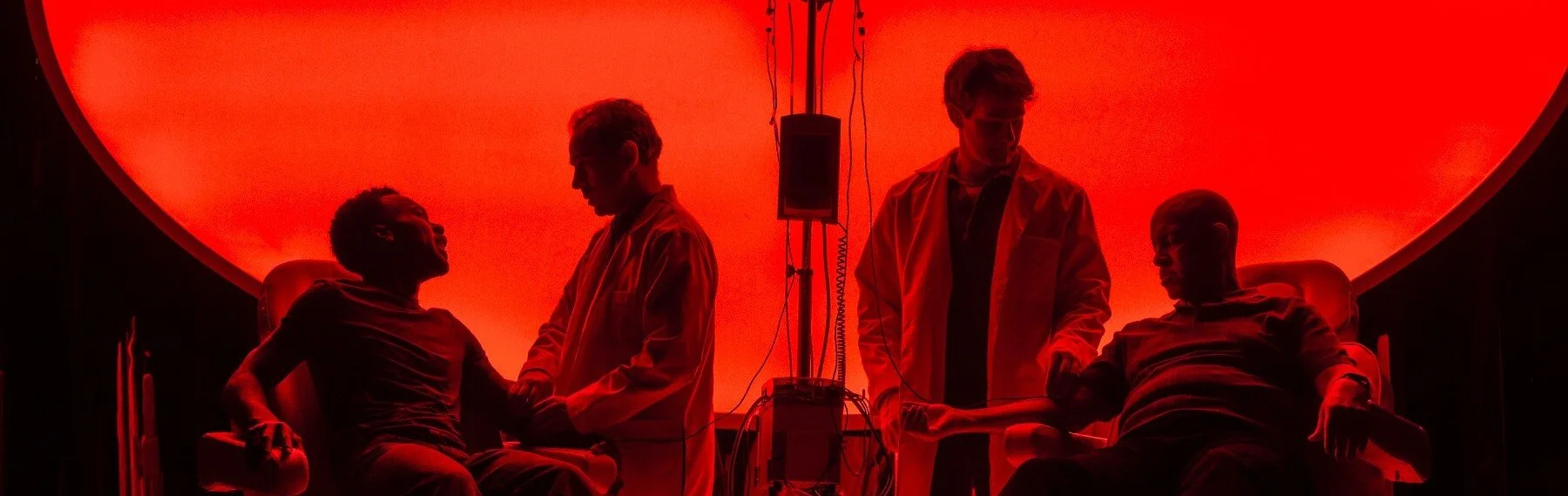
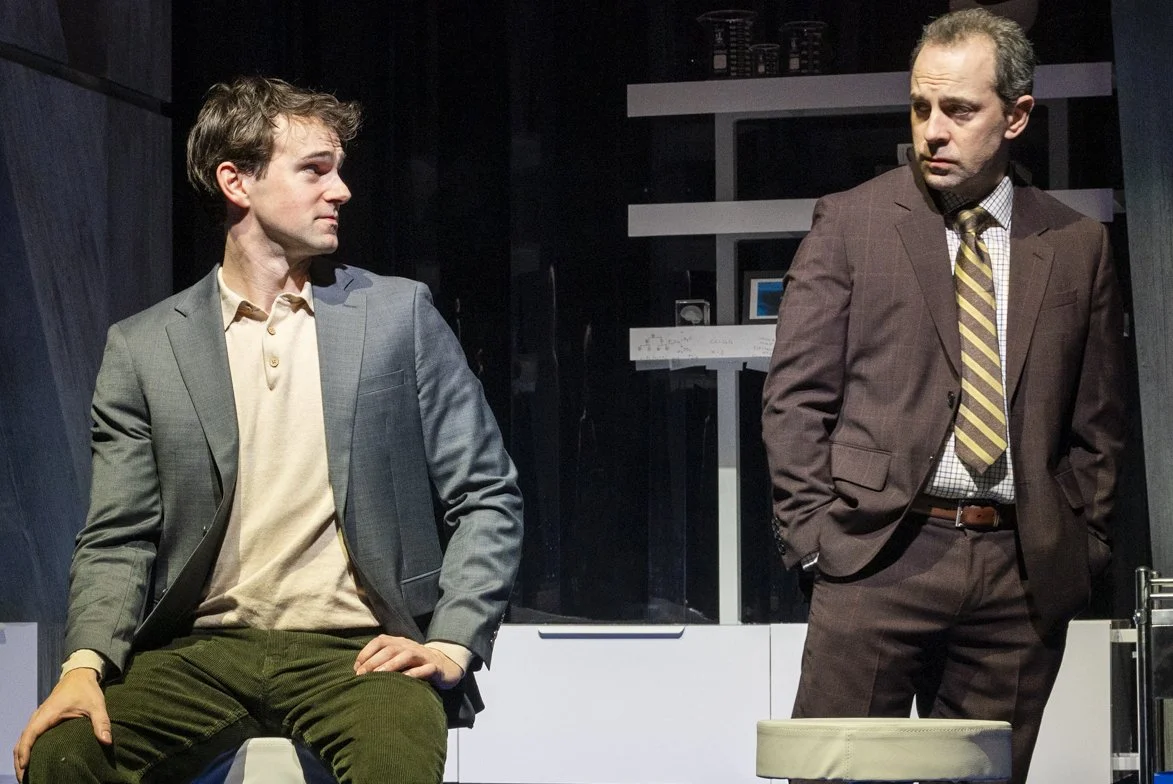
Graduate student Jeffrey Jordan (Matt Walker, left) consults with his professor, Chris Coffey (Rob McClure), in David J. Glass’s Spare Parts.
Playwright David J. Glass also happens to be a biomedical scientist with an expertise in age-related loss of muscle mass. So it is not a shock that his new work of science fiction, Spare Parts, is concerned with the limitations of growing old. What is more surprising is that the protagonist at the center of these medical proceedings has a plan for creating life that Doctor Frankenstein would envy, along with a thirst for blood motivated by desires in the vein of Count Dracula.

Jordan spends time with Shelley (Jonny-James Kajoba) outside the lab.
That’s not to say that the play is a full-on horror show. Nor is it a comedy. Despite the presence of a heartless billionaire with a diabolical plan who butts heads with a science professor—played by Rob McClure, the actor who gave us Broadway musical versions of Charlie Chaplin and Mrs. Doubtfire—the mood here is emphatically serious. This is due to the based-in-reality exposition and medical jargon that relentlessly fill the play’s 100 minutes. It is a win-lose scenario, effectively anchoring the goings-on in believability while simultaneously dragging down the action.
Zeit Smith (Michael Genet) is a megalomaniac billionaire with the technological smarts and procreative instincts of Elon Musk. He has a caring assistant, Ivan Shelley (Jonny-James Kajoba), and a plan for global domination of the Internet satellite business. “Soon everyone will have free Internet—if they just agree to look at an ad or two ... and tell us a bit about themselves,” he ominously explains. But the true obsession for this sixtysomething tycoon with high blood pressure and a serious peanut allergy is to find a way to stay young forever.
Toward that end, he summons to his lair Columbia professor Chris Coffey (McClure) and his graduate student colleague, Jeffrey Jordan (Matt Walker). The duo have been tinkering with “mechanisms to counter the aging process,” but so far their experiments have been limited to worms and flies. Smith makes them an offer they can’t refuse, namely millions of dollars in exchange for finding the key to eternal youth for one particular mammal: himself.
Jordan is emboldened by the possibility of wealth and fame, while Coffey wavers between moral outrage and the naked ambition of one day having his name prominently featured in a scholarly journal. They ultimately agree to explore the possibility of parabiosis, a real-world process usually limited to mice, where two beings share one circulatory system. The theory is that blood flowing from a young subject into the veins of an elder will instill a molecular youthfulness in the latter, while the former risks premature aging from receiving old-guy plasma into his system. Jordan is game to be the guinea pig if his blood type matches Smith’s, but alas, they are not made for each other.
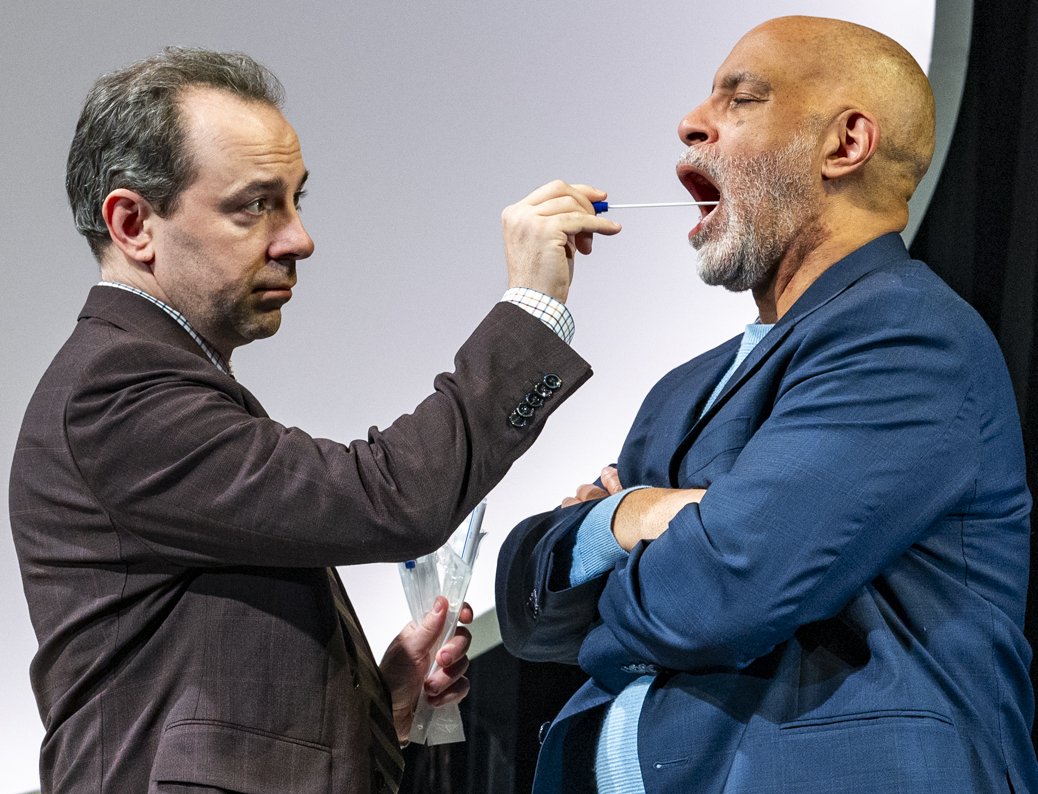
Coffey takes a DNA swab from the unscrupulous billionaire Smith (Michael Genet). Photographs by Russ Rowland.
This leads Coffey to check Shelley as a possible match, and what he discovers from a simple swab of the cheek is head-spinning. The test results send Shelley down new roads of discovery, as he learns that scientific techniques, some from as early as the 1970s and others from the 1990s, have evolved in unintended ways and are being put to work against him, forging his future without him even knowing. He will come to question his heritage and ultimately make a decision that will forever change his career path.
The results of Shelley’s test also spell trouble for Smith, forcing him to confess to a series of evil steps he has taken over the course of his life to gain immortality. And when it becomes clear that he has no intention of ceasing his plans, Shelley realizes he must put a stop to them; he does so with an inspired plot twist.
Under the direction of Michael Herwitz, Kajoba finds poignancy and grace in his ultimately tragic Shelley, while Genet brings at least a touch of humanity to what could have been a purely villainous caricature. McClure and Walker shine not as bright, finding themselves in roles that are decidedly less exciting, albeit less doomed, than their costars.
Complicating matters further, Shelley and Jordan forge a romantic relationship that continually calls into question their true motivations. Are they attracted to each other, or do they just need each other for financial success? Additionally, Glass threads another interest of his into the work, calling out the dangers of artificial intelligence. Watching everything, like a giant eye hanging over designer Scott Penner’s piecemeal set, Smith’s chatbot is always at the ready, violating privacy at will and, in one crucial scene, miraculously saving Shelley from certain doom. Some 2,500 years after Euripides, AI turns out to be the ultimate deus ex machina.
Spare Parts runs through April 30 at Theatre Row (410 W. 42nd St.). Evening performances are at 7:30 p.m. Tuesday through Sunday; matinees are at 2 p.m. Saturday and Sunday. For tickets and information, visit sparepartsplay.com.
Playwright: David J. Glass
Direction: Michael Herwitz
Sets: Scott Penner
Costumes: Amanda Roberge
Lighting: Zack Lobel
Sound: Ryan Gamblin
