Musical

Religious Phallusy

The art of making people laugh at what they would otherwise find offensive is, at bottom, a balancing act. On the one side, you have mean-spiritedness; on the other, impishness. Veer too far into the former, and you end up in the off-putting mire of misanthropy; too far into the latter, and you're left with the empty satisfaction of the prankster (or the forced smile of the pranked). As it stands, look not for a mischievous twinkle in the dead eyes of Thomas Bradshaw's Prophet, the bad joke now playing downstairs at PS 122: the pointless toxicity of the religious, gender, and racial stereotypes on display sinks the thing deep into the mephitic muck.

At light's rise, a middle-aged suburbanite named Alex (Peter McCabe) plants himself center stage, announces that his habitual kowtowing to his wife has made him unworthy of his penis, strangles her to death, then takes off to the ghetto in search of an unschooled, easily dominated "negress" as a replacement, but not before he is commanded by a cartoonish God to re-subjugate women, on pain of eternal damnation.

What follows is a hodgepodge of action and consequence: Alex begins his ministry, with his new wife Shaniqua (Detra Payne) as the proving ground; the ministry falls apart as the wives form a frothing mob bent on mass castration; and inevitably, several characters go to their goofy-voiced maker.

I would say the piece is offensive, but that would imply that it elicits some kind of excitement

Click for print friendly PDF version of this blog post

Sex and Politics

In Kirk Wood Bromley's three new one-acts, Three Dollar Bill, produced by Inverse Theater, the ideological tensions between gay values and conservative values tango in a tangled dialectic. Bromley's verse plays sound like linguistic Chinese finger traps: the more the characters attempt to reason out of their self-contradictions, the further they tend to be trapped by their own dubious assumptions. The first, and least successful, play, "What Are You Thinking, Mary Cheney?," is essentially a one-woman monologue in which the vice president's lesbian daughter tries to justify her existence. Skewered by the likes of the Moral Majority on the right for her sexual preferences, she is equally lambasted by the left for betraying the ACLU, Lambda, and others who try to defend her lifestyle choices.

We meet Mary in her idyllic "log cabin" in the woods�as if in a kind of demented Mister Rogers' neighborhood�where she greets us, reads us "fan" letters, and smashes cellphones when she gets calls from the irate public. While the premise is promising, the result comes off as a screed of self-justifying self-hatred. Director Howard Thoresen utilizes a wide array of blocking

Click for print friendly PDF version of this blog post

After the Riot

Producing a historical piece has its advantages and its disadvantages. The work has elements of a plot already created, and it often has a readymade audience. It also has a tendency to be weighed down by the facts, with the event itself often ill suited to the mechanics of theatrical presentation. Some of the advantages are apparent in the Alchemy Theater Company's fictionalized historical piece Haymarket, but nearly all of the disadvantages are present as well. The play is loosely based on events surrounding the Haymarket Riot in Chicago in the late 1800's, when anarchists and socialists squared off with police during a march in support of the eight-hour workday. In the confusion of the confrontation, an unknown instigator detonated a bomb, killing several policemen. Police then opened fire, and several workers were killed. In the aftermath, four anarchist leaders were hanged, among them Albert Parsons (Dennis McNitt), who, along with his family, is fictionalized here.

In the first scene, we are introduced to his daughter, Lucy. Her mother, also named Lucy (both are played by Squeaky Moore), has put her in an insane asylum because the events of her father's past haunt her

Click for print friendly PDF version of this blog post

Cruel and Unusual Pleasures

As soon as the curtains part in the Red Bull Theater's production of The Revenger's Tragedy, the audience is hurled headlong into an atmosphere of theatrical extravagance: a dance macabre at the Duke's court morphs from a stylized tableaux set to opera music into a lascivious discoth

Click for print friendly PDF version of this blog post

Our Daily Bread

Man cannot live by bread alone. He also needs puppets. If there is any doubt about that fact, the inimitable Bread and Puppet Theater dispels it with its current two-part offering, The National Circus and Passion of the Correct Moment. Lured in like kids to a candy store, the audience is delighted with The National Circus's opening scene with a white-bearded man on huge stilts. That is Bread and Puppet founder Peter Schumann, outfitted as Uncle Sam. He ambles in to "When the Saints Go Marching In," played with much verve by a little bouncing band. This isn't a nationalist pep rally, however.

As the weight of patchouli hangs in the air, a rumpled group of mostly college-age students enters the bare-bones stage at Theater for the New City. Their liberal earnestness is palpable

Click for print friendly PDF version of this blog post

Seasonal Pairing

Blame the extra time off. Nostalgia invariably arrives on the heels of Christmas, bringing with it the inevitable (and perhaps involuntary) tendency toward introspection. The New York Theater Experiment offers its own meditation on this annual hyper-self-awareness in a pair of short plays: Thornton Wilder's quiet gem The Long Christmas Dinner, a faithful snapshot of classic Americana, and A New York Christmas Carol, a quirky, modern take on a timeless British classic. Although the combination of two divergent scripts has the potential to create a fresh take on these two pieces, the coupling unfortunately offers little by way of enlightenment. Varying wildly in subject matter as well as production value, the two halves seem to have little in common other than their subject matter

Click for print friendly PDF version of this blog post

Destinations

The year is 1889, and a trio of intrepid Victorian female explorers stands poised on the brink of tomorrow. As these "sister sojourners" peer over the lip of the void, they are assaulted by the unknown

Click for print friendly PDF version of this blog post

Paradise Now

One always seems to exist in the worst age in human history. Whether you wish to have been a milkmaid in a quiet Italian village or just a bumbling caveman in pelts, contemporary life is clouded by romanticized views of a "simpler" time, a better time. Parisian writer and director Pascal Rambert, however, posits the opposite in his current work, Paradis (Unfolding Time). What if we are living in paradise right now? Or, in his own words, "what you're now watching you will someday remember as a marvelous world, while today you think it's hell because paradise was what came before." As part of the five-month Act French festival, which brings new theater from France to New York, Paradis poses grandiose, existential questions in its four-night stint at the Dance Theater Workshop.

Eleven actors enter the wide, black stage wearing winter coats, jeans, boots. They slowly remove all of their clothes and stand naked before the audience. (The reverse Edenic gesture is one nod throughout the evening to images of paradise.) Upstage, a flag of yellow, green, and pink waves tirelessly for the duration of the show. The actors unfurl a large, yellow mat and place it center stage. This motif is the first of three, which follow as green and then pink.

This "yellow" scene is splashed with other colors—blue swivel chairs, multicolor blankets, black and silver microphones that dangle from the ceiling. The stage is lighted with fluorescent lights both above the stage and upstage, facing the audience. The naked bunch dart about the space, scattering like lost children in search of their mother. One beautiful woman stands on tiptoes to speak into a mike. A succession of rapid-fire questions begins in French-tinged English, "How do you begin? Do you begin like that? What do you think we want?"

Paradis is enervatingly frenetic and endearingly French. Few traces of American "comic relief" are found in this heavyhearted piece. "Why are we so alone?" is asked more than once. The second segment, noted by a green mat placed center stage, carries the weight of the work. Two small projection screens flank the mat—one of famous paintings of nude women, the other a video of an escalator with random riders. This postmodern work (or is it "late"-modern now?) pays homage to France's best existential thinkers from the theater wings: Sartre, Artaud, Lecoq.

Kate Moran stands out as the only American actress and as one of the central "characters" in the ensemble. It is she who has her heart literally torn out during the green scene. There is much tumbling and various headstands. Some movements are done in sync, but there is little in the way of overt choreography.

Rambert wants to make a terribly beautiful statement, and to some level he succeeds. Still, feeling the loss of paradise—or confronting the possibility that we are blind to a utopia within our grasp—should seem more harrowing and less clinical. The sparse, cloying text is interwoven with movement, and words are passed from actor to actor like a hot potato.

The final, pink scene begins with a few statements, one of which is "You are the product. It's scary. You will see." Even more questions are posed toward the end: "Do you love me? Could you? Would you? Why did you expel me from the center?" Rambert's text alludes to Darwin and Copernicus as those whose findings have pushed human beings out of the center of the universe to the fringe. He adds that genetic engineering is the next step in removing us farther from the coveted middle. As fringe theater, Paradis seems to have found its proper place in the theater universe.

Click for print friendly PDF version of this blog post

Match Point

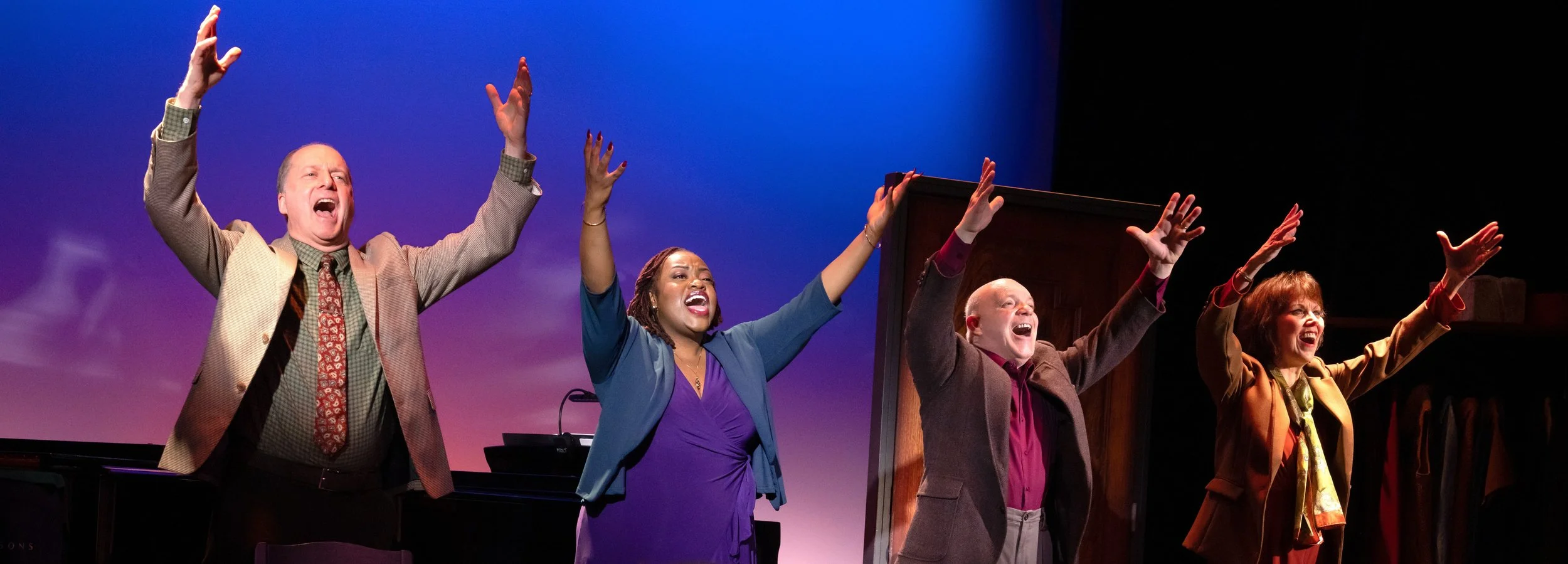
Watch your back, Sweeney Todd. The band GrooveLily has come to town, proving that you don't need to do a big-budget Broadway show to tell a captivating story and showcase the formidable gifts of multitalented performers. Tucked into the cozy venue Ars Nova, GrooveLily strikes gold with its inspired "rewired version" of Hans Christian Andersen's story "The Little Match Girl." Funky and fresh, playful and serene, Striking 12 is a very welcome gift to New York this holiday season. Simultaneously acting, singing, and accompanying themselves on instruments, the performers in this season's Broadway revival of Sweeney Todd have been celebrated for both their dexterity and their innovation. The instruments become more than mere appendages, as the actors use them as storytelling tools, creating a performance that connects the music with the performer in exciting new ways.

The members of GrooveLily

Click for print friendly PDF version of this blog post

Children Will Listen

The sterling Off-Broadway theater group the Axis Company has created a wonderful new holiday tradition with the fourth annual production of its winter show, Seven in One Blow, or the Brave Little Kid. This spirited children's play with music will have parents in the audience singing along as well. Seven tells the story of an urchin (Abigail Savage) who completes the herculean task of swatting seven flies at once. The Kid, as this hero is known, travels around town as a local celebrity, even sporting a belt buckle advertising the impressive feat. In a classic misunderstanding, everyone who encounters the Kid thinks the belt is referring to major acts of derring-do. Assuming that the Kid has killed seven people, they all try to make this new toughie do even more difficult tasks.

It is the lively cast of Seven that gives this sweet show its heart. The Kid meets up with a cornucopia of stock fairy-tale characters: the Scarlet Pimpernel (Brian Barnhart), an Ogre (Jim Sterling), a Princess (Margo Passalaqua), a Witch (Sue Ann Molinell), a Pea (the charming Laurie Kilmartin), even the month of December (Edgar Oliver).

All are remarkable performers, able to command the stage while charming both young and old audience members. Passalaqua, for one, demonstrates some impressive acrobatic dance moves, while Barnhart performs a rich, moving number that comes late in the show. And Molinell makes for quite a scary witch.

Director Randy Sharp's skills are just as impressive as the cast's. Not only is he a master at fluid pacing and making sure all of the cast members get equally prominent blocking, but he is also responsible for all the original songs. The show itself was written as a team effort by the Axis Company, and it is a clear representation of their synergy. This is an ensemble effort in every sense, and Axis's members seem to care as much about their young audiences as they do about each other. They never once talk down to their audience or appear bored or unhappy in roles that, in other performers' hands, could have come across as forced or trivial.

There are many morals to be found here for young people. The Ogre, for example, learns that you don't always have to brag about your physical prowess. The Princess realizes she should not judge a book by its cover and make fun of someone she doesn't know, since, for all she knows, they may have much in common.

Seven may be on the trite side, but it's always sweet and never saccharine. It is also very professionally done, thanks to its many top-notch technical effects, including David Zeffren's lighting design, Steve Fontaine's sound effects (as when the Kid kills the seven flies), and Valerie Hallier's artwork, which brings a veritable winter wonderland to life. Sharp also utilizes some video clips and cues to facilitate audience participation. One could presume that this show's purpose is to enthrall children, but the effect was the same for the parents on whose laps they were seated.

Click for print friendly PDF version of this blog post

Holiday Treat

Only a Scrooge would not be infected with the spirit of Christmas after seeing the delightful musical adaptation of Charles Dickens' A Christmas Carol that Personal Space Theatrics is presenting for a fourth season. Dickens's hoary tale of crippled Tiny Tim and the old miser who learns the true value of Christmas may appear to cry out for parody or some other form of radical reinvention. But in his beautifully crafted, faithful rendition of the classic, director Stephen Wargo demonstrates the value of close attention to the original story and its emotional nuances.

Wargo keeps the action moving at a sprightly clip through dramatic vignettes spliced with rousing song-and-dance sequences and snatches of narration told by the 23-member company in Greek chorus fashion. The actors spread out through the two aisles and a midpoint landing in the audience section (part of an extended stage), allowing for more inventive choreography, by Ann Robideaux, in the relatively confined space.

Leading the topnotch cast, which includes three able child actors, is Robert Ian Mackenzie, whose bushy eyebrows and craggy features make him the perfect embodiment of Ebenezer Scrooge even before the first "Humbug!" bursts from his lips.

Nicholas Alexiy Moran as Bob Cratchit and Michael Poignand as Fred infuse their leaner roles with warm humanity. Also worthy of special mention are Michael Salonia and Kathleen Hinders as the roguish Mr. Fezziwig, under whom Scrooge apprenticed as a young man, and his saucy wife.

The spare set by David Esler consists of tall lantern posts that serve double duty as coat racks, garlands draped on the walls, a large slab of black construction board, and 10 large black cubes. Bringing it all to life is the work of lighting designer Timothy Swiss and sound designer Chris Rummel, who both work in bold strokes.

Costume designer Jessa-Raye Court does yeoman's work outfitting the large cast in period costumes (at a low budget). But it is in her depiction of the ghosts of Christmas Past, Present and Future that she gets to flex her creative muscle. For two of the spirits, she uses gold paper masks, which give them an appropriately otherworldly cast.

A good example of the able teamwork of the production's designers is Marley's Ghost, who is dimly lit by a green spotlight and whose frayed finery gives off puffs of dust as he moves.

Expertly arranged by Dianne Adams McDowell, the musical sequences are embedded so organically in the drama that the transitions in and out of song are virtually invisible. Matt Vinson, the musical director, provides spirited accompaniment on piano.

Charles Dickens' A Christmas Carol opens and closes with a medley of Christmas carols and hymns, both traditional and obscure. The full company belts out these tunes in a manner as resonant and uplifting as any church choir's.

You'll leave the theater in high spirits, humming under your breath and thinking better of the world than it probably deserves for the rest of your day or night.

Click for print friendly PDF version of this blog post

Sounds of Silence

"When I was about 8, I saw the moon as it really is," writes expert mime Bill Bowers. As a youth, he would regularly twirl across grassy Montana fields while staring up at the night sky, never realizing that the glowing moon he looked fondly upon had a concealed dark side. His one-man mime show, Under a Montana Moon, playing at the newly renovated Performance Factory, is inspired by the day he took a closer look. In reverence to the visible half of the moon Bowers admired as a child, he maintains a light, happy note throughout the play's first act. His opening skits are silly, with delightful elements of slapstick humor. There are the usual mime gags: walking into walls and getting trapped in a box, though Bowers puts his own spin on the movements by performing them in a cow suit, which is best utilized in his impression of a "milkshake."

Once these crowd-pleasing skits are out of the way, he moves into uncharted waters, recreating a showdown on the Western frontier and a day spent at the county fair, where he plays games and rides coasters. The fair scenes are funny as a narrative but fascinating when you consider there is nothing on this stage other than a man and his suitcase of props. Bowers's movements are so convincing that when he wanders through what we presume is a dark carnival maze and bangs smack into walls, the audience yelps "Ouch!," feeling his pain.

Though this show is centered on mime, there is sound. In the beginning of Act II, Bowers lip-syncs to voice-overs when re-enacting teachings from a Mexican peace movement that came to North America by way of sacred clowns called Contraries. Bowers acts as a Contrarie in his piece The Way of Sweet Medicine when he passes these messages along to us through voice-overs, props, and his own graceful, controlled movements.

In the first teaching he uses menacing hand puppets to portray a man with two wolves fighting inside of him. One wolf is kind and loving; the other is angry and violent. "Which wolf will win?" a child asks in voice-over. "The one I feed," a man's voice responds.

The Way of Sweet Medicine indicates a shift in tone from where Act 1 left us, laughing at a silly cow and Bowers's carnival antics. The moon is darkening, and so is Bowers. In a deeply powerful scene, Prayer for a Boy, he re-enacts the circumstances of Matthew Shepard's heartbreaking death, told through voice-over testimony by the boy who found him.

This piece does not examine the violence or the psychology of those involved, but rather the sounds that came out of the tragedy. "They say we cannot call a sound back," says a monotonous child's voice on the soundtrack. "A sound goes on and on." To illustrate this point, the voice asks us to imagine the sound we think Shepard made when he was beaten and, more distressingly, the sound his mother made when she heard what had happened.

In Act II's final scene, Palette, we see Bowers stepping through a painting into a field alive with cricket noises reminiscent of his beloved Montana field. When he smiles at the moon and proceeds to twirl in dizzying circles, we sense he has come back to the light. The story is nicely framed by his return to the fields, where he now recognizes and embraces both sides of the moon.

One would expect a mime show to rely solely on visuals, given the nature of the craft. But Under a Montana Moon has deeper, richer elements in its stories, which contain important coming-of-age lessons and relevant social commentaries. It is also touching to acknowledge that, although Bowers has studied under the famous mime Marcel Marceau, taught at several colleges, and graced both the silver screen and Broadway stage, he has chosen to focus his one-man show not on these impressive accomplishments but on the Montana moon he grew up admiring. This production is a combination of his heart, mind, and body, and though he never speaks a word, you hear his message loud and clear.

Click for print friendly PDF version of this blog post

Married With Children

'Tis the season for family love and family strife, and the Gallery Players capture both in their winning production of Christopher Durang's classic play The Marriage of Bette & Boo. The most autobiographical of Durang's works, Bette & Boo twists and skewers the trappings of marriage, children, and domesticity, yet somehow still manages to exult in them. Sweet, childlike Bette wants nothing more than to have babies, and lots of them. After her first son, Matt, is born, however, she and Boo discover that her RH-negative blood will endanger the lives of any future children. Undeterred, Bette presses on even as Boo plunges into alcoholism and Matt withdraws further into himself. She has four more babies, all of whom die at birth.

As the play leaps back and forth over 30 years between 1940 and 1970, Matt revisits his parents' lives in an attempt to piece together his own history. Told in "33 short scenes," the play works as a scrapbook of his childhood. With each glimpse, we discover a new piece of the puzzle, and how or why or even where it might fit into the larger picture becomes a challenge for the audience as well.

In the beginning, Bette and Boo marry in an idealistic haze of wedded bliss, but the dysfunction of their families immediately portends a less than happy ending. On Bette's side, her domineering mother, Margaret, overbalances her father, Paul, who can do little more than stammer unintelligibly. Boo's father, Karl, on the other hand, talks incessantly. He is also a mean drunk, slurring his words as he constantly tosses toxic jabs at Boo's mother, Soot, who only giggles hysterically in response. Bette's sisters have problems as well: Joan is cruelly sarcastic and perpetually pregnant, while Emily is immensely self-critical, and her delicate nerves take her in and out of mental hospitals as well as a convent.

Durang's brilliance lies in his ability to be simultaneously cruel and bitter, and tender and hopeful. Thanksgiving and Christmas dinners become dangerous domestic battlefields, but a final moment between Bette and Boo rings with poignancy.

Director Heather Siobhan Curran locates the essence of Durang's potent blend of tragedy and comedy, coaching fine performances from her cast. At times the pacing becomes erratic, however, and absurd gestures that might be further extended feel rushed. The mothers, in particular, would be better played more over the top, because the high absurdity of their personalities only balances and adds to the very realistic pathos of Bette's situation.

Erin Kate Howard's Bette is the heart of this production, and she deftly captures the character's sweetness, determination, grit, and fragility. "I love cute things," she explains to her friend Bonnie in a late-night phone call. This is a shining moment for Howard, who reveals Bette's desperation as she attempts to reach out to someone

Click for print friendly PDF version of this blog post

Deconstructing Monroe

Making Marilyn aspires to grand heights. Ken Cameron's play focuses on the legendary Monroe, adding into the mix a few obvious factoids about her troubled life, such as her addiction to pills and alcohol and her dependency on men. The result is a bizarre psychodrama, but one that benefits greatly from the seductive star power of Ashlie Atkinson. As the title character, Atkinson takes a disjointed, mediocre play and turns it into a captivating tour de force. The year is 1953, and Marilyn has come to the small town of Banff, Canada, to shoot her new film, The River of No Return. While filming the movie, the lonely star encounters a young teenager named Scout (Patrick Costello), who lives in a rundown house with his mother, also played by the beguiling Atkinson. The mother spends her days drinking and her evenings waiting for a husband who will never return. Her nights are spent entertaining the men of Banff. Although she tries to provide a stable environment for Scout, her inability to accept reality, coupled with her drinking and prostitution, creates a corrupted home life that the troubled youth longs to escape.

When Marilyn comes to town, Scout's dreams of a different life begin to take form. Their chance encounter blossoms into a tender friendship that eventually evolves into an intense sexual relationship, the ramifications of which prove tragic for both. Flash-forward to 1962, shortly after Marilyn's death, and Scout is speeding down a California highway. When an overzealous policeman (Robin Mervin) pulls him over, Scout's history with Marilyn, and his mental stability, begins to unravel in disturbing detail.

Cameron has intriguing ideas brimming with promise, but they ultimately fizzle in the execution. His depiction of Monroe as a boozy, pill-popping prostitute is particularly troublesome and narrow. The constant time jumping among three decades proves confusing and ultimately hampers the story. A sense of vagueness prevails throughout, with reality and fiction blurring to the point of distraction.

Robin A. Paterson's direction effectively creates a nostalgic aura that evokes a 50's movie. His use of movable screens to denote time and scene changes helps move the story forward and alleviates the confusion created by Cameron's script. Paterson also guides his cast of five to engaging and lively performances.

As Scout's tough-talking, whiskey-swilling mother, Atkinson is all swagger and attitude. Her Marilyn, meanwhile, charms and delights, making the play come alive with each movement and word. In an astounding marriage of technique and natural talent, Atkinson seamlessly transforms herself from one character to the next and back, often within seconds. She modulates her voice, lowering the register for Scout's mother and raising it to bring Marilyn's breathy whisper to vivid life. But Atkinson's most accomplished feat is her ability to physically transform herself; her entire body changes so convincingly, it is like watching two completely different actresses at work.

Patrick Costello initially impresses as the troubled Scout. He convincingly plays the character's many torments, and his flirtatious moments with Atkinson are appropriately awkward and touching. But his portrayal is so overly nuanced that its shine eventually turns into a glare: his attempts at depth give way to a series of predictable psychotic ticks and manic ramblings that detract from the story and ultimately appear false. In the end, it seems more like a bag of tricks, unlike Atkinson's organic performance.

Robin Mervin scores laughs as the self-important cop. He takes an incidental role and finds comedy in the banal, turning in a hilarious performance. Devin Scott and Reyna De Courcy lend credible support in a series of minor roles.

While Making Marilyn ultimately buckles under the pressure of its weak narrative, the Bridge Theater Company's production thrives thanks to the exceptional Ashlie Atkinson's considerable gifts. Ultimately, Cameron's new play makes for an intriguing, if laborious, night of entertainment.

Click for print friendly PDF version of this blog post

Radio Days

Before television, radio served as the living room theater of the times. Listeners would tune in to follow their favorite characters in serials that boasted drama, suspense, and romance, as well as sound effects (supplied by foley artists) so they could visualize the action. Now, that simple idea has been turned around by putting the living room in the theater, as in the onstage radio productions of Radio Theater. Its current show, King Kong, is running through the end of December at the Kraine Theater, which makes for a timely tie-in with Peter Jackson's new remake of the 1933 film. As in the movie, nature filmmaker Carl Denham has learned of a place called Skull Island that's packed with fantastic beasts, and decides to make his next picture there. But when he has trouble finding a female lead willing to make a sea voyage with his rough and tumble all-male crew, he scours Manhattan for a fresh face. He soon meets the down-and-out starlet Ann Darrow, who's grateful for a place to sleep and somewhere to eat. The sailors are wary of Ann at first, but eventually grow fond of her�especially Jack Driscoll, who professes his love, which Ann returns in kind. Upon arriving at Skull Island, they learn of the dreaded Kong, and Carl becomes obsessed with putting him in the movie. But his fixation has disastrous results.

The story of a gigantic ape, the man who wants him, and the woman whom Kong wants is not entirely suited to the radio format. There are battles between huge prehistoric beasts and the destruction of much of Manhattan by Kong, both of which can't be depicted by prerecorded sound alone. Adapter Dan Bianchi has added a narrator to advance the plot, which was a normal practice in these types of broadcasts. But between Collin Biddle's tentative vocal performance and the overwritten, half-baked lines he's made to say, the narration actually slowed down the proceedings rather than expedited them.

Though the concept would lead you to believe that this is supposed to be the re-creation of a sound booth where performers acted out their roles and then waited for cues (like AMC's TV show Remember WENN), the staging instead employs awkward entrances and exits and blackouts at the end of scenes. Since these actors aren't changing costumes and the show's not too long, why not keep them onstage? If the director was looking for a bit of visual flair, he could've employed a foley artist to come up with inventive, elaborate ways to provide sound cues, rather than the two sullen characters hidden behind a host of machinery.

The production does have some good things going for it. John Nolan's mellifluous voice is criminally underutilized in the small roles of the host and Captain Englehorn. His "day job" is radio announcing; why not employ him as the narrator? Donna Heffernan plays Ann as a husky-toned angel of the streets, but she also has fun with a few celebrity impersonations at Kong's New York City coming-out party.

Still, it's not enough to make up for the slow pacing of what should be an exciting and fun event. Upon exiting, one young audience member said, "[The postcard] said, 'King Kong live onstage,' but you didn't see him!" Maybe a more imaginative production would have allowed him to.

Click for print friendly PDF version of this blog post

A Violent Life

Pier Paolo Pasolini, little known in America, is probably Italy's most important postwar intellectual. One reason for his relative obscurity in the States is his use of so many different mediums of expression and his lack of a central, easily digestible idea. He is a welter of contradictions: a lifelong Communist who sported expensive suits and an Alfa Romeo; a cosmopolitan who championed a peasant dialect; a poet and a filmmaker; awarded prizes by the Catholic Church and arrested as a vile pornographer. Pasolini was always a provocateur and an iconoclast, caught between purity and puerility, scatology and eschatology. Openly flaunting his homosexuality, he confronted the fascistic morality of his time with an unflinching realism about the tragic perversions of life that pervaded the lurid Roman alleyways: hustlers and prostitutes, backstabbings and secret deals. Pasolini mired himself in that imbroglio of political and sexual intrigue, and suffered as a result.

The Life and Death of Pier Paolo Pasolini presents this complicated figure through interlaced biographical vignettes, the dates and locales of which are projected onto the backdrop. We watch Pasolini plead his case in several court appearances, overhear his t

Click for print friendly PDF version of this blog post

Deer Santa

The Eight: Reindeer Monologues, presented by the Dysfunctional Theater Company and Horse Trade Theater Group, is a deliciously wicked alternative for those who prefer edgier holiday entertainment. Playwright Jeff Goode's dark comedy portrays a North Pole community unlike any presented in traditional seasonal offerings, but which bears a striking resemblance to shadier visions of contemporary America. Alcohol abuse runs rampant, sexual orientation is a hot-button issue, and a sex scandal threatens the reputation of the highest-ranking official. Each of the eight famed sleigh-pulling reindeer presents one of the monologues, slowly revealing the rift developing in their elite team over the sordid tale that could ruin Santa Claus

Click for print friendly PDF version of this blog post

A Good Buzz

A great deal of art intended for children is best left unexamined by adult sensibilities, as anyone who's watched a self-appointed guardian of moral or social conscience disappear down such a slippery slope knows. (Exhibit A: Jerry Falwell looking deep into the sexual agenda of the Teletubbies.) Still, it's hard to resist scratching beneath the surface of the puppet show The Adventures of Maya the Bee, now entering its sixth season at the Culture Project. The central conceit is something every kid can relate to: shirking your chores to play in the wonderful world around you. The unusually inquisitive (for a worker bee) Maya is born into the hive at the show's opening, quickly decides that collecting pollen doesn't scratch her traveler's itch, and flexes her wings in search of points unknown. Over the course of her three-day jaunt, she comes face to face with various insects of both pond and meadow

Click for print friendly PDF version of this blog post

Sins of the Father

Syphilis was to the 19th century what AIDS was to the 20th: a slowly debilitating disease that society

Click for print friendly PDF version of this blog post

Evergreen

Everyone's favorite redheaded orphan has been recently reborn in a new production by the St. Jean's Players on the Upper East Side. The company's sterling version of Annie is absolutely charming and makes for a perfect holiday treat. Sometimes a commercial work of art gets so engrained in the popular consciousness that it becomes easy to take it for granted. This is true of a perennial like Annie; it would be easy to dismiss this well-known and frequently performed show, but it has such heart and such a talented cast that it demands respect.

As does its famous score, with music by Charles Strouse and lyrics by Martin Charnin, along with Thomas Meehan's book, adapted from the popular comic book. Young Erin Moriarty is superb in the title role, bringing both charm and pathos to numbers like "Maybe" and "Tomorrow," songs that are as challenging as they are catchy. It is hard not to imagine her treading the boards on Broadway in the near future.

Annie's plot hasn't changed much over the nearly three decades since the show first hit the stage. The lovable orphan gets taken in by billionaire Daddy Warbucks (Charles Mobbs) at Christmastime, only to encounter his previously undiscovered feelings, both paternal (for Annie) and romantic (for assistant Grace Farrell, played by sweet-voiced Jennifer Hoddinott). Miss Hannigan (Sharon O'Neal), who runs Annie's boarding house, throws a monkey wrench into the Warbucks clan's plans by getting into cahoots with her no-good brother Rooster (Dean Polites) and his dame, Lily St. Regis (Amanda Butcher).

Does all end well? Bet your bottom dollar it does. Yet Sharon Lowe directs this family production with such finesse that one is engaged throughout. O'Neal is perfect as the nasty Miss Hannigan, and she and Polites (who proves to be remarkably flexible in the "Easy Street" number) work off of each other quite well. Lowe's entire company proves to be nearly flawless, from Arthur Gruen as Franklin Delano Roosevelt, to Larry Hirshik as radio personality Bert Healy, to Bailey Mason as Star-to-Be; her melisma during her "N.Y.C." solo is another testament to the score's strength. Furthermore, the girls who play Annie's orphan friends present a phalanx of talent.

Lowe's leads also excel. Mobbs is wonderful as Warbucks, who goes from thinking with his wallet to thinking with his heart. As he plays against Moriarty, you can't imagine someone would not melt in her presence. And though occasionally drowned out by the orchestra, Hoddinott, who also worked on the costumes, makes for a perfectly righteous Grace.

Annie may be an evergreen, but with solid performances and well-crafted songs, Lowe keeps it fresh, finding the perfect marriage between comedy and sentiment. It's shows like this that bring cheer to the holiday season.

Click for print friendly PDF version of this blog post