
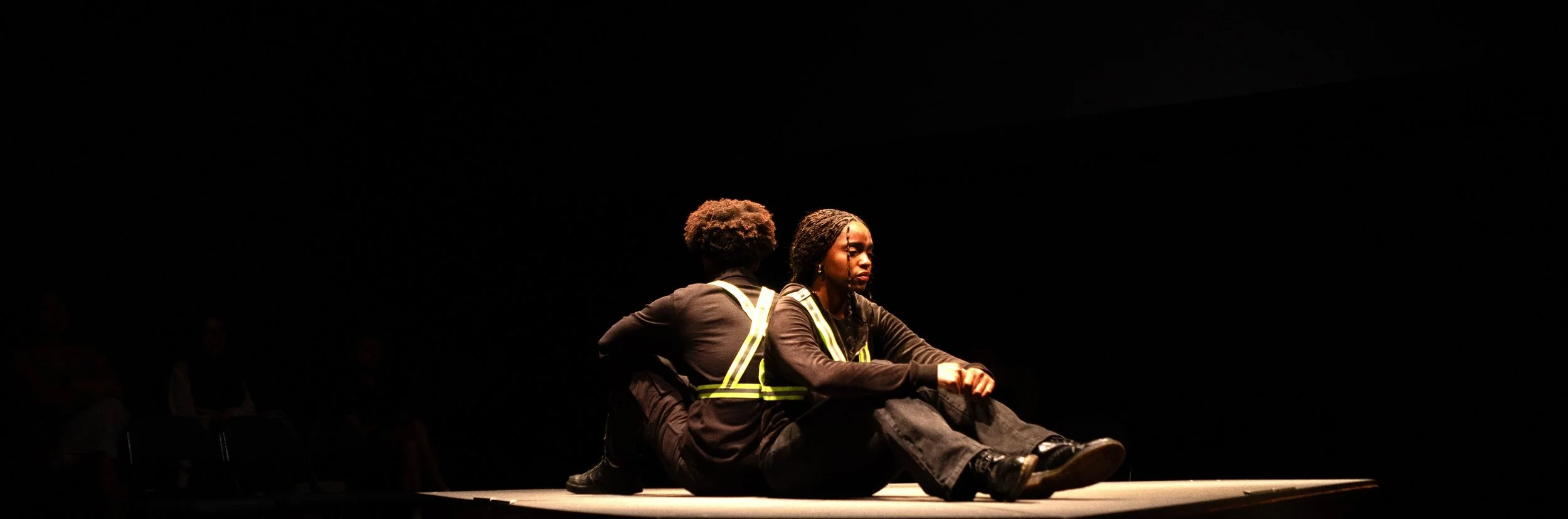
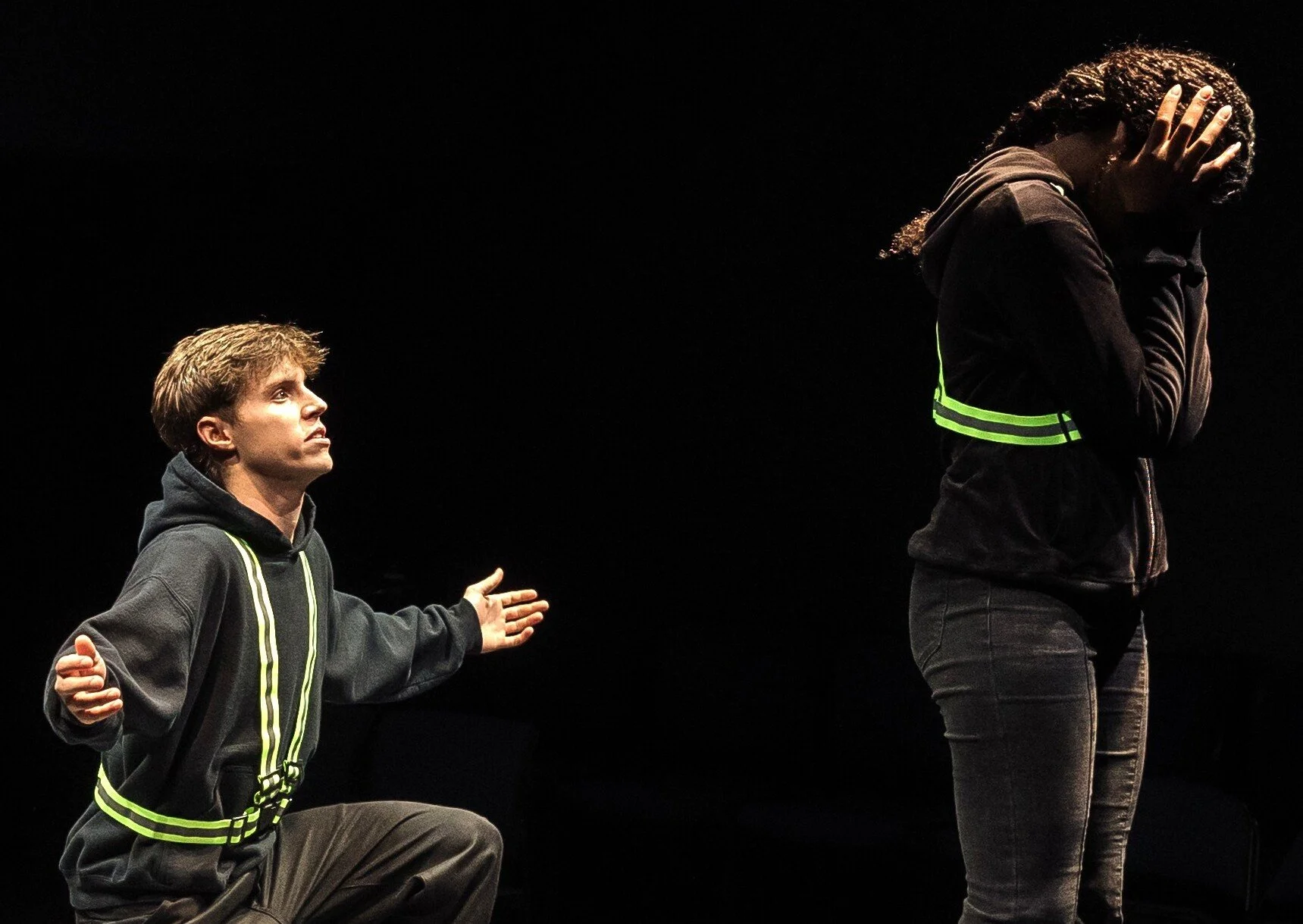
Viggo (Will Ingram, left) woos coworker Missy (Anastasia Locke) in The Vessel, a coproduction of 59E59 Theaters, Thrown Stone Theatre Company and director Peter Charney’s Through the Tollbooth Company. Photographs by Jacob Ruth; banner photo by Yiyuan Li.
“A combination of the Eiffel Tower and the Rockefeller Center Christmas tree.” “Upside-down pineapple. Honeycomb spaceship/shawarma.” These descriptions of Vessel, the tourist attraction in Manhattan’s Hudson Yards, are the most memorable lines in Brendan George’s well-intentioned play The Vessel, which has a lot to say but doesn’t say most of it in a theatrically exciting manner.
While Vessel, a 16-story-high, beehive-shaped metal structure designed for climbing and scenic views, could be enjoyed as an interactive sculpture or eye-catching piece of architecture, many New Yorkers have dismissed it—along with the rest of the luxury real estate development where it’s located—as an unnecessary monument to the 1%.
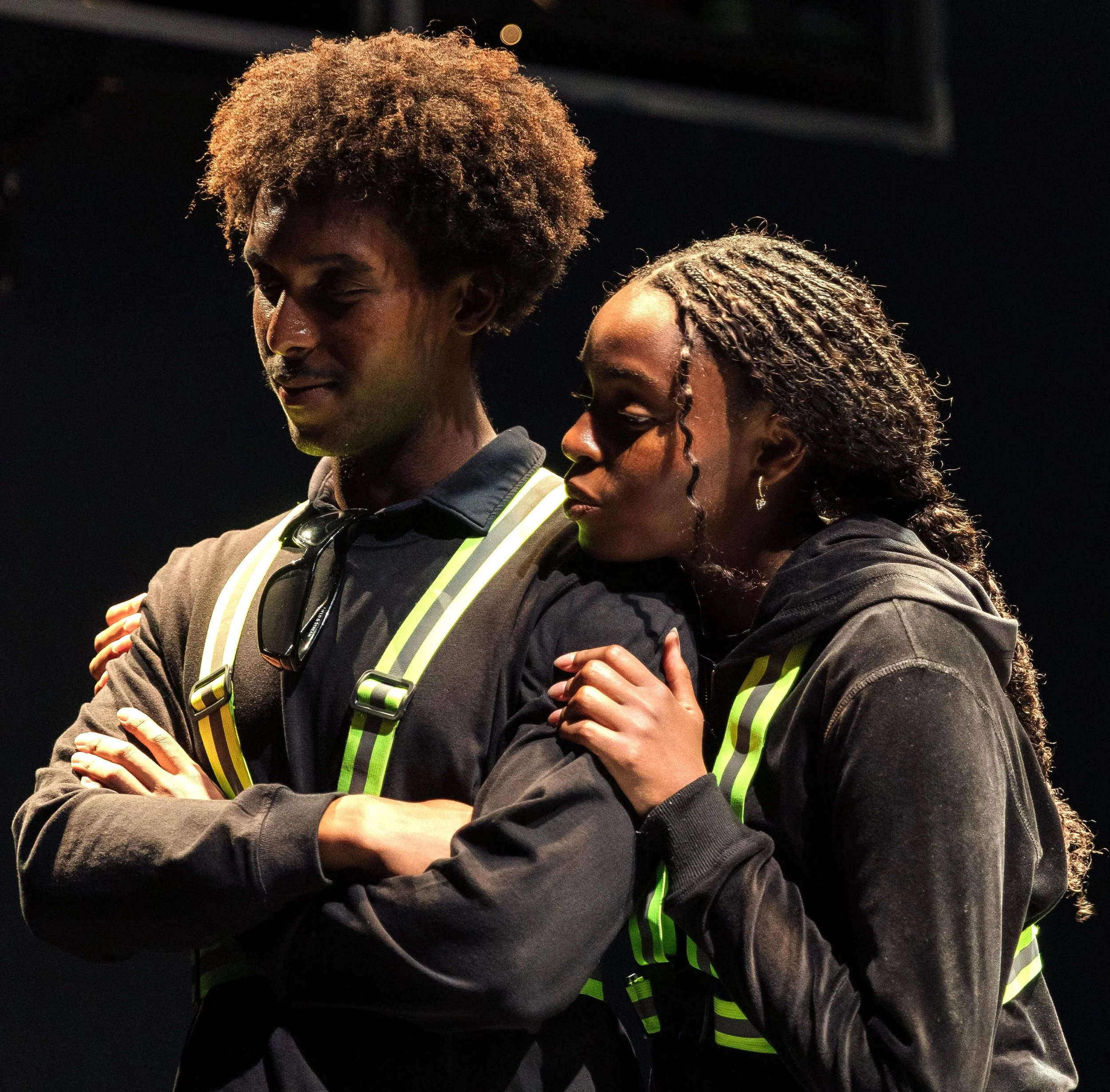
A traumatized Missy tells Drake (Sofonyas, left): “I was so set on seeing the bright side … I tricked myself into seeing something that wasn’t there. It’s like I can’t even see reality.”
It’s had a bigger problem than low public opinion, however: On four occasions during Vessel’s first couple of years, someone jumped to their death from the structure. George has used this sordid history to instigate his fictional characters’ soul-searching and philosophizing about human behavior, morality and hope.
Drake (portrayed by Sofonyas), Missy (Anastasia Locke) and Viggo (Will Ingram) work as Vessel “ambassadors,” greeting visitors, answering their questions and watching out for anything suspicious. A triangular platform serves as both stage and set for The Vessel, which takes place entirely on the Vessel landing where the three employees are stationed. This translates to 90 minutes of three people standing around in close proximity to one another (and the audience) talking.
George should have set at least part of the play during the characters’ lunch break or after hours, to allow some flexibility in the blocking. As is, it doesn’t make sense when an on-duty Drake and Missy sit on the ground during one scene—or, later, when the characters abandon their posts altogether for a personal trip to the top of Vessel.
The Vessel begins on Viggo’s first day on the job. Drake has worked at Vessel since it opened; Missy came onboard sometime after the first suicide. By the final scene, she will have dealt with two other fatal incidents at Vessel, an experience that transforms her from cheerful optimist to lost soul.
“There’s no mention of the actual catastrophes of the 2020–21 period when the play is set: pandemic, insurrection, George Floyd. ”
Viggo and Drake are preoccupied instead by purported crises in their pre-Vessel lives. George attempts to build suspense around the men’s pasts, but it’s not justified because, when eventually revealed, their backstories don’t sound particularly traumatic. Drake used to work as a security officer at an elementary school, and he has survivor’s guilt over an incident at the school that all the children and teachers survived, unharmed. Viggo became a viral folk hero for doing something that, in real life, is neither as unusual nor controversial as the play makes it out to be.
These events provide fodder for the men’s endless ruminations on the troublesome state of society. Drake and Viggo include the Vessel suicides when generalizing about human beings as a threat to humanity, as if the personal act of suicide were a contributing factor (rather than a product of) a troublesome world, akin to school shootings or religious intolerance. Besides this epistemological flaw in their thinking, Drake’s and Viggo’s theories are about as sophisticated as what students bandy about in a Philosophy 101 seminar—or while passing around a joint in their dorm room.
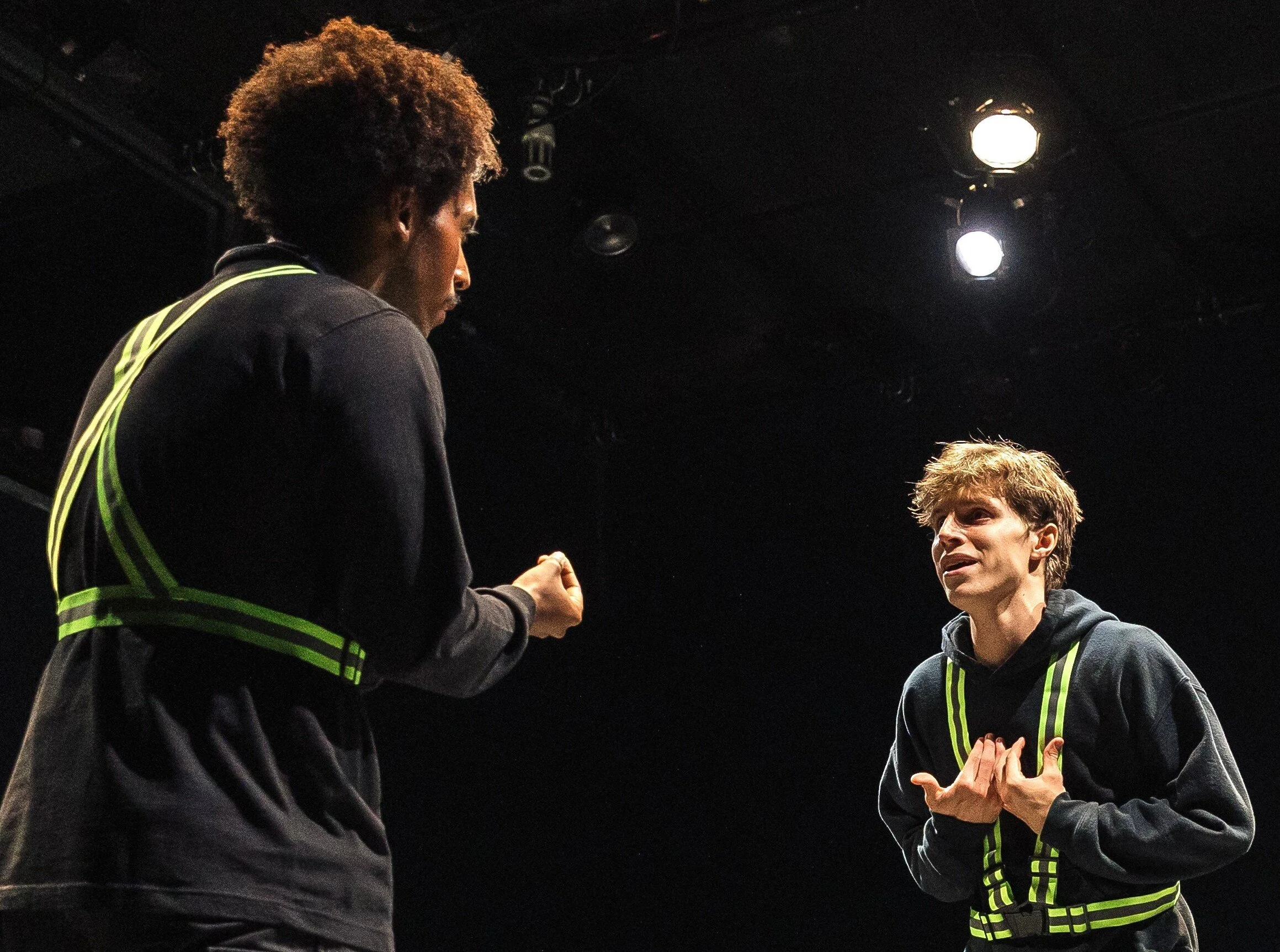
Drake and Viggo are both antagonists to each other and friends in The Vessel.
Viggo, an advocate of free will and challenging those in power, opens the second scene with a winding rant about “unnaturally long” life expectancy, in defense of an individual’s choice to commit suicide. Drake is focused more on inner peace, and his point of view can get a bit jumbled. “It isn’t brave to run when things get hard. The braver thing to do is to stay and fight and find a way through,” proclaims Drake, who did exactly the opposite with his school security job. He says to Viggo, “You are heart, but I am logic,” though he is driven by emotions on more than one occasion.
Yet with all the talk that “catastrophe is everywhere, life is painful and violent” and “history keeps teaching me that something bad will prevail,” there’s no mention of the actual catastrophes of the 2020–21 period when the play is set: pandemic, insurrection, George Floyd. The playwright’s choice not to engage with those issues, which surely would have been top of mind to young people aspiring “to create a better world,” amounts to a glaring omission in his script.
George was onto something in conceiving the drama: The suicides’ impact on bystanders and witnesses, especially those tasked with making Vessel a welcoming place, is a worthy subject. And Missy’s arc illustrates it well. Unfortunately, that plotline becomes overwhelmed by all of Drake’s and Viggo’s philosophical mansplaining.
The Vessel runs through Aug. 23 at 59E59 Theaters. Performances are at 7:30 p.m. Tuesday through Saturday, and 2:30 p.m. on Saturday and Sunday; for tickets and more information, visit 59e59.org.
Playwright: Brendan George
Director: Peter Charney
Scenic Designer: Tony DiBernardo
Lighting Designer: Yiyuan Li
Sound Designer: Emma Hasselbach
