
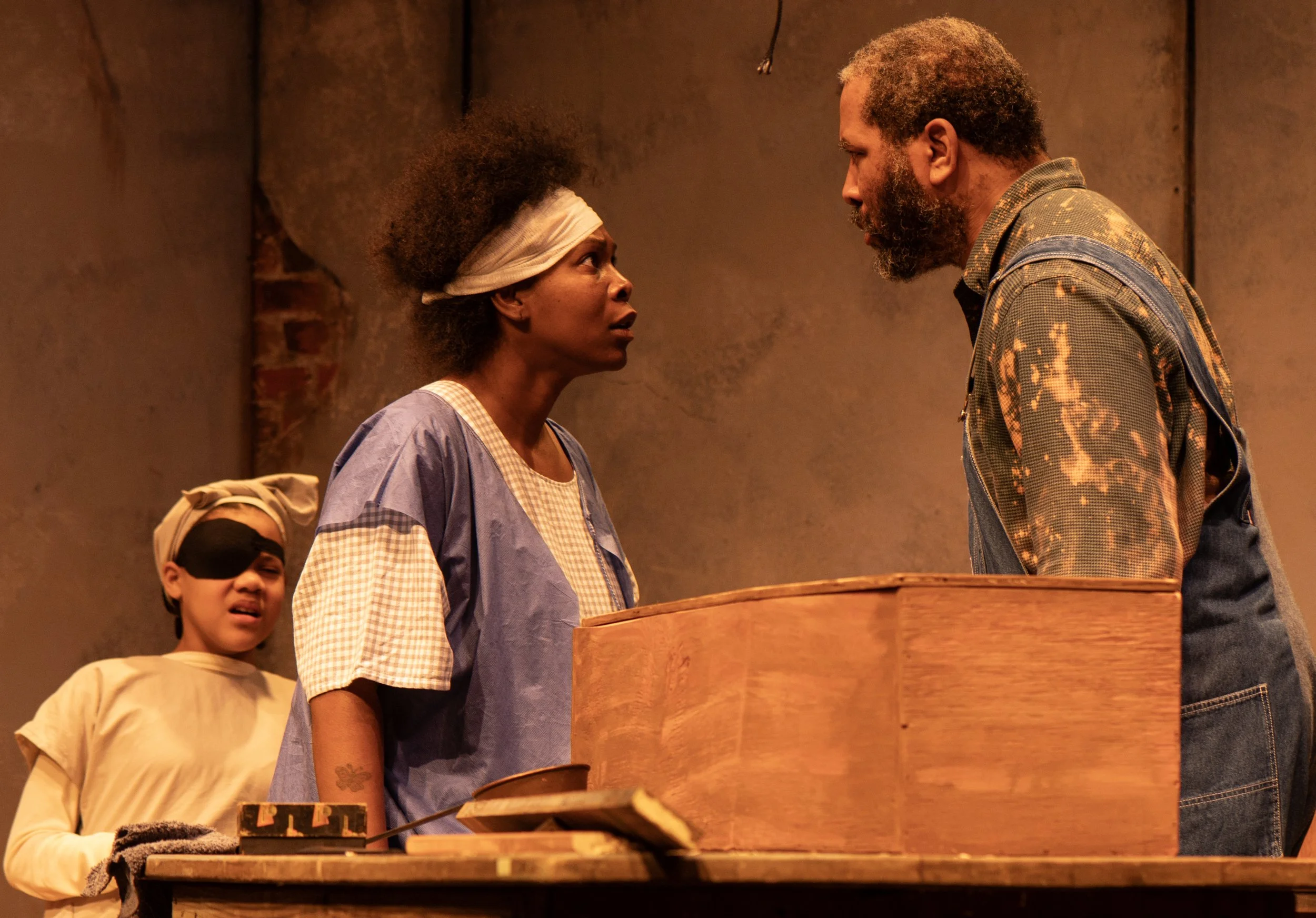
Sidney Hatcher (left, seated) plays Madeleine, Wadiah Wallah (left, foreground) is Effie, and Benjamin C. Rowe is Attius, three inmates at Central State Hospital in Terence Anthony’s drama The House of the Negro Insane.
Terence Anthony’s The House of the Negro Insane, set in 1935 inside Central State Hospital, a psychiatric institution built to confine “insane and idiotic negroes,” is a searing drama about confinement, despair, and the possibility of freedom. Structured in seven scenes, the play has a surreal texture that director Daniel Carlton brings to vivid life—a world in which even those resigned to death may dare to imagine freedom beyond the walls.
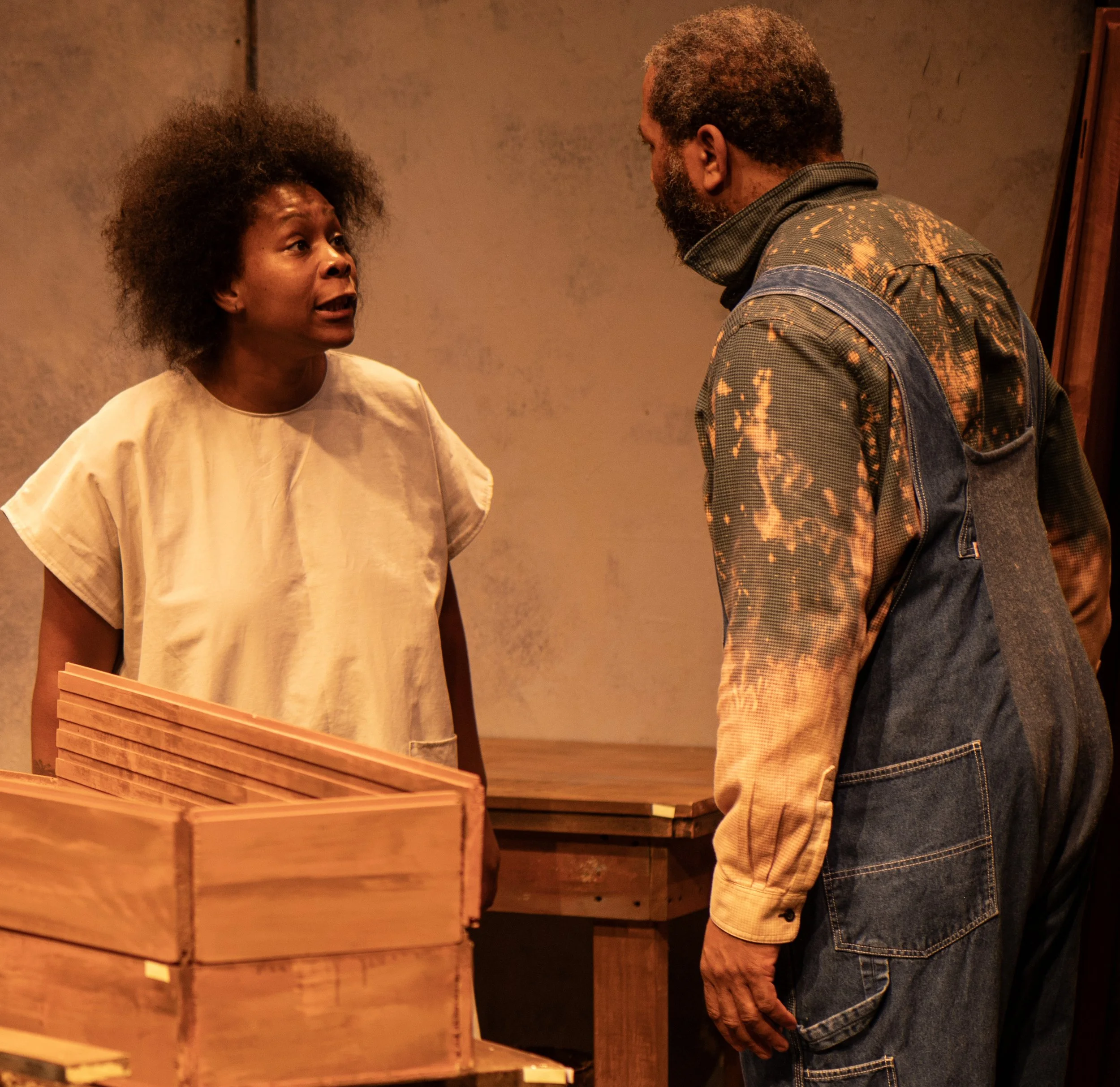
The feisty Effie sneaks into the workshop in which Attius builds coffins and challenges his resigned stoicism with her dreams for freedom beyond the asylum’s walls.
Anthony has constructed a chilling story around 38-year-old Attius Grimes (Benjamin C. Rowe), who seven years earlier was charged with assault with intent to commit rape. Declared insane because he was deemed incompetent to stand trial, Attius recounts his version of what happened: After becoming inebriated on “bug juice,” he smiled at a white woman, was beaten unconscious by white men, and arrested. Suffering from an undiagnosed traumatic brain injury that left him unable to speak coherently, he was committed to Central State Hospital, an asylum for Black people based on an actual hospital outside Petersburg, Va. Over time, he became the hospital’s top worker, and eventually its coffin-maker.
Set designer Chris Cumberbatch has created Attius’s scrappy workshop in the theater’s black box, where the inmate is tormented, humiliated and strangely befriended by his alcoholic white supervisor, Henry West (Rob Penty). When two new residents arrive—feisty Effie Litrell (Wadiah Waliah) and Madeleine (Sidney Hatcher), a child presumed to be 10—they bring dreams of freedom that Attius has banished from his mind. Their courage transforms him from a resigned stoic into a compassionate man who recognizes their plight even as he constructs their coffins. But in this cruel world, one cannot help wondering which character will soon find himself—or herself—inside a wooden box.
The Black characters are introduced standing before a “bottomless” coffin as a physician’s recorded voice recounts the circumstances that brought them to the asylum. The character then disappears, only to re-enter through an ordinary door; the device places the shadow of death before the audience from the outset—as a physical threat to those living within the walls.

Rob Penty (left) portrays the alcoholic white overseer Henry West, who torments, humiliates and strangely befriends Attius. Photographs by Steven Anderson.
Despite the harsh environment, Attius uses art—or, more specifically, music from Stravinsky’s The Firebird—to transport himself psychologically to a better place (“Sometimes a song—can help you feel something else.”). Anthony makes the work integral to Attius’ characterization, associating him with the mythic world evoked by The Firebird. As longer passages are heard, the music becomes an emotional touchstone. That connection deepens when Attius shares his secret antidote to despair with Madeleine, committed to the asylum by her aunt because of congenital partial blindness and arm tremors. Madeleine transforms Attius’s account of The Firebird into a story in which he becomes a tree where the Firebird can rest. When he objects, she changes the tree’s name from “Attius” to “Grimy”—and continues.
Madeleine: The tree’s name was—Grimy. And Grimy said to the firebird, “You look all tuckered out. … Why don’t you come and sleep in my branches?” And the firebird said, “Thank you, Grimy! But—if I land on you, I’ll light you on fire and burn you down!” Well—Grimy looked at him and said … “Don’t you worry.”
In sharp contrast to Madeleine’s dreamy innocence, 27-year-old Effie is tough as nails. Committed for indications of insanity, Effie is said to have made “claims that she is not a human being because she has not been allowed to vote,” according to the physician. When she sneaks into Attius’s workshop, he fears staff will suspect he enticed her there to rape her. Yet Effie, who becomes Madeleine’s self-appointed protector, gradually wins Attius’s respect.
The acting is convincing, not as solo performances but as an ensemble inhabiting the same social rules and emotional reality of the asylum. Rowe’s Attius quietly embodies a stoic inmate who knows he is always being watched for signs of atavistic sexual aggression; Penty, as the sinister white overseer, is jack-rabbit quick to wield the racial card against the Black inmates in his charge; Waliah’s Effie brings maternal love into an inhumane institution; and Hatcher’s Madeleine, despite her bleak surroundings, radiates faith in a brighter future.
In a playwright’s note, Anthony explains that The House of the Negro Insane was inspired in part by The Immortal Life of Henrietta Lacks, which recounts the story of a Black woman whose cells were harvested without her consent for cancer research and whose daughter died at Crownsville Hospital for the Negro Insane. Ultimately, Anthony invites theatergoers “to imagine the lives of the Black men, women, and children swallowed up by the state and, too often, forgotten by history.”
The Negro Ensemble Company production of The House of the Negro Insane plays at 59E59 Theaters (59 E. 59 St.) through Sept. 6. Evening performances are at 7:15 p.m. Tuesday through Saturday; matinees are at 2:15 p.m. Saturday and Sunday. For tickets and information, visit necinc.org.
Playwright: Terence Anthony
Director: Daniel Carlton
Scenic Design: Chris Cumberbatch
Lighting Design: Antoinette Tynes
Costume Design: Katherine Roberson
Sound Design: Linwood Booker
If you enjoyed this review, please click on the Like icon below.
