
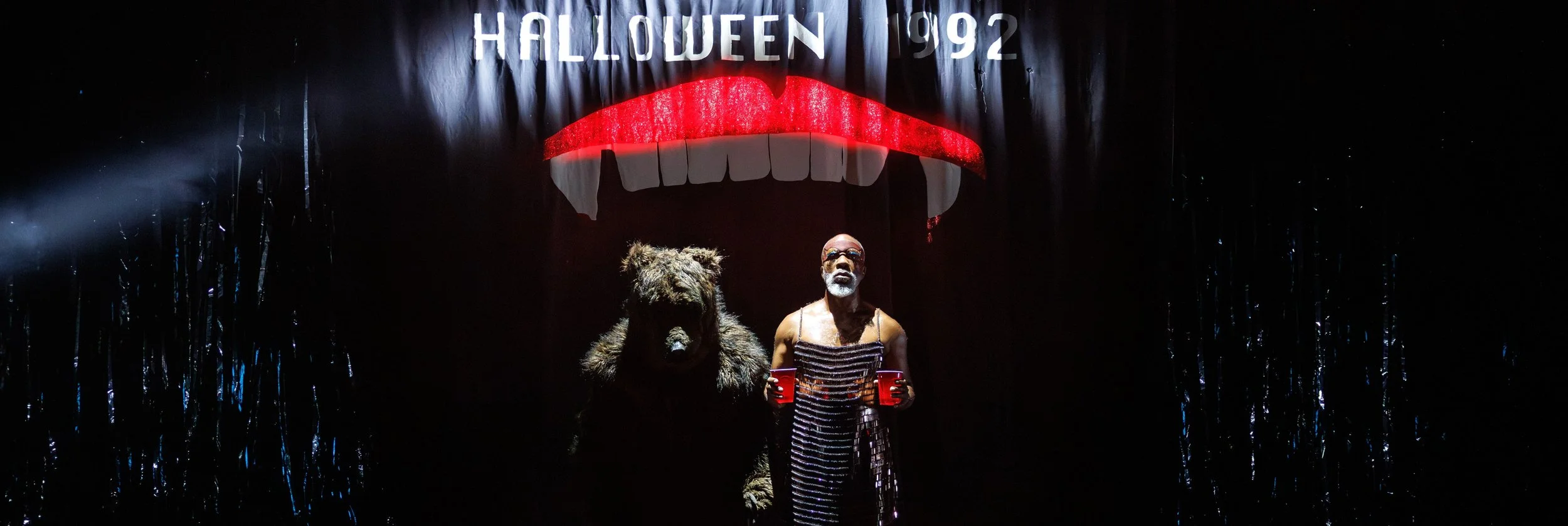
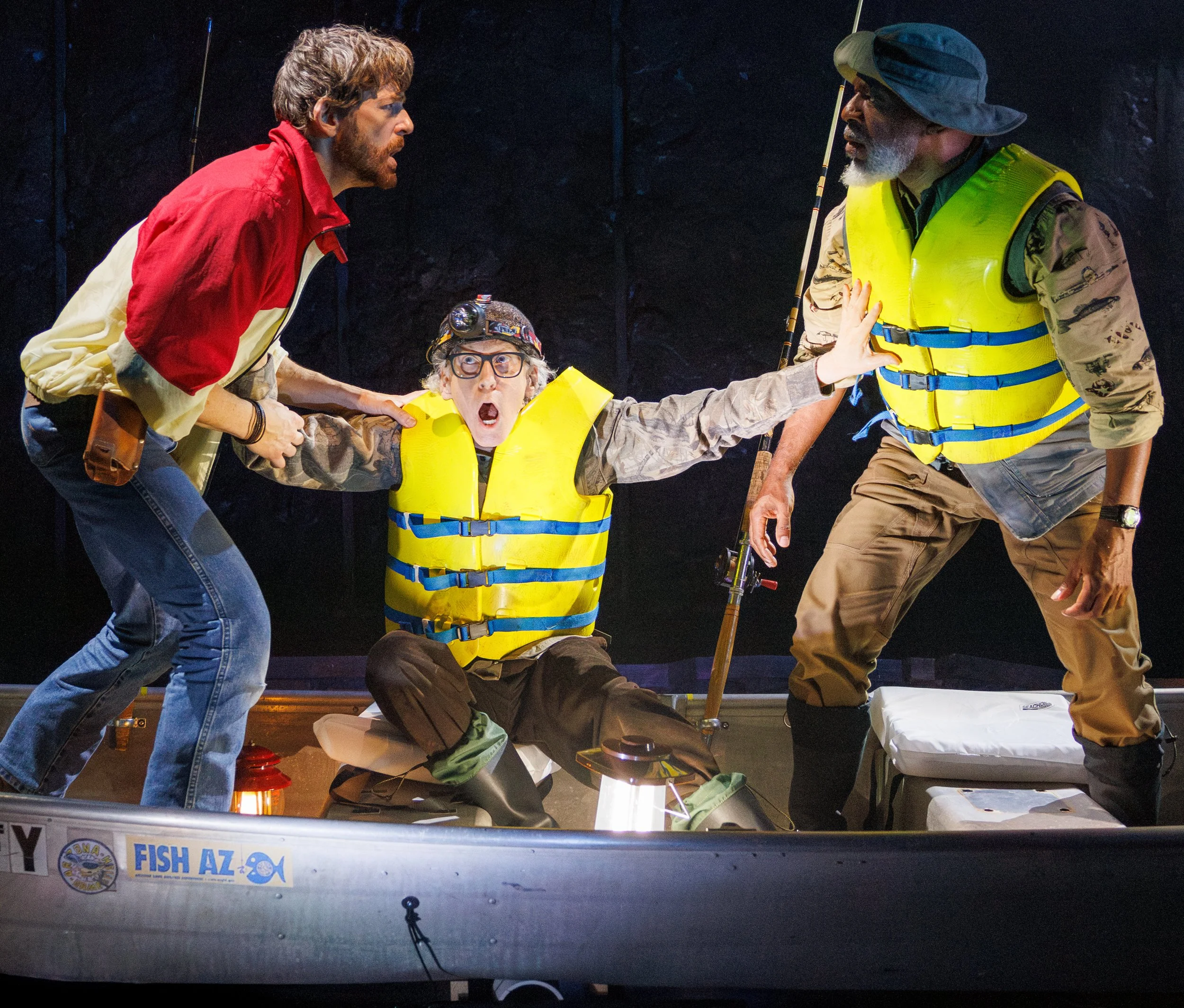
Con (Stephen Spinella, center) tries to steady the fishing boat as Bruin (Ken Barnett, left) and Doane (Jeorge Bennett Watson) have a disagreement, in John J. Caswell, Jr.’s Jerome at Playwrights Horizons.
John J. Caswell, Jr.’s Jerome is a departure from the typical gay play that pops up in June, geared toward Pride month: its focus is older gay men. A chalkboard in front of the proscenium curtain charts the decline of Jerome, Ariz., a mining town, from 10,000 population (crossed out) to lesser numbers (also crossed out) to, finally, Ghost City. That’s a tipoff that this eerie, intriguing drama is going to be different.
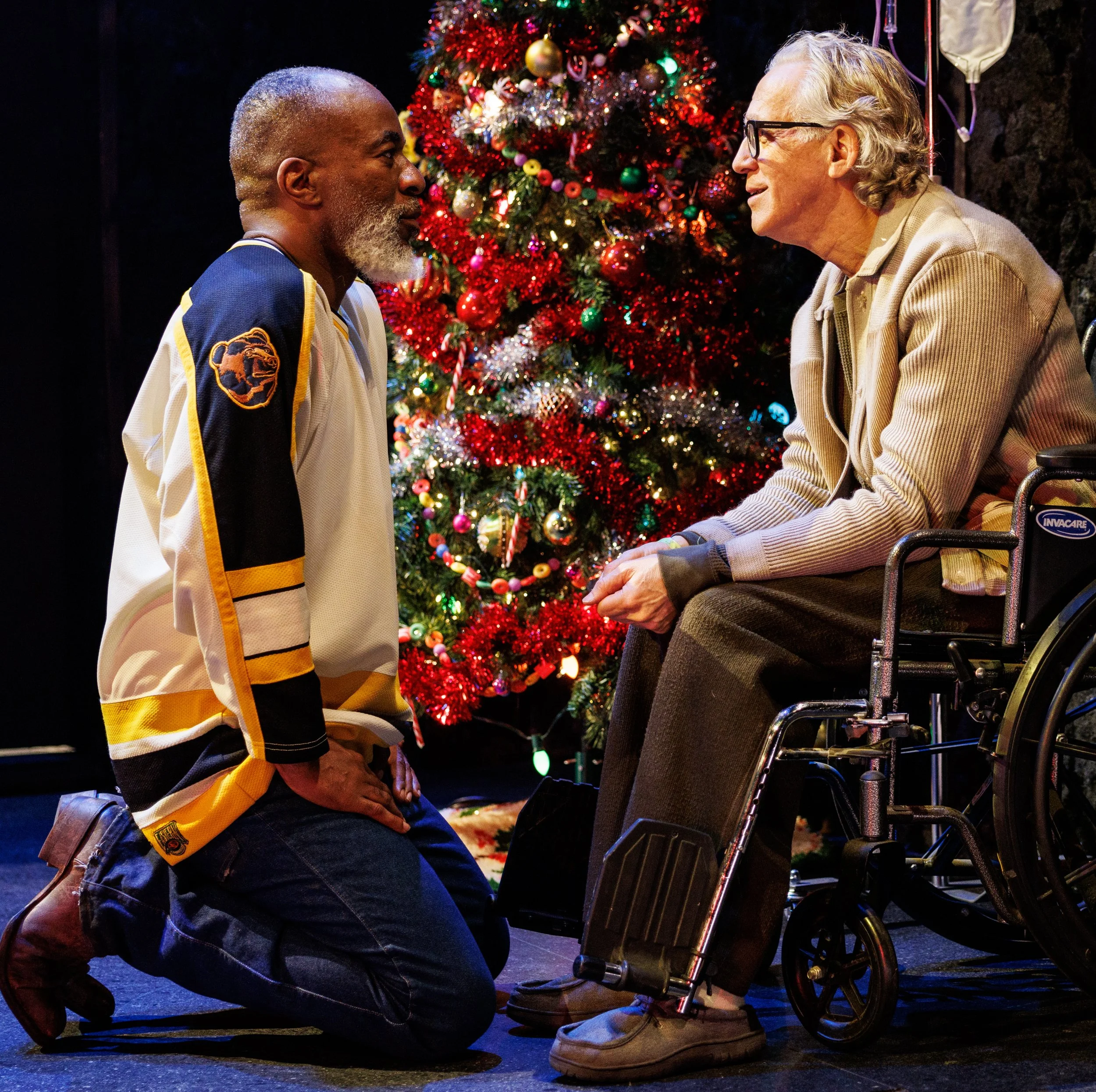
An ailing Con (right) tries to assuage the worries of Doane, his partner of 28 years.
Jerome begins in 1992 on Halloween—a night that folklore deems “the night of the dead, when the ghosts of the departed revisit the earth.” At a gay mixer, two senior men, Con (Stephen Spinella) and his partner of 28 years, Doane (Jeorge Bennett Watson), are pondering the possibility of sex with a stranger. But Con has a worsening liver condition, and Doane is reluctant to invite someone in. He tries to sidetrack Con’s obsession:
Doane: I’m telling you the truth, Connie: you’re all that I need.
Con: It doesn’t mean I’m all that you want. All our life, soldier, we’ve run nothing but a tight ship. And now it’s starting to look like we could use ourselves a helping hand. Come on, honey, humor me.
Con’s eye settles on a prospect named Bruin, who is dressed like a Masters of the Universe character: “yellow wig, chest harness, the mighty sword of Grayskull.” “You should go say hello,” Con urges Doane, “then invite him over to our place for tiramisu, but say tiramisu like a double entendre.”
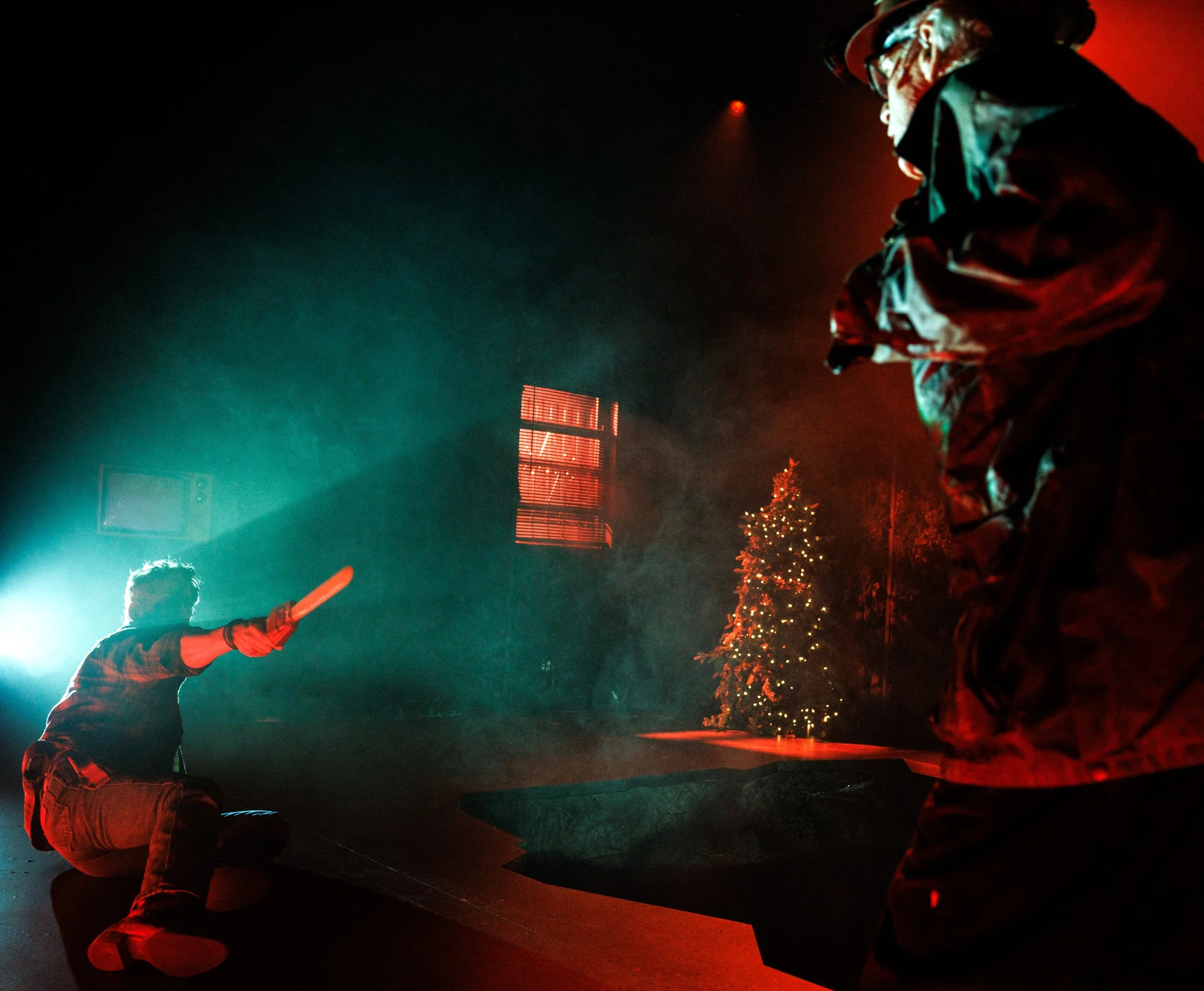
Bruin wields his Masters of the Universe sword at a phantom (Spinella). Photographs by Maria Baranova.
Con’s plan works out: Bruin (Ken Barnett), whom Con embraces as a third partner—and as his own prospective replacement—settles in for a throuple. The home, Con informs Bruin, was built by “a psychic medium and her wife, circa 1879 … nineteenth-century lesbians. Fortune tellers too, big business at the time.”
But once ensconced in Con and Doane’s mountainside retreat—the actual stone serves as one of the walls—it becomes clear that Bruin has baggage. He cries when he’s alone, and he makes long-distance phone calls for extended periods of time. A decade younger—and fitter—than Doane and Con, Bruin begins to drink too much. Although Doane balks at pressing Bruin for explanations, Con is relentless:
Con: I need to talk about this. Mortality, illness. Every time I bring it up, or anything of consequence related to, you know, your experience.
Bruin: I’m working through things as fast as I can.
Con: I’m not trying to be ungraceful, but honey, there is a clock.
All the while, strange things are happening in the house. A lighted Christmas tree turns by itself and flashes, as if in response to the action. (Con begins putting up Christmas decorations at Halloween.) Over two years, multiple trees suggest sentience through Barbara Samuels’s lighting, and at the end of Act I, the set (by Dustin Wills, who also directs), performs a breathtaking coup de théâtre.
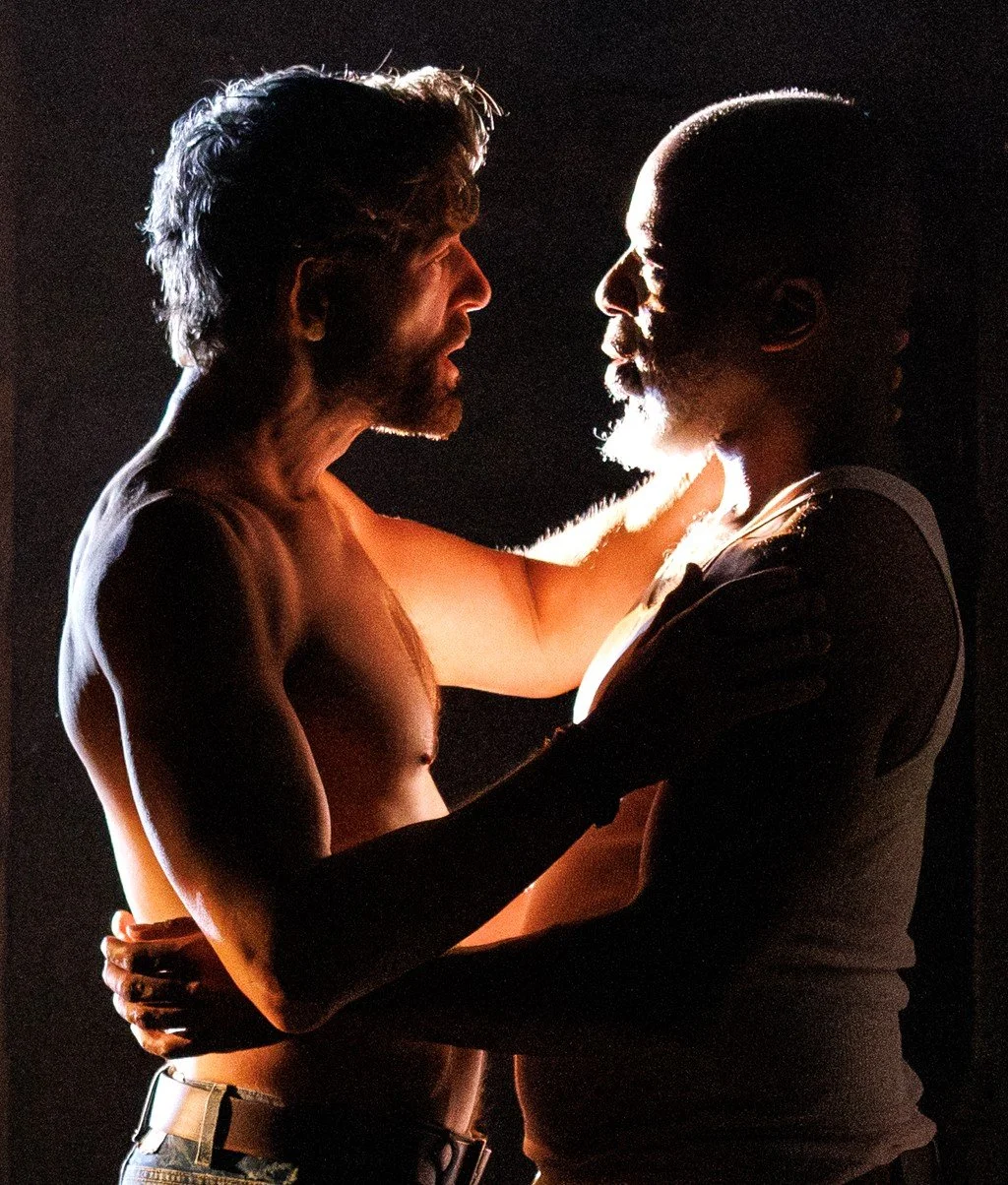
Bruin (left) and Doane strike sparks.
Although the story of people struggling with relationship problems is not of itself new, the designers provide visual and aural elements that do much to compensate. Wills’s second-act sets feature more surprises. Sound designer Leah Gelpe adds surreal rumblings from the mountain, fighter jet engines, and drips deep in the abandoned mines in Jerome.
The actors fill their parts well. At times Spinella is infuriating as the intrusive Con, but he has good comic lines. Watson’s Doane is a steady, accommodating force in their relationship, and Barnett’s Bruin reeks of private agony.
The play, though, is not without drawbacks. First, a key part of the plot has to do with the worked-over dramatic ground of the AIDS era and its toll on a generation. Also, Caswell has done himself no favors with an early scene of the three men out of sight in an upstage bedroom. For long periods, one only hears their sexual fumblings, some of which draw from clichés about old people: “Foot cramp, hold tight, it’ll pass” and “Here’s what we do instead. You lift up, put your leg over to the side.” They are meant as comic relief, but it doesn’t offset the boredom of a bare stage showing light from an upstage door, when often it’s unclear who is speaking the disembodied dialogue.
Still, the portrait of older gay men striving to hold on to life is empathetic. And the frisson produced by Wills’s final image, a serene trio dressed in white linen on a sunny verandah overlooking the Ligurian Sea, makes clear that folklore has been a driving force in the action.
John J. Caswell, Jr.’s Jerome runs through June 21 at Playwrights Horizons (416 W. 42nd St.). Evening performances are at 7:30 p.m. Tuesday through Sunday; matinees are at 2:30 p.m. Saturday and Sunday, with an additional matinee at 2:30 p.m. on Tuesday, June 16. For tickets and more information, visit playwrightshorizons.org.
Playwright: John J. Caswell, Jr.
Direction & Scenic Design: Dustin Wills
Costume Design: Rodrigo Muñoz
Lighting Design: Barbara Samuels
Sound Design: Leah Gelpe
If you enjoyed this review, please click on the Like icon below.
