
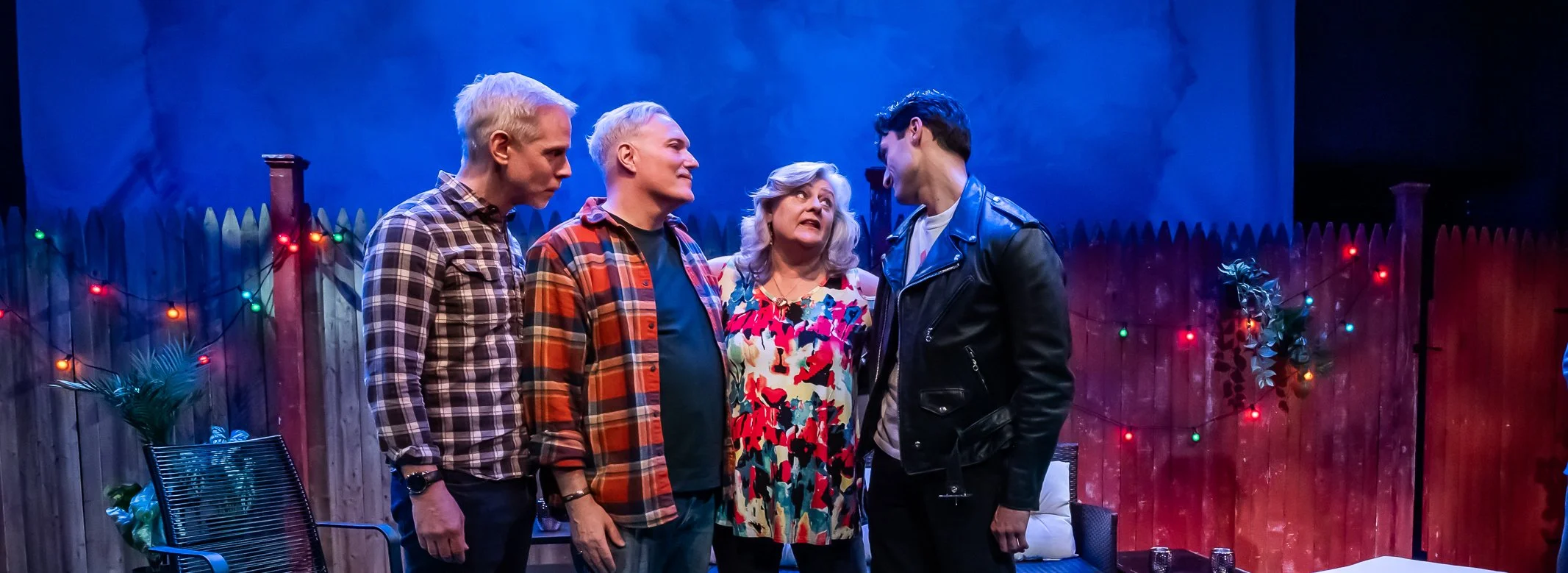
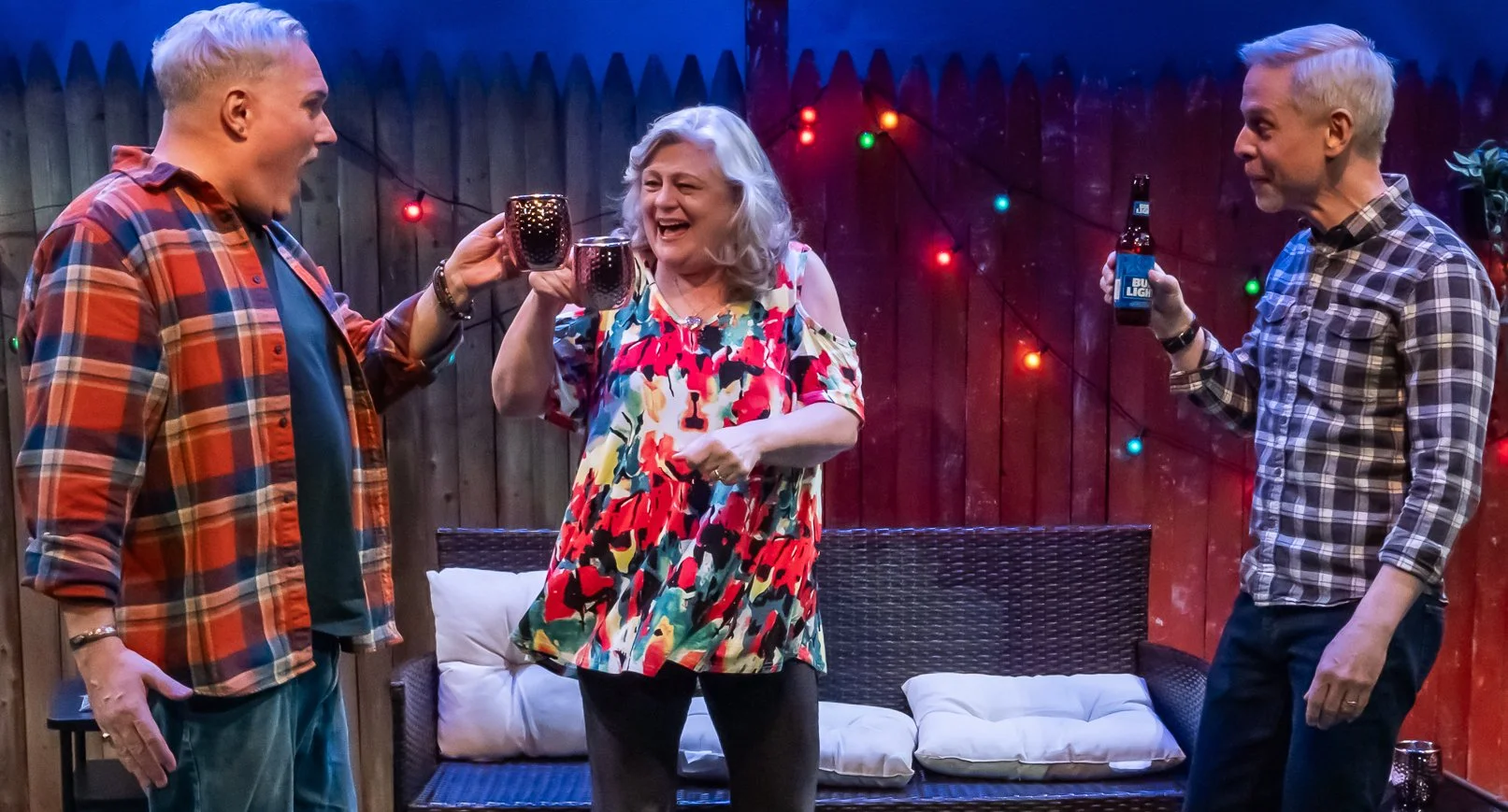
Andy (Christopher Borg, left), his sister Paula (Nancy Slusser), and his husband, Stanley (Tim Burke), are excited about the wedding of Paula’s son, which the older gay couple is hosting in Iowa, a state that recognized gay marriage early, in Barry Boehm’s Our House.
Barry Boehm’s play Our House takes up a staple of American drama, family strife, with the added difference that four of the six characters are gay. A long night of drinking and drug-taking puts it squarely in the vein of Long Day’s Journey into Night and Who’s Afraid of Virginia Woolf?, a show in which one of Boehm’s characters happens to be starring, in a community-theater production. More particularly, the gay characters echo any number of engaging dramas, from The Boys in the Band to Love! Valour! Compassion! to My Night with Reg.
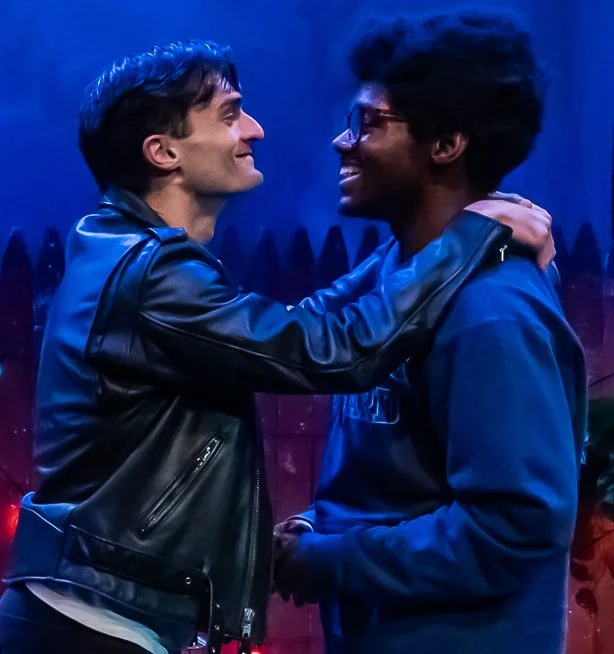
CJ DiOrio (left) plays Brendan, and Jalen Ford is his fiancé Eugene, in Our House.
At an old, restored Midwestern home that was built by his forbears, Andy (Christopher Borg), a teacher on summer leave, lives with his husband, Stanley (Tim Burke), a nurse. They are about to host Andy’s “genius” nephew Brendan (CJ DiOrio) and Brendan’s Black fiancé Eugene (Jalen Ford) at “the family estate” in Iowa for their wedding. Although Brendan’s mother, Paula (Nancy Slusser), lives nearby, the gays are sharing housing.
As the show opens, Andy is complaining to a policeman that roving neighborhood kids on skateboards go by and throw walnuts at the house and “yell stuff from the trees.” Anyone with half a brain can fill in the “stuff,” and indeed, the plot revolves around a gay-bashing. Given the neighborhood’s increasing sketchiness, it’s a smart move that the men have a high wooden fence surrounding their back yard. (Evan Frank’s set evokes comfort and privacy on what is surely a shoestring budget.)
Boehm has set his play in 2014, a year before gay marriage became the law of the land (Iowa was in the vanguard of adopting it). In younger days, though, Andy and Stanley lived in New York, where Andy was an ACT-UP activist. Stanley was a nurse at St. Vincent’s, and both saw friends die, notably one named Rafael, whom Andy adored but Stanley found difficult.
Although Our House is billed as a comedy, the laughs are sparse. Director Mark Finley’s production faces two chief problems. First, Andy flies into hysterical rages, none more bizarre than the Act I closing scene in which he hurls curses and spits as if he were a cross between Scarlett O’Hara and Maria Ouspenskaya’s gypsy in The Wolf Man. The wild histrionics leave comedy in the dust.
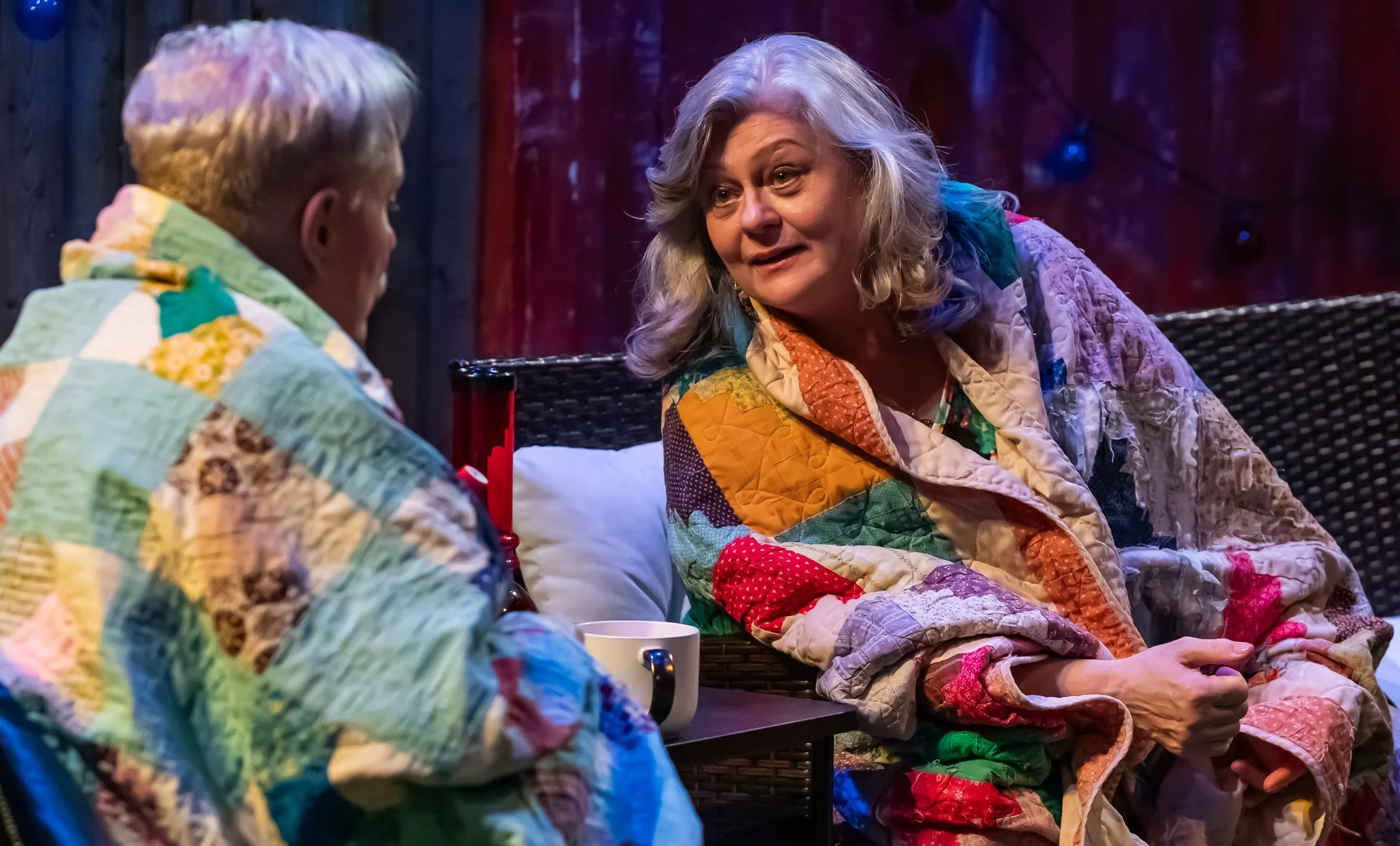
Andy and Paula have a heart-to-heart about sacrifices. Photographs by Mikiodo.
Meanwhile, Brendan is a wheedling, immature tease with Eugene: how they reached a point of lifetime commitment is baffling. DiOrio shows none of the seriousness that could persuade someone that he was a high school class valedictorian. Even Paula says of him, “He may be a genius, but he doesn’t know when to shut up.”
Still, as secrets unfold, there are moments that work. In Act II, Andy and Paula have a confrontation about elder care—the devotion to a parent, the cost, the finances, keeping up the homestead—that transcends issues of straight and gay. And Paula does have some zingers. After Eugene and Brendan fight, and Eugene says, “Are we ever going to be able to know, and truly trust each other enough to be together? … I’m tired, and I don’t like fighting. I don’t want to fight all my life to be heard,” Paula remarks, “Well, that’s the stupidest thing I ever heard. What in the hell do they think marriage is? One long fight trying to be heard.”
Fortunately, Paula, Stanley, and Eugene are more credible characters, and Burke is especially good as Andy’s wry and patient spouse. Tangential issues of white privilege and parenting briefly spark some interest after Stanley tells Eugene that he and Andy had once thought about adoption, although they feel shoehorned in:
We had this fantasy child. A girl! We’d talk about how we’d raise her. Buying her outfits. Ballet classes, soccer on Saturdays, Mathletics on Sundays. Fierce, gay dads to this brilliant, tough as nails, little Black girl.
It then devolves awkwardly into Stanley feeling white guilt over objectifying the child by race. “I made it sound like some sort of gay cliché, a white gay couple with this sassy little black girl,” says Stanley apologetically.
Boehm’s play works best as a history lesson—a generation of young gay audiences may find enlightenment in those parts dealing with AIDS and ACT-UP—but it lacks the vitality of currency. Even the dynamics of an interracial relationship, which might straddle both eras, prove fruitless in providing fireworks: the ending, in which everything seems to have worked out, feels unearned.
The Other Side of Silence (TOSOS) production of Our House plays through March 21 at A.R.T./New York’s Jeffrey and Paula Gural Theatre (502 W. 53rd St.). Evening performances are at 7 p.m. Wednesday through Saturday; matinees are at 2 p.m. Sunday. For tickets and more information, visit tososnyc.org.
Playwright: Barry Boehm
Director: Mark Finley
Scenic Designer: Evan Frank
Lighting Designer: David Castaneda
Sound Designer: Merry Campbell
Costume Designer: Ben Philipp
