

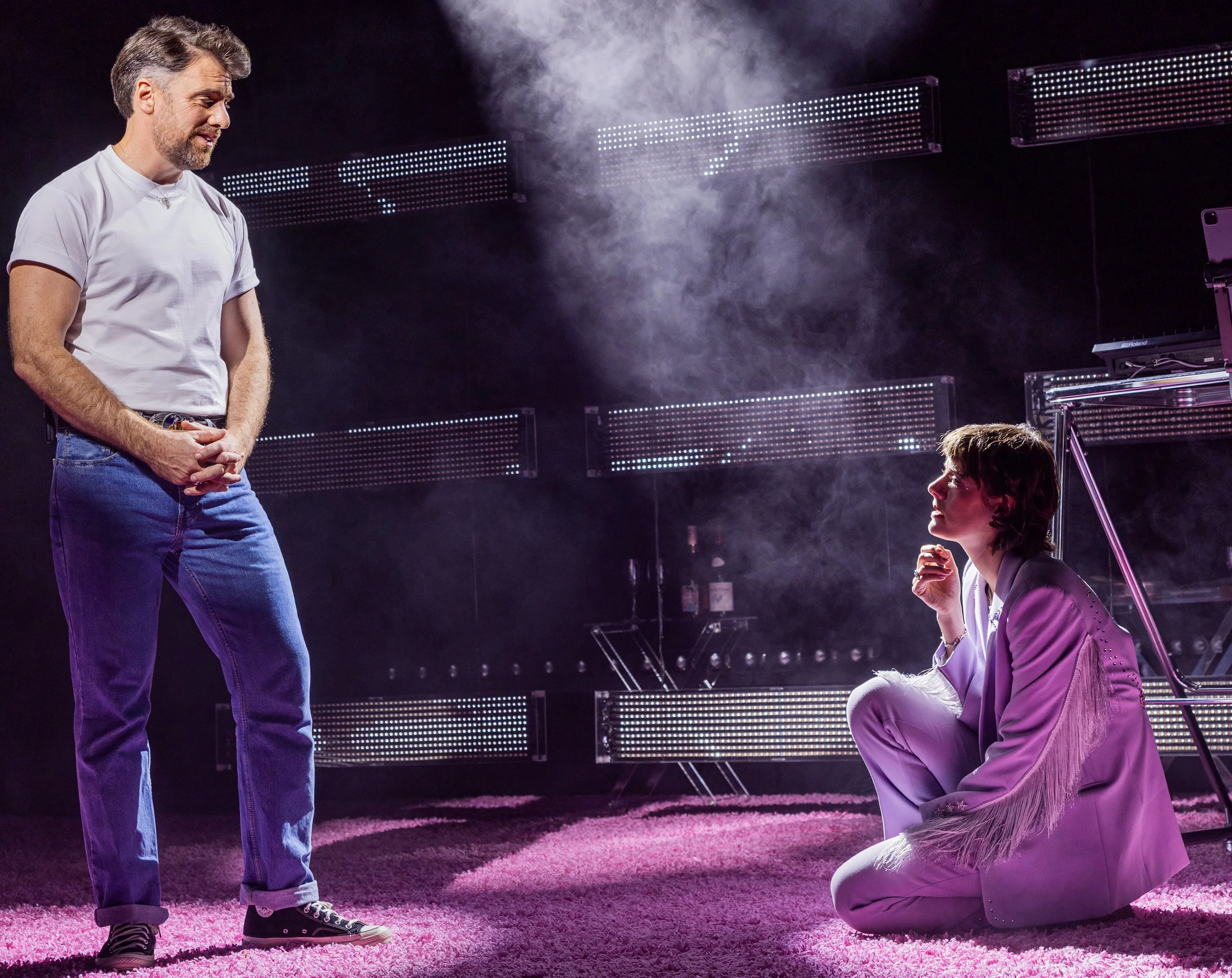
Karin McCracken (right) details the ins and outs of a breakup, examining the pain that immobilized her romantically for years, in Heartbreak Hotel. Simon Leary (left) plays all the male roles.
Titling her play Heartbreak Hotel is a major bit of misdirection from New Zealand dramatist Karin McCracken. Elvis’s recording of his classic 1956 single (by Mae Boren Axton and Tommy Durden) is barely mentioned, and its bouncy blues are a far cry from McCracken’s gloomier deep dive into the nature of heartbreak. Directed by Eleanor Bishop, the play reaches beyond McCracken’s personal drama to examine unexpected, more clinical aspects of a breakup, such as psychological, biological, and physiological symptoms. Interspersed with those sequences are musical interludes—she took up the synthesizer to occupy herself after the end of a six-year relationship, and she has learned six “powerful” chords.

Simon Leary plays McCracken’s gay best friend as well as other roles in the two-person show.
Entering in a white suit with bell-bottoms and long fringes on her suit jacket, and with the aplomb of a stand-up comic, McCracken speaks to the audience: “Is anyone here heartbroken, or grieving, or otherwise bereft? Doesn’t take much—just a little energy towards the thought: ‘Yes, I’m heartbroken, or grieving, or otherwise bereft.’” About her singing, she explains, “I read that it’s good for you. It suppresses cortisol in the body, which relieves stress.” It’s a foreshadowing of the blend of personal emotions and science that undergirds her show. Then she segues into her own story. Advice from her mother sets the tone:
When someone is in the midst of a heartbreak, it feels like time has stopped because they want the past and don’t want what the future holds. A state of limbo. It’s a terrible thing.
McCracken researches breakups and seizes opportunities for discussion, no matter with whom. On a Tinder date six months after the split, she wants heavy-duty conversation. She has spent a lot of time focusing on the issue, she tells her companion (Simon Leary deftly plays all the male characters):
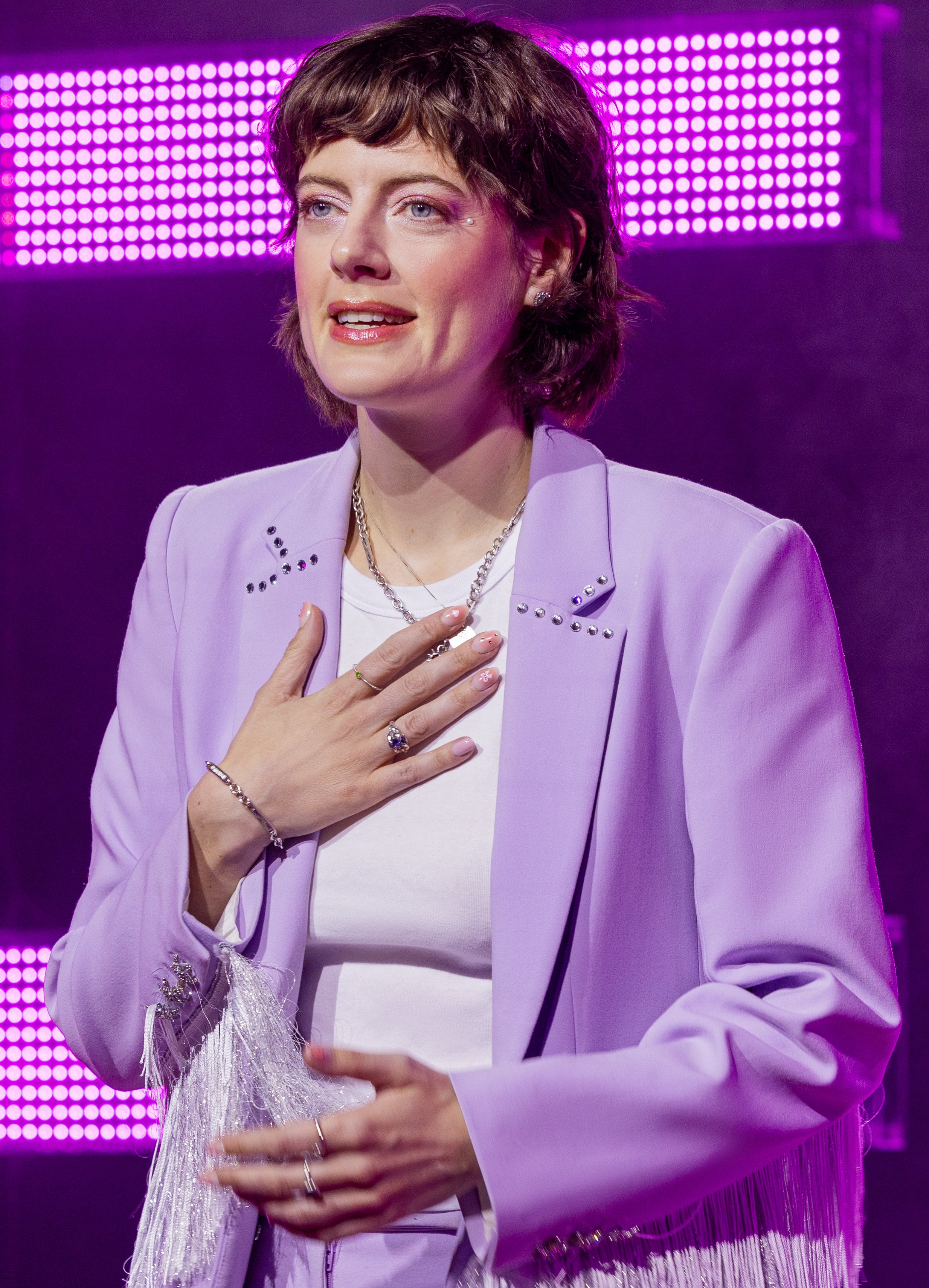
McCracken doesn’t flinch from showing her character’s flaws. Photographs by Evan Zimmerman.
Her: I guess I’m more generally asking, What is so wrong with dating after a breakup? … They’ve basically disproven that rebounds are a bad idea. If you’re heartbroken, it’s actually a pretty good idea to go out and date. Tops up oxytocin levels, calms down the nervous system, represses the body’s stress response. And statistically rebounds are just as likely to be successful relationships as any other kind. …
Tinder Date: Right. So, what’s the cure then?
Her: For heartbreak? There’s no cure. Unfortunately. … “There’s no getting over, only getting through.”
It’s no wonder she’s unable to connect, and one of the play’s strengths—or drawbacks, depending on one’s expectations for the journey—is the unflinching pain she radiates. McCracken becomes neurotic and obnoxious at a grocery store, browbeating a worker to double-check for a brand of chipotle sauce that he knows is sold out. At the doctor’s office, she tries to wheedle medicine: “There’s a pain in my chest. Behind my sternum, and it radiates up and down. And it’s there almost all the time.” The painful desperation of the scene is leavened with flashes of comedy:
Doctor: Do you have a therapist?
Her: I have the Headspace meditation app.
Still, McCracken doesn’t flinch from showing her worst self. After the Doctor (touchingly embodied by Leary) tries to bond by telling her of the pain of his husband’s death, she steers the conversation back to whether he will give her drugs. Apps, hobbies, medicine, studying the history of heartbreak—none of them really helps her. Her singular redeeming feature is that she is fearless in wanting to understand the pain of a breakup.

McCracken learned to play the synthesizer—somewhat—as part of her recovery from a breakup.
Her gay best friend Simon says she needs a vacation, so they go to Berlin and party in nightclubs. (Both Leary and McCracken conjure the wildness of Berlin nightlife, helped by Filament Eleven 11’s production design, which features wrapping LED lights.)
McCracken’s scenes with others include disquisitions about a friend’s split; examinations of the phases of a breakup—awe, protest, resignation—and snatches of trivia. Broken-heart syndrome has an official name: “Takotsubo syndrome,” she explains. “It’s when you’re under so much distress that your heart actually changes shape … until it comes to resemble a Japanese fishing pot used to trap an octopus called a Takotsubo.”
The show is, as McCracken acknowledges in an early aside, not the musical that some patrons might expect. That’s true, and some of it drags, especially the science. Ultimately, though, it is a brave attempt to examine seemingly every nook and cranny of love that goes wrong—it’s a strange breed of TED talk about breakup woes, illustrated with scenes of pain and discomfort, with the hope of recovery at the end.
The EBKM production of Heartbreak Hotel runs through April 19 at the DR2 Theater (103 E. 15th St.). Evening performances are at 7 p.m. Tuesday through Thursday and at 8 p.m. Friday and Saturday. Matinees are at 3 p.m. Sunday. For tickets and more information, visit heartbreakhotelplay.com.
Playwright: Karin McCracken
Director: Eleanor Bishop
Production Design: Filament Eleven 11
Sound Designer: Te Aihe Butler
