
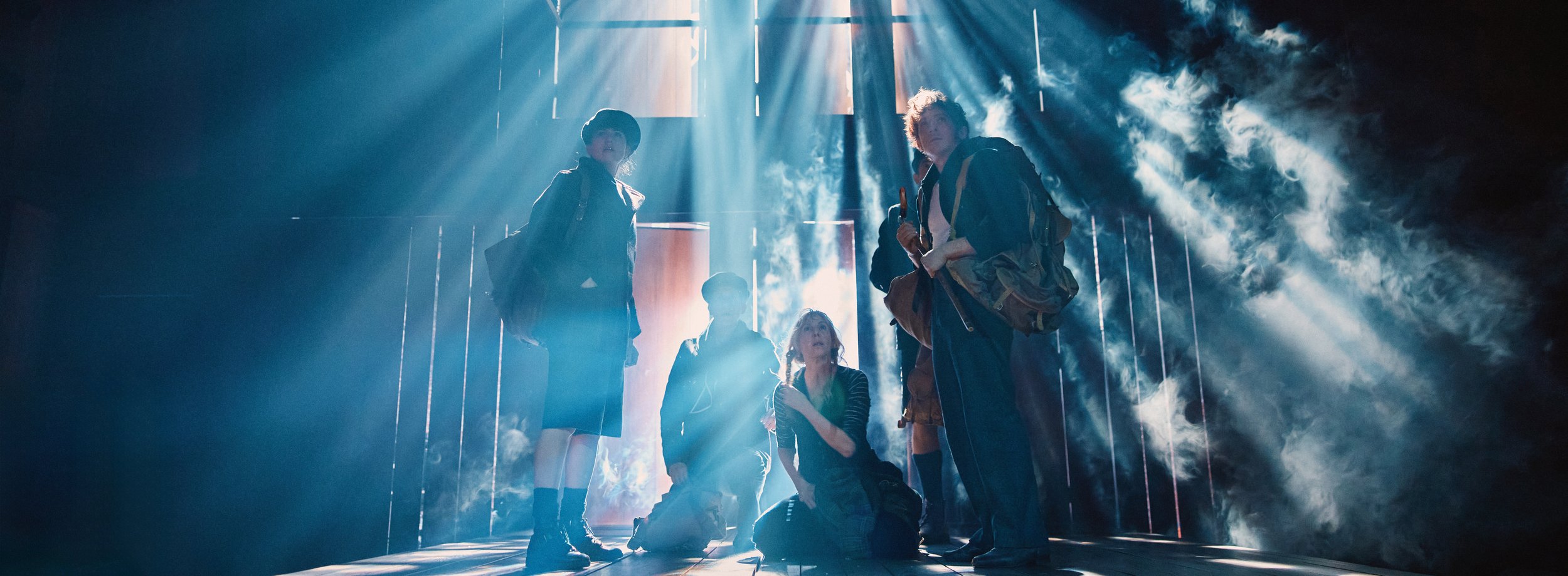
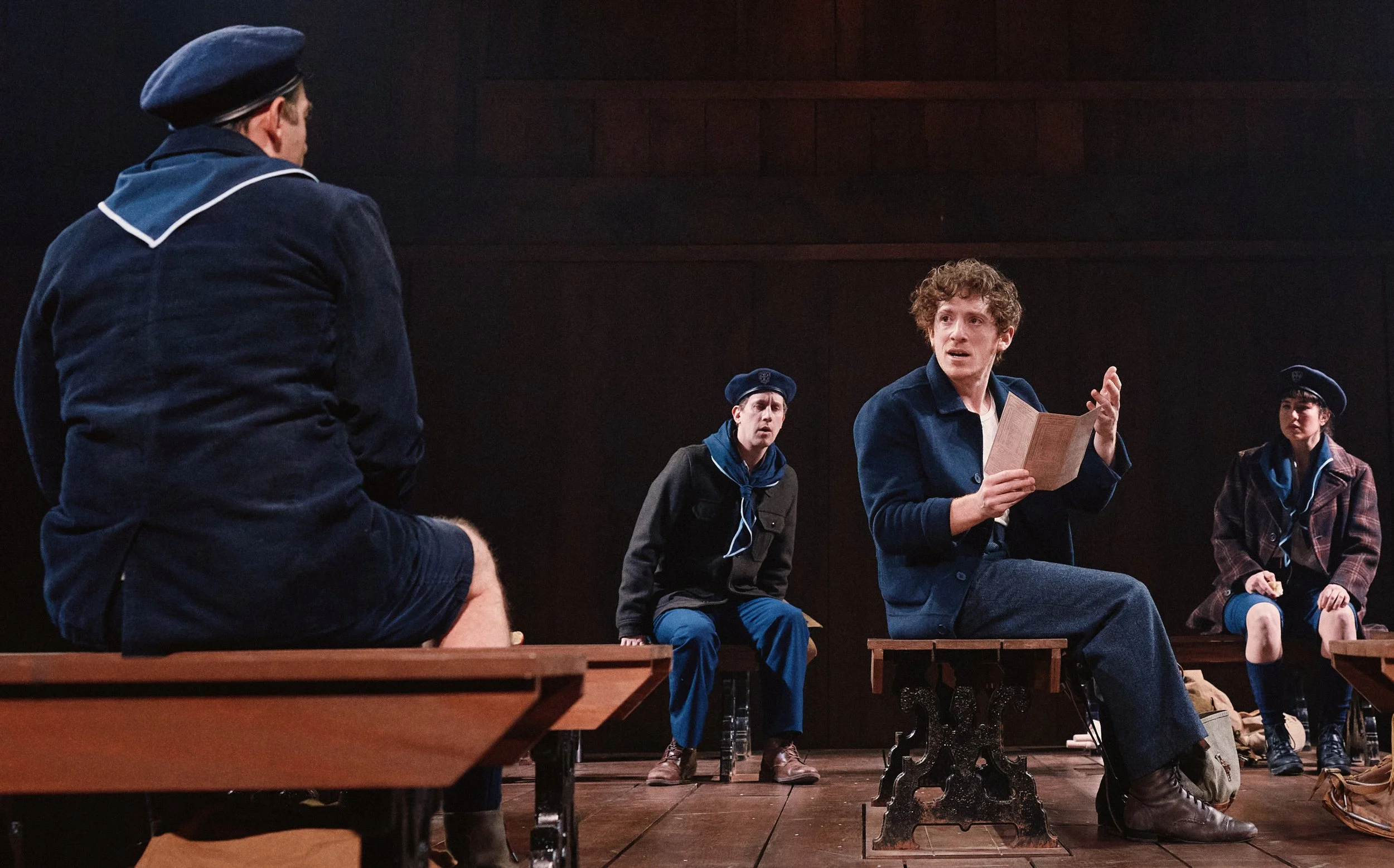
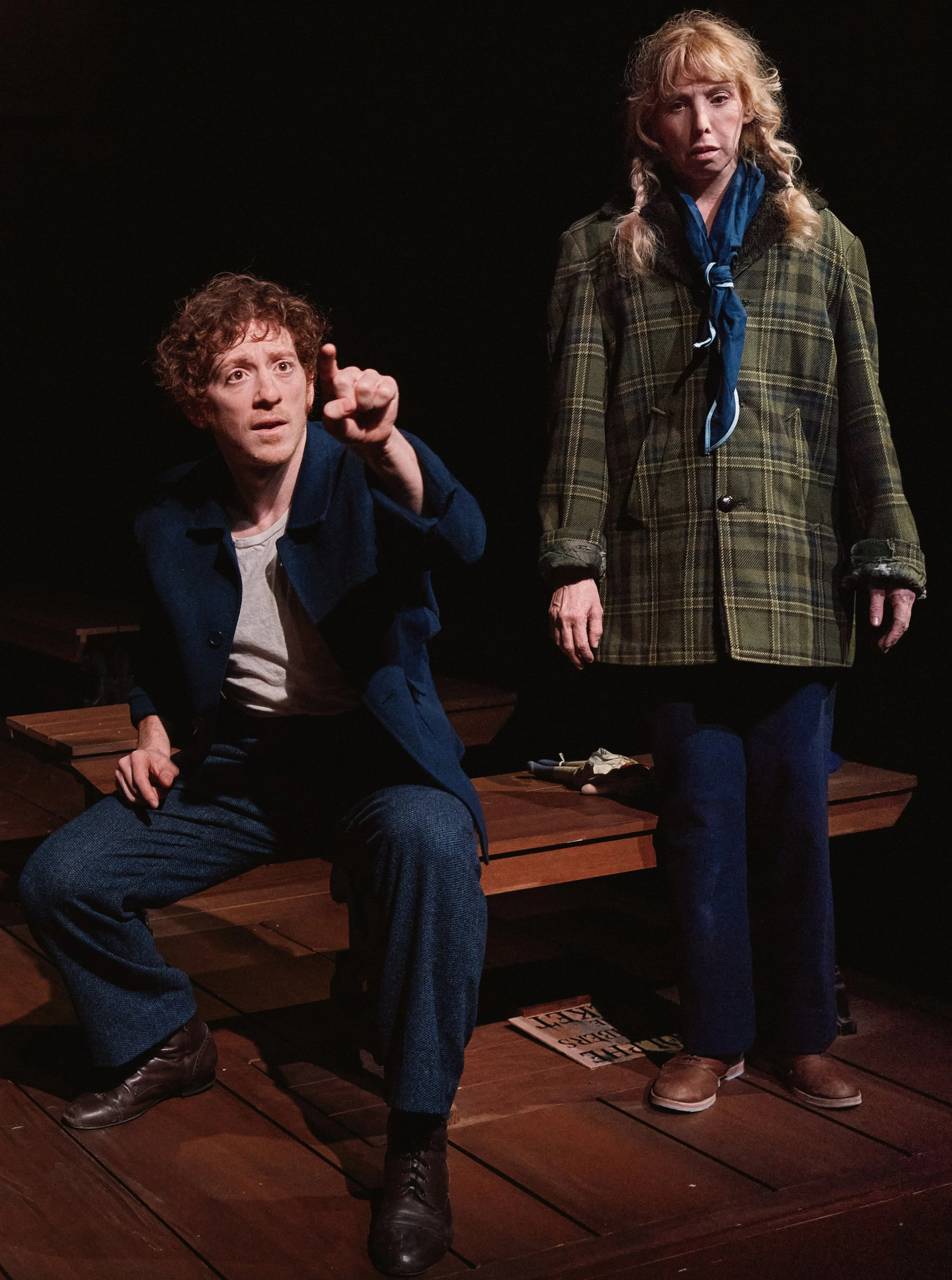
For their escape plan from Occupied France to succeed, the young Marcel Marceau (Ethan Slater, second from right) needs the cooperation of (from left) Adolphe (Max Gordon Moore), Henri (Alex Wyse) and Berthe (Tedra Millan) in Marcel on the Train.
The Marcel Marceau that most people, or at least most theater aficionados, know was one of the world’s greatest mimes. As Bip, a lovable, quirky, charming clown, he regaled audiences with a worn top hat from which protruded a floppy red flower. Marceau’s vulnerable and self-effacing persona, though, was but a thin veil obscuring his heroism during World War II, as recounted in Marshall Pailet and Ethan Slater’s Marcel on the Train.
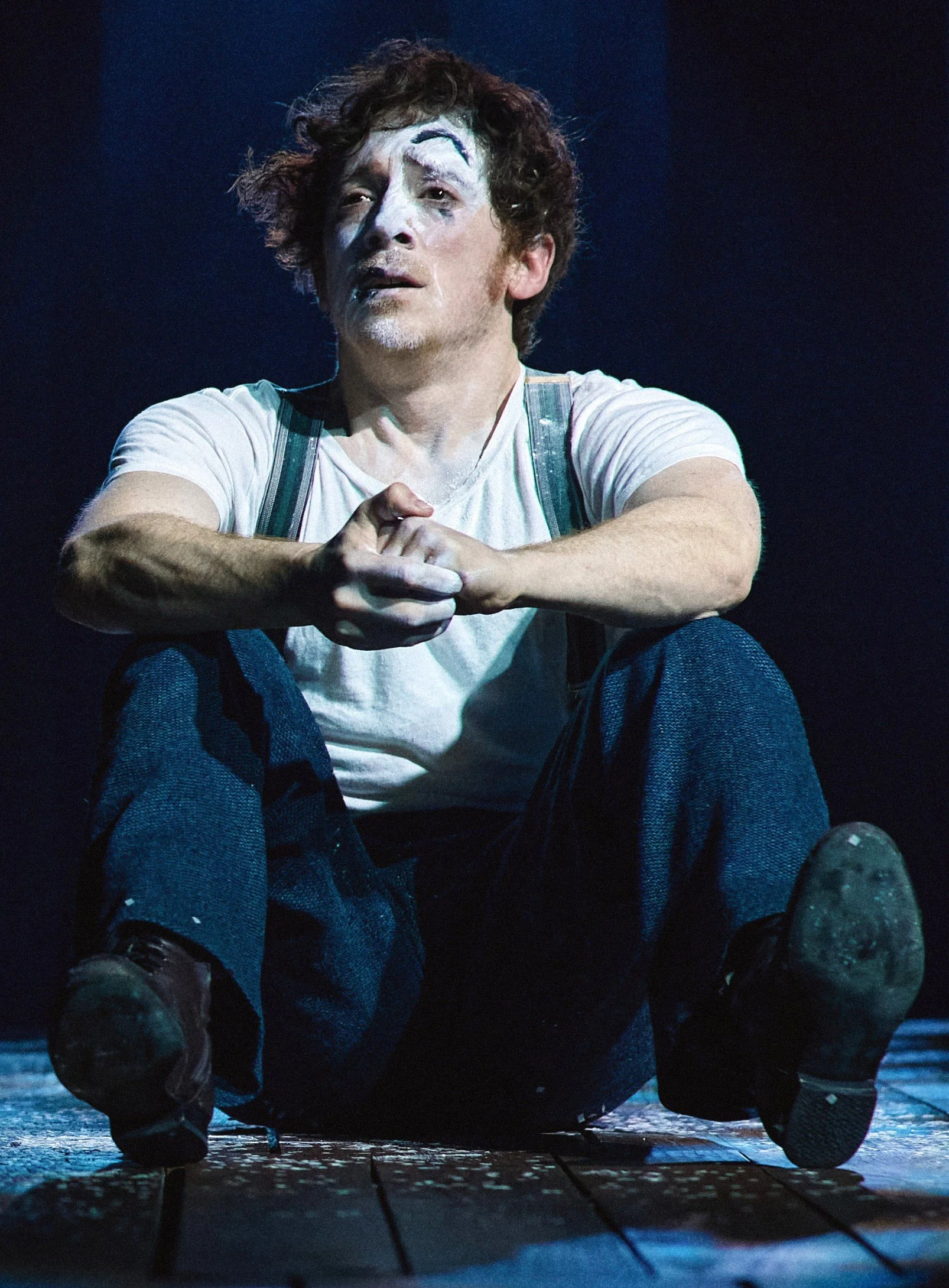
An older Marceau reflects on his years in the French Resistance. Photographs by Emilio Madrid.
Although Marceau’s birth in 1923 in Strasbourg, France, to Polish and Ukrainian émigrés Charles and Ann Mangel preceded the Nazi occupation of France, the family fled in 1940 to Limoges, where Charles owned a kosher butcher shop. By 1943, when Nazis accelerated the deportation of French Jews—almost exclusively to Auschwitz—Georges Loinger, Marceau’s cousin, had recruited Marceau to join the Resistance. At Loinger’s urging, the 20-year-old Marceau agreed to escort Jewish children to safety in Switzerland.
Hence, Marceau (Ethan Slater) chaperones four anxious 12-year-olds, two girls—Étiennette (Maddie Corman) and Berthe (Tedra Millan) and two boys—Henri (Alex Wyse) and Adolphe (Max Gordon Moore), all attired as Boy Scouts. They board a train to Annemasse, France, from where they can cross the Alps into Switzerland. Marceau is solely responsible for smuggling the children to safety. To escape detection by the Nazis on the train, he must maintain a calm environment, which is difficult. Although Berte is clever and communicative, she foresees only death and disaster, despite Marceau’s best efforts to assuage her fears. Millan captures Berthe’s charm and whiny pessimism.
Part of the group’s anxiety stems from a failed rendezvous at the train station with Loinger and other children. Yet Marceau’s concern for Loinger’s group is superseded by the urgent need to keep this motley group, who persistently tease one another, solvent and taciturn. He entertains Berthe and the others with shadow butterflies, other shadow creatures, and a gentle, modest demeanor that contrasts with his later bravado. These “survival tactics” foreshadow Marceau’s unparalleled talent as a mime (even before his rigorous postwar training). It is increasingly evident that Marceau’s art of visual illusion and his art of verbal deception are interdependent and factor heavily in his success in saving the preteens.
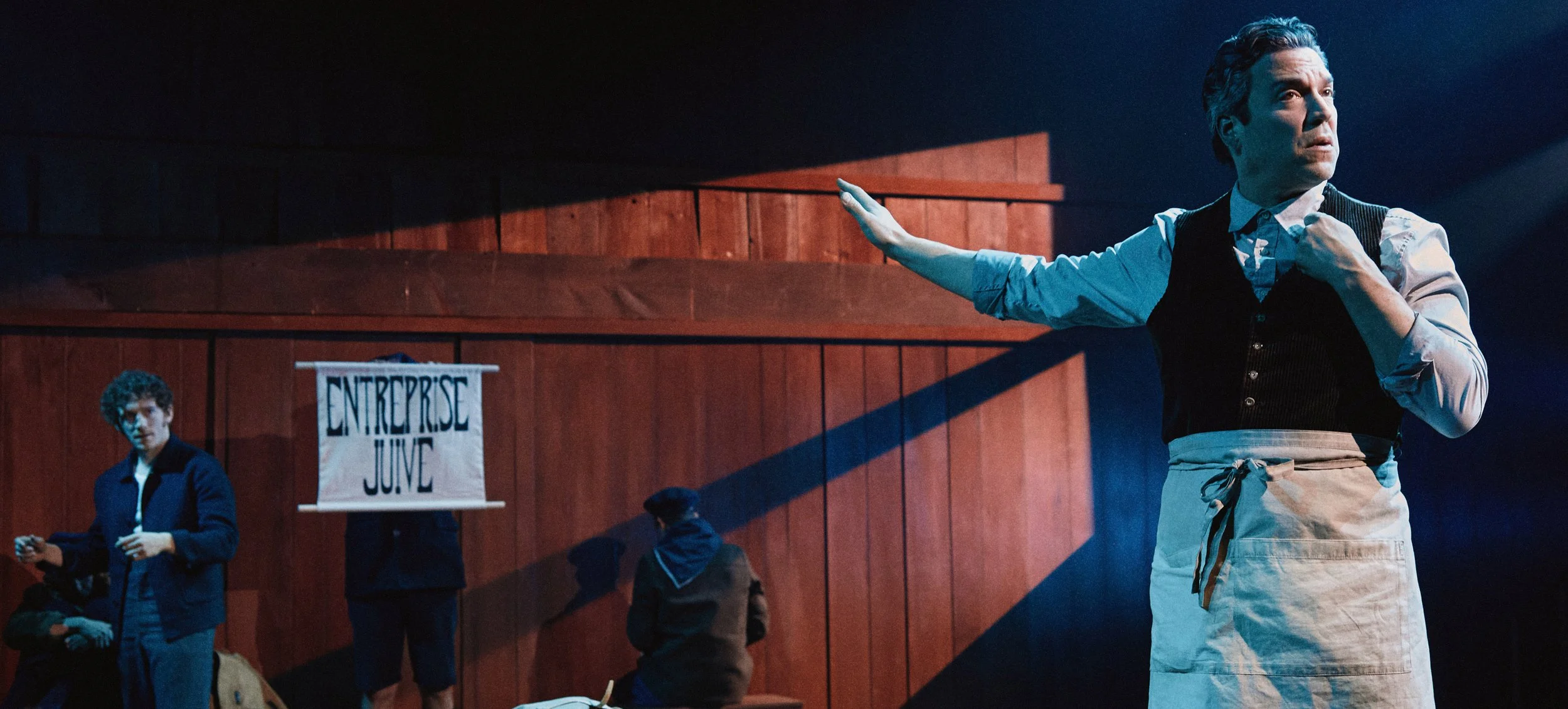
Marceau watches as his father Charles (Aaron Serotsky, right), a kosher butcher, grapples with the inevitable closure of his Jewish business.
Marceau treads the fine line separating nurturing and intrepid behavior, but Slater’s characterization illustrates the latter. There are two revelatory scenes that exemplify his daring.
The first occurs when he calculates how to prevent the swastika-bedecked French officer on the train from arresting them all. The second transpires after they disembark at Annemasse, trek five kilometers through the snow with an ill Berthe, and come to a forest near the Swiss border. Suddenly, German soldiers approach through the woods. Studio Luna’s unearthly lighting masks Marceau, concealed behind trees, as well as the children. He and the children pull off a daring bluff. They wield branches masquerading as rifles as Marceau impersonates a senior Free French officer, with the children as his surrogate soldiers:
Marcel: Sprechen Sie Deutsch?!? [He turns to the children standing tall.] Positions!
A voice from the trees: Wait! Who are you?
Marcel: I am the Commandant of the 16th Battalion of Free France and you are surrounded by the 16th Battalion of Free France. … Drop your weapons. Surrender.
Marceau tries to cheer up a miserable, scared Étiennette (Maddie Corman, right).
In this scene, as during the Nazis’ appearance on the train, any misstep or verbal slip could seal the fate of Marceau and the refugees.
Scott Davis’s ingenious wooden thrust stage easily adapts from train carriage with retractable bench seats into the parental butcher shop, back to train carriage and then into a forest at the edge of the Swiss border. Lorenzo Pisoni’s economic yet strategic use of movement within the limited stage space rings true to Marceau’s art, in which finite gestures can have universal meaning.
Much of the play’s magic lies, in part, in its realistic sound design. Jill BC Du Boff’s effects can instill terror: the sound of departing trains (in the Holocaust context, they are inherently sinister, such as when Loinger tells Marceau that his father was put on a train), gunshots, the cry of a wolf, and the cracking of branches in the forest, resembling German footsteps.
In this powerful rendition of Marceau’s little-known story, the ironic, incongruous clown becomes the hero, and the hero succeeds in part by mirroring the clown.
Marcel on the Train runs at the Classic Stage Company (136 E.13th St.) through March 22. Evening performances are at 7 p.m. Mondays through Saturdays, except for March 5 and 16; matinees are at 2 p.m. on Saturdays and Sundays. For tickets and more information, call (212) 677-4210 or visit classicstage.org.
Playwrights: Marshall Pailet & Ethan Slater
Director: Marshall Pailet
Sound Design: Jill BC Du Boff
Scenic Design: Scott Davis
Costume Design: Sarah Laux
Lighting Design: Studio Luna
Movement Consultant: Lorenzo Pisoni
Makeup Design: Charlotte Bravin Lee
