
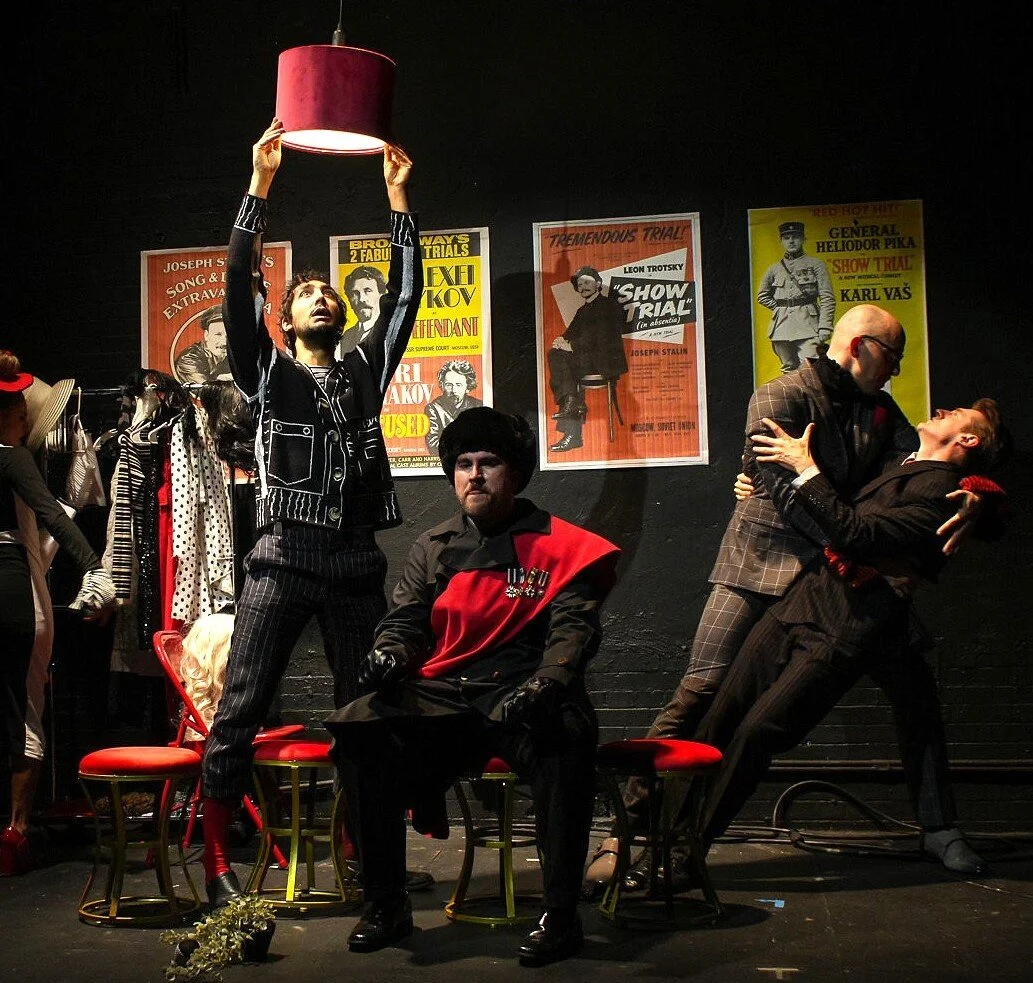
From left: Antonin Havelka (Justin Ahdoot) and Juraj Vieska (Tom Mezger), anxiously await the trial as Karel Trudak (Brian Bock) embraces Josef Urvalek (Alex J. Gould).
In the post–World War II U.S.S.R., and in its satellites in Eastern Europe, any way of thinking that did not conform to Communist—that is, Stalinist—ideology was considered treasonous. Suspected traitors were tortured, imprisoned, and executed. The most rudimentary rigged trials were conducted, and the outcomes were predetermined. Laura Zlatos’ Show Trial gives a satirical spin to the actual trial of Milada Horakova, a 50-year-old women’s rights activist and parliamentarian, in 1949.
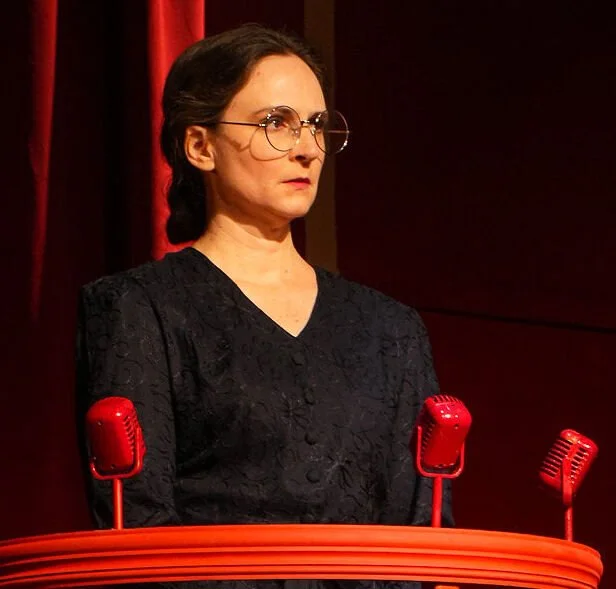
A somber Milada Horakova (Jessica Frey) realizes that her fate is sealed, no matter what she says.
The charges against Horakova (Jessica Frey) are espionage and veganism. Food was scarce after the war, so the veganism charge may be an exaggeration. Imprisoned, Horakova must appear in front of a tribunal that consists of prosecutors and party apparatchiks who cheer them on. It’s also obvious that some of them are “plants,” who watch anyone present in the courtroom to test their loyalty to Stalin and to the Motherland. It’s all for show. The prosecutor, Antonin Havelka, proclaims:
This trial is about the people. That’s right! Each and every one of you! We’ve got factory workers, farmers, even students have come from Poprad to Plzeň and everywhere in between to witness this once-in-a-lifetime event.
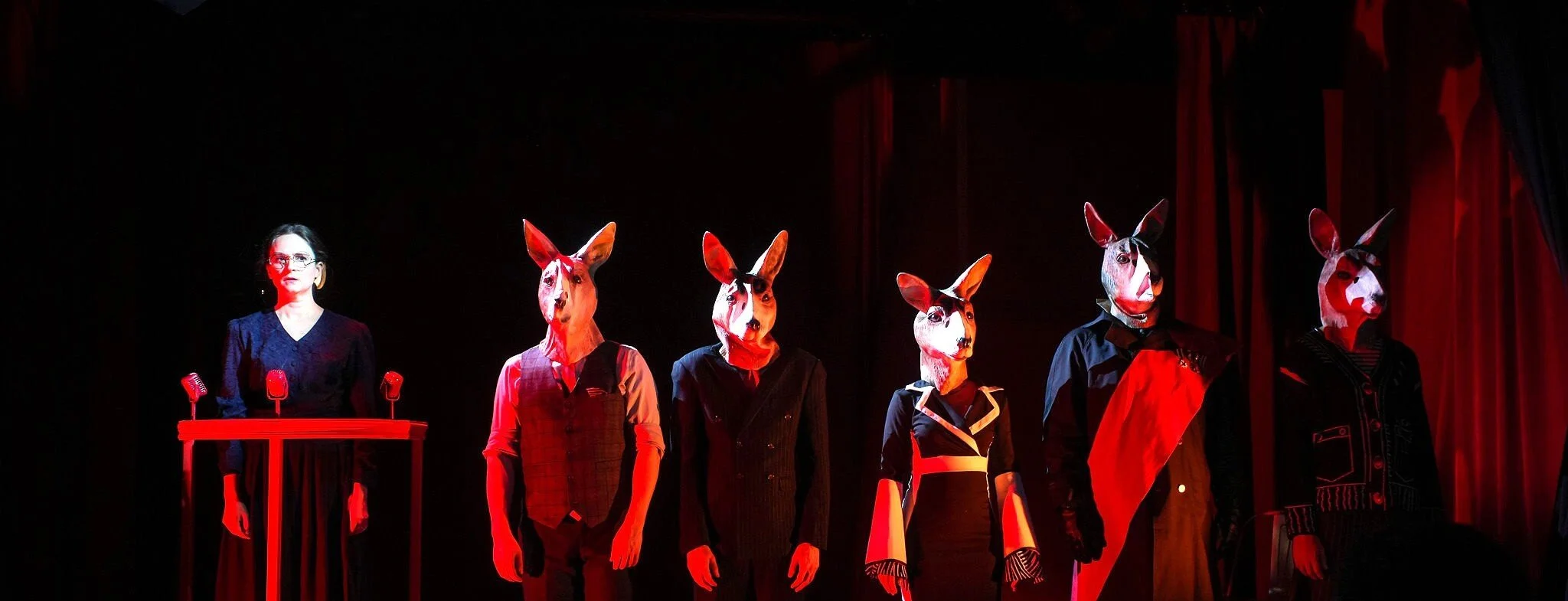
The emphasis at the trial is on spectacle, not justice, because for the party and its lackeys, that draws in audiences and reinforces the apparatchiks’ power. Throughout director Tom Costello’s production actors in kangaroo masks appear, hopping in and out of the makeshift “courtroom,” but even without the masks it is a kangaroo court.
Horakova is deprived of her ability to explain her ideological choices because her conviction and execution are a forgone conclusion. Frantiska Plaminkova (Ema Zivkovic), Horakova’s mentor and a pioneer of women’s equality, appears--only to Horakova—during the trial, in a flashback. “Plamka’s” apparition cheers Horakova on, who is repeatedly interrupted by her accusers. Her work for democracy in the Czech Parliament is twisted to brand her as an enemy of the state.
All that is most relevant to redeeming Horakova in the eyes of her accusers is made irrelevant, because the prosecutors are consistently trying to one-up each other. Most visibly, Ludmila Brozova (Jessie Cannizzaaro), the sole female among the prosecution’s team, poses seductively for the camera, demonstrating her narcissism and exhibitionism. Juraj Vieska (Tom Mezger), another prosecutor, who is built like a bear, implies, not too subtly, that those prosecutors who don’t play their scripted roles will be scrutinized by Stalin’s lackeys or Stalin himself, with dire consequences (exile to the gulag system of labor camps, or death).
This is evident in the power dynamic between the Stalin-like Juraj and Havelka (Justin Ahdoot), who is reluctant to be in the courtroom and speak against Horakova. To indicate how ludicrous the proceedings are, a sign that reads “Completely and Utterly Fair” is placed directly behind the Commentator (Alex Mandell, who resembles a master of ceremonies).
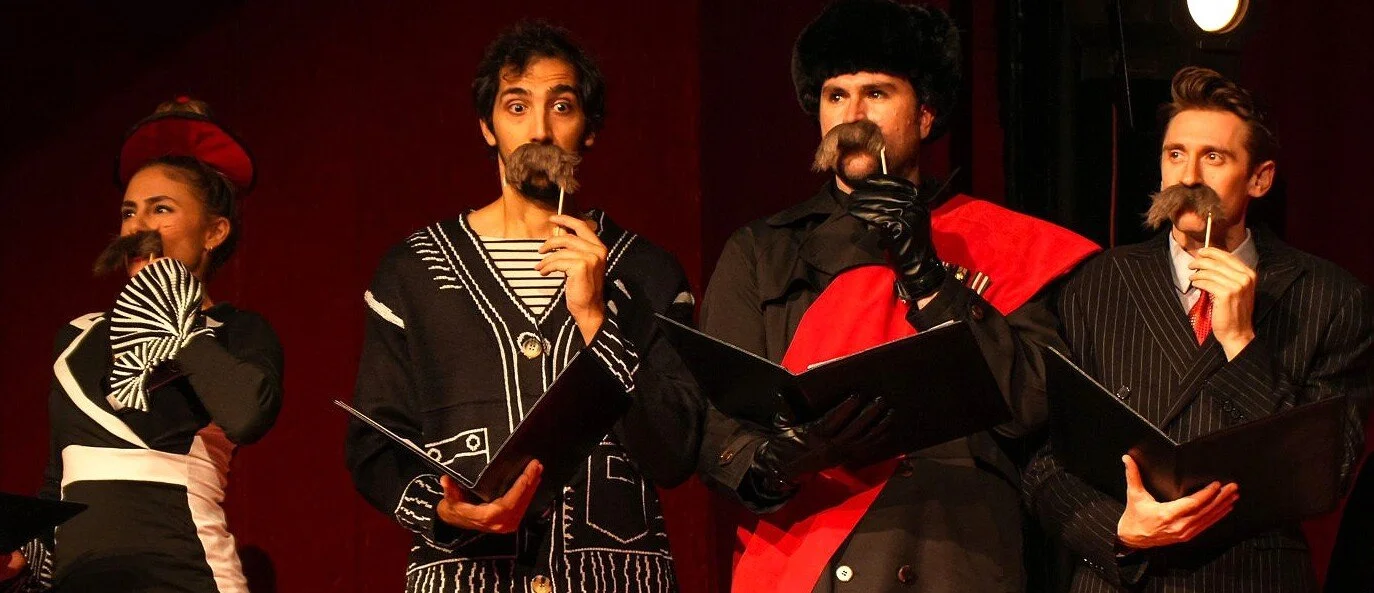
From left: Ludmila (Cannizzaro), Antonin (Ahdoot), Juraj Vieska (Mezger), and Urvalek (Gould) all wear Stalin moustaches and do his will. Photographs by Morgan McDowell.
The one light in this trumped-up miscarriage of justice transpires outside of the courtroom, and that is the moving narrative of Jana (Kalusha Brutlag), Horakova’s only child, who outlives her mother and the 1968 Prague Spring—the loosening of Communist rule under Alexander Dubček, crushed in August by a Soviet invasion—to escape to America. There she joins her father, who escaped before his wife’s trial and is powerless to defend her and at least help commute her death sentence to life imprisonment, as was the outcome for all but one other defendant. Jana reads Milada’s letter, written just prior to her execution. It exudes a mother’s love, which transcends separation by death, and is infused with hopes for her daughter’s future.
The puppet-like action of the prosecutors and the masked kangaroos are more than sufficient, sometimes even a bit excessive, as indicators of the trial’s farcical makeup. Nevertheless, Patricia Marjorie’s costumes and props and Cat Raynor’s tribunal setting epitomize both the pomposity and the sterility of Soviet-style justice.
Horakova’s trial is one of countless such farces that took place under the post-coup leadership in Czechoslovakia. The most significant takeaways of the play are present in excerpts from the trial’s recordings. Although their quality degraded over time and renders them unusable in the original Czech, the English translations allude to how an exceptionally brave woman, who knew the punishment that awaited her, sought a better, more democratic life for her countrymen. Even today, across the globe, the path for those mavericks who challenge the powerful is fraught with danger. If only one could have known Milada better.
Show Trial runs at The Tank (312 W. 36th St.) through Nov. 8. Performances are at 7 p.m. Mondays and Thursdays through Saturday, matinees are at 3 p.m. on Sundays. For more information, or to purchase tickets, call (212) 563-6269 or visit thetank.org.
Playwright: Laura Zlatos
Director: Tom Costello
Lighting Designer: Sawyer Smith
Scenic Designer: Cat Raynor
Sound Designer: Nicholas Webster
Costume & Props Designer: Patricia Marjorie
If you enjoyed this review, please click on the Like icon below.
