
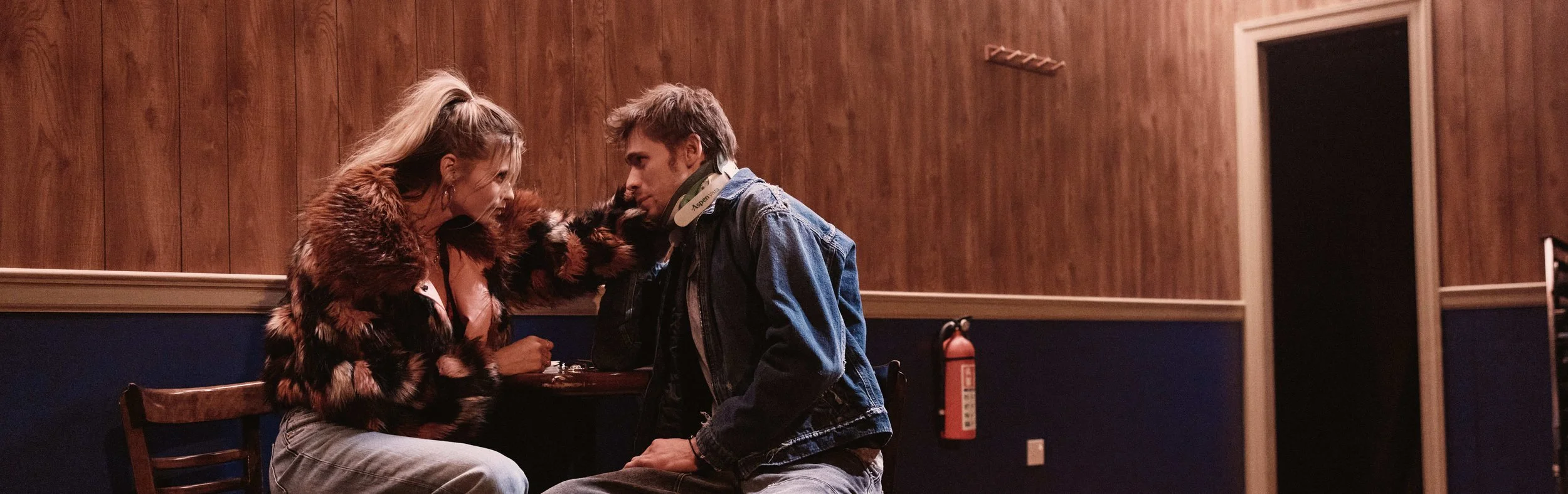
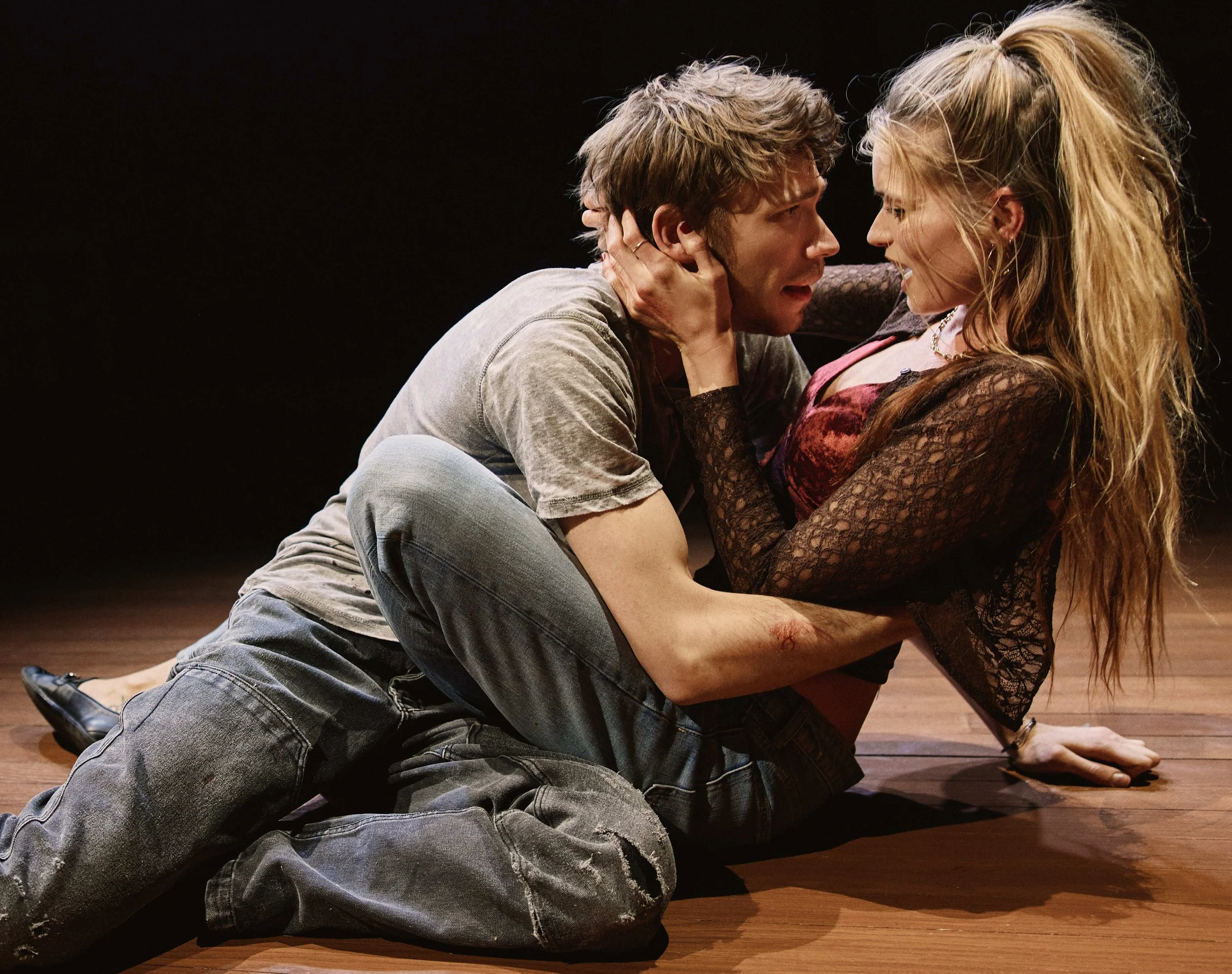
Owen Teague (left) and Abbey Lee trace the booze- and drug-fueled romance of Charlie, an art student, and Alice, a feckless would-be writer, in Joe White’s drama Blackout Songs.
Joe White’s Blackout Songs, nominated for an Olivier Award in 2023 and now playing Off-Broadway, depicts the convulsive romance of Alice and Charlie, who meet at the coffee urn of an Alcoholics Anonymous (AA) meeting and rush headlong into the squalid territory of pop-modernist classics such as The Lost Weekend and Days of Wine and Roses. Drunken-wastrel love is an old story, but White—with skilled assistance from director Rory McGregor and a team of very good theatrical designers—gives this short, insightful drama a 21st-century sheen.
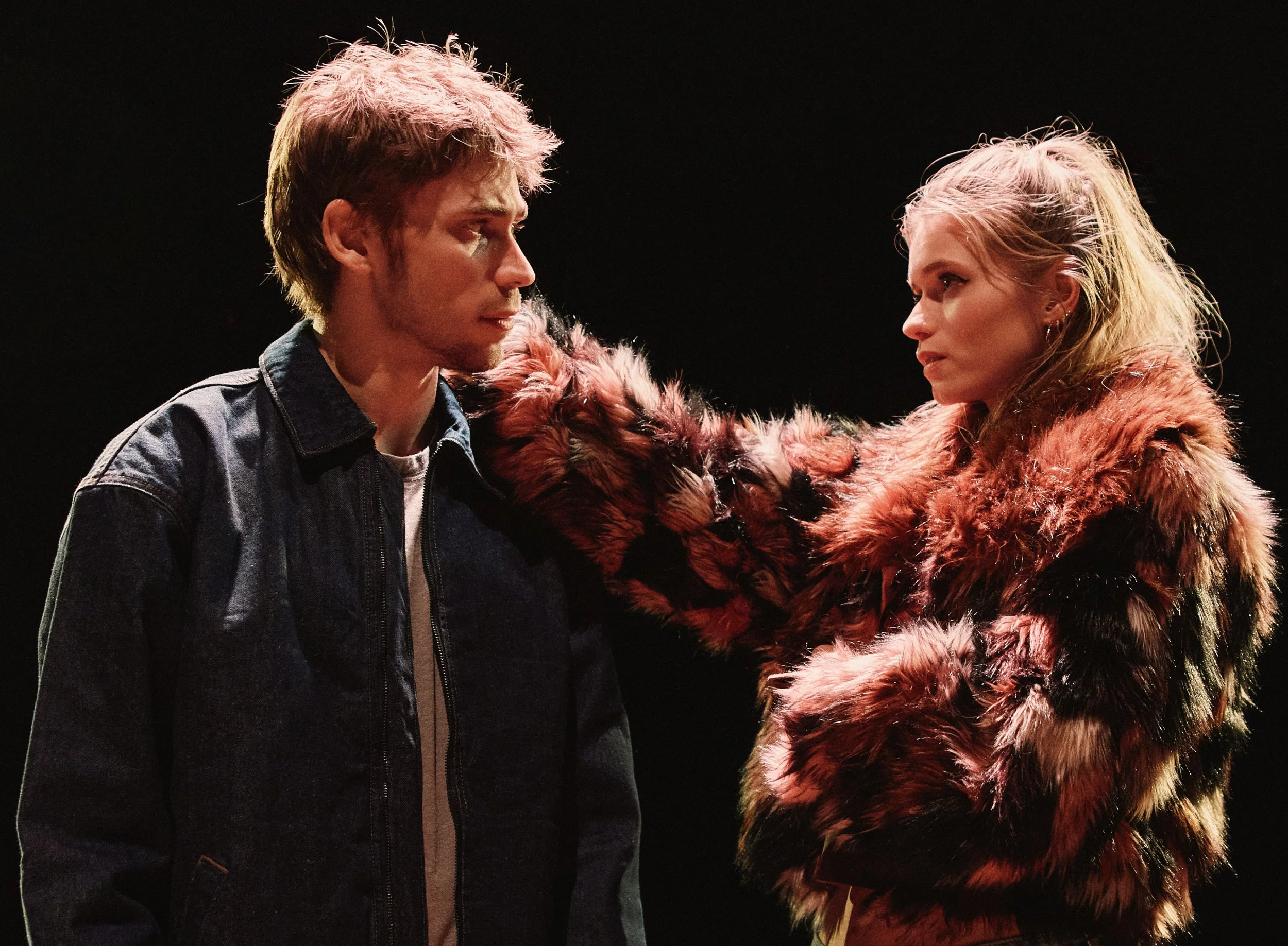
In White’s two-character drama, Teague (as an American living in England) and Lee (playing a London native) strike up a conversation before the start of an Alcoholics Anonymous meeting.
Charlie (Owen Teague) is an aspiring painter from the United States. Drawn to England by his enthusiasm for 20th-century figurative artist Francis Bacon, Charlie is enrolled at a London art college, where he’s studying painting. But addiction interferes with his work and has rendered his health frangible. He’s jaundiced, he blacks out, and, as he explains to Alice (Abbey Lee), “I change [when I drink]. D-do s-stupid, d-dangerous things.” Some of Charlie’s boozed-up shenanigans have him on thin ice with the administrators of the college, who are threatening to expel him. He fears this AA meeting may be his last chance to shape up and amount to something.
For her part, Alice is an aimless Londoner with poetic aspirations. She’s neither as near the edge as Charlie nor as earnest, but she recognizes a fellow addict when she sees one, and she knows how to manipulate him. “I descend from a long line of survivors,” Alice tells Charlie. “I know all the tricks. You need a bit of medicine is all. … And I’ll join you.”
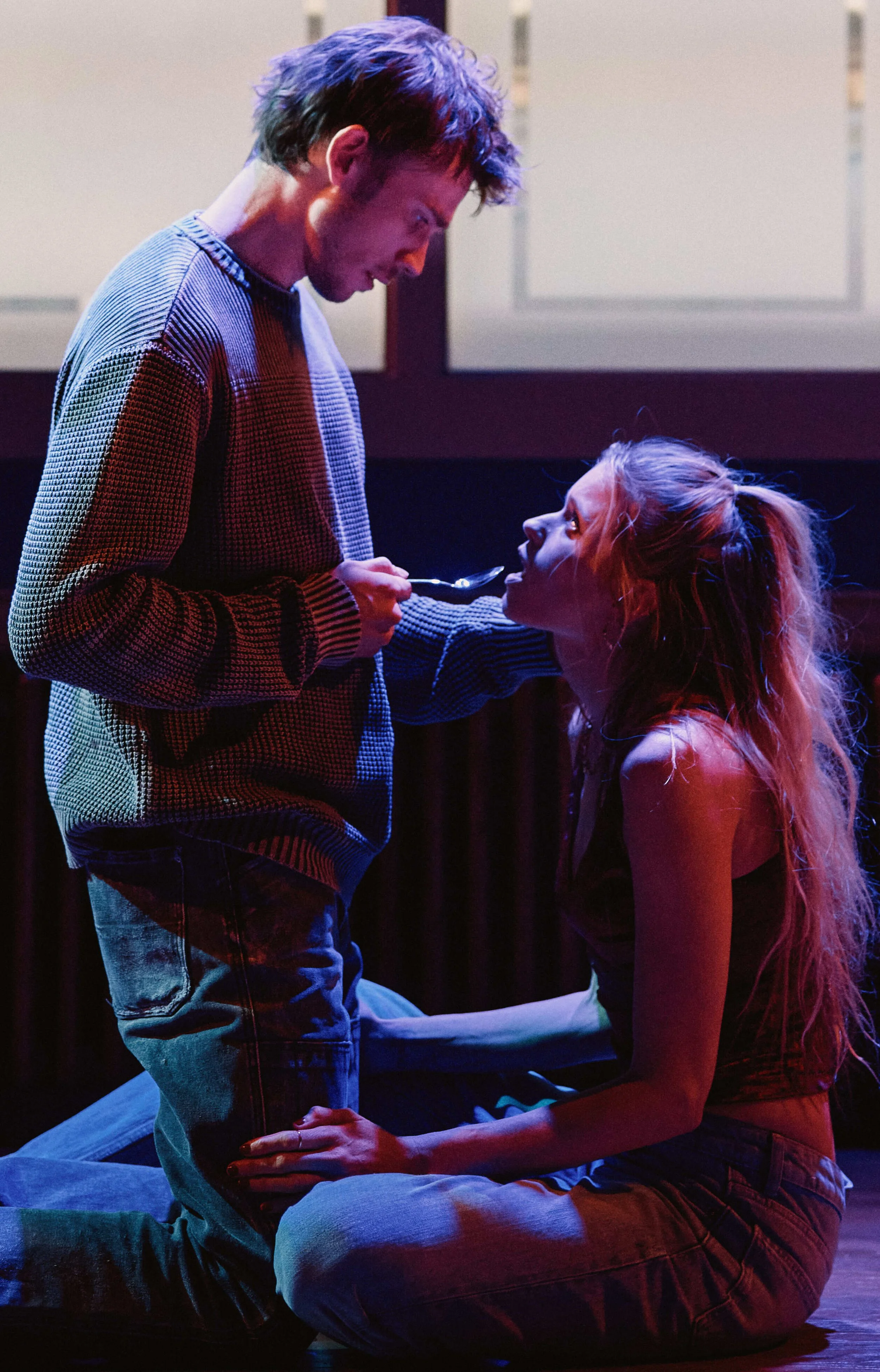
Rory McGregor’s high-velocity direction of Blackout Songs and the agitated performances of Teague and Lee only slow for moments of passion and convincingly simulated sex. Photographs by Emilio Madrid.
Alice has come to the AA meeting at her father’s insistence. The father (an offstage character) is emotionally distant and, due to an alcohol-related illness, presumably cirrhosis, not long for this world. Years ago he relegated Alice’s upbringing to a Catholic boarding school; now he’s expecting AA to solve her problems with drink and drugs. Meanwhile, he’s biding his time in a nearby pub, until Alice’s meeting adjourns.
Alice wants Charlie to ditch the meeting and go with her to a nearby bar (though not the one where her father is waiting). She’s confident the old man will be off on a binge before he suspects she’s giving him the slip. Charlie sincerely wants to straighten himself out, but his will isn’t sturdy enough to resist Alice or the “medicine” she offers, so he follows her out of the meeting hall, taking the first steps toward a bond of codependency.
What follows is an emotional merry-go-round, punctuated by comforting fantasies (what Eugene O’Neill’s drunks call “pipe dreams”), violence, recrimination, periodic estrangement, and a shared self-delusion that, before long, they’ll curb the carousing and accomplish worthwhile things. At one point, the two are desperate enough to break into a church to filch Eucharistic wine. Through it all, their existence is pocked with blackouts and great gaps in memory.
The play consists of brief, punchy scenes, several of them dreamlike or, perhaps, muddled recollections. Lee (in her U.S. debut) and Teague (making his first New York appearance) have stage chemistry that’s riveting to watch. They move with the agitation of addicts, but it’s a balletic kind of agitation. Scott Pask’s minimalist scenic design keeps the stage clear for McGregor’s fluid direction and the cinematic, scene-to-scene leaps of White’s script. The high-velocity staging and the actors’ speedy delivery of dialogue only slow for moments of passion and convincingly simulated sex. As a result, the proceedings, though melancholy, never become depressing.
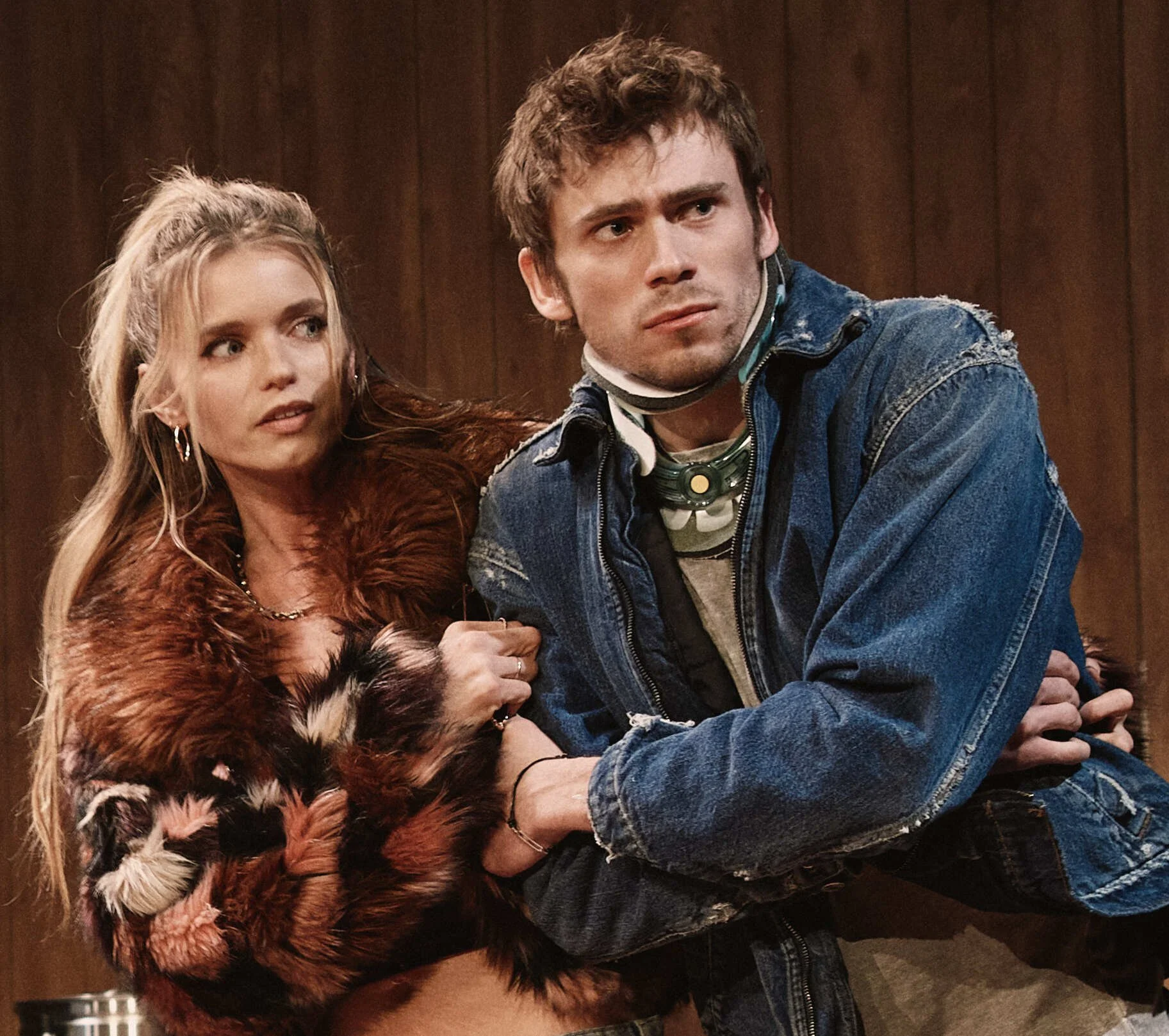
Lee and Teague offer a vivid portrait of codependency and mutual enablement in White’s drama, at the Robert W. Wilson MCC Theater.
Blackout Songs is the third Off-Broadway presentation by Regular People, a company founded by Jacob Stuckelman and Andrew Patino, that handles producing, general management, and marketing functions on a strategic, “in-house” basis, instead of engaging independent jobbers for those services on each show. Last year, Regular People produced Ken Urban’s Danger and Opportunity, a three-character drama about polyamory (specifically, about a committed “throuple”), and Bubba Weiler’s Well, I’ll Let You Go, a haunting psychological mystery of small-town life. Now, with three superb productions to its credit, the company’s taste and standards are discernible. All three plays build on post–World War II dramatic tradition (Wilder, Williams, Inge, and Albee, in the case of the first two; for Blackout Songs, the legacy is that of English writers such as John Osborne and Shelagh Delaney). In addition, they capture the callousness and spiritual vacuity of modern life and the harsh nature of 21st-century discourse. Most of all, the works are recognizable accounts of human need and longing by playwrights with distinct voices and Gen-Y humor.
Blackout Songs, presented by Regular People, runs through Feb. 28 in the Susan and Robert Frankel Theater at the Robert W. Wilson MCC Theater (511 W. 52nd St.) Evening performances are 7:30 p.m. Monday through Saturday; matinees at 2:30 p.m. Saturday. For tickets and information, visit blackoutsongs.com.
Playwright: Joe White
Director: Rory McGregor
Scenic Design: Scott Pask
Costume Design: Avery Reed
Lighting Design: Stacey Derosier
Sound Design & Original Music: Brian Hickey
