
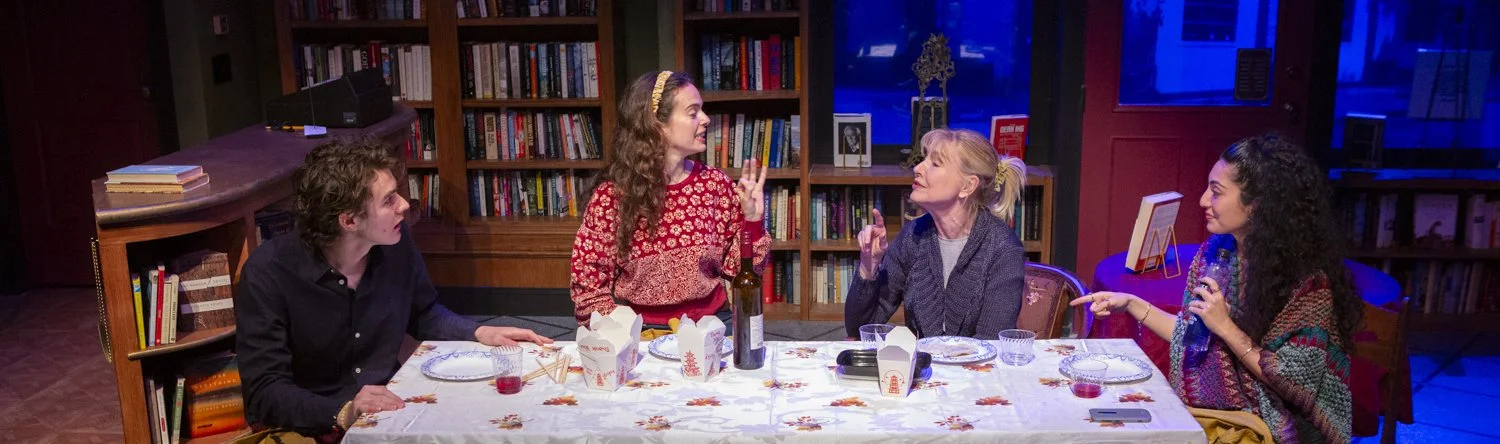
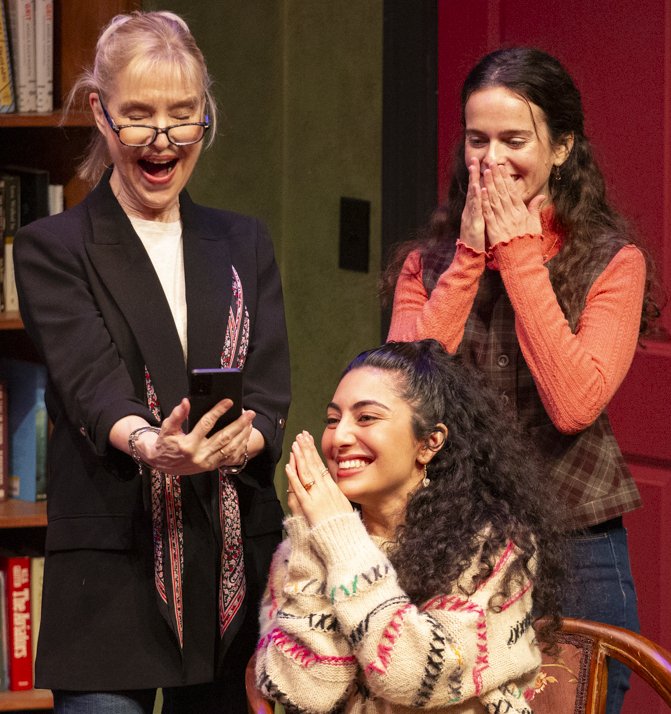
Bookstore owner Carey (Janet Zarish, left) looks at an online response to a posting created by her assistant Brittany (Ari Derambakhsh, center) to help her find a date, as another assistant, Abby (Arielle Goldman) looks on, in Michael Walek’s play The Bookstore.
Michael Walek’s The Bookstore is a cozy, unprepossessing play about the power of literature to change one’s life and the importance of both writing and reading. It is also about the people who do one or the other, and those who try to do both, and it’s peppered with nuggets about writers, readers, and the spectrum of human experience.
Carey (Janet Zarish) is the warm, wise owner of a New York City independent bookstore—not as busy a one as Shakespeare & Company or Book Culture, perhaps, but a welcoming place, in Jessica Parks’s scenic design. Carey acquired it after years as a Random House editor.
Carey employs two assistants: one is the prim and slightly haughty Abby (Arielle Goldman), a graduate of Yale who has been working on a novel for eight years. “I envy you,” Abby tells Carey. “For you, books are a spectator sport. But I’m a player.” The second assistant is the scattered, louche Brittany (Ari Derambakhsh), who can scarcely remember the boyfriend she had three weeks earlier. She, too, is an admirer of books, with a different slant: “When you think about it, most of these authors have passed away. Books are really messages from the dead.” She reads “mysteries and paperbacks you find at airports,” but Carey doesn’t dismiss them. “You were curious,” she says. “Curiosity is really the only thing that matters in life.”
All three are steeped in literary trivia.
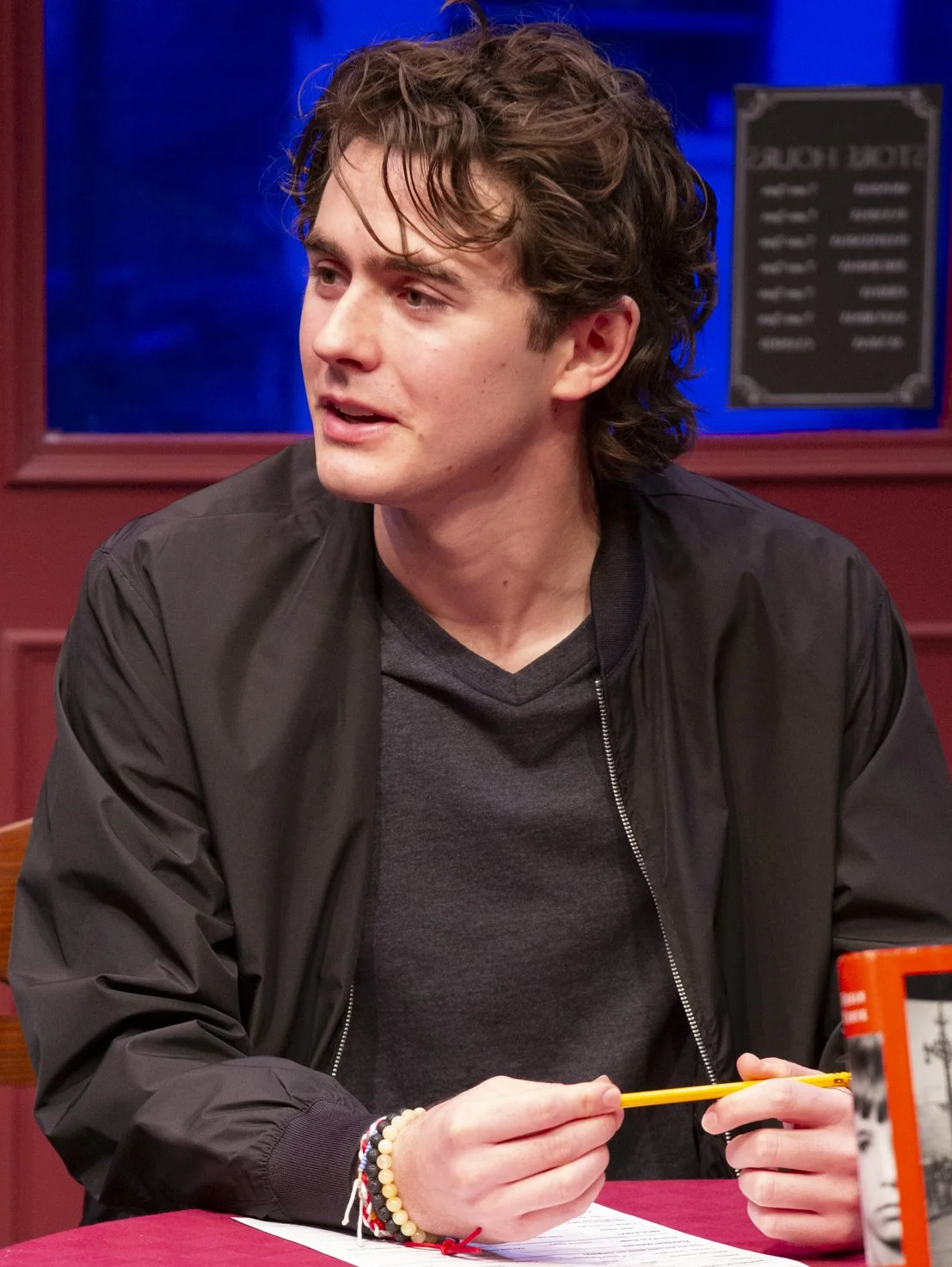
Quentin Chisholm plays Spencer, a gay actor who stumbles into the shop and is taken under Carey’s wing.
Abby: I wake up every morning at 5. That’s what Toni Morrison did. She liked making her coffee in the dark and then sitting down to her desk right as the sun began to rise.
Brittany: James Joyce wrote in bed on his stomach with blue pencils.
Abby: Virginia Woolf wrote standing up.
Brittany: So does Philip Roth. …
Abby: Dorothy Parker said she would write five words a day but change seven.
Although there is an oblique reference to secondary income as a supplement to the exigencies of running a bookshop—Brittany says of Carey, “Publishers hire her to consult all the time”—for the most part the financial strains are glossed over. Walek (Have You Met Jane Goodall and Her Mother?) is not so much interested in the dangers that conglomerates pose to independents as he is in the way literature can unite people of differing backgrounds.
The sudden arrival of a young man named Spencer (Quentin Chisholm), fleeing a gay-bashing, adds an outsider element to the dynamic. Naïve and unlettered, Spencer is new to New York, and he eventually becomes a mainstay of the group. When Brittany urges Carey to find him a book to read, he says his childhood favorites were the Amelia Bedelia books. Then Walek provides a snappy exchange:
Abby: Amelia Bedelia? Never heard of them.
Brittany: What did your parents read to you as a child? Fairy tales in the original German?
Carey, however, plucks The Code of the Woosters for Spencer, who quickly becomes a P. G. Wodehouse fan—and a reader. By the end of the play, he is not only taking on bulky Victorian novels, but also discovering films like Rear Window and Happy Together.
Yet there are darker days ahead for the group, as periodic monologues reveal ambitions and forebodings. Brittany, curious about the history of the building housing the bookstore, begins to research it; she also takes notes, then spins her scraps into stories. Abby gradually realizes that future success may be out of reach. Spencer, a would-be actor, lands the part of Hamlet. (It’s a glaring improbability in Walek’s script that a guy who’s apparently so fey that homophobic strangers can spot his sexual orientation would be cast as a credible wooer to Ophelia.)
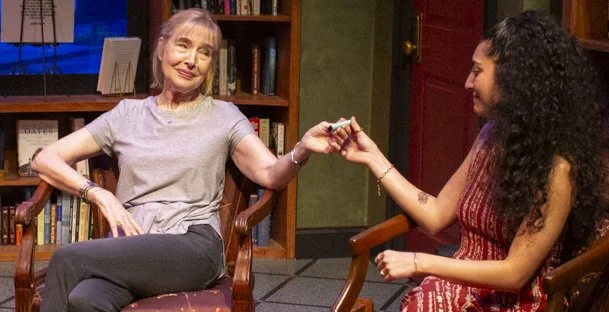
Carey and Brittany share a vape in the shop. Photographs by Hunter Canning.
Along the way—the action begins in January 2017 and proceeds month by month through the year—the characters talk about their literary opinions (for Carey, George Eliot’s Middlemarch is “perfect”) and the people who write, some of whom were unsavory in real life (Anne Perry and William S. Burroughs were literally killers, and Norman Mailer stabbed his wife). But the most formidable challenge, one that Carey hides, is a serious illness.
William Carden’s direction keeps the action moving, although Parks’s set offers anomalies. A white building across the street appears more British village than Big Apple. And why, when downstage a small sign points to “More Adventure This Way & Restrooms,” does Carey exit through an upstage door when she needs a bathroom?
Still, the warmth and camaraderie of The Bookstore hold one’s interest through all 12 chapters, satisfyingly garnished with delicacies like “Truman Capote wouldn’t finish anything on a Friday.”
The New Jersey Repertory Company’s production of The Bookstore runs through Feb. 15 at 59E59 Theaters (59 E. 59th St.). Evening performances are at 7 p.m. Tuesday through Saturday; matinees are at 2 p.m. Saturday and Sunday. For tickets and more information, visit 59e59.org.
Playwright: Michael Walek
Director: William Carden
Scenic Design: Jessica Parks
Costume Design: Suzanne Chesney
Lighting Design: Jill Nagle
Sound Design: Nick Simone
