
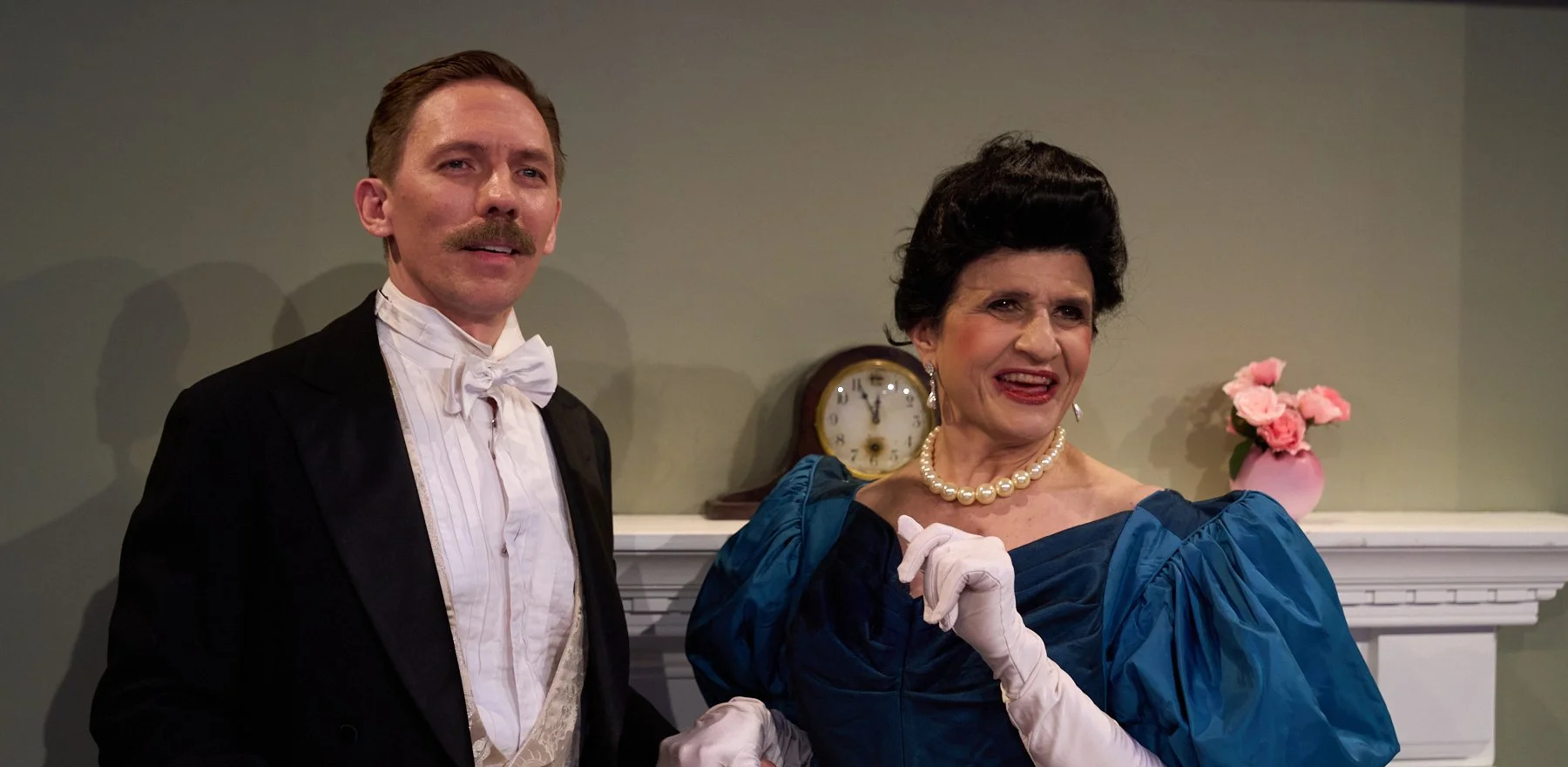
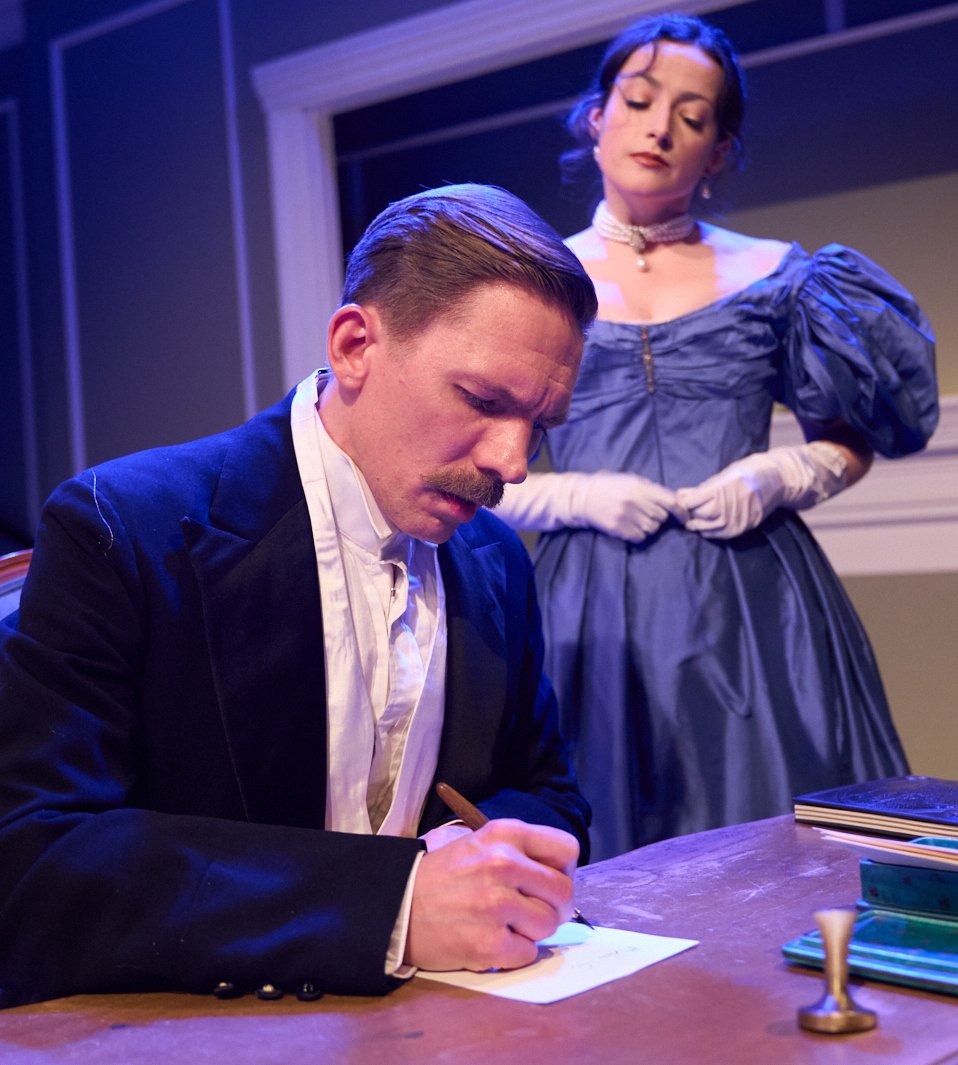
Lady Gertrude Chiltern (Madelyn Monaghan, right) pressures her husband Lord Robert Chiltern (Jed Peterson) to write a letter to a blackmailer in the Storm Theatre’s production of Oscar Wilde’s An Ideal Husband.
“Behind every great fortune lies a great crime” is a quotation attributed to French novelist Honoré de Balzac, but it applies directly to the plot of Oscar Wilde’s An Ideal Husband (1895). Written close to Wilde’s peak—it opened just a month before The Importance of Being Earnest—Husband fizzes with epigrams and uses heightened language to expose hypocrisy. The Storm Theatre is brave to tackle the work, packed both with melodrama and wit, but to succeed, as Sir Peter Hall did with his Broadway production 30 years ago, requires skills and experience that it can’t altogether muster.
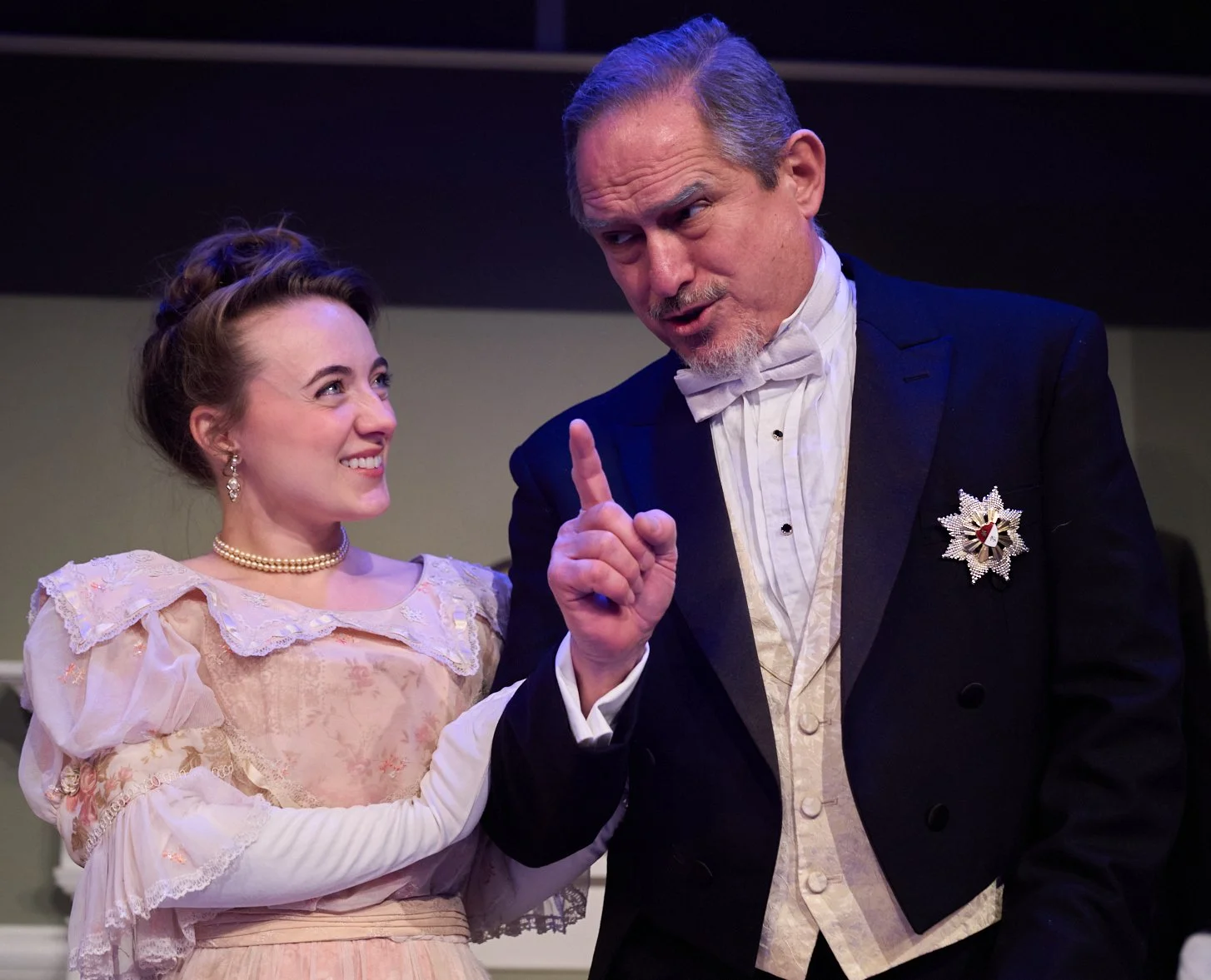
Mabel Chiltern (Heather Olsen), sister of Sir Robert, is charmed by the Earl of Caversham (Carl Pasbjerg), whose son, Lord Goring, she is fond of.
Adapter Thomas Bradshaw has pared down the text: a couple of footmen and a couple of languid dowagers are gone. Two butlers have stayed put, along with the important characters. At the center are Lord Robert Chiltern (Jed Peterson), a popular member of Parliament, and his wife, Gertrude (Madelyn Monaghan), who views her husband as an icon of probity. But when the Chilterns host a soirée, a befuddled dowager (Evangelia Kingsley) brings along one Mrs. Cheveley (Connie Castanzo), an uninvited guest visiting from Vienna. Although Wilde specifies Cheveley is dressed “in heliotrope, with diamonds,” costumer Sandrina Sparagna has dressed her in black—a useful clue to her character.
Wilde wastes no time in setting up a juicy situation. After discovering that Gertrude was her schoolmate, Cheveley obliquely admits that she operates outside society’s bounds:
Mrs. Cheveley: She has just reminded me that we were at school together. I remember it perfectly now. She always got the good conduct prize. …
Sir Robert: And what prizes did you get, Mrs. Cheveley?
Mrs. Cheveley: My prizes came a little later on in life. I don’t think any of them were for good conduct.

Viscount Goring (Chase Bishop, left) has no illusions about the character of Mrs. Cheveley (Connie Castanzo).
That last line is an early indicator of problems to come. It’s a delicious retort that needs a masterly delivery, but Castanzo lets it fall flat. Wilde’s language—like that of Noël Coward and Joe Orton—requires precise inflection in almost every syllable, and to be fair, productions of their works are too rare, so experience is hard to come by. But Castanzo, whose chirrupy voice is already a drawback to villainy, also projects poorly.
Cheveley has come to London to blackmail Chiltern with a letter she has acquired from the estate of a Baron Arnheim. When Chiltern was a young foreign-office worker, he succumbed to insider trading and gave the baron secret information about the government’s unreleased report on a scam in Argentina. Arnheim made a fortune from the tipoff and paid Chiltern handsomely. Although Chiltern’s life has been unblemished since, he acknowledges—in a line that might be ripped from today’s news—“the god of this century is wealth.” But his wife must never know, he tells his friend Lord Goring, whose help he seeks. Before acquiescing, Goring (Chase Bishop, who looks jarringly young to be dispensing advice) gently probes his friend’s psyche.
Goring: Robert, did you never suffer any regret for what you had done?
Sir Robert: No. I felt that I had fought the century with its own weapons and won.
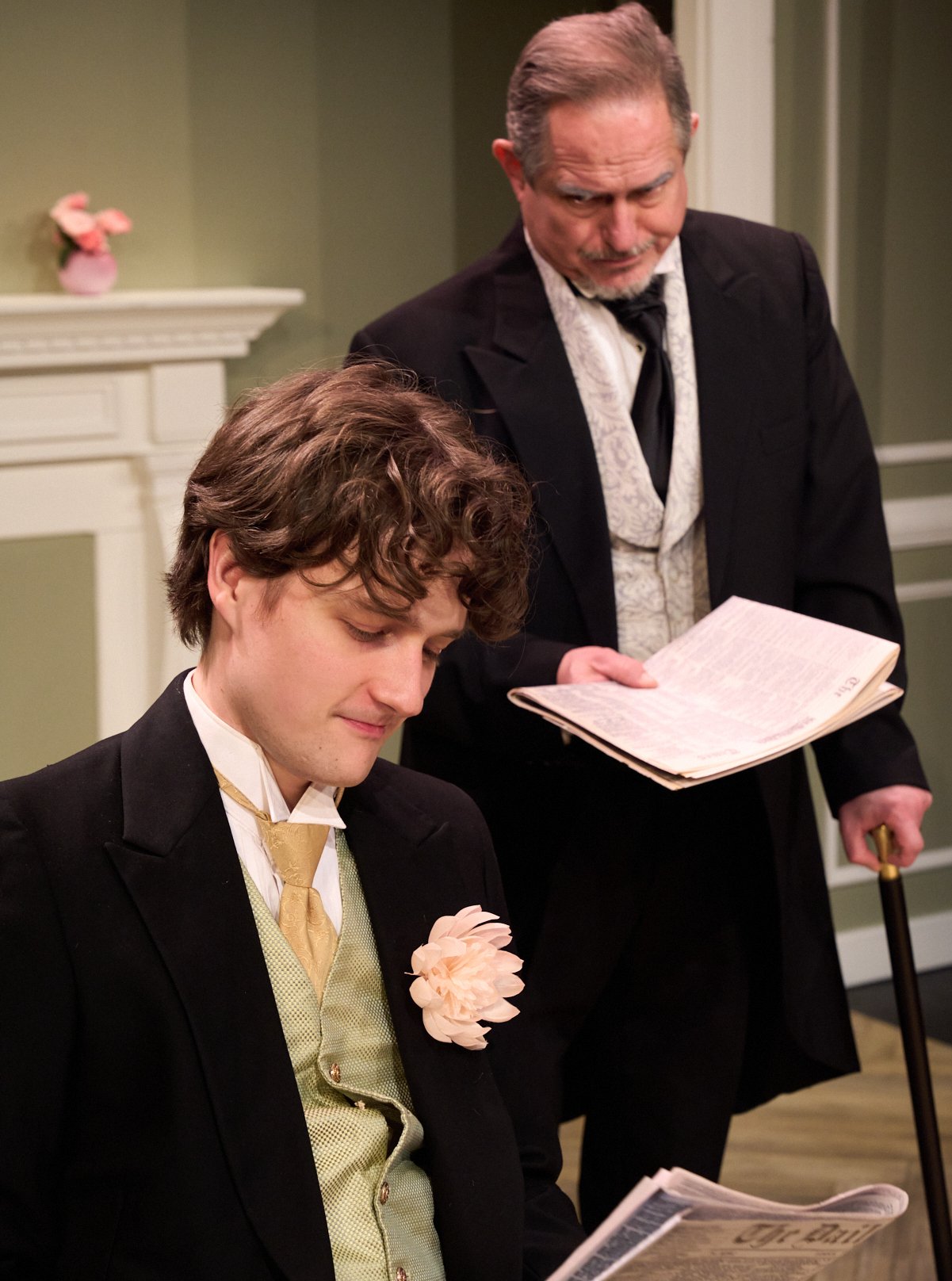
The Earl of Caversham is skeptical that his son will ever settle down in Wilde’s comedy-drama. Photographs by Michael Abrams.
Private morality, public behavior, and self-delusion are Wilde’s themes. “I did not sell myself for money,” Chiltern declares. “I bought success at a great price.”
Under the direction of Peter Dobbins, the melodramatic marriage crisis between the Chilterns is capably handled, although their union has a certain chill. It’s mostly the others who grapple with Wilde’s epigrammatic dialogue.
Another big laugh is missed when Goring says, “Women have a wonderful instinct about things. They can discover everything except the obvious.” On occasion, though, Bishop hits the mark, notably in a scene with his manservant Phipps (a dryly amusing Edward Prostak), where Wilde lays on the aphorisms. “Fashion is what one wears oneself,” Goring explains to Phipps. “What is unfashionable is what other people wear.” And “To love oneself is the beginning of a lifelong romance.”
Other players fare a bit better. Although she is dwarfed comically next to Bishop’s tall, lanky Goring, whom she wants to marry, Heather Olsen as Mabel projects clearly. But their pairing feels perfunctory. Carl Pasbjerg as Goring’s father, the Earl of Caversham, brings valuable gravitas to the part of the crusty lord.
Without a swirl of expert elocutionists to bedazzle the ears, a glaring mistake in Wilde’s text is exposed. Inexplicably, after years since seeing her school chum, Cheveley recognizes Gertrude’s handwriting on an incriminating letter. In a great production, the heightened language would hide the obvious improbability. Here, there’s too little sparkle to disguise it.
The Storm Theatre production of An Ideal Husband plays through Feb. 21. Evening performances are at 7:30 p.m. Wednesday through Saturday; matinees are at 2 p.m. Saturdays and Sundays. For tickets and more information, visit stormtheatre.ludus.com.
Playwright: Oscar Wilde
Director: Peter Dobbins
Set Design: Daniel Prosky
Lighting Design: Michael Abrams
Costume Design: Sandrina Sparagna
Sound Design: Andy Evan Cohen
