
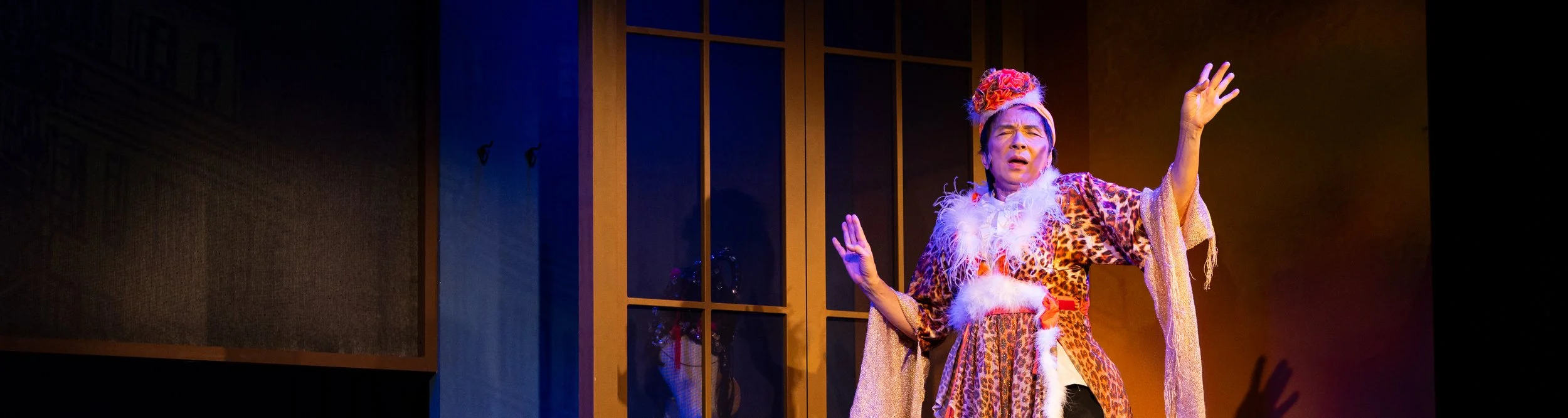
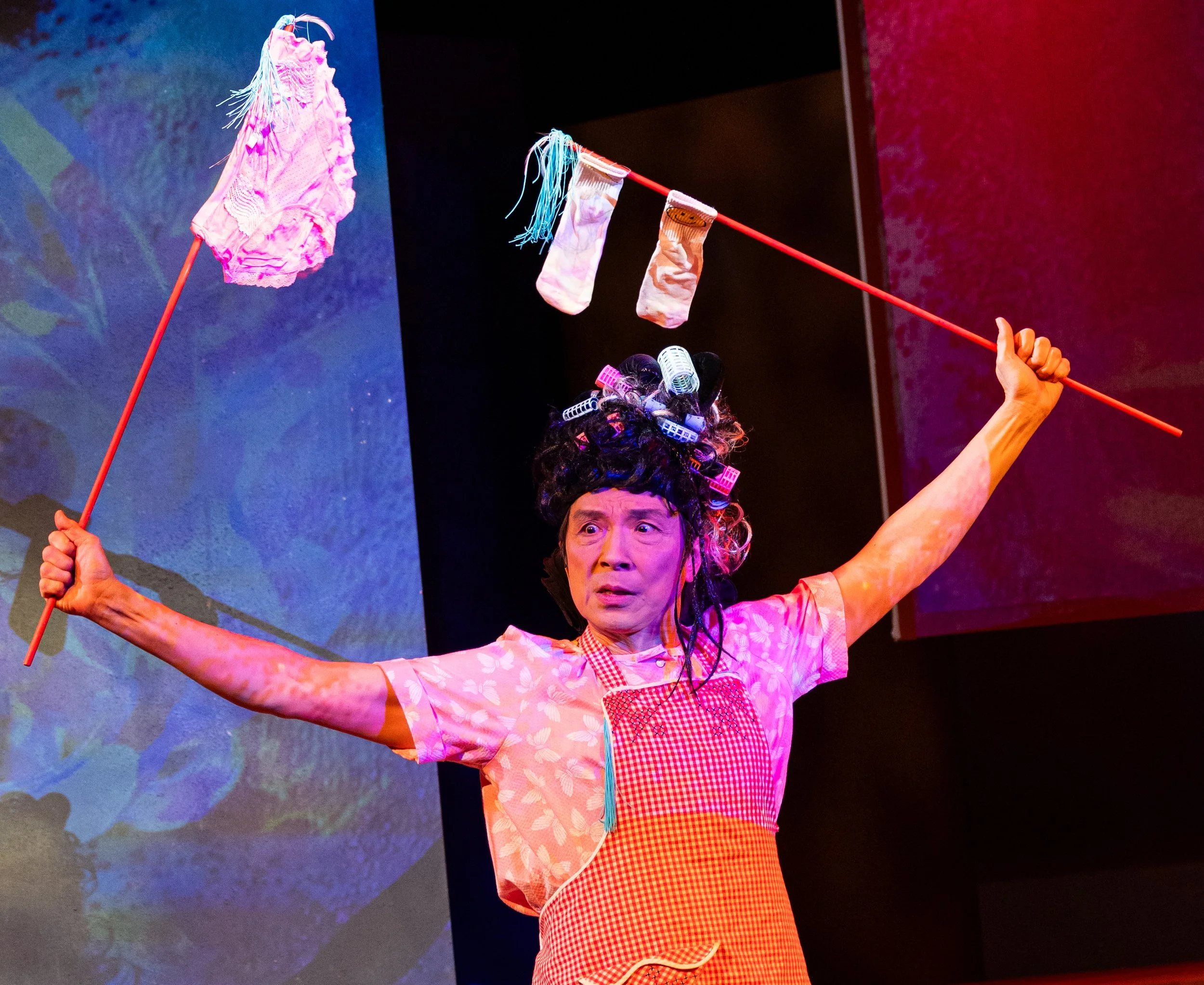
Richard Chang takes on a lot of characters, and a lot of costumes, in his one-man show Ai Yah Goy Vey!
In his solo show Ai Yah Goy Vey!, Richard Chang celebrates multicultural New York through the fictional tale of a Chinese man’s borough-hopping search for the father he has never met. But his picaresque is peppered with questionable jokes and portrayals, and, despite an impressive array of costumes, props and video backdrops, the production has an amateurish air to it.
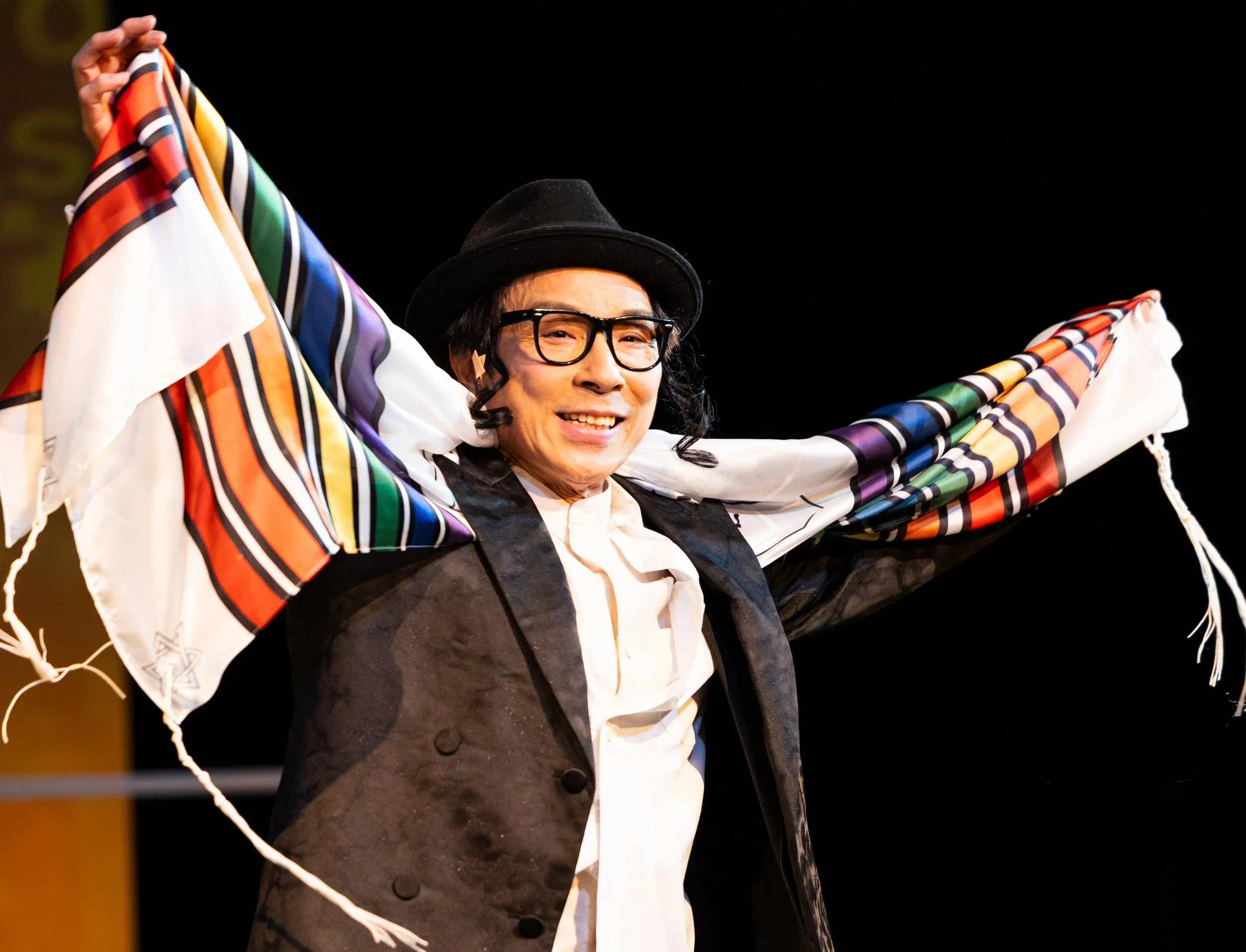
In one scene in the Pan Asian Repertory production, Chang plays an Orthodox Jew wearing a Pride tallis.
Chang’s protagonist is Sun Jik Kei, known in America as Jackie Sun (surnames come first in Chinese). He was conceived when his mother, a “beautiful Chinese opera diva,” had a whirlwind affair with an “ABC” (American-born Chinese) who was visiting Changdao, the island where she lives. The man declared “his eternal love, saying he’ll come back and marry her and live happily ever.”
At least that’s the story Jackie’s mother had always told him. She also told him that a bunch of records in their home were narrated love letters from his father. It’s from these records—which were actually Jackie Mason comedy albums—that Jik Kei learned English. So Chang performs the entire show in a New York–accented thick Chinese accent, frequently incorporating Yiddish words. Sample line: “You’re wondering how a guy from China can speak such poifect English? I loined it all from Papa when I was a little boychik. He’s a mensch. … He schlepped all over the woild.”
A grown-up Jik Kei decides to head to America, hence the show’s subtitle, Adventures of a Dim Sun in Search of His Wanton Father. Chang portrays everybody he encounters in his journey around New York, including Jackie Mason himself. This dated plot point—Mason died in 2021 and had peaked in popularity circa 1988—is one of the things that give Chang’s shaggy-dog story a very shaggy feel. (For that matter, the New York accent Chang so assiduously effects has been dying out for generations.)
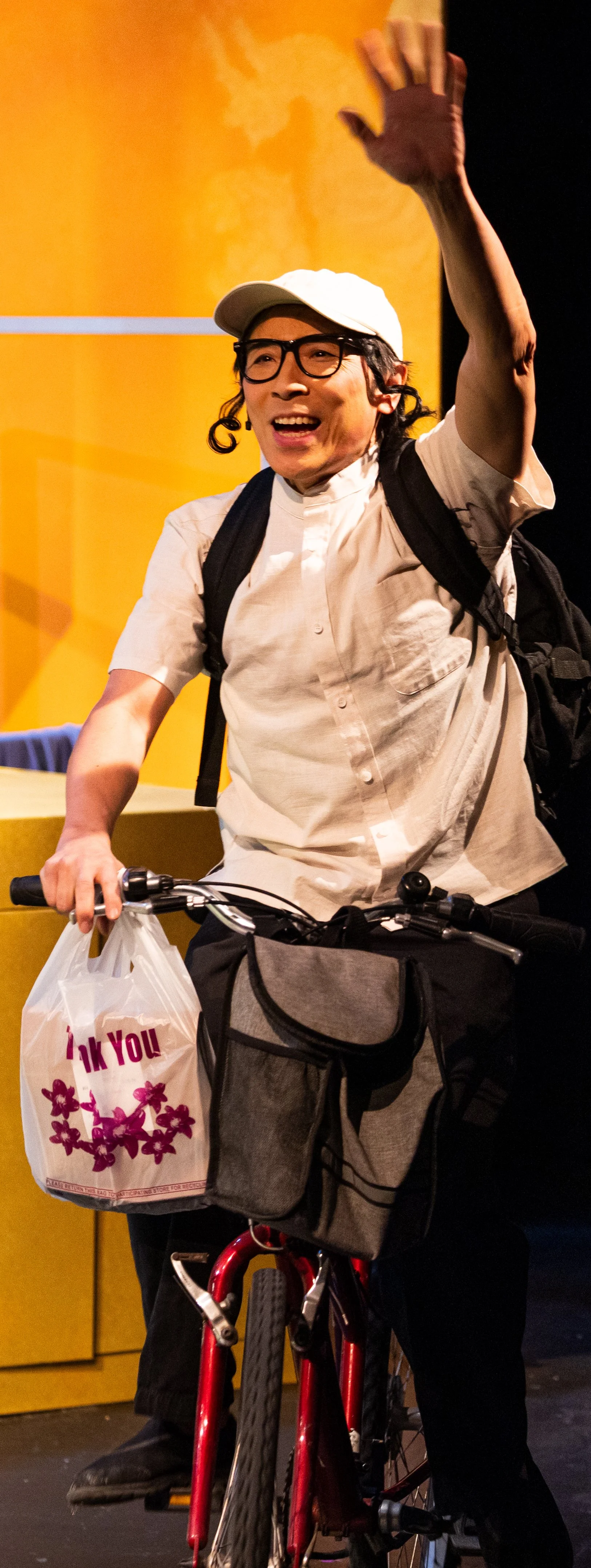
In New York, Jackie (Chang) works as a Chinese-restaurant delivery boy. Photographs by Jeremy Varner.
Another less-than-sophisticated element is the score, composed mostly of existing songs with new lyrics. And when Jackie’s mother finally shares the truth about his father, her revelation doesn’t even explain why she had the stash of Jackie Mason records or a collection of yarmulkes (also supposedly sent by the father), so the whole premise of the Chinese guy who thinks he’s Jewish has no basis in sense.
Yet Ai Yah Goy Vey!’s worst transgression is its insensitive—racist even—depiction of the diverse cultures of New York. An Irish priest drinks a lot. Jackie’s visit to an Arab community involves the I Dream of Jeannie theme music and “Walk Like an Egyptian” choreography. His impression of young Black men is that “they have no shirts or wear clothes that are 10 sizes too big [and] can’t even walk straight.” The woman he meets in Harlem is named LaKeisha ShaNeNe and she’s a finger-snapping unwed mother. Chang puns on Arnold Schwarzenegger’s name via two different racial epithets (one Yiddish, one American). He even uses a slur for Chinese.
At odds with the seeming carelessness that kept these offenses in the script is the tremendous effort that Chang, costumer Karen Boyer and the rest of the design team put into visually enhancing the play. The actor dons an outfit for every character: silk robes and opera costumes as his mother, clerical garments for the priest and a rabbi, a belly-dancing getup for the Egyptian man’s wife, plus several elaborate headdresses—one, worn by a character doing household chores, that’s fashioned out of toilet brushes and other cleaning supplies. On the multilevel set by Sheryl Liu, hidden compartments within the stage risers hold props and costumes. Scott Leff’s continually changing projections on the rear panels include place-setting images and words written in Chinese characters.
Chang’s Chinese lessons for the audience are a highlight of Ai Yah Goy Vey!, in particular the similarities between that language and Yiddish: He notes that the Cantonese word for a non-Chinese, guai, is nearly the same as goy, Yiddish for a non-Jew, and that Chinese people might exclaim “Ai wei!” just as Jews would the similar-sounding “Oy vey!”
Other amusing language-related bits stem from Jackie’s misunderstanding of what he hears around New York: He thinks the Puerto Ricans saying “aquí” are calling his name; he’s flattered when a Jewish man approaches him to say, “We need a minyan,” because ming yun means “a bright or distinguished person” in Cantonese; and he sure takes “fuck you” the wrong way, since fook is Cantonese for good luck.
Maybe Chang should go back to the drawing board with these jokes and come up with a more polished—and enlightened—show. For this version, Oy vey! says it all.
Ai Yah Goy Vey! runs through March 1 at ART New York Theatres (502 W. 53rd St.). Performances are at 7 p.m. Tuesday through Friday, with matinees at 3 p.m. Saturday and Sunday. For tickets and more information, visit panasianrep.org.
Playwright: Richard Chang
Director: Laura Josepher
Sets: Sheryl Liu
Costumes: Karen Boyer (headwear by Richard Chang)
Lighting: Samantha Weiser
Sound & Original Music: Christopher Liang
Projections: Scott Leff
