
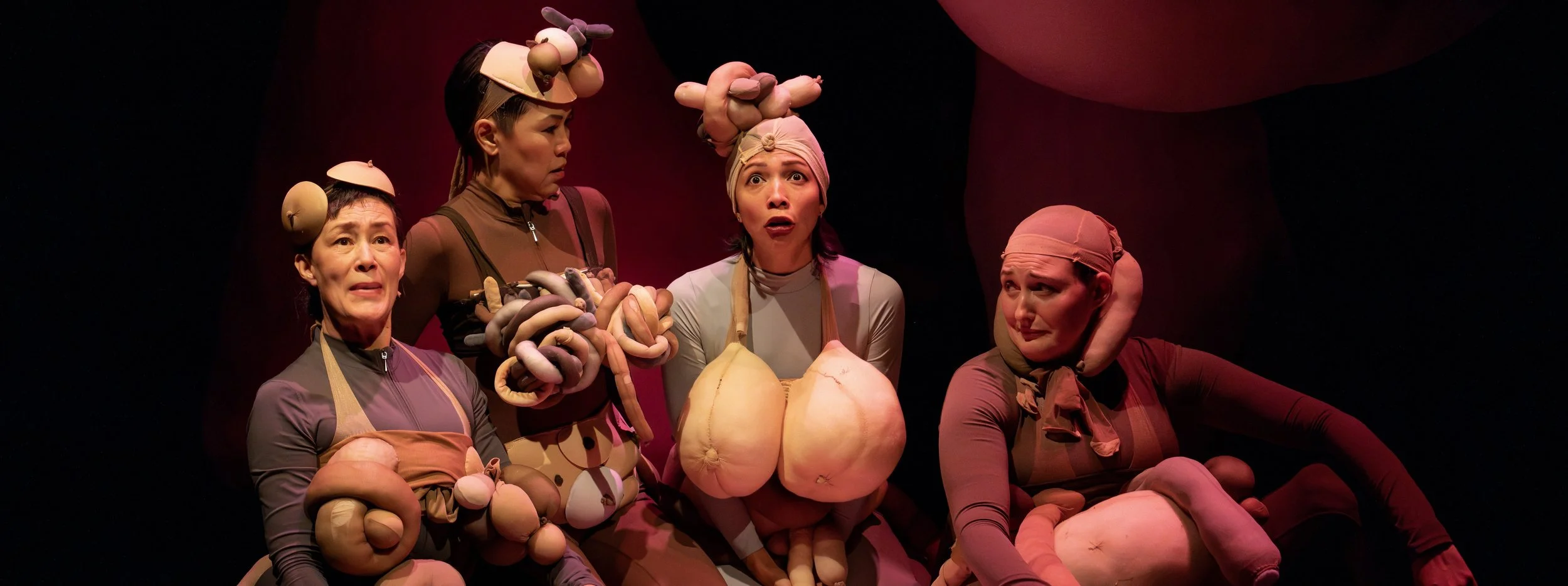
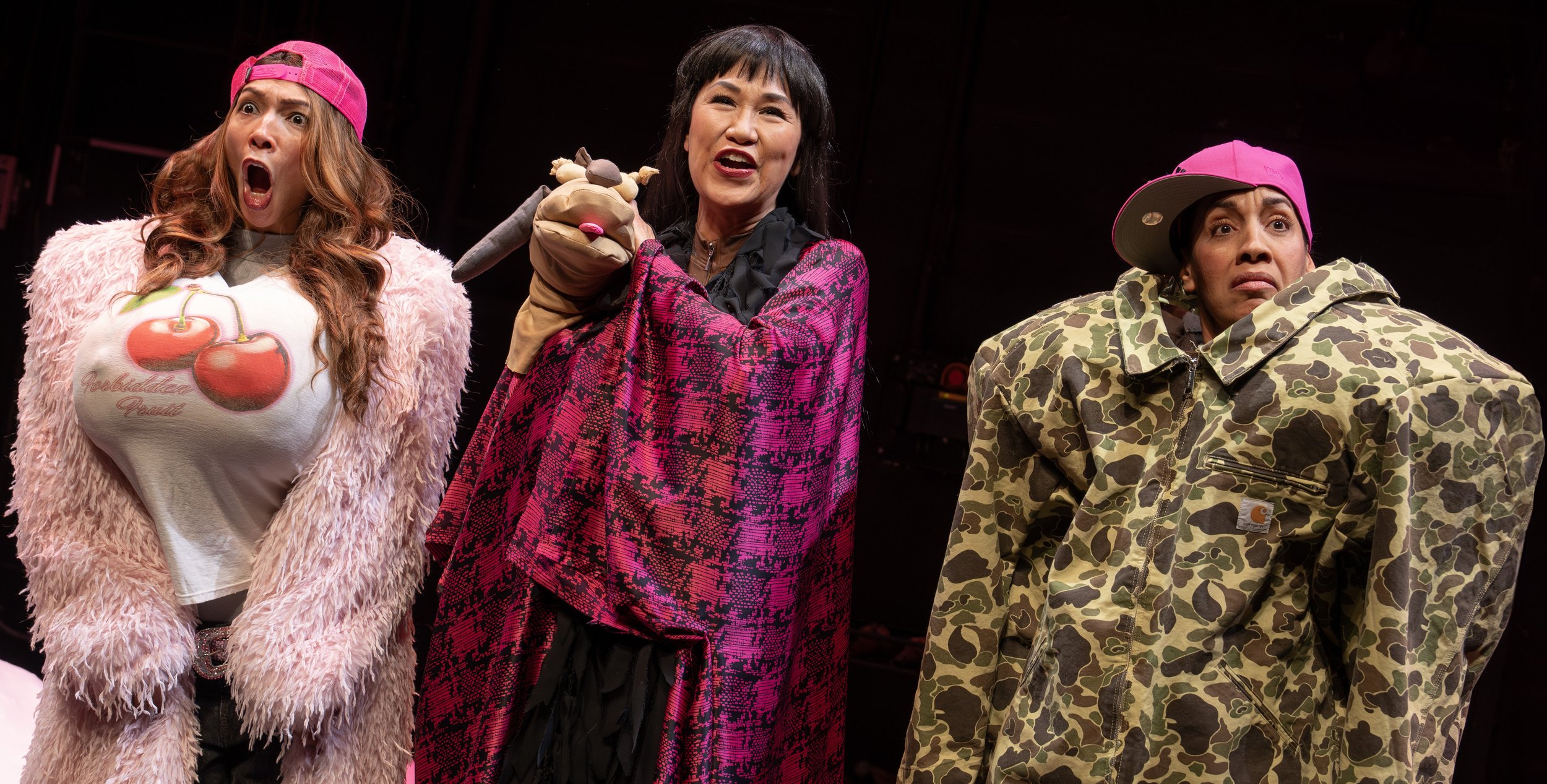
Three single, child-free women—played by (from left) Maureen Sebastian, Cindy Cheung and Robyn Kerr—meet their friend, a new mom, for brunch.
No one in Aya Ogawa’s Meat Suit ever speaks or explains the title phrase, but based on its use in fantasy literature and a Netflix documentary, it refers to a human body inhabited by a demon or alien. The play’s subtitle, The Shitshow of Motherhood, also conjures a negative impression of motherhood. So, too, does almost everything in the show—and in exhaustingly absurdist fashion. The play may not turn anyone off to motherhood, but it could turn people off to any future theatrical explorations of it.
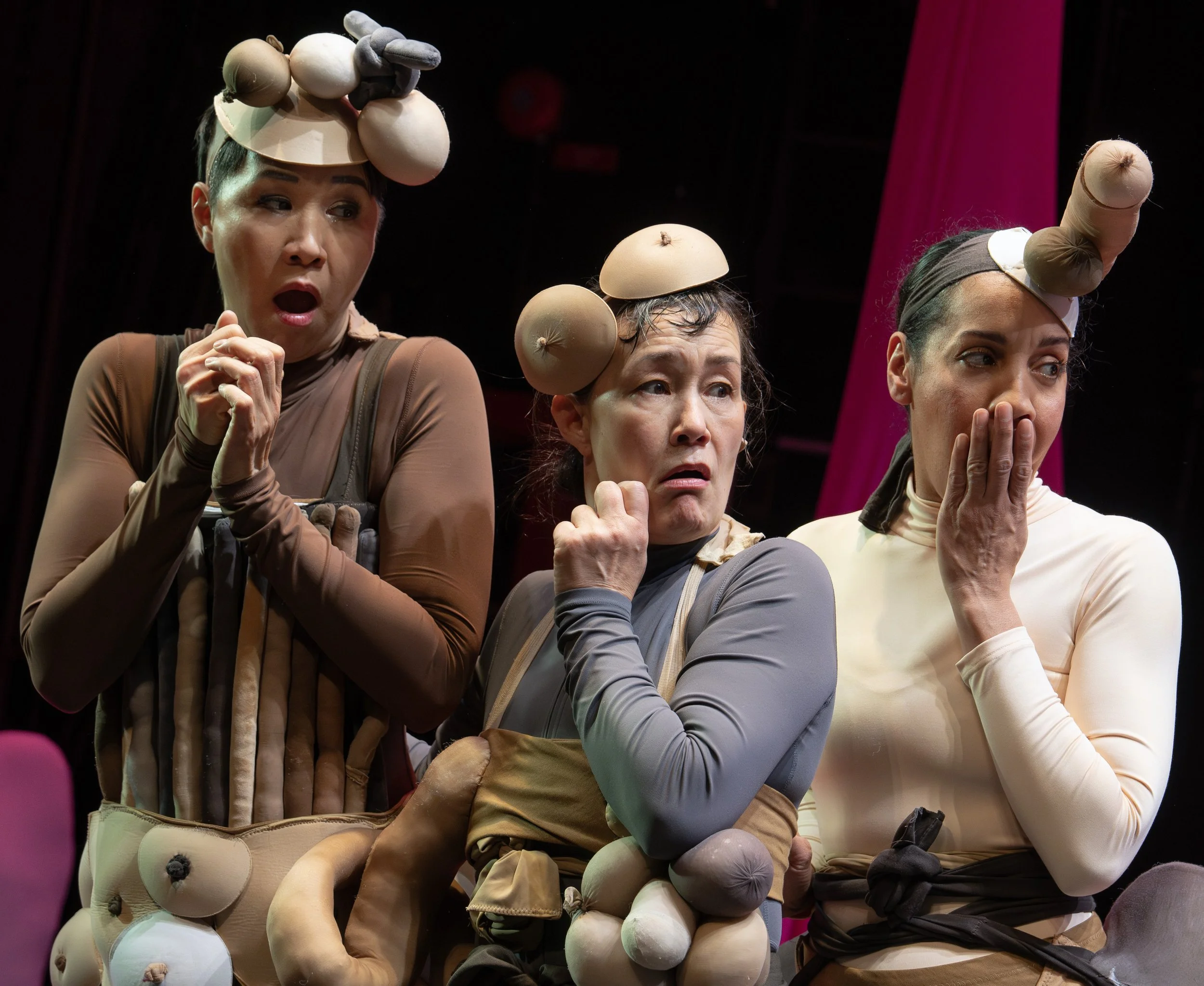
Cheung, Marina Celander (center) and Kerr explore what happens to a woman when she becomes a mother in Aya Ogawa’s Meat Suit. Photographs by Joan Marcus.
Meat Suit, or The Shitshow of Motherhood is composed of about 15 skits, monologues and songs, many of them performed in a heightened reality where bizarre behavior is taken in stride, costumes exaggerate body parts, actors wear penis and breast plushies on their heads, the set looks like a cross between a slaughterhouse and a day care center, and audience participation can feel intrusive.
The production is designed by the same team that worked on Ogawa’s 2023 Obie winner, The Nosebleed, including Jian Jung on set and costumes. Jung’s pink set has a pile of oversize cushions on one side of the stage—the type of “furniture” and bright colors one might see at day care—and on the other, giant plush versions of what look like cuts of beef and sausages (which also happen to be the shapes of sex organs) hanging from the ceiling, like in a meat locker.
“It’s all extremely in-your-face, quite literally when theatergoers are pulled into the action. ”
Meat Suit features fine ensemble work by its cast of five—Marina Celander, Cindy Cheung, Robyn Kerr, Maureen Sebastian and Liz Wisan—who play an assortment of characters, realistic and far-out, and prove adroit at both the physical and emotional demands of their roles. The actors wear bodysuits spackled with cushiony appendages that resemble distended or tumorous bodily organs. (This isn’t the only grotesque imagery in Meat Suit: At one point, a woman’s kids and husband feast on her carcass like a pack of lions tearing into a gazelle.)
It’s all extremely in-your-face, quite literally when theatergoers are pulled into the action. During a PTA meeting scene, actors go up to individual audience members and in close proximity address them as if they’re parents at the meeting. This scene showcases the competitive side of child-rearing, with the PTA moms commenting to one another:
“I didn’t see you at the fundraiser. ... Do you even care about the children?”
“So nice to see a dad at one of these meetings. Is he between jobs?”
“Having a nanny from another country is the best way to teach your kids another language!”
“Who raises their kids and keeps their bodies looking hot for their husbands? We do!”
While Ogawa’s work is empathetic to mothers, it’s occasionally repetitive—an early scene between two new mothers (Sebastian and Celander) who meet in the park devolves into the same kind of one-upping as in the PTA skit—and frequently negative, focusing on how motherhood costs women their professional standing, their sense of self, intimacy with their partner, respect in general, and their physical well-being.
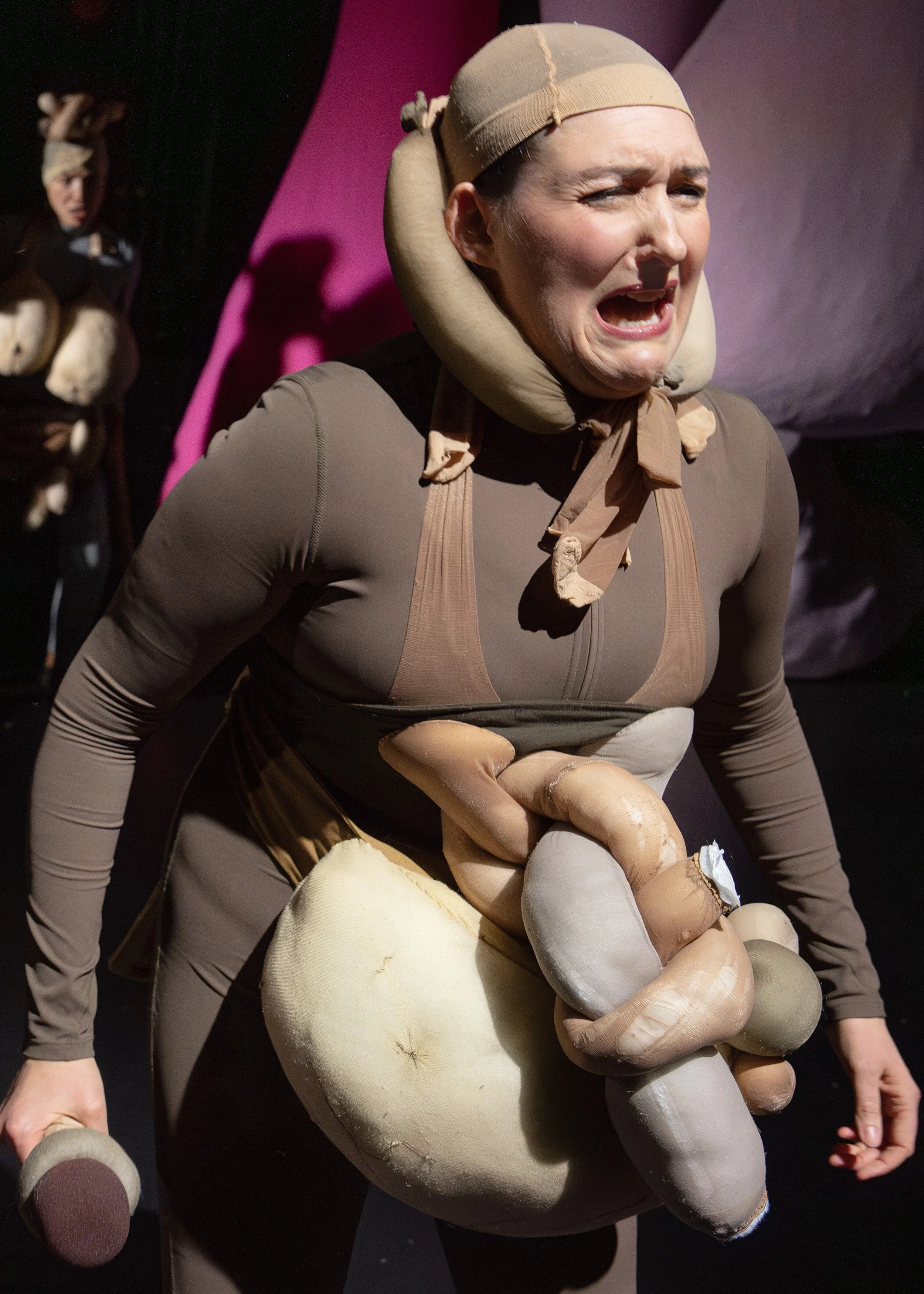
Liz Wisan wears one of the outlandish costumes designed by Jian Jung for Meat Suit, produced by Second Stage’s emerging writers initiative 1st Stage.
Those innards-laden costumes provide a visual representation of the latter, though the point is made in the first skit of the night, when a new mom (Wisan) joins her gal pals for brunch for the first time since giving birth but can’t drink because she’s nursing, can’t sit down because her crotch and butt are still wounded from delivering a baby, and can’t control her lactating breasts. The scene segues into a song about “What happened to my beautiful body?”
Leyna Marika Papach has written a half-dozen original songs for Meat Suit. They’re not very distinguished musically, so this is one more “fun” element of the show that doesn’t really justify the attention bandwidth it requires. It does bring some sweet singing by Wisan and Sebastian as mothers whose children died.
That song is part of a drastic tonal shift two-thirds of the way through the show. The women shed their wacky costumes for plain bodysuits, and each actor shares her own true story of motherhood. Sebastian leads the cast in reflecting on mothers who lost children; Celander speaks as a character experiencing her mother’s death. Then the ensemble return to their brunching characters from the opening scene, but now they’re much older and have dementia.
The late turn toward seriousness seems odd considering the strenuous absurdity throughout Meat Suit’s first hour—and it hints at what the show could have been if the antics were scaled back and the clowning and introspection better integrated. As it is, the high jinks overwhelm the ideas they’re meant to illuminate.
Meat Suit, or The Shitshow of Motherhood runs through March 15 at the Pershing Square Signature Center (480 W. 42nd St.). Performances are at 7 p.m. Tuesday through Sunday and 2 p.m. Saturday and Sunday. For tickets and more information, visit 2st.com/shows/meat-suit.
Playwright & Director: Aya Ogawa
Music & Lyrics: Leyna Marika Papach
Sets & Costumes: Jian Jung
Lighting: Jeanette Oi-Suk Yew & Christina F. Tang
Sound: Megumi Katayama
Choreography: Catherine Galasso
