

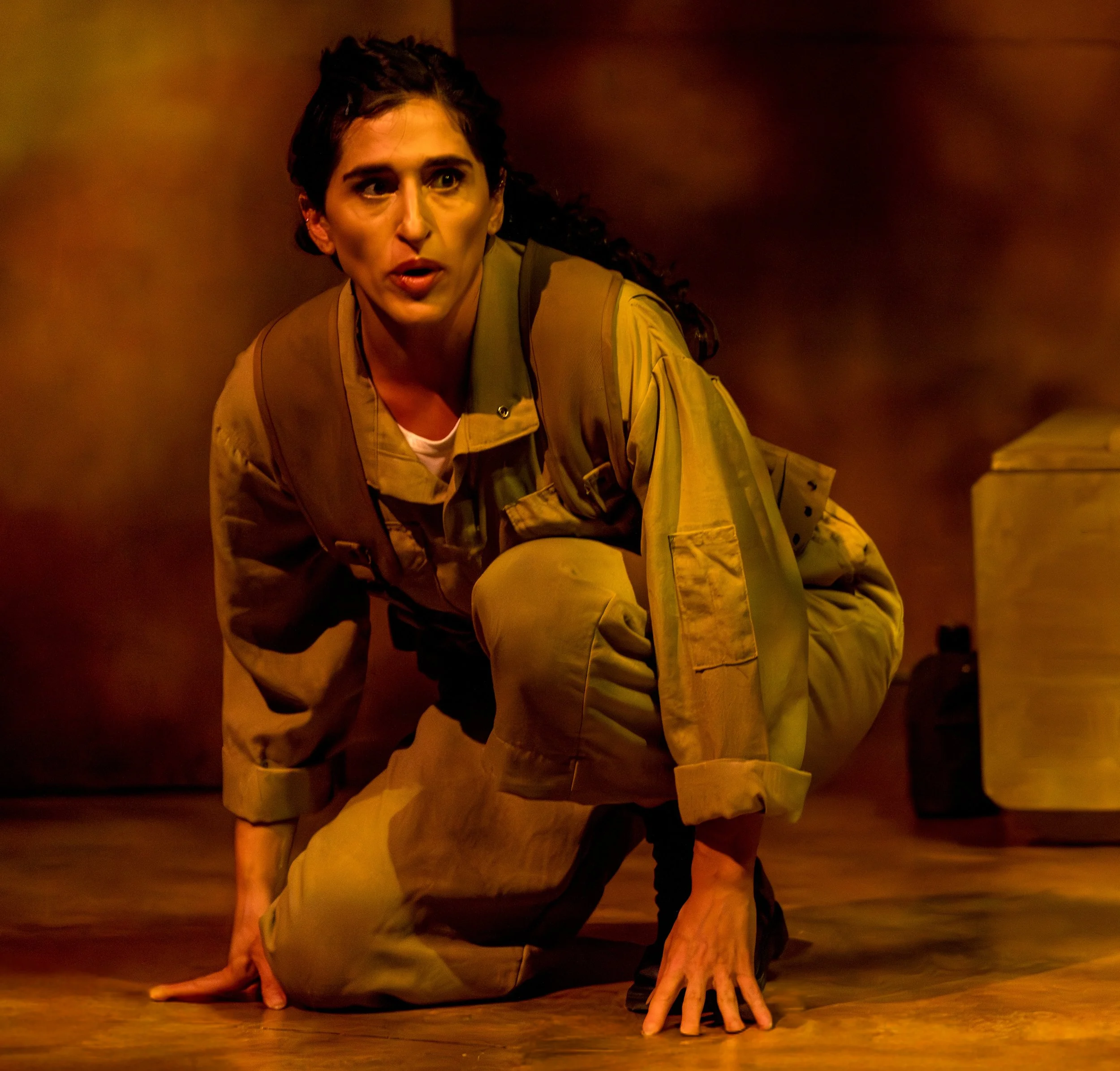
Jennifer Apple has the title role in Hannah Szenesh, in a biographical play of the same title about a World War II freedom fighter.
Holocaust historians have documented how heroes and heroines, Jews and Gentiles, put themselves at mortal risk to rescue others—but of those who have escaped, how many would re-enter a war zone and twice court danger? Hannah Szenesh, the Folksbiene Yiddish Theater’s one-woman musical drama, written and directed by David Schechter, is a sweeping testimony to the talent and courage of one such heroine.
This 90-minute narrative is largely based on Hannah’s diary, which she recorded from age 13 until her tragic death at 22. It documents her hopes, dreams, and fears, first in pre-war, fascist Hungary, next in Palestine under the British Mandate, and during her ill-fated incursion from Yugoslavia into her Nazi-occupied homeland.
There are seismic changes in Hannah’s life that commence after her comfortable, giddy teen years. She frets about dresses, boys, movie stars, and becoming a writer like her late father, Bela Szenesh, a renowned playwright. A more mature, prescient 18-year-old Hannah runs for office in the school literary society, but because she is a Jew her classmates disqualify her. Her anger is augmented when antisemitism prompts her family’s Jewish friends to convert to Christianity. She leaves Budapest for agricultural school in Palestine, rather than relinquish her identity.
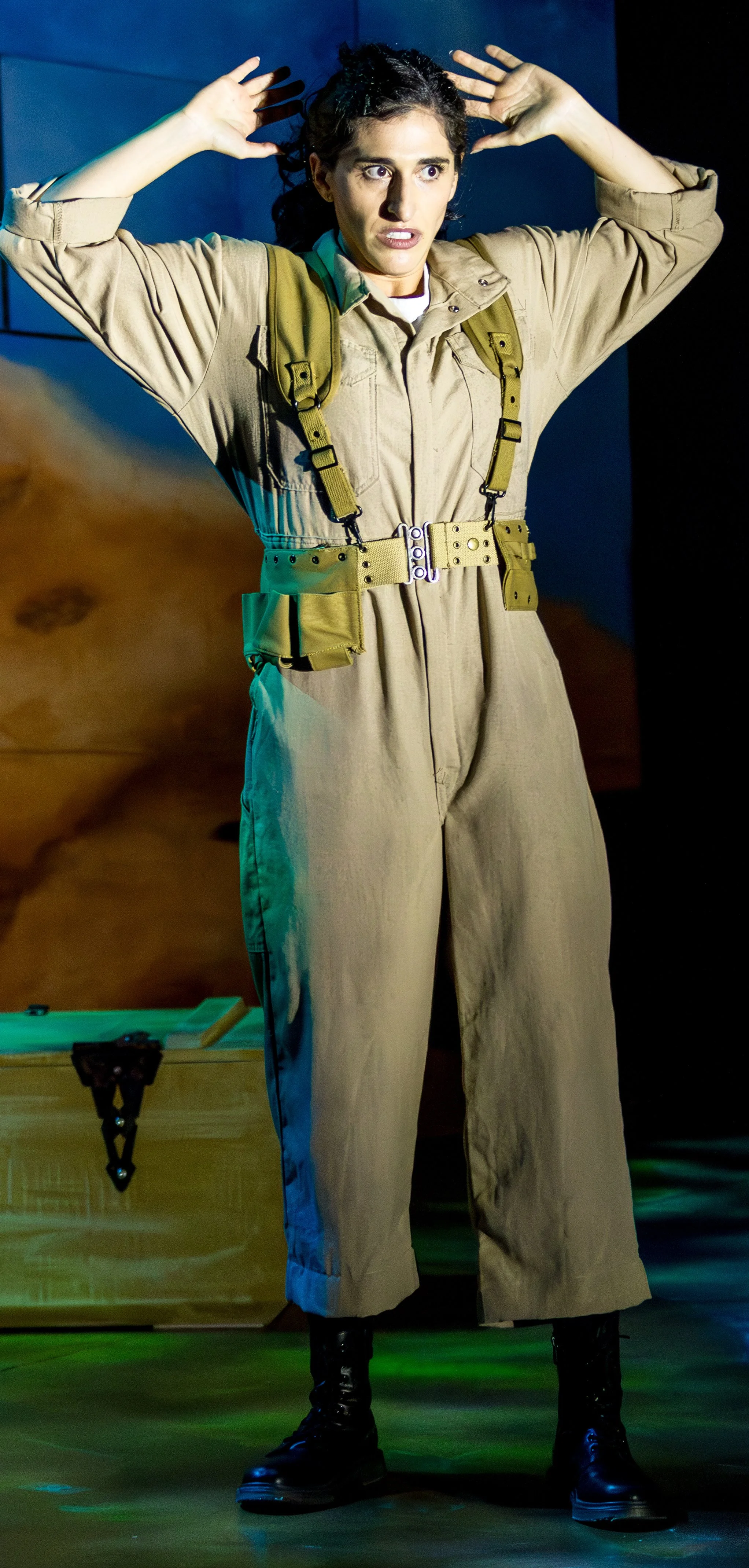
Hannah (Apple) is captured by a German guard at the Hungarian border. (Anna Marie Medley, Apple’s understudy, took over the title role at the performance under review.) Photographs by Tricia Baron.
In her diary entries there, Hannah worries about the fate of her mother, Catherine, and brother George, so when the British mobilize the Palestine Brigade—in this case, young Jewish paratroopers, to infiltrate behind enemy lines in Yugoslavia, Hannah enlists. She writes a letter to George (read offstage by Simon Feil), in case she doesn’t return from her mission. After intense paratroopers’ training, her mood, once somber, changes to hopeful, and then determined. Although warned of the perilous Hungarian border, she plans to risk a crossing for her family and others.
In Yugoslavia’s forests, gathering courage to enter Hungary, she stumbles into partisans whom she thought were dead. Overjoyed, she sings the Partisans’ Hymn, Zog Nit Keyn Mol (Never Say):
Never say that you are going your last way,
Though lead-filled skies above blot out the blue of day.
The hour for which we long will certainly appear ...
As actor and singer, Anna Marie Medley, who played Hannah at the performance I attended, is sublime. (Medley is the understudy for Jennifer Apple, who is normally in the role.) In her roles as Hannah and Catherine (the latter with a Hungarian accent), Medley deftly and seamlessly pirouettes through both women’s vacillating emotions; they are conveyed via subtle changes in body language and facial expressions, and for Hannah, through songs (including additional songs by Elizabeth Swados and David Schechter).
Medley’s characterizations of Hannah, as she adapts to new environments and realities, are enhanced by Vivien Leone’s lighting, which amplifies the impact of Court Watson’s scenic design. The sunrises, sunsets, and landscapes of Watson’s backdrops have poetic beauty, as does one strategically placed prop—the flame of the candlestick on the small table, whose light suggests the eternity of a mother-daughter love, which endures beyond their concurrent imprisonments and Hannah’s death.
Catherine, wrapped tightly in her shawl, is an intense anchor bridging Hannah’s privileged, relatively carefree childhood, the subsequent hardships she endures, and her legacy of courage. Her dignified presence in the first and last scenes unifies the narrative and brings it full circle; her account of Hannah’s imprisonment and death is highly moving.
Catherine doesn’t deliver her sobering narrative in song. Hannah’s voice, emergent from her diary and poems put to music, is a metaphor for beauty and light transcending darkness. Music is intrinsic to her being. In her poem Eli, Eli (which was put to music by David Zehavi after her execution), she hopes for life itself for her family. The haunting lyrics from her poem still memorialize the Holocaust today.
Oh Lord, my God, I pray that these things never end.
The sand and the sea, the rush of the water,
The lightning of the heavens, the prayer of humankind.
The tranquil imagery elicited by Szenesh’s song and the relative peace of her forest hideout are shattered by the harsh “Halt!” and blinding lights of the German guard (Simon Feil) when she enters Hungary. He asks in German, “Are you British?”, to which she replies in German “I am Jewish,” something, for safety’s sake, she has never even told the partisans. Perhaps her affirmation of pride in identity when confronting evil is the Folksbiene’s rationale for this production, right now.
Hannah Szenesh runs at Theatre Row (410 West 42nd St.) through Nov. 9. Performances are at 7 p.m. Wednesdays and Thursdays at, at 8 p.m. Saturdays, and at 5 p.m. on Nov. 9; matinees are at 1 p.m. on Tuesdays and Wednesdays and at 12:30 p.m. on Sundays. For more information, or to purchase tickets, call (212) 213-2120 or visit nytf.org.
Playwright & Director: David Schechter
Lighting Designer: Vivien Leone
Scenic Designer: Court Watson
Composer: Steven Lutvak
Sound Designer: Dan Moses Schreier
Costume Designer: Izzy Fields
