

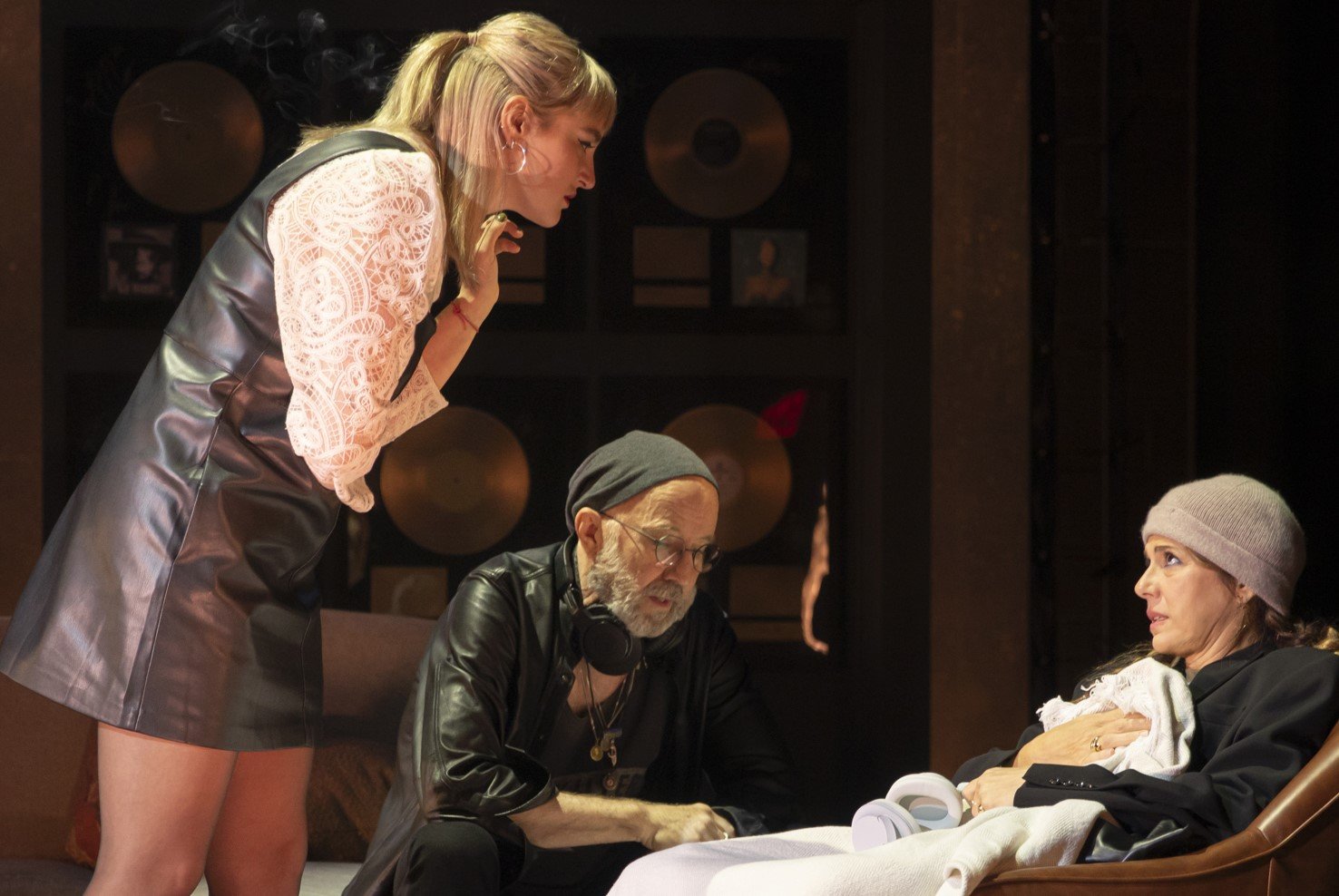
Abby (Marisa Tomei, right) receives a chemo treatment in the company of Gus (Arliss Howard) and Kat (Gracie McGraw) in Jessica Goldberg’s Babe.
The Oxford English Dictionary lists eight different meanings of the word babe, and that’s not even counting the famous talking pig. Playwright Jessica Goldberg is specifically interested in two of them. In Babe, her 2022 short and sour drama, currently receiving a well-appointed staging by the New Group, Goldberg offers an example of how the term can simultaneously signal affection and condescension. Pitting a powerful, wrong-headed man against two smart women of different generations, the trio admire one another for their singular skills while ruing the destructive power plays that undo their workplace relationship.
Gus (Arliss Howard) is a sixtysomething music producer with a wall full of gold records and a talent for building a star by usurping the best ideas of other, less marketable musicians. He explains, “It’s like this book my kid has—it’s got three sections, so you end up with the head of a goat, body of a robot, legs of chicken. That’s the business. Auto-tune fixes everything else.”
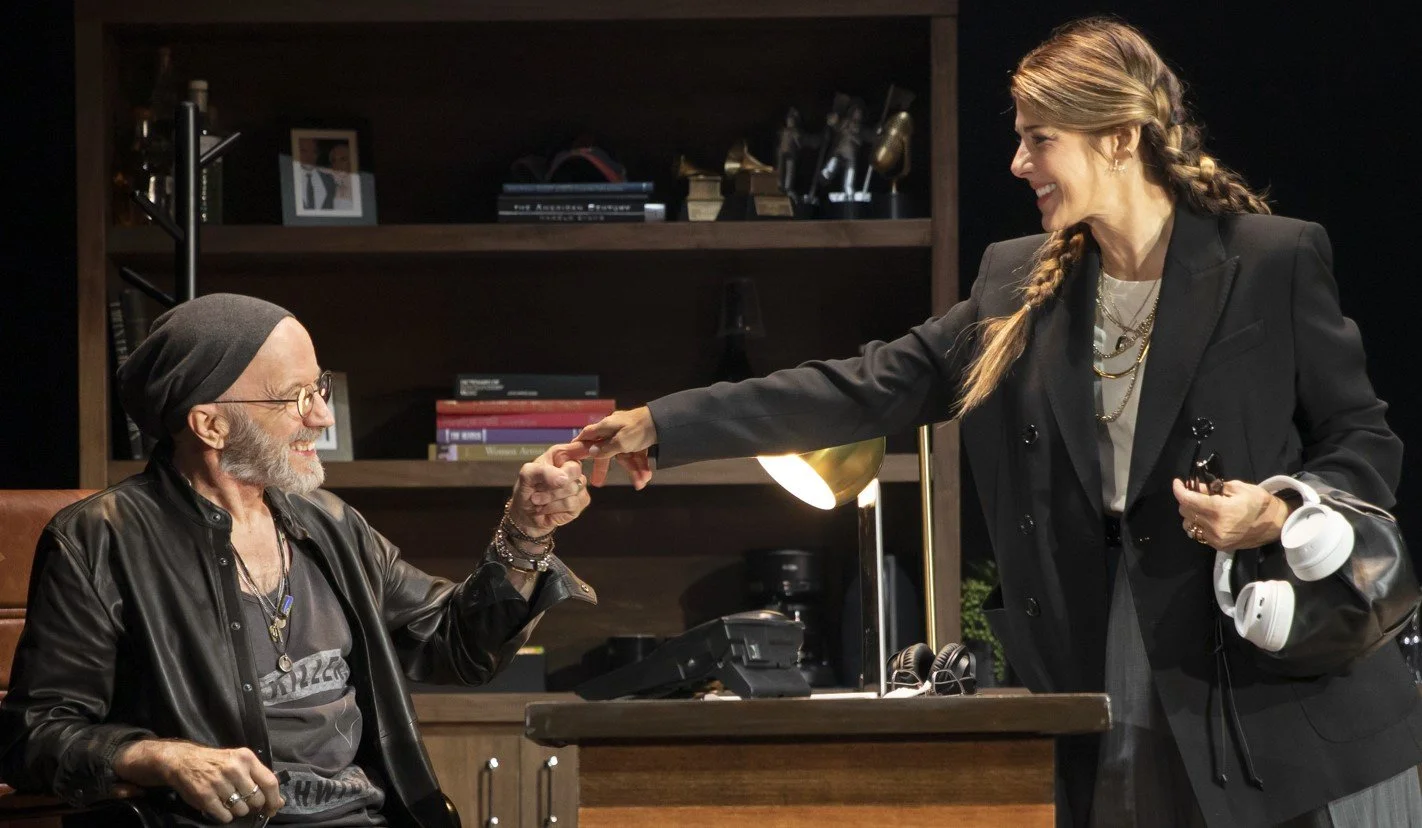
Gus (Howard) and Abby (Tomei) share a love-hate relationship.
While Gus is not at the Harvey Weinstein level of monstrosity, he is far from being a saint. The first indications of this come as he and his long-time colleague, Abby (Marisa Tomei), conduct an interview with a prospective new music scout, Katherine (Gracie McGraw). Showing concern as to whether the young interviewee has the proper “soul” for the job (her previous, woke work experience hilariously includes providing “sound baths for the unhoused”), he also makes note of her physical traits, coarsely commenting, “There’s an ease attractive people have with each other.”
Abby is mostly silent throughout the interview, and it slowly becomes apparent that silence has been an essential part of her music career, for better and worse. She is a decade or so younger than Gus; their 32-year office marriage has found her staying mum while Gus took credit for her best work and paraded his toxic masculinity, to say nothing (literally) of an act of physical abuse she suffered at his hands.
“The actors ... struggle to find the proper emotional proximity.”
Abby is also keeping quiet about her chemotherapy that, here, feels too much like a convenient device for the playwright. By letting only Gus in on the secret, it exemplifies their love-hate relationship. That Gus keeps her company during her treatments allows the audience to find something admirable about the guy. And that Abby tends to fall into a dream state as a side effect allows for flashbacks to her younger days when she managed, and had feelings for, her most successful discovery, a hard rocker on the way to a flameout named Kat Wonder (McGraw).
In sharp contrast to Abby, Katherine is the embodiment of empowered youth; highly confident and not afraid of ratting out sexism, come what may. When Gus ultimately crosses the line with her, she sees to his downfall, complicating Abby’s life in the process. She is not totally likable in this endeavor, adding a level of complexity to the play that is effectively unsettling. Using secret recordings and conspiring behind Abby’s back results in a queasy kind of justice, along with a grudging acceptance that the ends justify her means, Katherine also comes with her own emotional damage and generational blind spots. Explaining how her father, a high school teacher, slept with one of his students, she remarks, “It was like 9/11 all over again.”
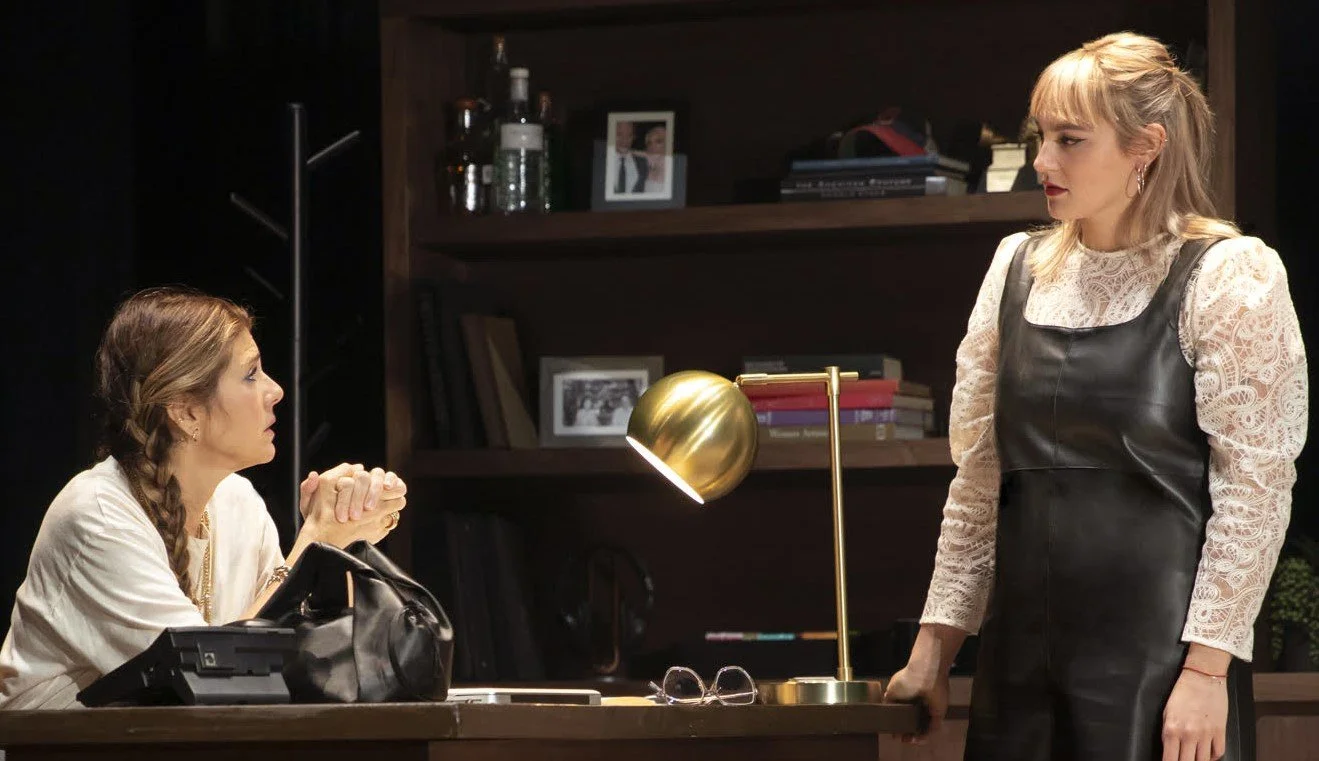
Abby (Tomei, left) and Katherine (McGraw) find themselves generations apart. Photographs by Monique Carboni.
Scott Elliott, founding Artistic Director of the New Group, is a master of executing smooth scene transitions, but the pacing generally lags through this 85-minute production, like a 45 rpm record played at 33. That is, until the final scene, when the otherwise musically subtle goings-on pivot to a flashback Kat Wonder power anthem that will finally stir Abby out of her funk. The tune, written by the New York rock trio known as BETTY, proclaims, “Crack the mask/Kill the whirl/I am not your puppet girl.”
The actors, with little chemistry or tension to be found among them, struggle to find the proper emotional proximity and often seem to be soaking in their own self-enclosed sound baths. Howard is a believably gruff and insensitive Gus, but he and Tomei come across like days-old, not ages-old acquaintances. McGraw feels distant from Tomei even in a bonding scene where they nearly kiss.
Derek McLane’s scenic design is sleek and dark. Gus’s office demands most of the turf. Appropriately, Abby’s apartment and hospital chemo room have to squeeze into his territory. And in a clever bit of sound design, Jessica Paz turns up the reverb during the flashback scenes, creating a sense of time travel that is transformative in this otherwise unmoving production.
The New Group staging of Babe plays through Dec. 22 at The Pershing Square Signature Center (480 West 42nd St.). Evening performances are at 7 p.m. Tuesday through Saturday; matinees are at 2 p.m. Saturday and Sunday. For tickets and more information, visit thenewgroup.org.
Playwright: Jessica Goldberg
Direction: Scott Elliott
Sets: Derek McLane
Costumes: Jeff Mahshie
Lighting: Cha See
Sound: Jessica Paz
