
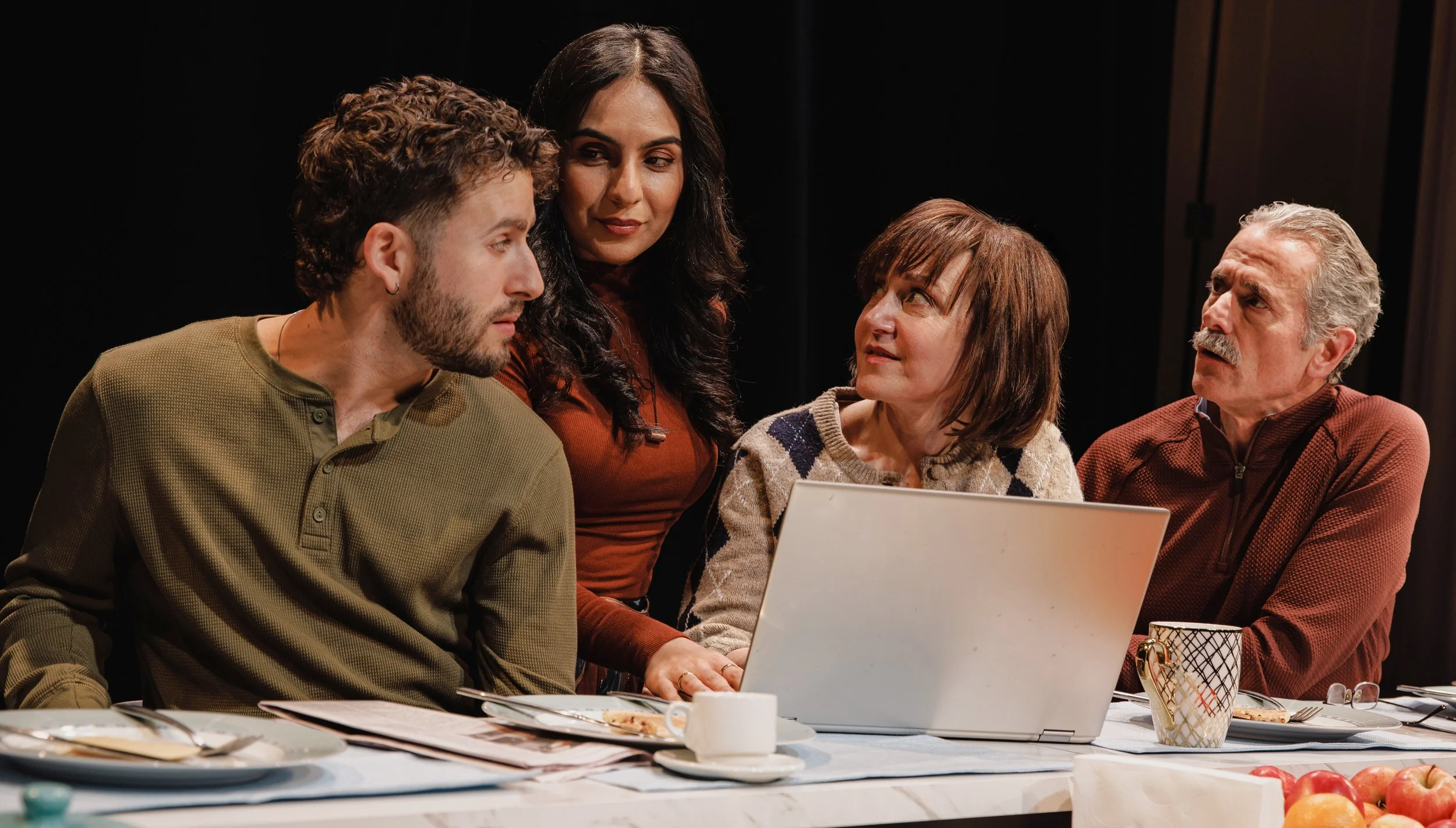
Josh Goldman (Danny Kornfeld, left) is resentful when his mother Linda (Jill Stern, center) and father Allan (Steven Skybell) make comments about his beard in David Zax’s Aftermath. Mina Kharo (Awesta Zarif), uncomfortable, looks on.
When there is a generation gap, when communication between children and parents goes awry, it often stems from divergent views, sometimes political, sometimes value-based, and sometimes both. Those parents who struggle to ease their children’s lives by providing them with material comforts that they themselves lacked are often disappointed when their kids reject affluence, and risk their financial or physical security for a greater “cause.” That is the case in playwright David Zax’s Aftermath.

Josh tries to explain to Mina what happened when he and her cousin Hamid were kidnapped in Afghanistan. Photographs by Marc J. Franklin.
Josh (Danny Kornfeld), son of Linda (Jill Stern) and Allan Goldman (Steven Skybell) is one of those offspring. Allan, a high-powered Washington, D.C., lobbyist and Linda, a teacher, have no shortage of expensive furnishings and other upper-middle-class trappings. Josh, however, disdains material objects; his passion is his profession—journalism, specifically investigative reporting. It’s 2011, and Josh has recently escaped from the Taliban in Afghanistan and returned home to Washington. Less than two months later, he starts growing a beard and playing Afghan music; both actions make his parents worry that he wants to return there.
As a journalist in Afghanistan, Josh heard stories about alleged mistreatment by the Afghan National Police of young boys; to verify the rumors, he stepped out of the “safe” zone, accompanied by his interpreter Hamid. Both were kidnapped, and later Hamid was killed attempting to run away.
Hamid’s cousin Mina Kharo (Awesta Zarif), an Afghan-born journalist raised in London, meets Josh as a reporter. She later visits Josh’s D.C. home at his invitation, unbeknownst to his parents. After Allan and Linda get acquainted, and much to Linda’s chagrin, Mina asserts that Linda’s “schedule” to rehabilitate “Joshy” (his nickname) from his trauma is stifling him.
Alone with Mina, Josh says, “When you think about what the average Afghan lives off … mortality. That’s been as disorienting as anything else. This return to opulence. To waste.”
There is clearly a clash of generations and cultures. Just as Josh’s affinity for Afghan music is a source of anxiety for Linda, so is Mina’s presence, with its attendant romantic ambiguity. The latter’s visit, an emotional “trigger” to the entire household, sets Josh spinning out of control and ruins Linda’s “schedule” for his recovery.
“Colton Pometta’s tight direction brings the gradually mounting tension to a boiling point. ”
The palpable tension between Josh and his parents, whose lifestyle infuriates him, seems to hinge on whether he will return to Afghanistan to continue his investigation. It remains everyone’s preoccupation until the flashpoint shifts to a single revelation (spoiler alert) that threatens to derail not only his recovery but his relationships with his family—and Mina.
Colton Pometta’s tight direction brings the gradually mounting tension to a boiling point. Within the restrictive living space visible to the viewer, Chen Wei Liao’s compact set—a small, elevated bedroom, a ground floor with parlor and oriental carpets, and a kitchen island with bar stools and assorted gourmet kitchenware—is a petri dish for each family member’s anger and frustration. Liao’s design conveys a level of physical comfort befitting a wealthy professional (Allan) and is luxurious enough to upend Josh’s social justice mindset.
Skybell’s Allan is simultaneously volatile and defensive, dominating Linda and trying to dominate Josh. He furiously propels what is just beneath the surface into the family dynamic with a vengeance, railing at Josh about the sacrifices he has been forced to make for an ungrateful son.
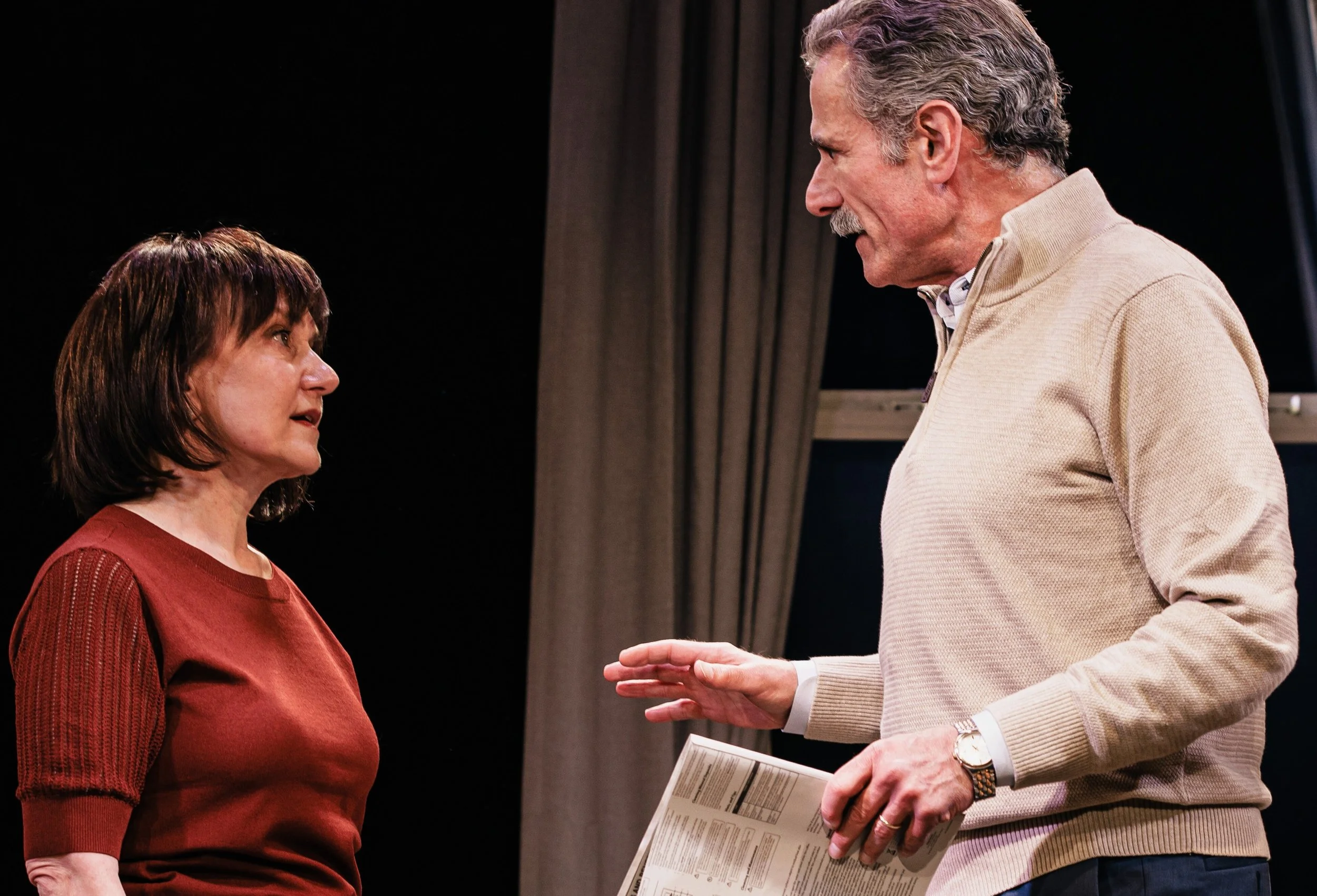
An angry Allan (Skybell) vents to Linda (Stern) about his frustration with Josh’'s behavior.
Stern’s Linda is generally even-tempered, rational, and somewhat manipulative; with a “soft touch,” she attempts to defuse the two men’s confrontations. Despite her best efforts, an enraged Josh sometimes storms out, and Allan, unsettled and insomniac, wants to be left alone. Kornfeld’s Josh is an idealistic man-child, tentatively testing out his affections on Mina, lacking foresight, and unwilling to acknowledge the consequences of his actions and the havoc he causes.
Zarif, as Mina, is a gem of a performer, possibly in part because, as an Afghan woman and former asylum seeker herself, Mina’s experience is all too familiar to her. Mina is a beautiful, confident, savvy, and vulnerable woman who has seen unspeakable horrors and personal loss. Yet she, too, has risked much to go back to Afghanistan as a reporter. The self-possessed Mina is caring, compassionate, and other-oriented. Although she grieves for Hamid, she realizes that in Afghanistan there is broader ongoing societal damage occurring.
In 2026, 15 years after the play’s action takes place, Aftermath is no less relevant than it was at that time.
Aftermath runs at A.R.T./New York Theatres (503 W. 53rd St.) through Nov. 8. Performances are at 7 p.m. Mondays, and Wednesdays through Fridays, and on Saturday, Nov. 7; there’s an additional 5:30 p.m. performance on Nov. 1; matinees are at 2 p.m. Thursdays and Saturdays, and at 1 p.m. on Sundays. For tickets and more information, call (212) 594-0422 or visit aftermaththeplay.com.
Playwright: David Zax
Lighting Design: Lucrecia Briceno
Scenic Design: Chen-Wei Liao
Sound Design: Stan Mathabane
Costume Design: Rayya Gracy
If you enjoyed this review, please click on the Like icon below.
